




Solar Hybrid Battery Container for PV, Backup and Grid Support
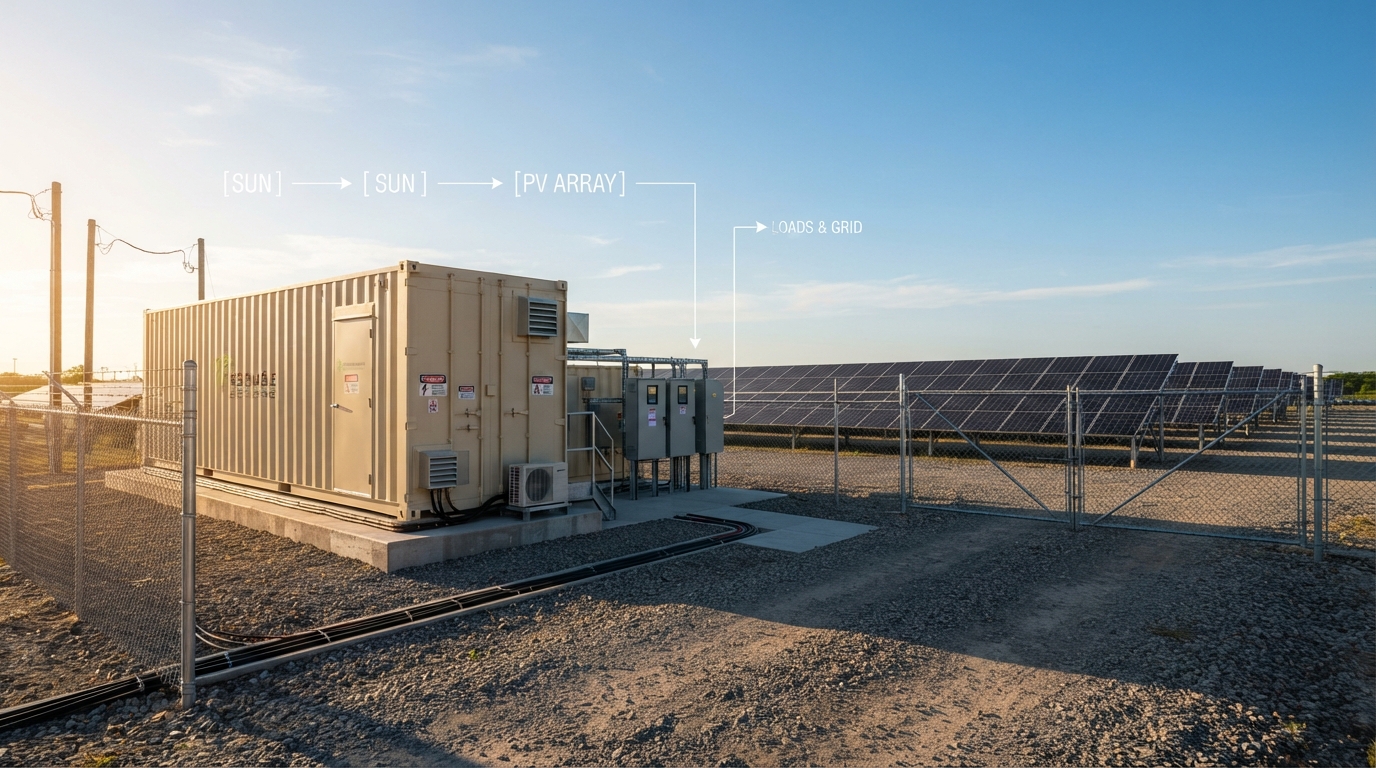
A solar hybrid battery container is a containerized battery energy storage system designed to work with photovoltaic (PV) generation, site loads, and either the grid or a local microgrid. “Hybrid” in this context means the system coordinates multiple energy sources—solar, battery, grid, and sometimes a generator—under a single control strategy.
This guide covers the main components inside a solar hybrid battery container, how hybrid operating modes work, how to think about sizing in kW and kWh, and what to evaluate before choosing a supplier. The goal is practical: understand the system well enough to define your own project requirements and ask better technical questions.
What Is a Solar Hybrid Battery Container?
A solar hybrid battery container is a self-contained BESS housed in an outdoor-rated enclosure. It differs from a smaller integrated battery system in scale and architecture: a container is designed for larger commercial, industrial, solar-farm, microgrid, or remote-power projects, and it normally includes the power conversion, control, thermal, and safety equipment needed to operate as a complete system.
Typical subsystems inside a container include:
| Subsystem | Role |
|---|---|
| Battery racks | Store DC energy in modules and packs |
| Battery management system (BMS) | Protects cells, manages balancing, monitors temperature and state of charge |
| Power conversion system (PCS) or hybrid inverter | Converts DC battery power to AC for loads or the grid, and AC to DC for charging |
| Energy management system (EMS) | Decides when to charge, discharge, import, export, or island based on operating rules |
| Thermal management / HVAC | Controls operating temperature and humidity |
| Fire detection and suppression | Detects thermal events and limits fire propagation |
| Switchgear and auxiliary systems | Distribute AC power and power internal auxiliaries |
The PV array connects at the DC or AC side, depending on architecture. The grid or generator connects at the AC side. Critical loads connect through switchgear that can be separated in island mode.
For a smaller integrated format that combines solar and battery in one system, see hybrid solar battery single system. The container version scales that idea up and adds more integration flexibility.
How a Solar Hybrid Battery Container Works in Hybrid Operating Modes
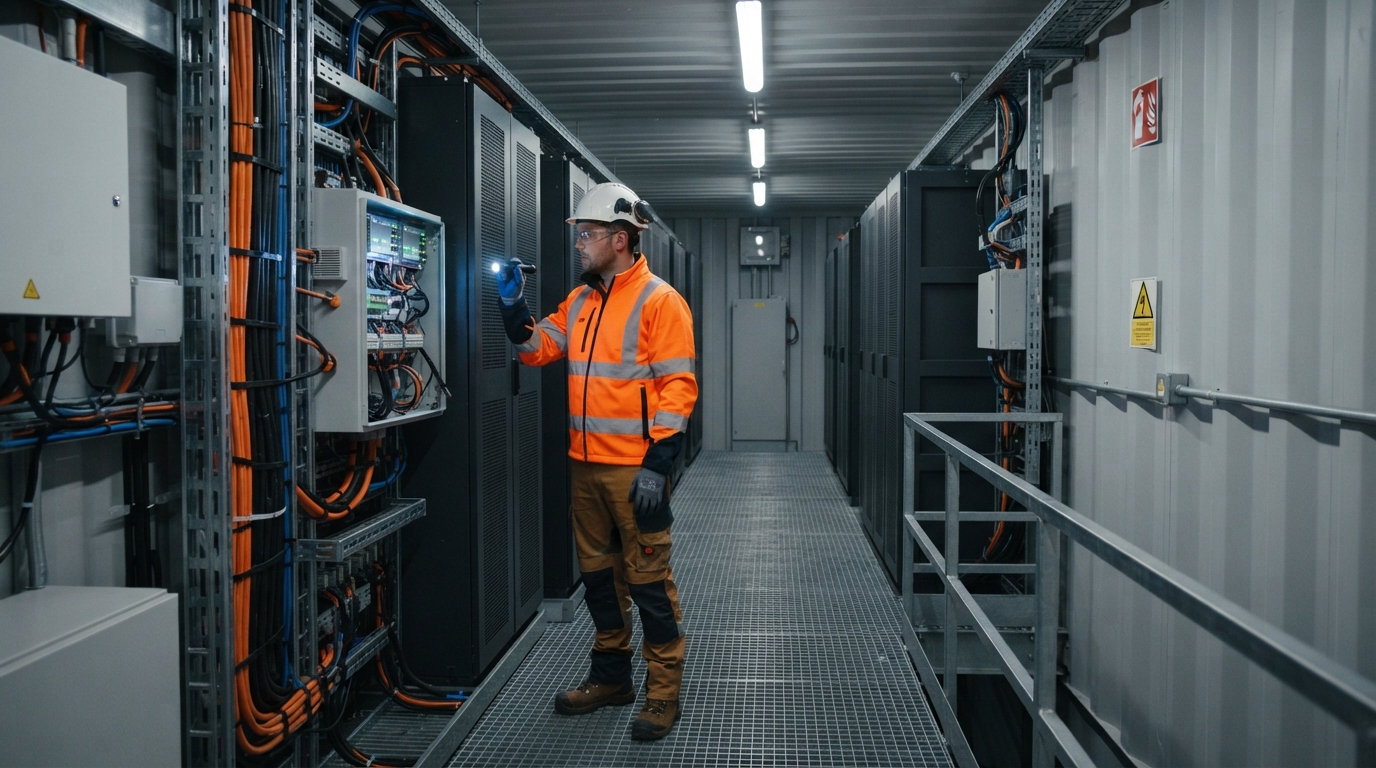
A container’s “hybrid” behavior comes from the EMS and PCS working together. The system can operate in several modes, sometimes switching within the same day.
| Operating Mode | What Happens |
|---|---|
| Solar self-consumption | PV powers loads first; excess solar charges the battery; battery supplies loads when solar is low |
| Backup / island mode | The container isolates critical loads from the grid and supplies them from battery or PV |
| Peak shaving | The battery discharges during periods of high demand to reduce grid import |
| Load shifting | The battery charges during low-demand or high-solar periods and discharges later |
| Grid support | Where allowed by interconnection rules, the battery provides frequency or voltage-related services |
| Microgrid / off-grid | The container coordinates PV, storage, and often a generator to maintain local supply |
| Generator coordination | The battery reduces diesel runtime and improves generator loading |
What makes the system hybrid is not a single feature. It is the ability to manage multiple resources automatically and prioritize them according to site objectives.
Backup, Islanding, and Critical Loads
For backup operation, the container must detect a grid loss and safely separate from the grid before powering local loads. This is called islanding. Anti-islanding protection prevents the system from energizing grid lines while maintenance crews assume the grid is dead.
Backup duration depends on three variables:
- usable energy in the battery;
- average load power;
- how much solar is available during the outage.
Critical loads should be defined before sizing, because the size and priority of loads determine how long the battery can support them. A container that is oversized for the critical load costs more than necessary; one that is undersized will not meet the required autonomy.
Generator and Microgrid Hybrid Operation
In many hybrid projects, a diesel generator is added to the system. The battery can let the generator run at a more efficient load, reduce fuel consumption, and allow shorter generator runtimes. The EMS coordinates solar, battery, and generator according to operating rules set by the site operator.
For a deeper look at how batteries reduce generator use, see bess for diesel generator optimization.
The same control logic applies to microgrids: the battery provides the fast response needed to keep frequency stable while slower assets like generators follow the dispatch signal.
Sizing a Solar Hybrid Battery Container: kWh, kW, Voltage, Current, and Runtime
Buyers often confuse the two main sizing values: kW and kWh. They answer different questions.
| Specification | Unit | What It Tells You |
|---|---|---|
| Power | kW | How much instantaneous output the system can deliver |
| Energy | kWh | How much total energy the battery can store and deliver over time |
| Voltage | V | The electrical level the battery presents to the PCS or inverter |
| Capacity | Ah | Charge capacity at a given voltage |
| Current | A | Charge/discharge rate, which affects cables, protection, and thermal loads |
| C-rate | A/Ah | How fast the battery is charged or discharged relative to its capacity |
A simple way to think about it: kW is the size of the fuel line; kWh is the size of the fuel tank. A container may have high energy but limited power, or high power but limited energy. Both values must match the load profile.
From Nominal Capacity to Usable Energy
Nominal capacity is the total energy contained in the battery at rated conditions. Usable energy is the portion the BMS allows the system to use without damaging the cells or reducing life too quickly.
Depth of discharge (DoD) and state-of-charge limits reduce nominal capacity to usable capacity. For example, a battery operated between 10% and 90% state of charge gives only 80% of its nominal energy in normal operation.
When comparing systems, ask for usable energy, not just nominal capacity. A long runtime figure based on nominal energy will overstate real performance.
Estimating Backup Runtime
Backup runtime can be estimated with a simple formula:
Usable energy (kWh) ÷ average load power (kW) ≈ runtime (hours)
Example with a hypothetical container:
- Nominal energy: 1,000 kWh (1 MWh)
- Usable energy: 80% → 800 kWh
- Average critical load: 100 kW
- Estimated runtime: 800 kWh ÷ 100 kW = 8 hours
Inverter/PCS losses reduce actual runtime. If the conversion path is 90% efficient, the effective runtime moves closer to 7.2 hours. Solar generation during the outage can extend that further, but only when sunlight is available and the system is configured to charge from PV in island mode.
Always ask whether a supplier’s runtime figure includes usable energy, efficiency losses, and real load behavior. Those assumptions matter more than the nominal kWh number.
AC-Coupled or DC-Coupled Container Architecture?
The main architectural decision for a solar hybrid container is how PV and battery share the conversion path.
AC coupling: The PV array has its own inverter, and the battery has a separate PCS. The two systems meet on the AC side. This is common in retrofits or projects where the PV inverter is already installed. It simplifies compatibility but can add conversion steps.
DC coupling: PV and battery share a DC bus and one conversion stage. DC-coupled systems can reduce overall conversion losses and may simplify power flow, but they require closer matching of PV string voltages, battery voltage, and PCS input range.
There is no universal winner. The best architecture depends on whether the project is new or a retrofit, what the PV inverter can support, how the container will be dispatched, and where the conversion losses matter most.
For a closer look at the DC-side approach, see dc coupled solar storage.
Thermal Management, Enclosure Protection, and Fire Safety
Battery performance and safety depend heavily on temperature control. Lithium-ion cells operate within a defined temperature window; outside that window, capacity, charge acceptance, and life can decline. Thermal management also affects the risk of thermal propagation events.
Air Cooling Versus Liquid Cooling
| Cooling Approach | Typical Strengths | Typical Trade-offs |
|---|---|---|
| Air cooling | Simpler design, lower maintenance, easier service access | May struggle with very high power density or hot climates |
| Liquid cooling | More uniform temperature control, better for high-power or dense systems | More complex, requires coolant system maintenance |
The right choice depends on site climate, average charge/discharge profile, container power density, and local service capability. Neither approach is automatically better for every project.
Fire Detection, Suppression, and Thermal Runaway
Thermal runaway is a credible risk with large lithium-ion battery installations. A single cell fault can release heat and gas, and if adjacent cells absorb that heat, the failure can propagate through a rack or a container.
A proper safety design includes detection, alarms, suppression, ventilation, and physical separation. Buyers should not rely on a paragraph in a brochure. They should ask for the exact system configuration and the safety evidence attached to that configuration.
Useful context is available from UL Solutions on UL 9540A test methodology and the relationship between UL 9540A, NFPA 855, and large-scale fire testing for BESS. Standards like NFPA 855 and IEC 62933 also inform how these systems are installed, but the applicable requirements depend on site jurisdiction.
Ask for model-specific test reports, not just a general statement that a manufacturer is “certified” or “compliant.” A certificate should identify the exact product model and the standard it was tested against.
Where Solar Hybrid Battery Containers Are Used
The best fit for a containerized hybrid system depends on project size, site conditions, and the operating objective.
| Application | Typical Goal |
|---|---|
| Commercial and industrial sites | Backup power, peak shaving, load shifting, higher PV self-consumption |
| Solar farms | Storing excess PV, reducing curtailment, time-shifting generation |
| Microgrids and remote sites | Local supply with PV and storage, often with a generator |
| Generator-hybrid sites | Fuel savings, improved generator loading, quieter operation |
For solar-farm-specific context, see solar farm battery storage system.
Container systems are not necessarily the right answer for small residential projects. In those cases, a smaller integrated battery format is usually more practical. The container format makes sense when the energy, power, or site-integration requirements exceed what a cabinet or rack system can practically handle.
How to Evaluate a Solar Hybrid Battery Container Supplier
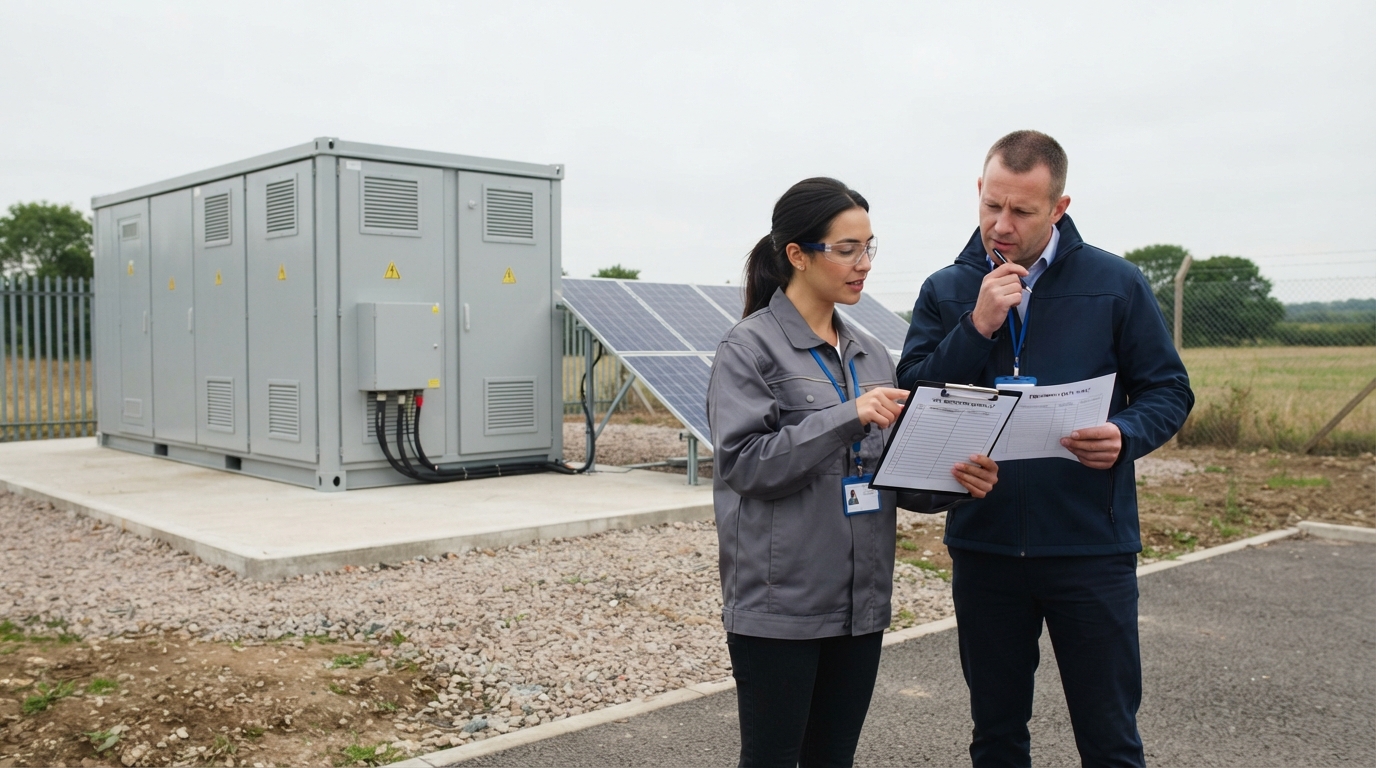
The quality of a container project depends as much on the supplier’s engineering and documentation as on the battery itself. A complete response should include clear technical specifications, relevant test evidence, and a realistic integration plan.
Project Data to Prepare Before Contacting a Supplier
A useful supplier conversation starts with solid project data. Prepare at least the following:
- Site location and climate;
- Grid connection type and local interconnection requirements;
- PV array size and DC/AC configuration;
- Load profile, including peak demand and daily energy use;
- Critical loads and required backup duration;
- Whether the system must island or support a microgrid;
- Whether a generator is involved;
- Future expansion plans.
The more specific the data, the more useful the quotation will be.
Supplier Documentation and Evidence Checklist
When comparing suppliers, request the following in writing:
- A datasheet for the exact proposed system, not a generic category brochure;
- Nominal and usable energy in kWh;
- Rated power in kW, with battery-side and AC-side ratings shown separately;
- Nominal voltage range and charge/discharge current limits;
- Depth of discharge and state-of-charge operating window;
- Cycle-life assumptions and the conditions they are based on;
- Round-trip efficiency under stated operating conditions;
- Cooling method and container enclosure rating;
- Fire detection and suppression configuration;
- Communication interfaces and monitoring capabilities;
- Warranty terms and what invalidates the warranty;
- Commissioning and after-sales support scope.
Company-level marketing claims should not be confused with model-specific evidence. A manufacturer may have broad experience, but the safety and performance of a container depend on the exact configuration delivered to the project.
VoltaLink Battery—the brand behind voltalinkbattery.com—is an example of a manufacturer focused on energy storage for residential, industrial and commercial, and outdoor scenarios. The company presents itself as a high-tech enterprise under Shandong Guoli New Energy Co., Ltd., with a Shenzhen global foreign-trade and business center. If you approach VoltaLink with a container project, bring the site data above and ask for the exact model documentation, system architecture, and safety evidence tied to that configuration.
Bringing the Evaluation Together
A solar hybrid battery container is not a single standard product. It is a project-level solution that must be sized, configured, and integrated around real operating needs.
Before making a decision, confirm that the system’s usable energy, power rating, architecture, thermal design, safety evidence, and communication capabilities all match your load profile and site conditions. If a supplier cannot provide model-specific documentation or explain the control strategy clearly, that is a warning sign.
Once the project data is clear, the next step is to discuss the configuration with a qualified supplier. Bring your load profile, PV details, backup requirements, and site constraints, and ask for the system design and evidence behind the proposal.

-

 OEM ODM Home Energy Storage Manufacturer for Stackable Home Battery Solutions
2026-08-20
-
 High-Rate Discharge in Data Center UPS Battery Backup Systems Explained
 -
 LiFePO₄ RV Battery 48V System Design: Battery, Inverter, Solar and DC Load Integration
2026-08-19
-
 51.2V LiFePO₄ Server Rack Batteries: 100Ah Capacity, Energy Output and Runtime
2026-08-18
-
 51.2V 100Ah LiFePO₄ Battery for Inverter in Solar Energy Storage Systems
2026-08-17
Share this:





.svg)






-899.svg)


