




BESS for Diesel Generator Optimization: Fuel Savings, Spinning Reserve and Hybrid Control
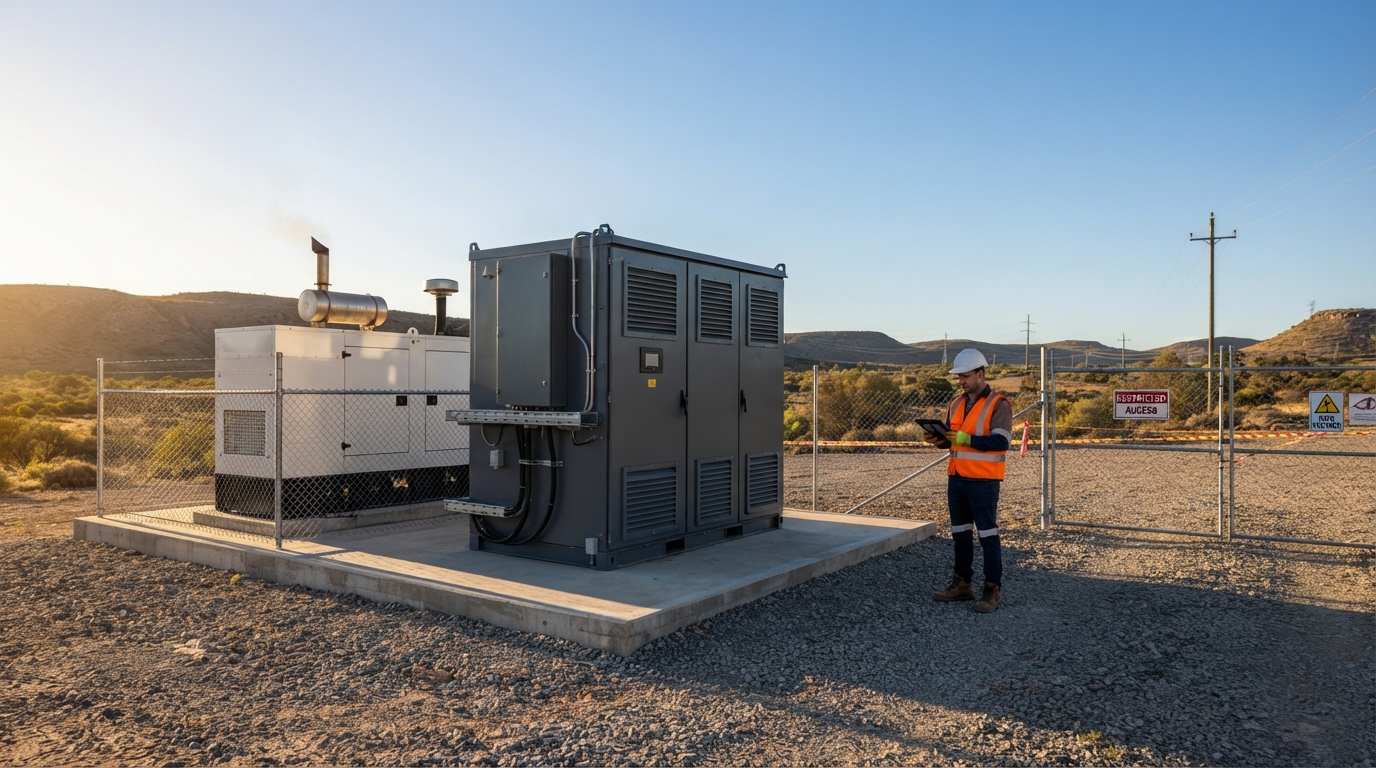
A battery energy storage system (BESS) can make a diesel generator run less often, run closer to its efficient loading range, and provide spinning reserve without burning fuel. But it is not a simple “add a battery and save fuel” decision. Whether a diesel-BESS hybrid delivers real savings depends on the load profile, the generator’s operating limits, the BESS power and energy ratings, the control logic, and the fuel economics of the site.
This guide explains how a BESS changes the way a diesel generator is dispatched, how spinning reserve works in a hybrid system, which hybrid control modes matter, and what information is needed to evaluate a real project. For the broader context, see the Comprehensive Guide to Commercial & Industrial Energy Solutions.
Why Diesel Generators Need Optimization
Diesel generators are not equally efficient at every load. Most are designed to run best within a specified loading band, often somewhere between 50 and 80 percent of rated power. When a generator is forced to run far below that band, fuel consumption remains disproportionately high, and the operating condition becomes less economic.
This matters for sites that keep generators running for reasons other than peak demand. A generator may be kept online to provide reserve, to respond to sudden load changes, or because the site operator believes the load is too small to justify stopping it. In each case, the generator spends hours producing energy at a cost that is higher than necessary.
Low-Load Inefficiency and Wet Stacking
Fuel consumption does not fall in proportion to electrical output. A generator at 30 percent load will consume something closer to 45 or 50 percent of its full-load fuel rate. The rest is lost as heat, friction, and poor combustion efficiency.
Prolonged low-load operation can also cause wet stacking. This is a condition in which unburned fuel and carbon particles accumulate in the exhaust system because the engine never reaches the temperature needed to burn the mixture completely. Wet stacking can increase maintenance costs, reduce engine life, create visible exhaust smoke, and make the generator more likely to fail when the load finally increases.
For that reason, improving the generator’s load profile is not only a fuel saving exercise. It is also a way to reduce the mechanical stress that comes with running a large diesel engine at very low demand for hours at a time. Sandia National Laboratories identifies low-load operation as one of the main inefficiencies that hybrid storage can address.
The Cost of Spinning Reserve
Spinning reserve means generation capacity that is already online and ready to respond immediately if another source fails or if demand suddenly rises. In a diesel-only system, the simplest way to provide spinning reserve is to keep one or more generators running with spare capacity.
That approach is expensive. A generator held at minimum load to provide reserve still burns fuel, consumes runtime, produces emissions, and requires maintenance even though it is not serving useful load. The cost of reserve becomes especially visible in remote microgrids, islanded systems, and critical facilities where reserve must be available at all times.
A BESS can provide the same fast-responding reserve function without the generator having to spin at minimum load. The battery can hold energy in reserve, release it immediately when needed, and then be recharged once the generator recovers. The Catalina Repower feasibility study from the National Renewable Energy Laboratory shows how battery storage can be modeled as a reserve provider, although the exact reserve rule must be defined for each site.
How a BESS Improves Diesel Generator Operation
The value of a BESS in a diesel hybrid system comes from changing how the generator is used, not from replacing it with a larger battery.
A BESS can perform several distinct operating functions:
- respond to sudden load increases while the generator ramps
- supply spinning reserve without requiring the generator to run at minimum load
- absorb low-load periods so the generator can stop or run at a more efficient point
- charge from the generator when the generator is operating at a good load
- smooth fluctuations from solar PV when the hybrid system includes renewables
These functions are controlled by an energy management system (EMS) that coordinates the generator, the battery, the power conversion system (PCS), and the site load.
Fuel-Efficient Generator Dispatch
In a conventional diesel system, the generator follows the load. When the load falls, the generator must keep running and consume fuel at a low efficiency. When the load rises, the generator must respond quickly, which may require it to be already spinning with reserve available.
With a BESS, the EMS can separate generator operation from the site’s instantaneous demand. The generator can be run at a higher, more fuel-efficient load while the battery absorbs the difference. Later, when the load is low, the battery can supply the site while the generator stops or runs at a more comfortable minimum.
This is the core of fuel-efficient dispatch. DOE research on diesel generation and energy storage shows that fuel savings come from operating generators closer to their efficient loading point and using the storage system to shift generator operation over time. The actual saving depends on how far the generator’s real operating curve deviates from the ideal.
Spinning Reserve Without Burning Fuel
A BESS can act as spinning reserve because it can deliver power almost instantly. When a generator fails, the battery can supply the critical load immediately. When a large load step occurs, the battery can cover the difference until the generator ramps.
The key word is “can.” The BESS must have enough power capacity to handle the reserve requirement, and it must keep enough stored energy reserved for that purpose. If the battery is used for load shifting or solar smoothing, the EMS must never allow the state of charge to fall below the reserve band.
This is one of the most important differences between generator reserve and battery reserve:
| Reserve Function | Diesel Generator | BESS |
|---|---|---|
| Fuel required to hold reserve | Yes, generator must keep running | No, energy is stored |
| Response speed | Limited by governor and ramp rate | Very fast, near instantaneous |
| Effect of reserve on runtime | Increases operating hours and maintenance | No additional runtime |
| Duration capability | Infinite as long as fuel is available | Limited by stored energy |
| Best role | Long-duration backup and recharging | Fast response and short-term reserve |
A generator still provides the long-duration safety net. The BESS provides the fast, fuel-free reserve that otherwise forces the generator to run inefficiently.
Load Following and Transient Support
Diesel generators have ramp limits. A sudden increase in load can cause the engine to slow down, voltage to dip, or frequency to deviate until the governor responds. In some applications, such as motors starting or equipment cycling on and off, those transients can occur frequently.
The BESS can absorb the first moment of the transient. Because the PCS can change output in milliseconds, the battery supplies the immediate power and gives the generator time to ramp to the new operating point. Once the generator is carrying the load, the battery can return to its reserve state or begin recharging.
This transient support is especially valuable when the site has loads that start and stop repeatedly. It also reduces the chance that the generator will be forced into a sudden, inefficient load step.
Reduced Runtime and Maintenance Pressure
If the battery can carry the site during periods of low demand, the generator can be stopped entirely for part of the day. Fewer operating hours mean less fuel burned, less oil degradation, fewer service intervals, and lower exposure to the type of continuous part-load running that creates wet stacking.
The maintenance benefit should not be overstated. Starting and stopping a diesel generator more often creates its own wear on the start system and carries the risk that a generator may fail to start when needed. A good hybrid controller manages this by setting minimum engine run times and maintaining an adequate battery reserve before allowing a generator stop.
Hybrid Control Sequence and Operating Modes
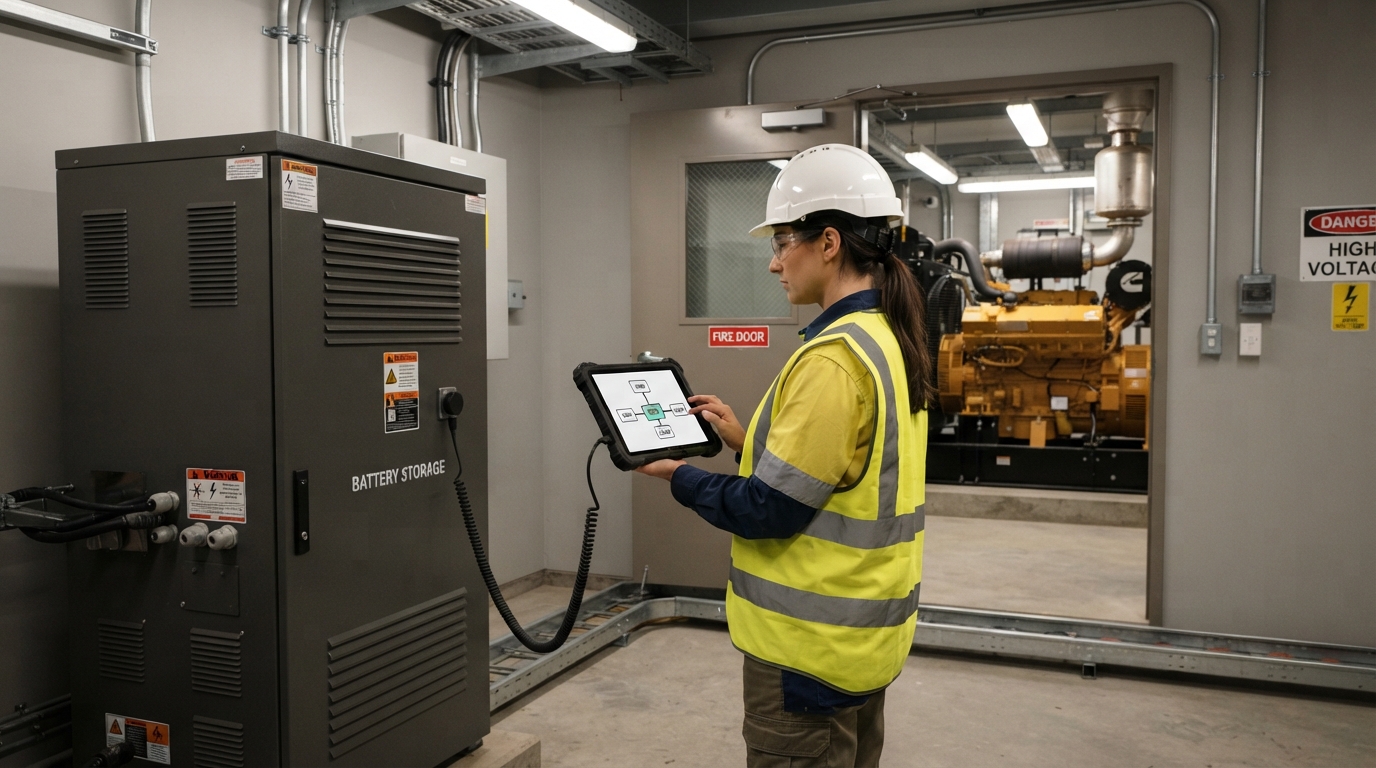
The BESS and generator cannot simply be connected together and expected to cooperate. An EMS has to decide when the generator should run, when the battery should discharge, when the battery should charge, and how much battery energy must be held in reserve.
The control logic will vary by project, but most diesel-BESS hybrids use the same set of core operating modes.
Steady-State Operation
During normal operation, the system holds the generator in a preferred loading range. If the site has enough demand, the generator carries the load and the BESS remains idle or handles small fluctuations. If the demand is too low for efficient generator operation, the battery may absorb surplus generator output and charge, bringing the generator up to a cleaner operating point.
The EMS keeps the BESS state of charge inside a defined band. The upper limit prevents overcharging. The lower limit preserves the reserve required for contingencies and prevents deep discharge that could shorten battery life.
Sudden Load Increase
When the site load jumps:
- The BESS immediately delivers the additional power.
- The generator begins to ramp toward the new demand.
- The EMS transfers more load to the generator as it becomes available.
- The BESS returns to its normal state and recharges if needed.
The result is a smooth response that does not force the generator to catch a fast load step on its own. This is also how the BESS can provide spinning reserve without the expense of a loaded generator.
Renewable Variability and Solar Bumps
When solar PV is added to the system, the BESS can smooth the fast changes in PV output. A passing cloud can cause a PV array to lose output in seconds. Without a battery, the diesel generator must react to every fluctuation. With a battery, the BESS absorbs the short-term change while the generator follows the slower, more predictable trend.
This is particularly useful in remote microgrids where PV penetration is high. The battery effectively makes the renewable resource appear more stable to the generator controller.
Low State of Charge and Generator Start-Up
If the BESS reaches its minimum state of charge, the system starts the generator. The generator supplies the load and may also charge the battery back to a usable level. The controller must decide:
- how low the state of charge can fall before starting
- how long the generator should run
- whether the generator should charge the battery while serving the load
- how much reserve must be preserved after the battery is recharged
This mode is the safety net. It ensures that the site never depends on the battery beyond its designed duration.
Sizing a BESS for Diesel Generator Optimization
Sizing a BESS for diesel generator optimization is different from sizing a backup battery. The goal is not simply to run the site for a certain number of hours after a power failure. The goal is to change how the generator operates, which means the BESS must be sized around both power and energy.
The two numbers are easy to confuse, but they answer different questions.
Power Capacity: kW and Response
The power rating of the BESS, expressed in kilowatts, determines how much load the battery can support at any instant. It must match the largest transient event the system is expected to handle.
Typical power requirements include:
- the largest load step on site
- the amount of spinning reserve required by the grid or the site owner
- the power needed to charge from the generator without pulling the generator below its minimum safe output
The response time also matters. A battery rated for the required power cannot provide reserve if the PCS cannot respond quickly enough. In a modern BESS, the power conversion system can usually respond in milliseconds, but the control logic and the EMS settings must allow it to act without delay.
Energy Capacity: kWh and Duration
The energy rating of the BESS, expressed in kilowatt-hours, determines how long the battery can sustain its power output.
As a simplified estimate:
Usable energy (kWh) ÷ average load (kW) ≈ duration (hours)
This estimate must account for state-of-charge limits, round-trip efficiency, and the reserve that must remain for contingencies. A 100 kWh battery does not provide 100 kWh of usable energy if the controller only allows use from 15 to 85 percent state of charge.
For a diesel optimization project, the energy requirement is usually shaped by:
- how long the generator may be stopped during light-load periods
- how much energy must be reserved for spinning reserve
- how much battery capacity is needed to absorb generator charging during efficient periods
- how long the BESS must support the site while the generator ramps
Power sizing and energy sizing must be done together. A battery with enough power but very little energy will help with transients but cannot replace generator runtime. A battery with lots of energy but insufficient power cannot provide the reserve or load-step response the site needs.
Practical Sizing Workflow and Inputs
A useful sizing process starts with the operating profile, not with the battery catalogue.
- Collect a load profile at intervals that capture real variation, not just a peak figure.
- Define the critical load that must be supported without interruption.
- Identify the reserve requirement from grid rules, site reliability standards, or critical-load analysis.
- Map the generator minimum load and ramp rate to understand where the generator is inefficient.
- Select BESS power for the largest transient or reserve event.
- Select BESS energy for the required support duration while preserving a state-of-charge reserve.
- Run a site-specific energy model before buying equipment.
Sizing from a competitor’s case study or from a generic “diesel + battery = 30 percent fuel saving” headline is not reliable. Every site has a different load profile and a different generator set.
Fuel-Savings Analysis and Feasibility Inputs
A fuel-saving claim only means something if it is measured against a clear baseline.
The right baseline is the fuel the diesel generator currently burns under the existing dispatch rules. The optimized case is the fuel the generator would burn with the BESS in place, including battery losses and the energy used to recharge the battery. The difference between those two numbers is the fuel saving.
Simple life-cycle energy storage models show that dispatch strategy determines whether storage creates value. NREL’s work on optimizing energy storage economics highlights that the value of a storage asset depends heavily on how it is dispatched. The same principle applies to a diesel-BESS hybrid.
Data Required for a Credible Analysis
| Data | Why It Is Needed |
|---|---|
| Load profile | Shows when the generator is lightly loaded, heavily loaded, or idle |
| Generator rated power | Establishes the possible operating range |
| Generator minimum load | Defines the lowest safe or practical output |
| Generator fuel curve | Shows how much fuel is burned at different load points |
| Ramp rate and start time | Determines how quickly the generator can replace the battery |
| Existing dispatch rules | Defines the baseline operation |
| Fuel price | Converts fuel savings into money |
| Operating schedule | Shows how many hours per day the generator runs |
| Critical load and reserve requirement | Defines how much BESS reserve must be preserved |
| Site constraints | Includes space, climate, cooling, safety, and grid interconnection rules |
With this data, an experienced integrator can simulate the hybrid system and estimate the fuel saving for that specific site. Without it, no credible number can be produced.
Why Savings Percentages Are Site-Specific
Published fuel-saving figures are usually examples from particular projects. They depend on:
- how inefficiently the generator was running before the BESS was added
- how much low-load operation the site actually experiences
- how often the generator can be stopped
- how much energy the battery can store and usefully return
- how the EMS is programmed
- whether the site has PV to recharge the battery
A site that already runs its generator efficiently may see a much smaller saving. A site that currently runs a large generator at 20 percent load for 12 hours per day is a much stronger candidate.
The BESS also has limits. It cannot replace a generator for a long outage unless it has enough energy and a way to be recharged. It cannot create fuel that was not being wasted in the first place. The role of the feasibility study is to find the gap between current operation and efficient operation.
System Integration, Control, and Safety Requirements
A diesel-BESS hybrid is a complete power system, not a battery bolted onto a generator. The electrical, control, protection, thermal, and safety systems must all be designed together.
For a broad view of how such systems are built, see the ci energy storage system page. The sections below cover the main integration points.
PCS, EMS, and Generator Controller Coordination
The PCS converts direct current from the battery into alternating current for the site. It also converts AC back into DC when the battery is charging. The PCS must be capable of the required power, response time, and communication with the EMS.
The EMS sits above the PCS and decides what the system should do. It receives data on load, generator output, battery state of charge, renewable output, and system voltage. It then sends commands to the generator controller and the PCS.
The generator controller must accept external start, stop, load, and synchronization commands. Not every generator controller is designed to be controlled by an external EMS. This is one of the first compatibility questions in any diesel-BESS project.
A battery management system (BMS) protects the battery itself. It monitors cell voltages, temperatures, currents, and state of charge, and it will limit operation if a cell is outside its safe range. The EMS must coordinate with the BMS so that dispatch decisions respect battery limits.
Synchronization, Protection, and Switchgear
When the BESS and the generator operate in parallel, their output voltages and frequencies must be synchronized before the connection is closed. This is a protection issue, not just a control setting.
Protection coordination must cover:
- generator faults
- battery and PCS faults
- feeder faults
- reverse power
- overcurrent and overvoltage
- unintended islanding
- loss of synchronization
Switchgear must allow the generator, BESS, and loads to be safely isolated for maintenance. In a microgrid, the protection philosophy must also define whether the system operates grid-connected, islanded, or both.
BESS Cooling, Fire Safety, and Compliance
BESS equipment produces heat, especially when delivering high power or charging quickly. The thermal management system must keep the battery within its design temperature range for the expected operating pattern. The cooling method may be air-based or liquid-based, but the correct choice depends on the BESS design, the site climate, and the duty cycle.
Fire safety must be considered in the enclosure design, the battery chemistry, the detection system, the suppression system, and the surrounding site layout. A diesel-BESS installation in a remote industrial yard has different fire-response options than a containerized system in a dense commercial area.
Compliance documents should be requested for the exact installed configuration. Do not assume that a certificate for one battery product covers a different battery model, a different rack, a different container, or a different control configuration.
Limitations and Common Mistakes
A diesel-BESS hybrid is not the right answer for every site. Common mistakes include:
- Sizing only for peak power without checking whether the battery has enough energy for the required duration.
- Using nominal energy as usable energy without accounting for state-of-charge limits and efficiency.
- Assuming the generator can be stopped when the battery does not have enough reserve or when the site cannot accept the risk of a failed restart.
- Forgetting the fuel curve and claiming savings without a site-specific baseline.
- Believing published savings percentages from a different load profile.
- Assuming any BESS can synchronize with any generator.
- Neglecting protection coordination between the battery and the generator.
- Ignoring battery degradation in the lifecycle economics.
- Adding a BESS as a backup asset when the actual goal is fuel optimization. These are different applications with different sizing logic, much like the difference between commercial backup energy storage solutions and a dispatchable hybrid plant.
The BESS is an enabling asset. It makes the diesel generator easier to operate efficiently, but it does not eliminate the need for good engineering.
How to Evaluate a Diesel-BESS Integrator or Supplier

The technical concept is only as good as the system design. When evaluating an integrator or supplier, ask for proof that the system can be engineered for your specific site.
Use the following checklist:
- [ ] Has the supplier requested the actual load profile and generator fuel curve?
- [ ] Has the supplier identified the generator minimum load and ramp rate?
- [ ] Has the supplier shown how the EMS will start, stop, charge, and discharge the generator?
- [ ] Has the supplier confirmed PCS and generator-controller compatibility?
- [ ] Has the supplier defined the reserve requirement and the state-of-charge band?
- [ ] Has the supplier explained synchronization, islanding, and protection coordination?
- [ ] Has the supplier provided safety documentation for the exact proposed configuration?
- [ ] Has the supplier explained battery degradation assumptions in the economic model?
- [ ] Has the supplier connected the fuel savings calculation to the site baseline?
- [ ] Has the supplier provided references for hybrid or microgrid projects?
A credible supplier will ask for data before promising savings. A supplier that gives a fixed fuel-saving percentage without seeing the load profile is not doing engineering.
Applications such as battery storage for mining operations and battery storage for airport microgrid often need this kind of detailed evaluation because the reliability requirements are high and the fuel costs are significant.
If you are starting a diesel-BESS evaluation, begin with your own site data. Collect the load profile, identify the critical load, document the generator fuel curve, and define the reserve requirement. That information will determine whether the project can deliver meaningful fuel savings, and it will give every supplier a common basis for comparison.

-

 OEM Residential Energy Storage Solutions: Passive vs. Active Cell Balancing
2026-09-30
-
 Smart Home Battery with BMS Communication: Cybersecurity and BMS Safety
 -
 10kWh Home Battery Backup System: Is 90% DoD Better for Daily Solar Storage?
2026-09-29
-
 Integrated Home Energy Storage System 150–430V MPPT Design
2026-09-28
-
 LiFePO₄ Residential Backup Battery SOC Accuracy in Parallel Systems
Share this:





.svg)






-899.svg)


