




Battery Storage for Airport Microgrids: Critical Loads, Solar and Resilience
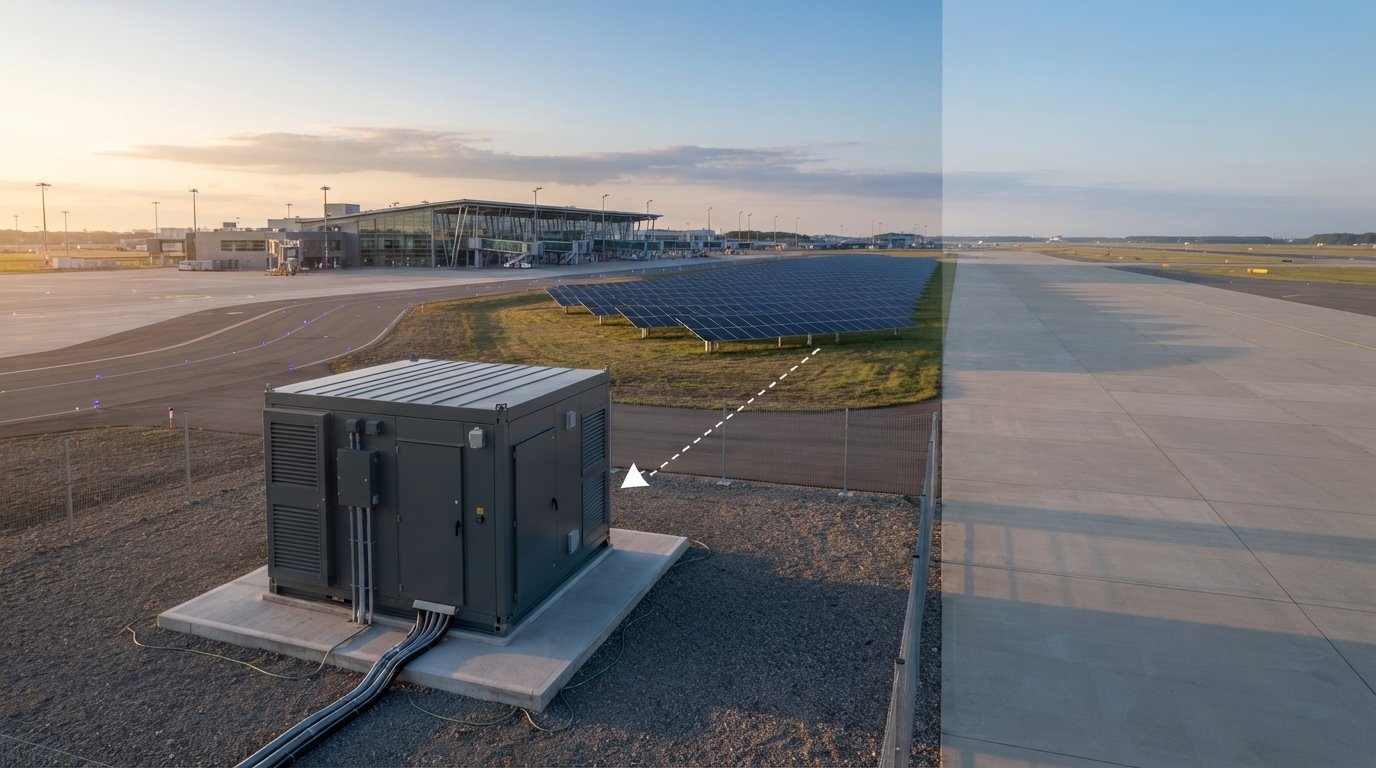
An airport microgrid is more than a backup system. It is a coordinated electrical network that can operate alongside the utility grid or detach from it when the grid fails. Battery storage is often the piece that makes that detachment practical: it responds quickly, supports solar generation, and supplies critical loads during an outage.
Battery storage for an airport microgrid starts with one question: which loads must stay online when the grid does not? The rest—power rating, energy capacity, solar integration, controls, safety, and supplier selection—should follow from that answer. This guide walks through those decisions in the order an airport project team is likely to face them, and it fits within the broader context of VoltaLink’s Comprehensive Guide to Commercial & Industrial Energy Solutions.
Why Airports Need Battery Storage and Microgrid Resilience
Airports are not typical commercial facilities. Terminals, airfield lighting, security systems, passenger processing, baggage handling, and operational communications cannot simply switch off. Power quality also matters: voltage dips and frequency deviations can disrupt sensitive equipment even when power does not fail completely.
Standby generators solve part of the problem, but they bring their own constraints: fuel storage, refueling logistics, response time, emissions, and maintenance. Generators also do not integrate renewable generation by themselves. This is where battery storage fits.
A battery energy storage system (BESS) can:
- respond to a grid disturbance in milliseconds;
- provide voltage and frequency support;
- charge from solar during the day and discharge when loads need power;
- operate in parallel with existing generators;
- support islanded operation when the microgrid disconnects from the utility grid.
Airports are increasingly pairing solar with storage for both resilience and energy-cost reasons. The Redwood Coast Airport Microgrid, for example, combines PV, battery storage, and electric-vehicle charging in a microgrid that can operate grid-connected or islanded. The solar-plus-storage microgrid planned for JFK’s New Terminal One is another example of how airports are using batteries to keep critical functions running even during a wider grid outage.
For a broader look at backup architecture in commercial facilities, VoltaLink’s commercial backup energy storage solutions page covers related continuity concepts.
How a Battery Supports Islanded Airport Operation
The defining resilience feature of an airport microgrid is islanding. When the utility fails, the microgrid controller can separate the airport system from the grid. A battery paired with a grid-forming inverter can then establish the voltage and frequency reference that other equipment relies on.
During islanded operation, the BESS discharges to match critical load, recharges from solar when surplus is available, and supports a controlled reconnection once the grid stabilizes. That capability makes the battery far more useful than a passive backup source.
Defining Airport Critical Loads and Priorities
Before sizing any battery, the project team must define what the microgrid is protecting. “Critical” is not universal. It is decided by the airport operator, airlines, air-traffic and safety authorities, tenants, and local utility interconnection rules.
A helpful approach is to separate airport loads into priority bands, then decide which loads must stay online during the first minutes, the first hours, and a longer outage.
Classifying Airport Loads by Priority
The table below gives common airport load categories and the design questions that follow from each one. Use it as a starting point, not as a fixed requirement list.
| Priority Band | Examples | Typical Design Question |
|---|---|---|
| Life safety and security | Emergency lighting, access control, alarms, CCTV, first-responder systems | Is this load already protected by a UPS? Does it need no-break power or only short ride-through? |
| Airfield operations | Airfield lighting and other airside systems approved by the responsible authority | Which airside loads must remain available during low visibility or emergency operations? |
| Terminal passenger processing | Check-in, security screening, boarding systems, passenger information | Can these functions be temporarily reduced while people remain safe and informed? |
| Communications and data | Airport network, servers, phone systems, operational databases | Does IT already have UPS protection? Does the BESS supply the UPS or sit behind it? |
| Baggage handling | Conveyors, sortation equipment, baggage storage systems | Can baggage be managed manually for a short period, or is automation essential for departures? |
| HVAC and refrigeration | Chilled water, terminal air handling, cold storage | Could load shedding for a few hours create safety, equipment, or product risks? |
| EV charging and general facilities | Passenger EV chargers, retail loads, maintenance areas | Which loads are clearly deferrable during islanding? |
Airports behave like multi-building campuses, so the load-zoning concept in VoltaLink’s guide to a campus battery energy storage system is directly relevant. A campus approach helps project teams decide which buildings and circuits belong on the resilient microgrid bus and which do not.
Load Shedding Extends Battery Runtime
Battery runtime is not fixed by battery capacity alone. It depends on what the system is allowed to run.
A microgrid controller can shed noncritical loads automatically when the grid is lost. A defined “survival load” might keep life safety, communications, and critical airside equipment online while HVAC, baggage, and EV charging are temporarily reduced. That strategy can extend battery duration significantly without increasing the size of the battery.
Airport planners should define at least two operating levels:
- Minimum survival mode: only life-safety, security, communications, and essential airside loads.
- Normal islanded operation: a broader set of terminal loads that can operate while the airport remains functional but not at full capacity.
These decisions become the basis for both battery sizing and microgrid control logic.
How Solar and Battery Storage Work Together in an Airport Microgrid
Solar and storage complement each other. Solar generates during daylight, the battery stores surplus energy, and the battery releases that energy when solar output falls or load increases.
During an outage, this relationship becomes even more valuable. Solar can recharge the battery during daylight, extending islanded operation beyond what the battery could provide on its own. The actual recharge depends on solar size, weather, cloud cover, and whether the microgrid controller permits charging while critical loads are being served.
Solar can be integrated in two general ways:
- AC-coupled systems: the PV inverter and battery inverter connect on the AC side. This is often simpler for retrofits because the solar system can be added independently of the battery.
- DC-coupled systems: the PV array can charge the battery on the DC side before conversion to AC. This can reduce conversion losses in some designs and is often considered for new, closely integrated systems.
The right architecture depends on whether the project is new or a retrofit, how much solar is expected to feed critical loads, and how the microgrid controller will coordinate both resources. The system-level design concepts in VoltaLink’s ci energy storage system page provide useful background for this stage of planning.
Many airport microgrids also retain diesel generators for extended outages. In that configuration, battery storage can handle rapid load changes, reduce unnecessary generator runtime, and support solar integration. The coordination strategy for combining batteries and generators is covered in VoltaLink’s bess for diesel generator optimization guide.
Research from the National Renewable Energy Laboratory has examined how PV and battery storage can be sized together to improve resilience, including coordination with diesel generators. That type of analysis is more useful than a simple “worst-case day” calculation because it accounts for solar variability and outage timing.
Battery Power vs. Battery Energy: Sizing an Airport BESS
Two of the most common specification errors are confusing power and energy.
- Power (kW) tells you how much load can be served at a given moment.
- Energy (kWh) tells you how long that load can be served.
For an airport microgrid, the battery must be sized for both. A large battery with low power capability cannot start a baggage conveyor or handle a sudden load step. A high-power battery with low energy capacity cannot sustain critical loads through a long outage.
A practical way to think about runtime is:
Usable energy (kWh) ÷ average critical load (kW) ≈ approximate runtime
Usable energy is not the same as the battery’s nominal capacity. It must account for:
- depth of discharge limits;
- system efficiency losses;
- a reserve margin for unexpected load growth;
- degradation over the life of the system.
Always ask a supplier to state usable energy, not just nominal capacity.
Sizing Battery Power (kW)
Battery power should be based on the loads that will operate simultaneously during islanding. Add the kW of those loads, then account for startup surges.
Some airport loads draw more current when they start than when they run steadily. Baggage conveyors, chillers, pumps, and some passenger-processing equipment can create momentary power spikes. The battery and its inverter or PCS must be sized to handle the peak, not just the average load.
For example, if a terminal’s critical load is 300 kW on average, but a chiller startup creates a 600 kW peak for a few seconds, the battery system must be rated for that peak unless the design avoids the conflict through sequencing or soft starts.
Sizing Battery Energy (kWh) and Runtime
Battery energy should be based on the required backup duration. There is no universal number. The airport should define its own resilience objective:
- ride through a short disturbance;
- sustain critical loads for several hours;
- support a multi-day outage with solar recharge;
- coordinate with generators for indefinite runtime.
Solar can extend runtime during daylight, but the project should not assume perfect sunshine. A conservative design uses a lower solar contribution during outage hours and treats solar recharge as a bonus rather than the primary source.
Reserve margin also matters. Airports grow, loads change, and batteries degrade. A system sized exactly to today’s load and the first year’s performance will be undersized within a few years. Adding a reserve margin at the design stage protects the airport from premature degradation problems.
NREL’s resilience research provides a framework for evaluating whether a PV-plus-storage system can serve critical loads through an outage, rather than relying on a single back-of-envelope estimate.
Microgrid Controls: BMS, EMS, PCS and the Microgrid Controller
A battery alone does not make a microgrid. The system needs coordinated controls that manage battery safety, energy dispatch, and grid synchronization.
| Component | Primary Job | What to Ask About |
|---|---|---|
| BMS (Battery Management System) | Monitors cell voltages, temperatures, and currents; protects against overcharge, over-discharge, and overheating; supports cell balancing. | Does the BMS operate at cell level or module level? What alarms and limits does it enforce? |
| EMS (Energy Management System) | Manages energy strategy: when to charge, discharge, hold reserve, and coordinate with solar and loads. | Can the EMS accept operating rules from the airport, such as load-priority settings? |
| PCS (Power Conversion System) | Converts DC battery power to AC and AC to DC; sets the power limit for charging and discharging. | Is the PCS rating matched to the battery power and the airport’s load profile? |
| Microgrid controller | Coordinates islanding, reconnection, load shedding, generator start-stop, and dispatch across all microgrid assets. | Does the controller have a clear sequence for islanding and reconnection? Who programs it? |
These roles sometimes overlap in integrated products. For procurement, the important question is who is responsible for each function, not just which box contains it.
Grid-Forming vs. Grid-Following Inverters
The most important technical distinction for islanded airport operation is the difference between grid-forming and grid-following inverters.
- Grid-following inverters track the voltage and frequency created by the utility grid or another source. If that reference disappears, they stop producing power.
- Grid-forming inverters create the voltage and frequency reference themselves, using stored energy. This capability is what allows a microgrid to operate independently after disconnection.
If an airport must stay online during a grid outage, at least one asset in the microgrid needs to be grid-forming. In many designs, the battery and its inverter fill that role. The Redwood Coast Airport Microgrid is a notable example because it uses grid-forming PV and battery inverters to operate independently from the utility.
Islanding, Black Start and Reconnection
Airport microgrid operation can be understood as a sequence:
- Normal operation: the microgrid imports or exports power according to its operating strategy.
- Outage detection: a protective relay or controller detects a utility disturbance and opens the point of common coupling.
- Islanding: the BESS, with its grid-forming inverter, establishes the voltage and frequency reference.
- Load management: the microgrid controller sheds noncritical loads to protect battery duration.
- Solar and generator coordination: solar recharges the battery when possible, and generators start if the outage exceeds the battery’s design duration.
- Reconnection: when grid quality returns, the controller synchronizes the microgrid with the utility and closes the connection.
Every step should be tested during commissioning, not assumed to work.
Battery Safety, Thermal Management and Enclosure Design
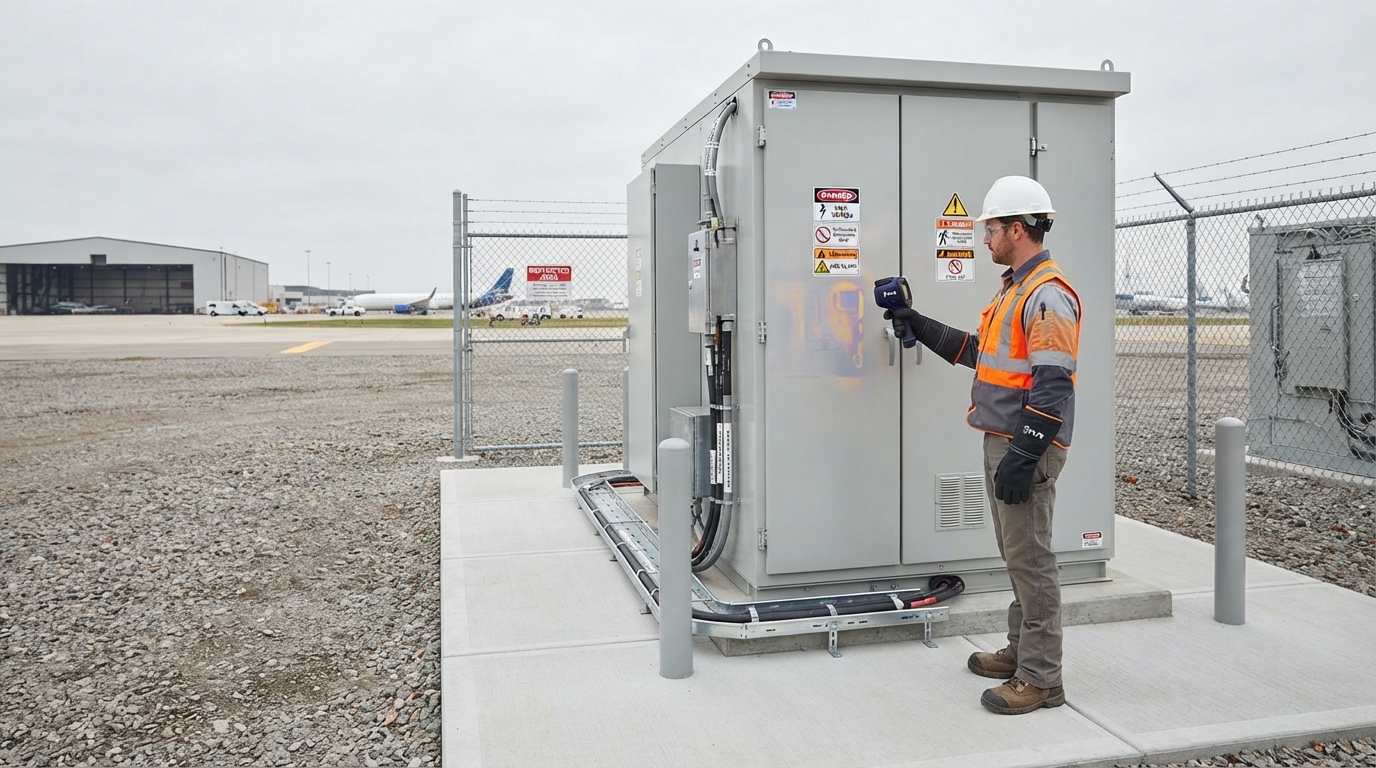
Airports cannot accept avoidable fire risk. Battery safety depends on the whole system: cell chemistry, BMS protection, thermal management, enclosure, fire detection and suppression, siting, and emergency response planning.
Lithium iron phosphate (LiFePO4) is a common chemistry in commercial and industrial battery storage because of its thermal stability and long cycle life compared with some other lithium-ion chemistries. No chemistry alone eliminates system-level risk, but LiFePO4 is a reasonable starting point for many critical-facility projects.
Thermal management keeps cells within their operating temperature range. Two general approaches are:
- Air cooling: simpler, often adequate for smaller systems or climates with moderate temperature swings.
- Liquid cooling: provides more direct temperature control and is often used in higher-density or containerized systems.
VoltaLink offers a liquid-cooled energy-storage system as an example of this design approach. The choice between cooling methods depends on system scale, site climate, enclosure space, and maintenance capability.
For larger airport installations, a containerized BESS provides a factory-integrated enclosure with cooling, fire protection, and monitoring in a single unit. Containerized systems are often easier to deploy at airport sites because much of the integration work is completed before arrival.
Regardless of format, the project must address:
- fire detection and suppression;
- IP-rated enclosures for outdoor siting;
- setback and access requirements;
- coordination with the local authority having jurisdiction (AHJ);
- emergency response planning with airport fire services;
- transport, handling, and installation requirements.
Local codes and utility requirements must be verified on a project-by-project basis.
Airport Microgrid Implementation: From Feasibility to Commissioning
Airport microgrid projects follow a structured path. The Airport Cooperative Research Program’s Airport Microgrid Implementation Toolkit describes this process as a sequence of requirements, feasibility, design, construction, and commissioning. In practice, it looks like this:
- Requirements assessment: identify critical loads, historical outage risk, resilience objectives, operating constraints, and stakeholder approvals.
- Feasibility study: evaluate solar resource, available site space, electrical interconnection, utility rules, local permits, and economic or resilience value.
- System design: select architecture, technologies, controls, safety systems, and enclosure format; define load-shedding priorities and operating sequences.
- Procurement and construction: prepare specifications, evaluate suppliers and integrators, install equipment, and coordinate with the utility and AHJ.
- Commissioning: perform factory tests, site tests, islanding tests, load-shedding tests, and reconnection tests; train airport operators; document the as-built system.
- Operations and maintenance: monitor system performance, track state of health, update operating parameters, and maintain the system over its lifetime.
The Airport Microgrid Implementation Toolkit is useful for airport teams that need a more detailed project-management view of these phases.
How to Evaluate a Battery Storage Supplier or Integrator
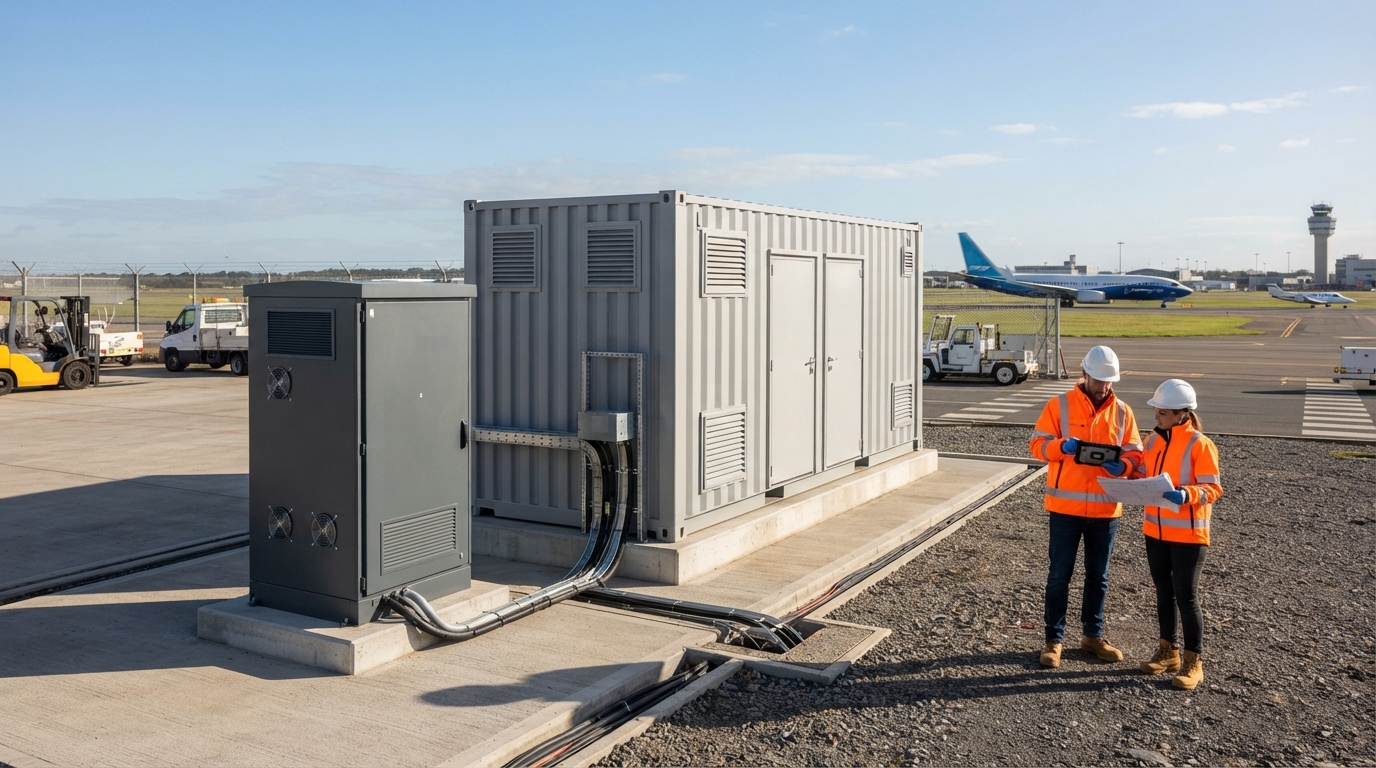
Airport procurement should be based on evidence, not marketing language. The following checklist helps project teams evaluate whether a BESS supplier or integrator can actually support an airport microgrid.
- Request model-specific datasheets with correct units: V, Ah, kWh, kW, current, depth of discharge, cycle life, and operating temperature range.
- Ask whether the rating applies to a battery module, a rack, a cabinet, or a complete system. Do not compare module-level energy with system-level power.
- Confirm which components are included: BMS, PCS, inverter, cooling, fire suppression, enclosure, and monitoring.
- Ask who supplies the microgrid controller and who programs the islanding, load-shedding, and reconnection sequences.
- Request certifications and test reports for the specific model or system, not general claims about the company.
- Ask how the battery communicates with the EMS, solar inverters, generators, and utility metering.
- Define the boundary of responsibility between the battery supplier, the integrator, and the EPC.
- Confirm warranty terms, spare parts, monitoring access, response times, and commissioning support.
- Request references from similar critical-facility projects, not only residential or general commercial installations.
No supplier should be selected on the basis of a website page alone.
Sizing the Right Storage Starts with the Right Questions
The right battery for an airport microgrid cannot be selected from a specification sheet until the airport defines its survival load. Once critical loads are clear, the rest of the design becomes more orderly: power, energy, solar integration, controls, safety, and supplier evaluation all follow from the airport’s resilience objective.
That objective should be written down. It should name the loads that matter, the duration the airport wants to defend, and the conditions under which load shedding is acceptable. From there, a feasibility study can translate those requirements into a defensible system design.
For more on how battery storage fits into commercial and industrial energy architecture, start with VoltaLink’s Comprehensive Guide to Commercial & Industrial Energy Solutions and bring that system-level perspective to your feasibility discussion.

-

 OEM Residential Energy Storage Solutions: Passive vs. Active Cell Balancing
2026-09-30
-
 Smart Home Battery with BMS Communication: Cybersecurity and BMS Safety
 -
 10kWh Home Battery Backup System: Is 90% DoD Better for Daily Solar Storage?
2026-09-29
-
 Integrated Home Energy Storage System 150–430V MPPT Design
2026-09-28
-
 LiFePO₄ Residential Backup Battery SOC Accuracy in Parallel Systems
Share this:






.svg)






-899.svg)


