




Wind Farm Battery Energy Storage System for Smoothing and Grid Services
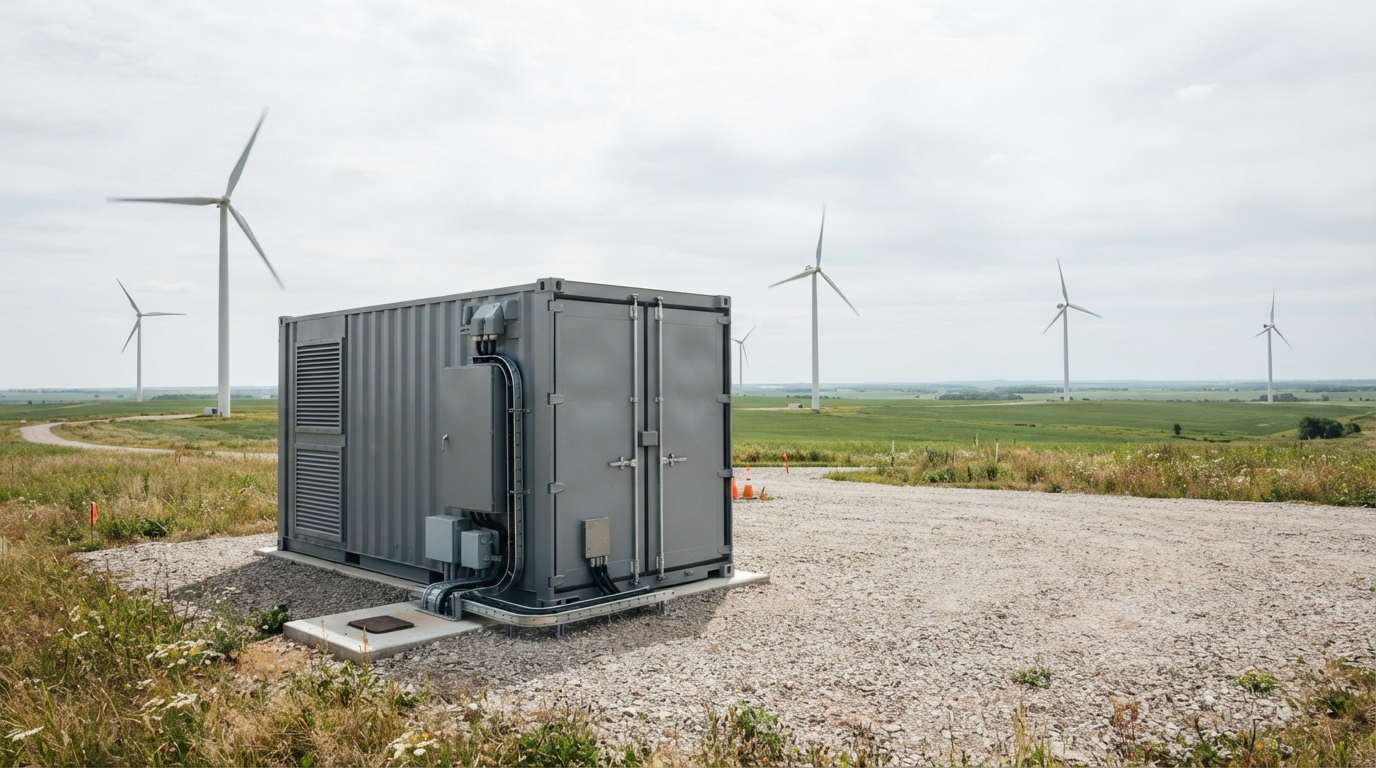
A wind farm battery energy storage system (BESS) is a battery installation integrated with a wind power plant to manage variability in generation and provide services to the grid. It charges when wind output exceeds demand or grid limits, and discharges when the plant must smooth output, shift energy delivery, or respond to grid signals. Used this way, storage turns a wind farm from a variable energy source into a more controllable and dispatchable resource.
This guide explains how a wind-farm BESS works, what functions it can perform, how power and energy capacity are determined, and what buyers should evaluate when selecting a system. For a broader view of storage technologies, see Power Storage Technology: The Key to Future Energy Solutions.
Why Wind Farms Need Battery Storage
Wind generation is variable over multiple timescales. Minutes-long gusts can cause sudden output ramps, while larger weather patterns influence production over hours and days. Grid operators and interconnection agreements often hold wind plants to defined ramp limits, export caps, or scheduling obligations that a turbine alone cannot reliably satisfy.
Battery storage can absorb or release power more quickly than wind turbines can change output. That makes it well-suited for:
- Ramp-rate control, where the plant must limit how quickly its output changes.
- Energy shifting, where excess generation is stored for delivery later.
- Curtailment reduction, where energy that would otherwise be wasted is captured.
- Grid services, where the battery responds to frequency, voltage, or operator dispatch signals.
The caveat is that no practical battery can make a wind plant perfectly firm at all times. The real value depends on the specific ramp requirements, energy duration, grid connection, and operating strategy. Sandia National Laboratories describes this type of adaptive storage control in its work on smoothing wind generation: Using Intelligent Storage to Smooth Wind Energy Generation.
How a Wind Farm Battery Energy Storage System Works
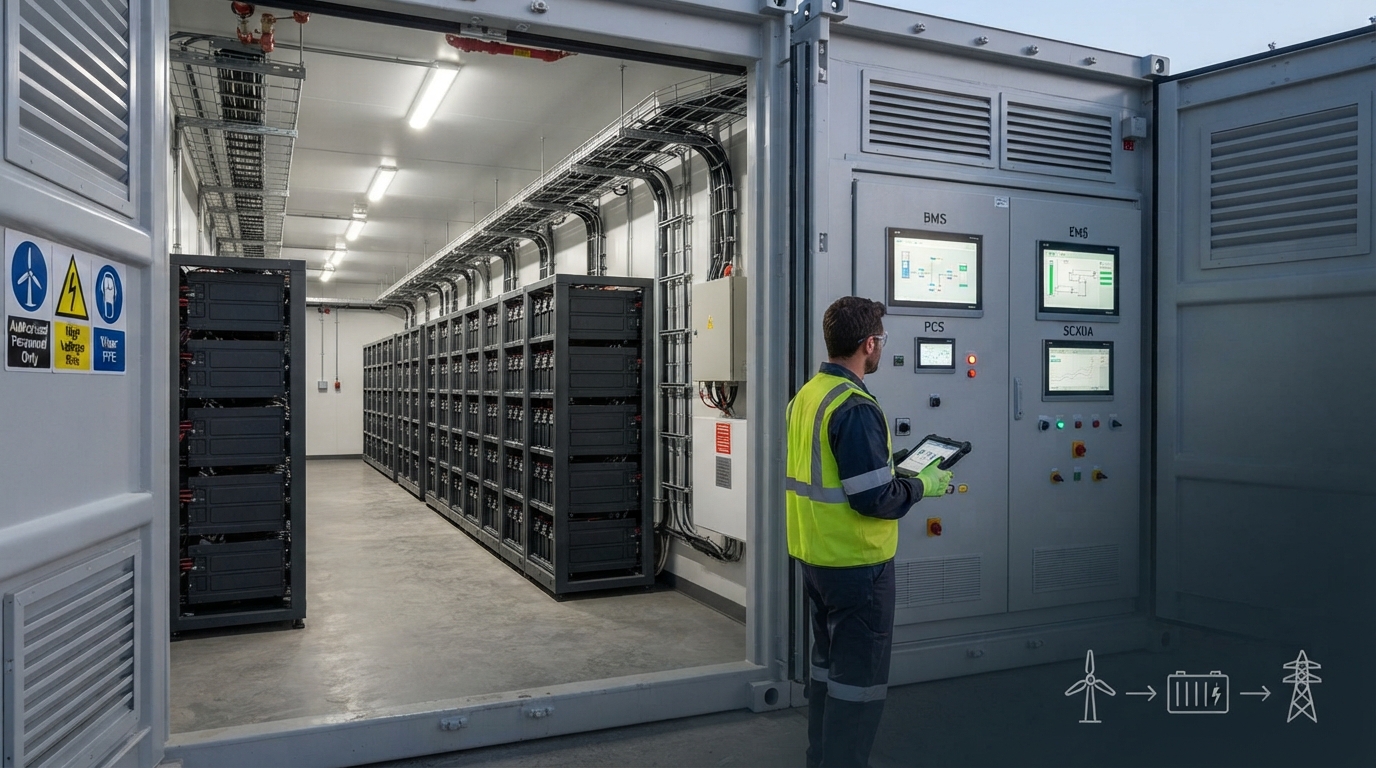
A wind-farm BESS is not just a battery. It includes the energy-storage hardware, power-conversion equipment, and a control system that coordinates charging and discharging with plant and grid conditions.
The basic operating cycle is:
- Charge when the wind plant produces more power than can be delivered, when the grid is not requesting the energy, or when output must be reduced.
- Discharge when a smoothing event occurs, when grid services are needed, or when the plant is scheduled to deliver power.
- Measure output at the point of interconnection to confirm that the combined plant meets the required limit or command.
Control decisions are made by the system’s energy management system (EMS). It uses wind measurements and forecasts, plant output, state of charge, grid limits, and service commands to decide when the battery should act.
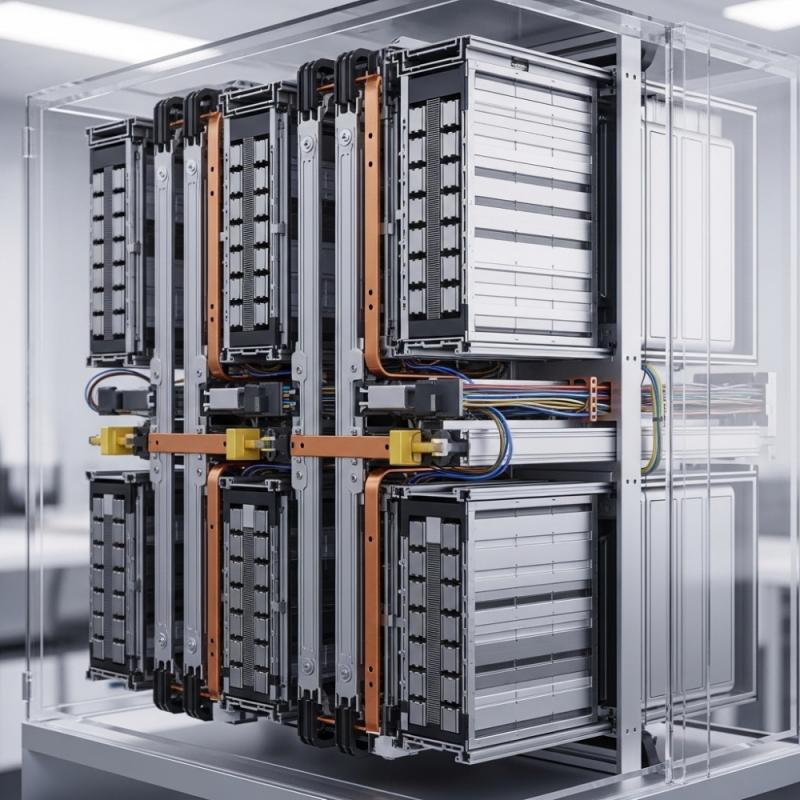
The battery itself is assembled from modules and racks, often housed in a container. Containerized designs are common for utility-scale projects because they integrate the battery racks, thermal management, fire protection, and power equipment into a single enclosure. VoltaLink’s battery energy storage container pages describe this packaging approach for grid-scale storage.
AC-Coupled vs. DC-Coupled Wind-Plus-Storage Architecture
The two main ways to connect a BESS to a wind plant are AC-coupled and DC-coupled.
| Architecture | Connection Point | Typical Use |
|---|---|---|
| AC-coupled | BESS connects to the AC collection or grid side through its own PCS | Most common for wind; works with any turbine type; good for retrofits and independent operation |
| DC-coupled | BESS connects to a shared DC link behind the turbine or plant converter | Less common for wind; depends on turbine/converter design; more often seen in solar hybrid systems |
AC-coupled is usually the practical choice for wind farms because the battery can operate independently of the wind turbine’s power-conversion system. DC-coupled designs exist but require the turbine’s DC architecture to be compatible, which is not universal across wind turbine models.
Core System Components: BMS, PCS, EMS, and Controls
| Component | Function | Role in the System |
|---|---|---|
| Battery modules/racks | Store DC energy | Define the energy capacity and current limits |
| BMS | Monitors cells and protects the battery | Reports voltage, current, temperature; triggers protection |
| PCS | Converts DC to AC and manages active/reactive power | Acts as the interface between the battery and the grid |
| EMS | Supervises charging, discharging, and grid services | Ties wind forecast, grid commands, and battery status together |
| SCADA/communications | Delivers data and commands | Connects the plant operator and grid operator to the BESS |
Each component affects the others. The BMS protects the battery; the PCS sets response capability; the EMS decides what to do next. A useful design discussion must cover all three.
Primary Use Cases: Smoothing, Shifting, and Grid Services
A wind-farm BESS can serve several purposes, but each use case places different demands on power and energy capacity.
| Use Case | Main Objective | Key Demand |
|---|---|---|
| Output smoothing | Reduce short-term variability | Power response and enough energy to cover ramp events |
| Energy shifting | Move generation to a later time | Large energy capacity relative to power |
| Curtailment reduction | Capture surplus energy | Energy capacity matched to curtailment patterns |
| Frequency response | Respond quickly to grid frequency deviations | Fast power control and reserved capacity |
| Voltage support | Manage reactive power at the connection point | PCS capability, not necessarily battery energy |
| Black start | Restore a localized grid segment | Grid-forming control and islanded operation capability |
Output Smoothing and Ramp-Rate Control
Smoothing is the most common description of a wind-farm BESS, but it is more precise to talk about ramp-rate control. A ramp-rate limit defines the maximum change in output the plant is allowed to make over a set interval, such as megawatts per minute. The BESS measures output at the point of interconnection and charges or discharges instantly to keep the combined output within the allowed slope.
This requires enough power (MW) to offset the ramp and enough usable energy (MWh) to sustain that response for the full duration of the event. Wind forecasting helps the EMS prepare in advance, but a feedback control loop can also respond to the measured output directly.
Energy Shifting and Curtailment Reduction
When grid congestion, market conditions, or export limits cause a wind plant to be curtailed, the BESS can capture some of that energy instead. The stored energy can be discharged later when the constraint clears or when prices are more favourable.
The value of curtailment reduction depends on three factors:
- How often curtailment occurs.
- How much energy is available during those events.
- When the stored energy can be delivered.
Projects with frequent, large curtailment events and a clear later value window are better candidates for this use case. Research on multi-use BESS operation in wind farms, such as this study in the Journal of Energy Storage, describes how a single system can combine self-consumption, smoothing, and curtailment-related operation.
Frequency Regulation and Other Grid Services
A wind-farm BESS can also provide frequency regulation if the PCS and EMS are designed for it, and if the local grid operator permits the service. Frequency response requires a fast active-power change in reaction to grid frequency. The battery can act quickly, but its ability to sustain that response depends on the reserved state of charge. Research from the U.S. Department of Energy describes coordinated wind-BESS control for multi-timescale frequency support: Coordinated Control Strategy of a Battery Energy Storage System to Support a Wind Power Plant Providing Multi-Timescale Frequency Ancillary Services.
Voltage support is another possible service, but it depends on the PCS’s reactive-power capability and the interconnection design, not simply on the battery’s energy capacity.
Black start is a more specialized function. It requires grid-forming controls and a defined sequence to energize a portion of the grid without help from the network. This is not an automatic capability in every BESS. For a discussion of battery storage designed for frequency response, see battery storage for frequency regulation. For islanded operation differences, see off grid battery storage.
Commercial examples show how varied these services can be. Ørsted’s Hornsea 3 project includes a 600 MWh BESS co-located with an offshore wind farm to support grid stability and reduce price volatility (announcement). Alfen describes a Swedish wind-farm BESS used for fast-frequency reserve and black start (project note).
Sizing a Wind-Farm BESS: Power vs. Energy
The most common mistake in wind-storage specification is confusing power with energy.
- Power (MW) describes how fast the BESS can charge or discharge.
- Energy (MWh) describes how long it can sustain that power.
A battery rated at 10 MW / 20 MWh can deliver 10 MW for 2 hours, or 5 MW for 4 hours, within its operating limits. But not all of the nameplate energy is usable. The EMS typically keeps minimum and maximum state-of-charge limits, and the depth of discharge is limited to protect cycle life. Usable energy is therefore lower than nameplate energy.
C-rate is also important. It relates current to the battery capacity. A 1C rate on a 20 MWh battery means 20 MW discharge for one hour; a 0.5C rate means 10 MW. Higher C-rates increase thermal load and can accelerate degradation.
Sizing cannot be reduced to a fixed percentage of wind-farm capacity. The correct size depends on:
- The wind plant’s output profile and curtailment history.
- The ramp limit or grid-code requirement.
- The intended services and their duration requirements.
- The point-of-interconnection export limit.
- The market rules and operator constraints.
- The allowed depth of discharge and degradation budget.
A project-specific study is always required. This is consistent with NREL’s guidance on hybrid wind-storage systems, which emphasizes resource profiles and sizing trade-offs rather than fixed ratios: Hybrid Distributed Wind and Battery Energy Storage Systems.
Degradation, Efficiency, and Operating Trade-Offs
A wind-farm BESS has a finite cycle budget. Each charge and discharge consumes a small part of its lifetime, so the more services the battery performs, the faster it ages.
Service stacking is attractive economically but creates competition:
- Energy shifting wants full usable capacity.
- Frequency response wants reserved headroom.
- Smoothing wants available charging and discharging power.
- Reserve services want energy held back.
These roles often conflict. The EMS must assign priority so one service does not undermine another.
Round-trip efficiency also matters. Some energy is lost during each charge-discharge cycle. The effective return is lower than the nameplate energy delivered, so the economic value of shifting must exceed the efficiency loss.
The best strategy is project-specific. Some owners prefer a conservative depth of discharge to preserve warranty and cycle life; others accept deeper cycling for higher short-term revenue.
Thermal Management and Safety for Utility-Scale BESS
Temperature control is a core design issue because battery performance, aging, and safety all depend on operating temperature. Two common approaches are air cooling and liquid cooling. Liquid cooling usually offers more precise temperature control in high-density or high-power designs, while air cooling is simpler and may suit lower-power systems. The right choice depends on the enclosure, system rating, ambient conditions, and operating profile.
Thermal management must be integrated with the enclosure design, fire detection, and fire-suppression system. Protection and isolation are also required between the battery, the PCS, and the grid. A utility-scale project will not receive interconnection approval unless it satisfies the applicable grid code and local fire-safety requirements.
Safety claims should always be model- or system-specific. A certificate for one battery model does not automatically apply to the full container system or to another model.
VoltaLink, for example, describes a liquid-cooled energy-storage system that can be used with renewable power plants including wind farms: Liquid Cooling Energy Storage System for Industrial Use.
Selecting a Wind-Farm BESS Supplier: Evaluation and RFQ Checklist
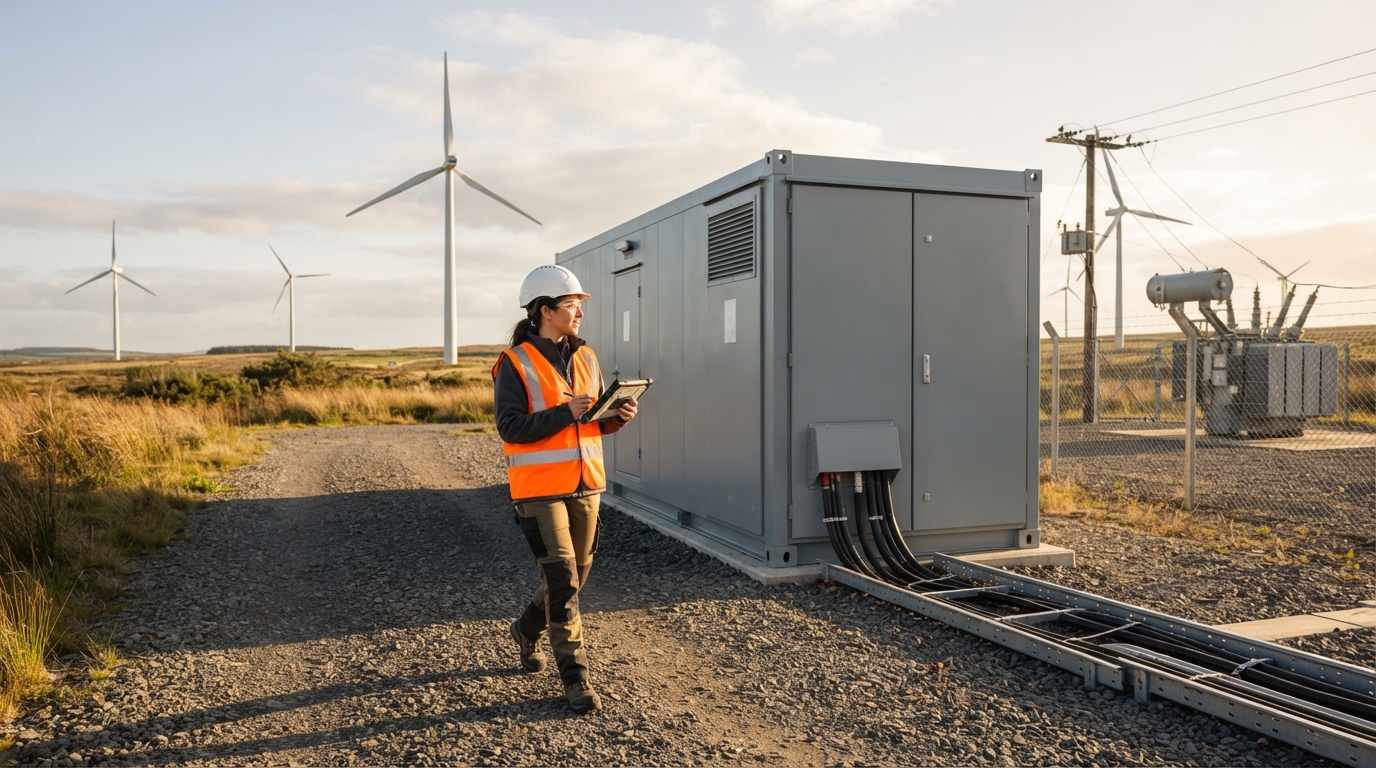
The procurement decision comes down to one question: can the supplier deliver a complete system that meets the project’s performance, compliance, and lifecycle requirements?
Before requesting a proposal, the project team should assemble:
- Wind-output time series and forecast data.
- Ramp limits and grid-code obligations.
- Export and import limits at the point of interconnection.
- Curtailment history and future market expectations.
- Desired services and their priority.
- Operating constraints, such as site temperature range and ambient conditions.
The RFQ should ask the supplier to define:
- Scope of supply: battery modules, racks, BMS, PCS, EMS, thermal management, fire suppression, enclosure, and communications.
- Integration responsibility: who performs grid studies, protection coordination, commissioning, and testing.
- Performance guarantees: usable energy, availability, response time, round-trip efficiency, and degradation model.
- Warranty terms: cycle or calendar basis, exclusions, and what invalidates coverage.
- Compliance evidence: model-specific certificates, test reports, and grid-code compliance documentation.
- Support services: monitoring, spare parts, remote diagnostics, and local or regional service coverage.
Buyers should avoid accepting category-level claims as system-level evidence. A supplier may offer a utility scale battery container, but the complete wind-farm system must be confirmed through the project-specific design and documentation.
VoltaLink’s website positions the company around energy-storage solutions for utility and industrial applications. Its commercial and industrial energy solutions page describes EMS-based system integration, which provides a starting point for defining the engineering scope in a project-specific conversation.
Conclusion: Making the Wind-to-Battery Match a Project Decision
A wind-farm BESS is not an off-the-shelf add-on. The right system depends on how the plant is constrained, which services are valuable, how much energy must be shifted, and what the grid operator requires.
Start with the operating requirement, not the battery. Define the ramp limit, the energy shift, the service priority, and the interconnection rules. Then choose a system with the power, energy, controls, thermal design, and compliance evidence to match.
For a practical next step, assemble the wind plant data described above and contact VoltaLink with project-specific details for a system-level discussion.

-

 OEM Residential Energy Storage Solutions: Passive vs. Active Cell Balancing
2026-09-30
-
 Smart Home Battery with BMS Communication: Cybersecurity and BMS Safety
 -
 10kWh Home Battery Backup System: Is 90% DoD Better for Daily Solar Storage?
2026-09-29
-
 Integrated Home Energy Storage System 150–430V MPPT Design
2026-09-28
-
 LiFePO₄ Residential Backup Battery SOC Accuracy in Parallel Systems
Share this:






.svg)






-899.svg)


