




Battery Storage for Frequency Regulation: Response, Controls and Degradation
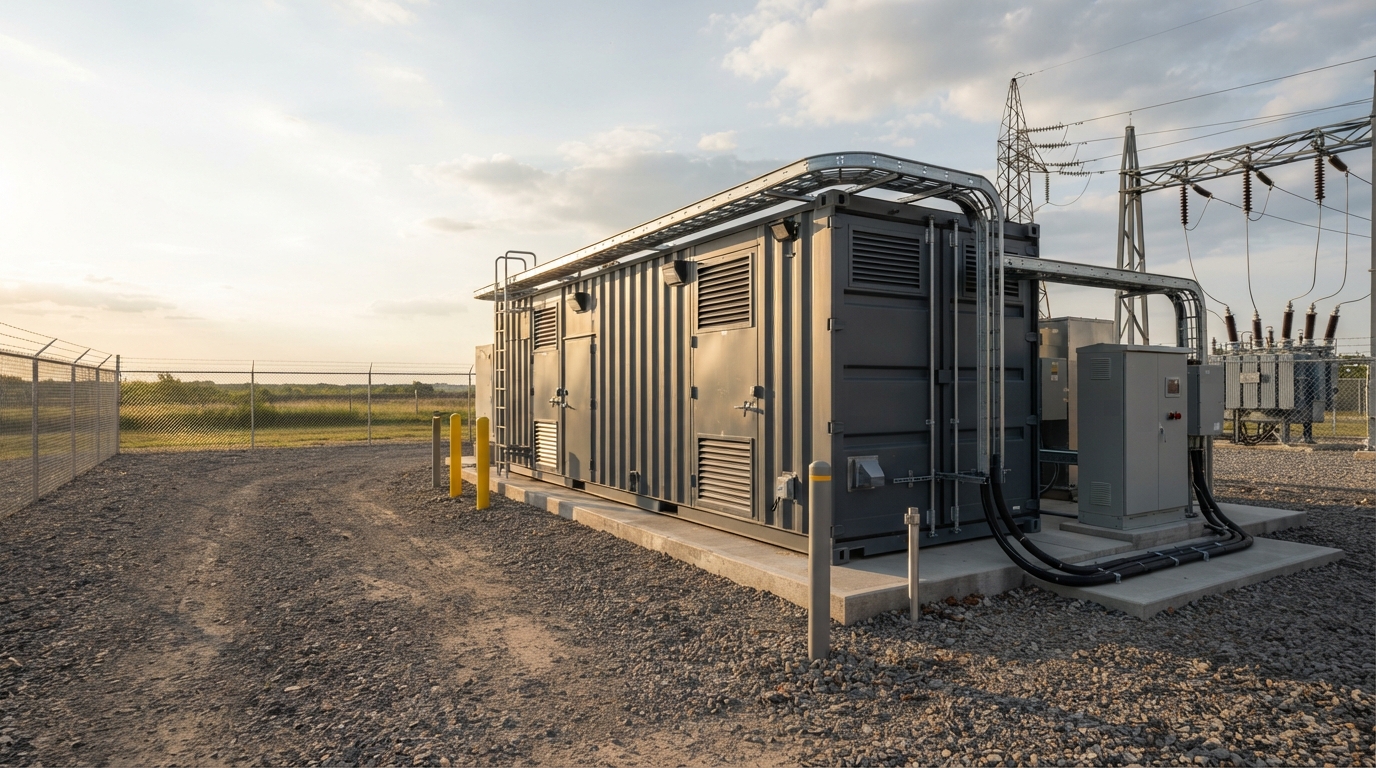
Battery storage for frequency regulation works by adjusting active-power output almost immediately when grid frequency moves away from its nominal value. When frequency is too high, the battery charges. When frequency is too low, it discharges. The practical challenge is not simply that batteries respond quickly: the system also needs a reliable control chain, a state-of-charge strategy, and a realistic view of how regulation duty affects battery life.
This guide explains how battery storage provides frequency regulation, which controls matter, and how degradation should influence system selection and operation.
What Is Frequency Regulation and Why Does It Matter?
Grid frequency reflects the balance between supply and demand. When generation is lower than load, frequency falls. When generation exceeds load, frequency rises. Frequency regulation is the service that corrects this imbalance by adjusting active power quickly.
Batteries are well suited to this task because they can change their power output in both directions — charging or discharging — with very little delay. The U.S. Energy Information Administration describes frequency response as a service that maintains grid frequency near its nominal value, and notes that batteries are increasingly used for this kind of grid balancing. Sandia National Laboratories similarly describes frequency regulation as a service that adjusts output on a second-by-second basis.
Terminology varies by market. Some grid operators call it frequency response, balancing service, dynamic containment, or primary and secondary regulation. The underlying idea is the same: a storage system must respond to a frequency deviation, or to a dispatch signal based on frequency, by changing its real-power output.
How Battery Storage Provides Frequency Regulation
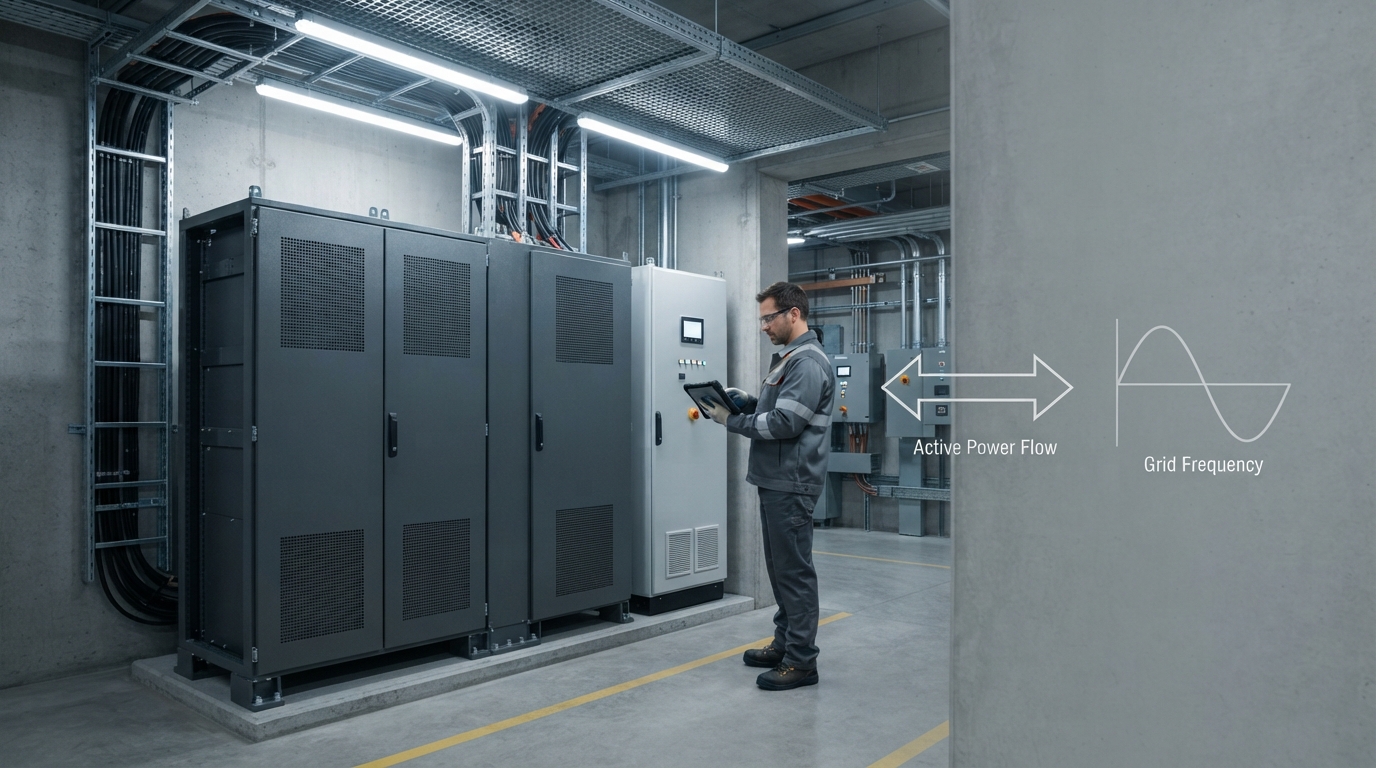
A frequency-regulation event follows a defined sequence:
- Frequency is measured. The measurement may happen locally at the plant or through a signal sent by the grid operator.
- A regulation command is generated. The command tells the plant how much active power to produce or absorb.
- The plant controller or EMS interprets the command. It checks operating limits and determines the target power setpoint.
- The PCS adjusts the AC output. The power conversion system controls the direction and magnitude of power flow between the battery and the grid.
- The BMS supervises the action. It protects the cells by monitoring voltage, current, temperature, and state of charge.
- Performance is recorded through telemetry. The grid operator or market system verifies that the response matched the command.
Response speed depends on more than the battery itself. The signal path, controller response, PCS ramp rate, and communication latency all contribute to the measured response time. A battery can be capable of very fast response, but the full system must be designed and tested for the specific service.
Response Speed, Power, and Energy
Frequency regulation is often a power-intensive service. The battery must be able to change its output quickly, but the energy needed per event may be relatively small.
That distinction matters for sizing. Power is measured in kilowatts (kW). Energy is measured in kilowatt-hours (kWh). A regulation asset may need a high power rating with a relatively modest energy capacity, depending on the market signal and the state-of-charge strategy.
The C-rate links these two values. A 1 MW battery with 1 MWh of usable energy has a 1C rating, meaning it can charge or discharge its full usable capacity in one hour. A regulation signal that only requires 15 minutes of sustained output may allow a higher C-rate, but the actual stress on the battery also depends on current, temperature, and how often the signal changes direction.
Control Architecture for Frequency-Regulation BESS
A complete frequency-regulation BESS includes several control layers. They are often confused, but each has a distinct role.
| Component | Role |
|---|---|
| BMS | Protects the battery and monitors cell voltage, current, temperature, and state of charge |
| EMS | Supervises dispatch, state-of-charge limits, and operating strategy |
| PCS | Converts DC battery power to AC grid power and controls the direction of power flow |
| Plant controller | Coordinates multiple PCS units and tracks the grid operator’s regulation signal |
The BMS is a safety and protection system. It does not decide whether the plant should participate in a market signal. That decision belongs to the EMS and the plant controller. The PCS executes the power command, while the EMS makes sure the command does not push the battery outside its operating window.
A clean separation between these functions makes a frequency-regulation plant easier to control, easier to commission, and easier to verify.
State-of-Charge Headroom and Recovery
Frequency regulation requires the battery to operate in both directions. That means the state of charge (SOC) must be kept inside a window that preserves headroom for charging and discharging at the same time.
If the battery is fully charged, it cannot absorb energy during an overfrequency event. If it is fully discharged, it cannot deliver energy during an underfrequency event. The EMS therefore sets a SOC reserve that allows bidirectional response.
Sustained one-sided signals can push SOC toward a limit. For example, a long period of low frequency may require repeated discharging. The EMS must then manage SOC recovery, either by using a higher setpoint, allowing idle periods, or absorbing energy before the next event. That recovery takes time and energy, and it must be included in the plant’s availability assumptions.
Communication, Telemetry, and Interconnection
Frequency-regulation plants depend on reliable communication with the grid operator. Telemetry confirms that the plant is following the regulation signal and records response performance. Communication latency affects how quickly the plant receives and executes a command.
Interconnection requirements also apply. The plant must meet local grid-code rules for protection, metering, power quality, and communication. These requirements vary by market, so a fixed worldwide solution does not exist. A buyer should ask for a clear description of the plant controller, communication protocols, and the grid-code documentation used for interconnection.
How Frequency-Regulation Duty Affects Battery Degradation
Degradation in lithium-ion batteries is driven by two broad mechanisms: calendar aging and cycling aging. Frequency regulation creates a specific duty cycle that affects both.
Calendar aging occurs over time, even when the battery is not cycling. It is influenced by temperature and state of charge. Cycling aging occurs when the battery charges and discharges, and it is influenced by throughput, current, depth of discharge, and temperature.
Frequency-regulation duty is characterized by many small, irregular charge and discharge pulses. These pulses can cause measurable wear, especially when the battery operates at a high C-rate or outside a moderate SOC range. Research on batteries providing dynamic containment frequency response has shown that SOC oscillation and rapid power changes influence degradation and must be considered in control design.
Calendar Aging vs Cycling Aging
| Aging Type | Main Drivers | Why It Matters for Frequency Regulation |
|---|---|---|
| Calendar aging | Time, temperature, SOC | The battery degrades even while idle; high SOC and high temperature accelerate it |
| Cycling aging | Throughput, C-rate, depth of discharge | Frequent regulation pulses add cycling stress beyond ordinary charging cycles |
A supplier that only quotes cycle life at 100% depth of discharge is not giving useful information for frequency regulation. The actual duty is partial, dynamic, and sensitive to operating conditions.
Partial Cycling, C-Rate, and Service Stacking
Regulation signals do not produce clean full cycles. The battery may move only a few percent of its capacity before reversing direction. This makes it difficult to describe wear using equivalent full cycles alone. Methods such as rainflow counting are sometimes used to translate irregular partial cycles into a more comparable measure of cycling stress.
C-rate matters because high current increases both electrical and thermal stress. A regulation signal that demands rapid output changes may create higher current pulses and more heat than a slower service.
Service stacking adds another layer of complexity. Many project developers want a BESS to earn revenue from frequency regulation, energy arbitrage, and renewable firming at the same time. That can improve utilization, but it also changes the duty cycle. The EMS must be able to choose between services, respect SOC limits, and protect the battery from destructive combinations of high C-rate and high temperature.
Thermal Management and Degradation-Aware Dispatch
Thermal management controls cell temperature and reduces temperature differences between cells. Air cooling and liquid cooling are common approaches, and the choice affects auxiliary load, installation complexity, and how well the system handles sustained regulation duty.
Degradation-aware dispatch is an operating strategy that balances short-term market revenue against the lifetime cost of cycling. Rather than always following a regulation signal, the EMS may reduce participation during periods of extreme temperature, high SOC, or high C-rate. This can lower total operating cost even if it reduces immediate revenue.
The same principle applies to warranty and performance agreements. A buyer should ask what duty cycle the warranty covers, not just how many cycles the battery can technically achieve. For thermal-management and system-design context, VoltaLink offers a liquid-cooled energy storage system that shows how cooling is integrated into a complete BESS.
Sizing a Battery Storage System for Frequency Regulation
Sizing a frequency-regulation BESS starts with the grid service requirement.
The required power, in kW, determines the PCS rating and the battery’s deliverable power. The required energy, in kWh, depends on how long the plant must respond, how much SOC reserve is needed, and how the EMS plans to recover SOC after one-sided events.
A simple example helps explain the logic. If a market service requires 5 MW of response power, the PCS and battery must be able to deliver 5 MW within the required response time. If the same service typically lasts only a few minutes, the usable energy may be less important than the ability to change power direction quickly. However, the plant still needs enough energy to avoid hitting an SOC limit before the signal changes.
Usable energy is not the same as rated energy. Depth of discharge and SOC limits reduce the energy that can actually be dispatched. A battery with a 10 MWh rating may only allow 8 MWh of usable energy under normal operation. That distinction must be reflected in the proposal.
Single-Service vs Stacked-Service Operation
| Operating Mode | Strength | Limitation |
|---|---|---|
| Single-service regulation | Clear performance profile, simpler control, easier degradation tracking | Revenue may be too low to justify the project |
| Stacked services | Higher utilization and more revenue streams | More complex control, higher degradation risk, availability constraints |
Stacked operation is attractive because most projects need multiple revenue streams. But the duty cycle created by simultaneous services must be documented, and the warranty should match the intended operating profile.
Choosing and Specifying a Frequency-Regulation BESS

A buyer evaluating battery storage for frequency regulation should ask for evidence, not general claims. The supplier should provide model-specific documentation that covers the full system, not only the battery cells.
Use this checklist when comparing proposals:
- Model-specific datasheet showing rated power (kW), energy capacity (kWh), usable energy, voltage range, current limits, and C-rate.
- PCS documentation describing response time, bidirectional control, and communication interfaces.
- BMS and EMS descriptions showing how the system protects the battery and manages SOC.
- Thermal-management design, including cooling method, operating temperature range, and auxiliary power consumption.
- Safety documentation covering the enclosure, fire protection, and protection against electrical faults.
- Warranty terms that define allowed throughput, SOC window, operating temperature, and expected service life.
- Grid-interconnection references, including communication protocols and any market-specific performance reports.
Some suppliers may offer a battery product without a complete control solution. For a frequency-regulation application, the battery, BMS, EMS, PCS, and plant controller must work as one system. That is especially true for utility scale battery container deployments, where multiple PCS units and protection systems must be coordinated.
Performance Documents, Safety, and Interconnection
The most useful performance evidence is model-specific and duty-specific. A general battery datasheet does not prove that a system can follow a frequency-regulation signal.
The supplier should be able to describe:
- The exact PCS model and its response characteristics.
- The communication protocol used between the plant controller, PCS, BMS, and grid operator.
- The operating SOC window and how the EMS restores charge headroom.
- The cooling and fire-safety design for the proposed enclosure.
- The interconnection and grid-code standards the system meets in the target market.
If the supplier cannot provide these details, the performance claim is incomplete. Frequency regulation is a market-facing service, and the market will verify response performance. Buyers should apply the same standard before committing to a system.
Frequency Regulation vs Other Battery Applications
Frequency regulation is often confused with other battery applications because many BESS projects claim to support multiple services. The operating priorities are different.
| Application | Main Priority | Typical Duty |
|---|---|---|
| Frequency regulation | Fast bidirectional power | Short, dynamic charge/discharge pulses |
| Peak shaving | Energy shifting | Longer discharge to reduce peak demand |
| Off-grid storage | Autonomy and reliability | Daily cycling with renewable generation |
| Backup power | Availability during outages | Infrequent, high-energy discharge |
| Telecom backup | Continuous DC power | Standby duty with long float periods |
A battery designed for off-grid autonomy may have plenty of energy but not enough power or response speed for frequency regulation. Conversely, a frequency-regulation battery may have enough power but not enough usable energy for long backup events.
For related application examples, VoltaLink provides a battery energy storage container platform for commercial and utility-scale systems, an off grid battery storage solution for standalone power, and dedicated telecom power backup solutions and data-center backup power pages. These applications have different operating priorities than frequency regulation.
Next Steps for Buyers and Project Teams
Frequency regulation is a demanding application because it combines fast response, bidirectional power control, and continuous SOC management. The easiest way to evaluate a system is to compare suppliers on the evidence they provide.
Start by defining the market service you want to target. Determine the required power, response time, energy duration, and communication requirements. Then ask each supplier how their system will maintain SOC headroom, protect the battery, and manage degradation under that specific duty cycle.
If you are evaluating a BESS for frequency regulation, VoltaLink Battery manufactures energy-storage systems designed for commercial, industrial, and utility-scale use. Review the energy-storage product range on the VoltaLink website and ask for the model-specific control, thermal-management, and warranty documentation that matches your project’s duty cycle.

-

 OEM Residential Energy Storage Solutions: Passive vs. Active Cell Balancing
2026-09-30
-
 Smart Home Battery with BMS Communication: Cybersecurity and BMS Safety
 -
 10kWh Home Battery Backup System: Is 90% DoD Better for Daily Solar Storage?
2026-09-29
-
 Integrated Home Energy Storage System 150–430V MPPT Design
2026-09-28
-
 LiFePO₄ Residential Backup Battery SOC Accuracy in Parallel Systems
Share this:





.svg)






-899.svg)


