




Commercial BESS for Time-of-Use Arbitrage: Dispatch Logic and Savings Inputs
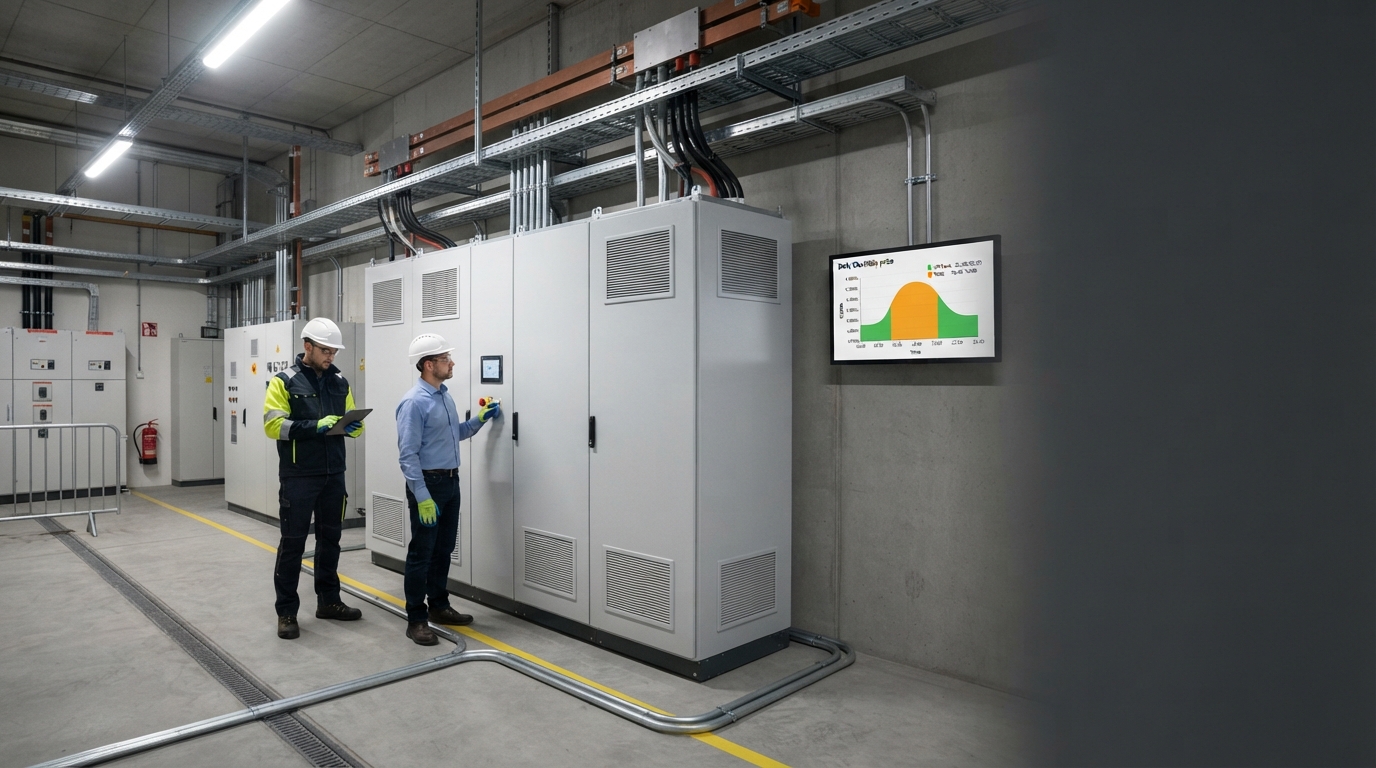
Commercial electricity rates often change by time of day. Under a time-of-use tariff, energy is cheaper during off-peak hours and more expensive when demand on the grid is high. A commercial battery energy storage system (BESS) can take advantage of that difference by charging when electricity is cheaper and discharging when it is more expensive. That strategy is called time-of-use arbitrage.
This guide explains how a commercial BESS is dispatched for TOU arbitrage, what inputs are required to estimate savings, and why the real economics are more complex than simply “charge low, discharge high.” It is part of VoltaLink’s broader coverage of commercial and industrial energy solutions.
What Time-of-Use Arbitrage Means for a Commercial BESS
TOU arbitrage is a behind-the-meter operating strategy. The battery charges from the grid, or from on-site solar, during low-price periods. Later, during a high-price period, the battery discharges to serve facility load instead of importing power from the grid.
The value comes from the difference between the price paid for charging energy and the price avoided by discharging energy. That difference is called the price spread.
TOU arbitrage is often confused with other battery applications. They are related, but they have different objectives:
| Application | Primary Objective | What It Targets |
|---|---|---|
| TOU arbitrage | Shift energy purchases from expensive hours to cheaper hours | Energy charges, usually billed per kWh |
| Peak shaving | Reduce the facility’s peak demand | Demand charges, usually billed per kW |
| Solar self-consumption | Use more on-site solar energy | Grid imports and exported energy |
| Backup power | Maintain power during an outage | Reliability and business continuity |
A single commercial BESS can support several of these strategies, but they compete for the same battery capacity. That is why the system needs clear dispatch priorities, not just a simple charge and discharge schedule.
The U.S. Energy Information Administration defines arbitrage in similar terms: charging storage when electricity prices are low and discharging when prices are high. In a commercial setting, the practical question is whether the price spread is large enough to justify the battery investment.
Dispatch Logic: How the EMS Decides When to Charge and Discharge
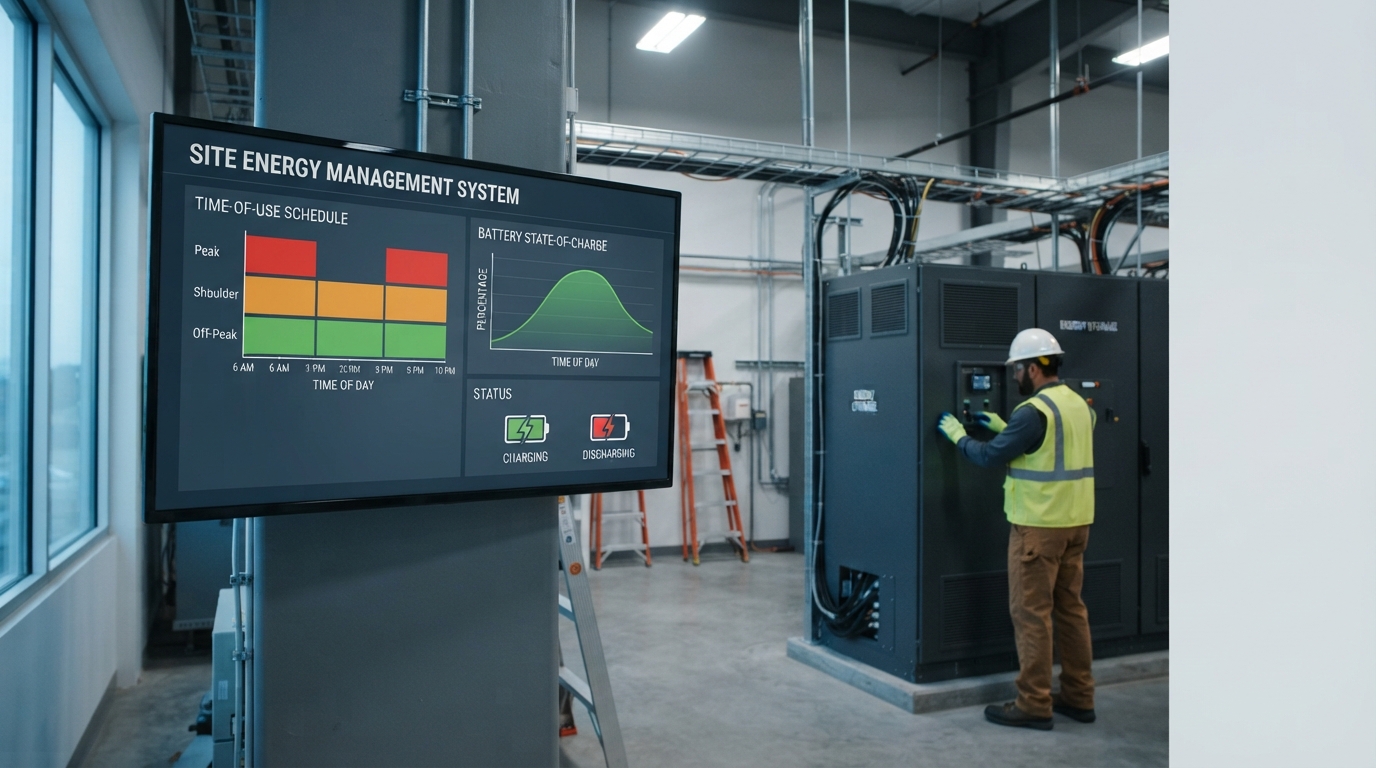
A commercial BESS is not a passive battery. It is controlled by software and power-electronics systems that decide when to charge, when to hold, and when to discharge.
The key components are:
- Battery: stores energy as DC electricity.
- BMS: monitors voltage, current, temperature, and state of charge, and protects the battery from unsafe operation.
- EMS: makes the dispatch decision, usually based on tariff data, load forecasts, and system limits.
- PCS or inverter: converts DC power from the battery to AC power used by the facility, and converts AC power back to DC when charging.
The EMS is the decision-maker. It schedules the battery according to the tariff, the facility’s load, and the battery’s operating limits. A well-designed EMS also protects a state-of-charge reserve when the facility wants backup capability. For a closer look at how EMS controls fit into a complete system, see the bess container ems control system page.
A Practical Dispatch Sequence
TOU arbitrage is not a fixed daily routine. The EMS should re-evaluate conditions continuously and adjust the schedule when the tariff, load, or solar forecast changes.
A practical dispatch sequence looks like this:
- Load the current TOU tariff schedule into the EMS. This defines the low-price charging windows and the high-price discharge windows.
- Forecast facility load and PV generation for the next day or the next few hours. The battery can only create value by serving load that actually exists in the discharge window.
- Set state-of-charge limits. This includes the minimum SOC, maximum SOC, and any reserve set aside for backup or operating flexibility.
- Charge during the lowest-price or most favorable window. The EMS compares the cost of charging energy against the expected value of discharging it later.
- Hold stored energy when prices are moderate. Discharging too early can leave the battery empty before the true peak arrives.
- Discharge during the highest-value window. The battery offsets facility load when prices are high, avoiding grid purchases.
- Avoid cycling when the net value is negative. If the price spread is too small, the losses from charging and discharging may exceed the benefit.
- Re-evaluate at the next interval. Load changes, cloud cover, tariff changes, and price signals all affect the optimal schedule.
This sequence is a summary, not a fixed algorithm. Real EMS logic varies by vendor, but the core principle is the same: dispatch the battery only when the expected value is positive.
When Discharging Does Not Make Sense
Many simple explanations of arbitrage assume the battery should always discharge during the peak window. In practice, the EMS should sometimes keep the battery idle. Discharging may not make sense when:
- Facility load is too low to absorb the stored energy.
- The price spread is small and the round-trip efficiency loss consumes most of the benefit.
- Export compensation is unfavorable, so charging the battery to export power later is uneconomic.
- A backup reserve is needed, especially during extreme weather or grid alerts.
- Forecast uncertainty is high, and discharging early could leave the facility exposed during a later, more expensive peak.
A commercial BESS with a backup requirement must balance revenue-producing dispatch against the need to preserve energy for an outage. That trade-off should be built into the dispatch logic before commissioning. For more on the backup side of that decision, see commercial backup energy storage solutions.
Required Inputs for a Commercial BESS Savings Model
A credible savings estimate is only as good as the assumptions behind it. A supplier who promises savings without reviewing tariff data, load data, and battery limits is guessing.
Before modeling TOU arbitrage, the following inputs should be available.
Tariff Schedule and Price Spread
The TOU tariff defines the economic opportunity. The important values are:
- The start and end times of each rate period.
- The energy price in each period, usually expressed in currency per kWh.
- Seasonal rate changes, if any.
- The price spread between the charging window and the discharge window.
A wider spread creates more gross value. A narrow spread may make arbitrage uneconomic once battery losses and degradation are included.
Interval Load Profile and Peak Demand
The facility’s load profile shows how much power is consumed at each point in the day. Interval data, usually in 15-minute or 30-minute increments, is essential because it shows whether the facility actually has enough load during the discharge window.
The battery cannot offset load that does not exist. A facility with low demand during the peak window will not capture much arbitrage value, regardless of the tariff.
The load profile also shows peak demand, which is the basis for demand charges. That matters because energy arbitrage and peak shaving can overlap in the same time window.
PV Production and Export Rules
If the facility has solar, the model should include the PV generation profile. Solar can charge the battery during sunny hours, allowing the stored energy to be used later in the evening when prices rise.
Export rules also matter. If the utility pays little for exported power, storing solar energy and using it on-site may be more valuable than exporting it. But if the export price is favorable, charging the battery with grid power purely for export may be permitted or restricted depending on local rules.
The key is avoiding double-counting. The same solar-generated kWh should not be counted as both solar self-consumption and TOU arbitrage without a clear model.
Battery Performance Inputs
The battery model needs more than the nameplate capacity. The important performance inputs are:
| Input | Why It Matters |
|---|---|
| Usable energy (kWh) | The energy the BMS and EMS will actually allow the battery to cycle |
| Rated power (kW) | The maximum charge or discharge rate |
| Depth of discharge limits | How much of the nominal capacity can be used |
| Round-trip efficiency | The share of charging energy that is delivered back as usable AC energy |
| SOC reserve policy | The energy held back for backup or operating flexibility |
| Degradation assumption | How quickly the battery loses capacity over time |
| Warranty throughput | The amount of cycling covered by the warranty |
A battery with 200 kWh of nominal capacity may have only 160 kWh of usable energy if the SOC is limited to protect cycle life and preserve a backup reserve. Savings models should use usable energy, not nominal capacity, for dispatch calculations.
Demand Charges and How They Interact
TOU arbitrage primarily targets energy charges, which are billed per kWh. Demand charges are billed separately, usually based on the highest power draw measured during the billing period.
A commercial BESS can provide both values in the same discharge window. By reducing both energy purchases and peak demand, the battery may create more value than energy arbitrage alone. But the savings must be attributed carefully.
If the battery’s main purpose is demand reduction, that strategy is called battery storage for peak shaving. The two strategies are complementary, but they should not be double-counted in a savings model.
Gross Savings vs Net Savings
The simplest arbitrage calculation looks like this:
- Gross avoided energy cost: the amount of energy discharged during the high-price period, multiplied by the avoided energy price.
To get a realistic net savings figure, the model must subtract:
- The cost of the energy used to charge the battery.
- Round-trip efficiency losses, because more energy goes into the battery than comes out.
- Battery degradation, because cycling shortens the usable life of the system.
- Any additional operating costs, such as maintenance or demand increases caused by charging.
The formula can be expressed in words:
Net savings = avoided energy cost − charging energy cost − efficiency losses − cycling-related degradation cost
This is a framework, not a universal result. The actual outcome depends on the tariff, the load, the dispatch logic, and the specific battery design. A supplier should be able to show these inputs, not just a final payback number.
Sizing a BESS for TOU Arbitrage: kW, kWh, and Usable Capacity
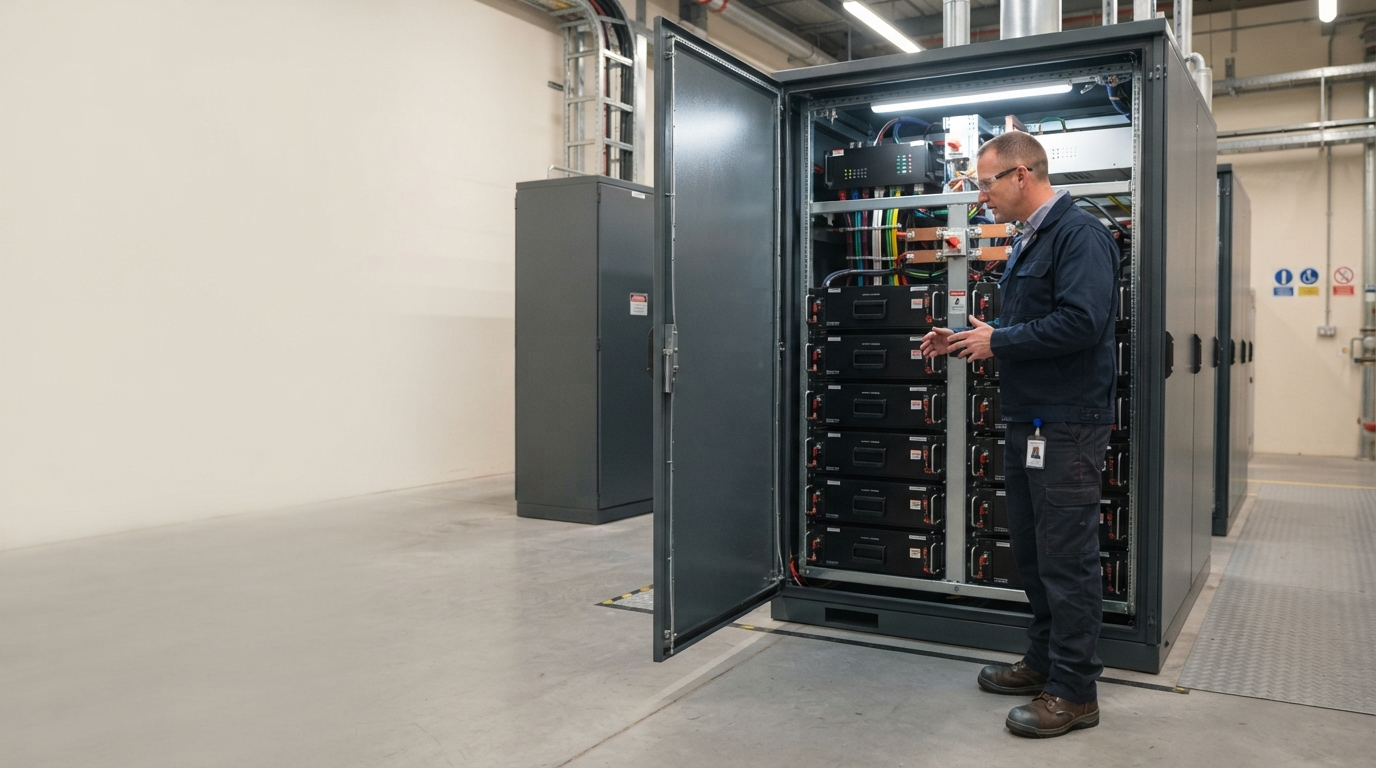
Battery sizing is often confused because two different units are used.
- kW is a measure of power. It describes how fast the battery can charge or discharge. A 100 kW battery can offset up to 100 kW of facility load at a given moment.
- kWh is a measure of energy. It describes how long the battery can sustain that power. A 100 kW battery with 200 kWh of usable energy can discharge at full power for about two hours, ignoring losses.
The facility’s demand during the discharge window helps determine the required power. The length of the high-price period helps determine the required energy.
Usable capacity matters more than nominal capacity. The EMS may limit the operating range to preserve battery life or maintain a backup reserve. A system sized on nominal capacity alone may not deliver the expected runtime.
Parallel expansion can increase capacity, but the practical limit depends on the BMS, the PCS design, and the vendor’s system architecture. Any expansion claim should be confirmed with the specific manufacturer and system configuration.
Commercial Facilities That Benefit Most
TOU arbitrage is not attractive for every commercial facility. Better candidates tend to have:
- Consistent consumption during high-price periods.
- A meaningful spread between peak and off-peak energy prices.
- A load profile that can absorb stored energy during the discharge window.
- High demand charges that create additional value from peak reduction.
- On-site solar with low export compensation.
Common examples include factories that run during peak hours, warehouses with large evening or afternoon loads, offices with air-conditioning-driven peaks, retail sites, and data centers. But the exact fit depends on the local tariff and the facility’s interval data.
Common Mistakes in BESS Arbitrage Planning
Several errors appear repeatedly in early-stage project planning.
- Assuming every peak-price period is profitable without checking the price spread and efficiency.
- Ignoring round-trip efficiency and treating stored kWh as if it cost the same as grid kWh.
- Ignoring degradation and cycling costs.
- Treating nominal capacity as usable capacity.
- Forgetting to reserve SOC for backup or other operating priorities.
- Double-counting the same battery capacity for arbitrage, peak shaving, and solar self-consumption.
- Accepting a supplier’s savings estimate without reviewing the tariff, load, and battery assumptions behind it.
A good feasibility model should be transparent enough for the buyer to see exactly which assumptions produced the result.
Commercial BESS Buyer’s Checklist
When comparing commercial BESS proposals, use the same assumptions for every quote. Otherwise, the comparison is meaningless.
Ask the supplier for:
- Usable energy in kWh, not just nominal capacity.
- Rated power in kW for both charging and discharging.
- Round-trip efficiency and how it was measured.
- SOC operating limits and the expected depth of discharge.
- The backup SOC reserve policy, if backup is required.
- The EMS dispatch logic and how tariff schedules are updated.
- Warranty terms, including throughput limits and cycle restrictions.
- Monitoring and data-access capabilities.
- Safety, standards, and interconnection documentation relevant to the project location.
The goal is to compare systems on the same tariff, the same load profile, and the same operating assumptions. For a broader look at VoltaLink’s commercial and industrial system approach, see the ci energy storage system page.
Frequently Asked Questions
What is the difference between energy arbitrage and peak shaving?
Energy arbitrage shifts energy purchases from high-price hours to low-price hours and targets energy charges. Peak shaving reduces the facility’s peak demand and targets demand charges. A commercial BESS can do both, but the savings must be calculated separately.
Can a commercial BESS provide both TOU arbitrage and backup power?
Yes. The dispatch logic must reserve part of the battery’s state of charge for backup. That reserve reduces the energy available for arbitrage, so the usable capacity for daily cycling is lower than the battery’s nominal capacity.
How much can a commercial BESS save through TOU arbitrage?
It depends on the tariff spread, the facility’s load profile, battery efficiency, usable capacity, degradation, demand charges, and local export rules. There is no reliable universal savings figure. A credible estimate requires project-specific inputs.
What data should I give a supplier for a savings estimate?
Provide the current TOU tariff schedule, interval load data, PV production data if applicable, and any backup-power requirements. The supplier should also state the battery’s usable kWh, rated kW, efficiency, SOC limits, and degradation assumptions.
Discuss Your Commercial BESS with VoltaLink
VoltaLink’s website focuses on industrial and commercial, household, and outdoor energy-storage scenarios. A useful starting point for a commercial project is to review the ci energy storage system offering and then prepare your tariff and load data for a feasibility conversation.
A reliable evaluation begins with accurate inputs: the tariff schedule, interval load profile, PV generation data, and a clear statement of operating priorities. With those inputs, a commercial BESS can be assessed on its real dispatch value — not on a generic savings claim.

-

 OEM Residential Energy Storage Solutions: Passive vs. Active Cell Balancing
2026-09-30
-
 Smart Home Battery with BMS Communication: Cybersecurity and BMS Safety
 -
 10kWh Home Battery Backup System: Is 90% DoD Better for Daily Solar Storage?
2026-09-29
-
 Integrated Home Energy Storage System 150–430V MPPT Design
2026-09-28
-
 LiFePO₄ Residential Backup Battery SOC Accuracy in Parallel Systems
Share this:





.svg)






-899.svg)


