




Battery Storage for Peak Shaving: A C&I Load-Reduction Playbook
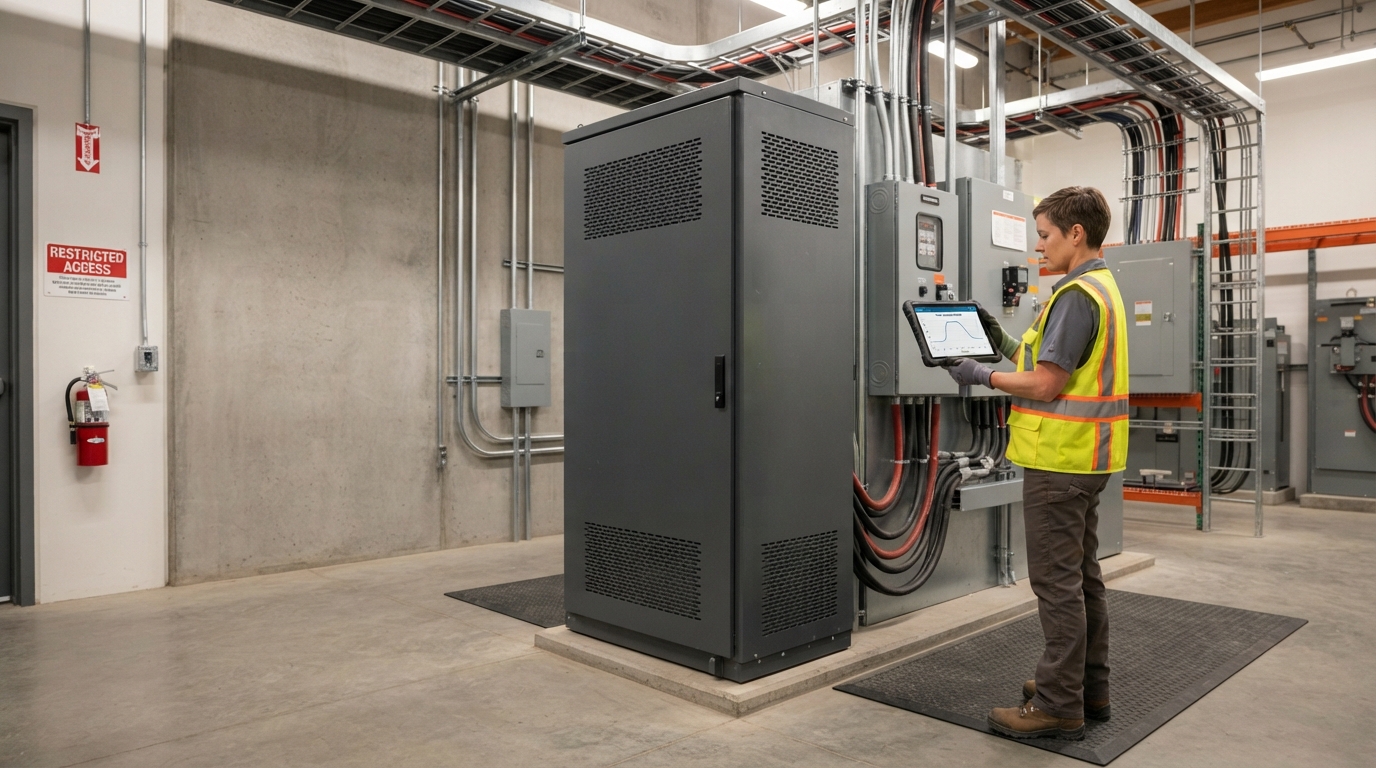
Battery storage for peak shaving is a behind-the-meter strategy that reduces a commercial or industrial facility’s electricity demand charges. The battery charges during periods of low demand, then automatically discharges when facility load approaches a preset threshold, lowering the amount of power imported from the grid during the billing interval that determines peak demand.
This playbook walks through the entire decision chain: how peak shaving works, why demand charges determine its value, how to size a system in kW and kWh, which controls are essential, and what to ask a supplier. It is published by VoltaLink Battery, a B2B LiFePO₄ battery and energy-storage-system manufacturer serving residential, telecom, server-rack, and commercial/industrial applications. For a broader view of C&I energy-storage options, see the Comprehensive Guide to Commercial & Industrial Energy Solutions.
What Is Battery Peak Shaving?
Peak shaving is the practice of reducing the highest measured power draw at a facility’s utility meter during a defined billing period. Unlike load shifting, which moves energy consumption from one time of day to another, peak shaving specifically targets the short periods when facility demand spikes — often lasting only 15 minutes to a few hours. The U.S. Department of Energy’s Federal Energy Management Program identifies peak shaving as one of the primary use cases for facility-scale battery storage.
A battery energy storage system (BESS) enables peak shaving by acting as a local power source during these high-demand windows. When facility load approaches a defined peak setpoint, the battery discharges to supply the difference, preventing grid import from exceeding the target.
The table below shows how peak shaving differs from related concepts:
| Strategy | Trigger | Objective | Facility vs Grid Control |
|---|---|---|---|
| Peak shaving | Facility demand approaches setpoint | Reduce the facility’s billed maximum demand | Facility-controlled |
| Load shifting | Time-of-use rates | Move energy use to cheaper periods | Facility-controlled |
| Demand response | Utility or grid signal | Reduce load at the grid’s request | Third-party or utility-controlled |
These strategies are not mutually exclusive. A facility can shave its demand peak and still participate in load shifting or demand response. But the economic logic differs, and peak shaving is usually evaluated against the demand-charge component of the utility bill.
How Does Battery Storage Actually Shave a Peak?
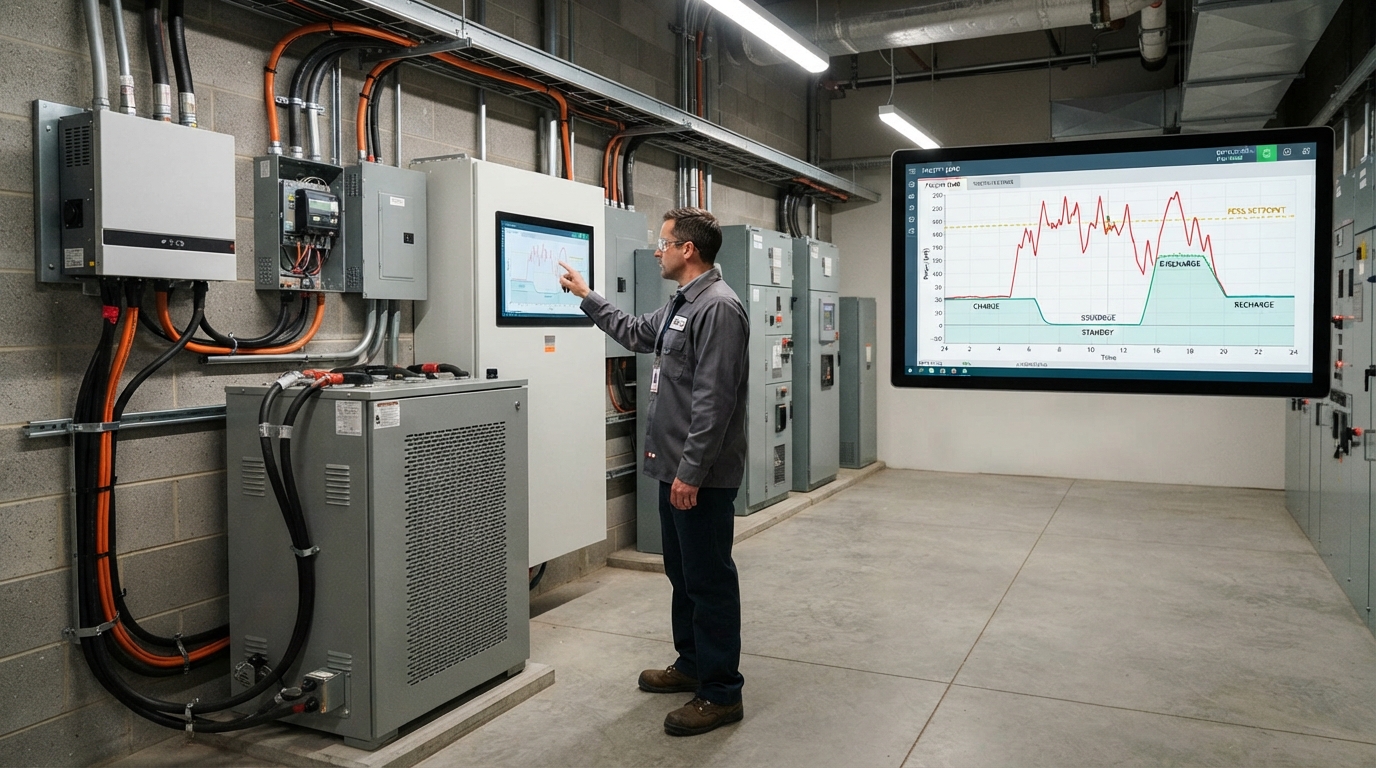
The operational cycle follows a repeating pattern:
- Charge. The battery charges during low-demand periods, either from on-site solar or from the grid when electricity is inexpensive.
- Standby. The system monitors facility demand in real time using data from the utility meter or current transformers.
- Discharge. The EMS compares live facility demand to the peak setpoint. When demand approaches the setpoint, the PCS/inverter dispatches battery power to serve the load.
- Recharge. After the peak window passes, the battery recharges, ready for the next event.
This process depends on the energy management system (EMS) reading the meter in near real time and triggering the PCS before the facility exceeds its target. The depth and duration of discharge are governed by the battery’s state of charge (SOC) and the reserve SOC intentionally maintained to handle a later peak.
The battery management system (BMS) works alongside the EMS to protect cells from voltage, current, and temperature limits during high-rate discharge. The EMS decides when to act; the BMS determines what is safe to do. For a deeper look at EMS setpoint logic and monitoring, see the bess container ems control system guide.
Demand Charges and Measurement Intervals: Why Tariffs Matter
Peak shaving only delivers financial value when the facility’s electricity tariff includes a demand charge. A demand charge is a separate billing component based on the highest average power import recorded during the billing period, typically expressed in dollars (or the local currency) per kilowatt. Demand charges can represent a substantial portion of a C&I electricity bill, especially for facilities with short, intense load spikes.
Utilities calculate demand over defined measurement intervals, commonly 15, 30, or 60 minutes. The facility’s peak is not necessarily the highest instantaneous draw — it is the highest average demand within any single interval. This distinction matters:
- A 15-minute interval may catch short spikes that a 60-minute interval would average away.
- A 60-minute interval rewards sustained peak reduction but may not justify batteries sized for brief pulses.
Tariffs also vary in other ways that affect peak-shaving economics:
- Ratchet clauses carry a portion of a past peak forward into future bills.
- Seasonal demand charges may apply only during summer or winter months.
- Coincident-peak charges apply when the facility’s peak aligns with the utility’s system-wide peak.
- kVA vs kW billing changes the basis for the demand charge.
Before investing in battery storage, request 12 months of interval load data and the utility’s tariff schedule. If the tariff has no demand charge — or the demand charge is low — peak shaving may not be the right application.
Sizing a Peak-Shaving Battery: kW and kWh Are Both Important
Two ratings define a peak-shaving battery’s capability:
- Power (kW) determines how much demand can be shaved at any instant.
- Energy (kWh) determines how long the battery can sustain that discharge.
A battery rated at 100 kW continuous output can reduce facility demand by up to 100 kW during a peak event. But if the peak lasts two hours, the battery needs enough usable energy to deliver 100 kW for the full period — 200 kWh before accounting for losses and the usable SOC window. Facilities with short, sharp peaks may need more power than energy; facilities with long, sustained peaks need proportionally more energy.
The relationship between power and energy is sometimes expressed as a C-rate. A 1C battery can discharge its rated energy in one hour; a 0.5C battery takes two hours. For peak shaving, the C-rate must align with the duration of the facility’s peak events.
Sizing follows the load profile, not a rule of thumb. The complete process for matching a battery to a commercial load profile is covered in detail in the commercial battery storage sizing guide. The steps below provide a practical pre-feasibility framework.
A Simple Step-by-Step Sizing Framework
- Collect 12 months of interval data from the utility or facility meter. Ideally, the data should be at the same resolution the utility uses for billing (15, 30, or 60 minutes).
- Identify the top demand days. Look for the days that set the billing peak and understand what caused them — production runs, HVAC startup, shift changes, or weather events.
- Set a target peak. Decide how much demand to shave. For example, if the facility peaks at 500 kW and the target is 400 kW, the battery must supply up to 100 kW at the moment of peak.
- Estimate power requirement. This is the target-kW difference.
- Estimate energy requirement. Multiply the required discharge power by the expected peak duration. A 100 kW reduction for 1.5 hours implies 150 kWh at the battery’s AC output, before accounting for usable SOC and round-trip efficiency.
- Add a reserve margin. The battery should retain enough SOC to respond to a second peak later in the day — or to support backup operation if that is part of the design.
- Validate with a qualified supplier. A battery-specific dispatch model should confirm that the proposed system can reliably meet the target across all seasons.
The example above is a framework, not a quote. Real projects require a site-specific analysis using interval data and a supplier’s verified performance assumptions.
Why Usable Capacity, Depth of Discharge, and Reserve SOC Matter
The nameplate capacity of a battery is not the amount of energy available for peak shaving. Three factors reduce what the EMS can actually dispatch:
- Depth of discharge (DoD): Most batteries do not operate from 100% SOC down to 0% on a routine basis. A usable operating window — for example, between a minimum and maximum SOC — protects cycle life and leaves headroom for control.
- Reserve SOC: The EMS may be programmed to stop discharging before the minimum SOC to leave energy for a later peak, a grid event, or a backup need. If the reserve is too high, available shaving energy shrinks; if it is too low, the system risks missing a second peak.
- Round-trip efficiency: Energy is lost during charging, storage, and discharging. The AC energy delivered to the facility is lower than the DC energy stored in the battery. A buyer should always compare the system’s usable AC-delivered energy, not its raw DC nameplate.
The battery also degrades with cycling and time. Capacity fade reduces usable energy over the system’s life, which means the peak-shaving capability at year 10 will not match year 1 unless the system was oversized to account for it. When a battery will also serve as commercial backup energy storage solutions, reserve SOC must cover both operating roles.
EMS, BMS, and System Architecture: The Control Side of Peak Shaving
Reliable peak shaving depends on the coordination of several system components:
| Component | Role in Peak Shaving |
|---|---|
| Utility meter / CTs | Measures grid import in real time |
| EMS | Compares demand to the setpoint, controls dispatch, maintains reserve SOC |
| BMS | Protects battery cells, enforces voltage/current/temperature limits, manages balancing |
| PCS / inverter | Converts battery DC to facility AC, controls real power output |
| Communication link | Connects meter, EMS, PCS, BMS, and monitoring (e.g., Modbus, CAN, relays) |
The EMS is the decision-maker. It receives live grid-import data, applies the peak setpoint, and commands the PCS to charge or discharge. More advanced EMS logic uses look-ahead forecasting, tariff-aware scheduling, or weather data to anticipate peaks before they occur, which is especially valuable for facilities with variable production schedules.
The BMS is the safety layer. During a high-rate discharge, it monitors cell-level voltage and temperature and can limit current if a cell approaches its operating limit.
The physical architecture may be a battery cabinet for smaller C&I systems or a containerized BESS for larger installations. The difference is mostly about scale, enclosure, thermal management, and integration complexity. For guidance on the broader C&I system configuration, see the ci energy storage system overview.
For projects where the battery must integrate with existing inverters, generators, or building-management systems, confirm communication compatibility early. A peak-shaving system is only as good as its ability to receive accurate meter data and act on it quickly.
Combining Peak Shaving with Solar Generation
On-site solar can improve peak-shaving economics in two ways: it offsets a portion of facility load during sunny hours, and it can charge the battery during midday when generation is high and facility demand may be lower. The battery then discharges during the late-afternoon or evening peak, a pattern common in commercial buildings that peak after solar output declines.
The coupling architecture matters:
- AC-coupled systems add a battery with its own inverter to an existing solar installation. This is the simpler retrofit option and works well when the solar system is already operating.
- DC-coupled systems connect the battery and solar array to a shared DC bus. This configuration is common in new solar-plus-storage designs and can reduce conversion losses in some operating modes.
The EMS coordinates the two assets. When solar generation exceeds facility load, the EMS can divert surplus energy into the battery instead of exporting it to the grid. When demand rises, the battery discharges alongside the solar array to keep grid import below the peak setpoint.
Net-metering rules and export limits affect how much surplus solar energy can be stored and used. These rules vary by region and utility, so they must be reviewed alongside the tariff.
When Does Peak Shaving Make Economic Sense?
Peak shaving is not universally profitable. The conditions that favor it include:
- A meaningful demand charge, which can represent a significant share of a C&I electricity bill depending on the tariff;
- Recurring, predictable peaks — daily or seasonal patterns that the EMS can anticipate;
- A clear charging window between peaks, whether from the grid or solar;
- Peak durations long enough to require stored energy but not so long that the battery size becomes impractical; and
- A facility that can also capture value from backup power, solar self-consumption, or resilience.
The conditions that undermine peak shaving are equally common:
- Low or absent demand charges;
- Highly irregular, unpredictable peaks;
- Peaks so long that the required energy capacity makes the system too costly;
- Limited charging opportunity between peaks;
- Grid interconnection constraints that prevent meaningful import changes; and
- Tariff structures with ratchets or coincident-peak provisions that do not reward shaving individual facility peaks.
Peak-shaving economics also depend on system losses. The round-trip efficiency of the battery, inverter, and auxiliary systems determines how much energy must be purchased to deliver a given amount of discharge. Degradation means the delivered capacity declines over time, so the first-year performance is not a lifetime average. Buyers should request proposals that state efficiency, degradation, and expected cycle life as explicit assumptions — and then validate them against a battery-specific dispatch model.
Research on demand-charge reduction from the National Renewable Energy Laboratory consistently finds that the economics depend heavily on the facility’s load shape and the utility’s demand-charge structure. A site-specific study using realistic interval data is the only reliable way to determine whether the project works.
Peak Shaving Project Checklist for C&I Buyers

- Provide the supplier with: 12 months of interval data, tariff pages, a single-line diagram of the facility, operating schedules, critical loads, and any planned expansion.
- Ask the supplier to state: proposed battery power (kW), energy capacity (kWh), usable SOC window, reserve SOC policy, round-trip efficiency, degradation assumptions, and expected dispatch logic.
- Verify EMS behavior: how the system detects the approach to the setpoint, how quickly it responds, and what happens when the reserve SOC is reached mid-peak.
- Check integration requirements: compatibility with the existing meter, inverter, generator, building-management system, or solar array.
- Review safety and compliance documentation: model-specific certificates and test reports, not company-wide claims, plus installation requirements, fire-safety provisions, and interconnection permits. Local electrical, fire, and grid-interconnection codes apply and must be reviewed with qualified professionals.
- Confirm the warranty duty cycle: cycle limits, throughput limits, and whether the warranty supports the frequency of cycling that peak shaving requires.
- Request a commissioning and performance test plan: how the system’s ability to shave the specified peak will be demonstrated after installation and measured thereafter.
- Ask for a written feasibility report with clear assumptions, not just a one-line price quote. If a supplier cannot explain how the battery will behave across your facility’s demand patterns, the risk is being transferred to the buyer.
Battery storage for peak shaving is a proven C&I load-reduction strategy, but its value depends on the specific tariff, load profile, and system design. The next step is site-specific: gather your interval data, understand your demand-charge structure, and compare supplier proposals against the checklist above. If you need support evaluating whether peak shaving fits your facility, contact VoltaLink Battery with your interval load data and tariff pages for a feasibility review.

-

 OEM Residential Energy Storage Solutions: Passive vs. Active Cell Balancing
2026-09-30
-
 Smart Home Battery with BMS Communication: Cybersecurity and BMS Safety
 -
 10kWh Home Battery Backup System: Is 90% DoD Better for Daily Solar Storage?
2026-09-29
-
 Integrated Home Energy Storage System 150–430V MPPT Design
2026-09-28
-
 LiFePO₄ Residential Backup Battery SOC Accuracy in Parallel Systems
Share this:





.svg)






-899.svg)


