




Off-Grid Battery Storage in Standalone Microgrids: A Practical System Planning Guide
Standalone microgrids autonomously generate, store, manage, and distribute electricity. They can be deployed away from the public utility network. Standalone microgrids are commonly deployed at remote facilities, fisheries, telecom stations, commercial buildings, and data and energy project infrastructures where the availability of power can be low or unstable.
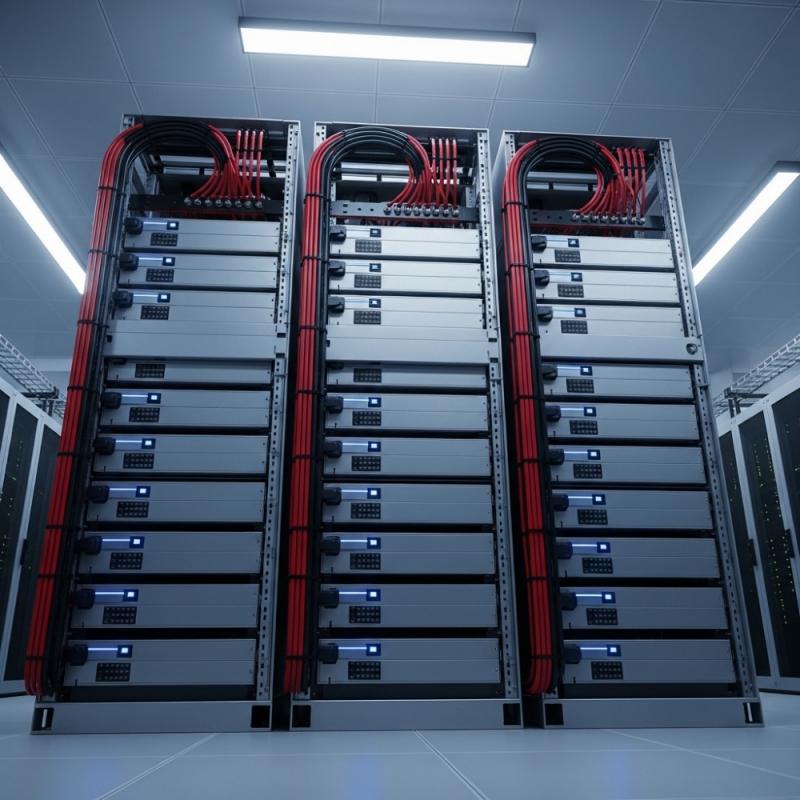
The off-grid battery storage system within a standalone microgrid fulfills several functions. It stores the surplus of renewable electricity and enables load management for critical loads. The off-grid battery storage system helps balance and stabilize the power system and plays a role in the energy flow management between the solar panels, inverters, generators, and the rest of the electrical load.
The selection of off-grid battery storage systems for a specific application goes beyond the consideration of battery capacity. The selection should consider the load profile, required backup time, compatibility of the inverter, discharge current, temperature, and the control strategy.
What’s the Role of Off-Grid Battery Storage in a Microgrid?
The operating role of the battery influences system sizing, cycling frequency, inverter selection, and energy-management settings.
| Storage Function | Main Purpose | Typical Operating Pattern | Key Design Priority |
| Solar energy shifting | Move daytime solar energy to evening use | Regular daily cycling | Usable capacity and recharge rate |
| Emergency backup | Maintain critical equipment during outages | Infrequent, time-sensitive discharge | Availability and response |
| Load balancing | Support temporary demand increases | Short and variable discharge | Output capability |
| Generator coordination | Reduce unnecessary generator operation | Controlled charge and discharge | Communication and control logic |
| Independent power supply | Support locations without a stable grid | Frequent or continuous operation | Autonomy and expandability |
A standalone microgrid may require several of these functions simultaneously. VoltaLink therefore approaches Off Grid Battery Storage as part of an integrated energy system rather than as an isolated battery unit.
How Energy Flows Through a Standalone Microgrid
The microgrid adjusts energy flow according to solar production, connected loads, battery state of charge, and generator availability.
| Operating Condition | Typical Energy Flow | Role of Off Grid Battery Storage |
| Solar output exceeds demand | PV supplies loads and charges the battery | Stores surplus electricity |
| Solar output is below demand | PV and battery operate together | Covers the energy shortage |
| No solar generation is available | Battery or generator supplies loads | Provides scheduled power |
| A pump or motor starts | Multiple sources may support the surge | Responds to short-term demand |
| Battery charge becomes low | A generator or secondary source may start | Preserves reserve capacity |
| External supply becomes unstable | Battery supports the inverter or UPS | Helps maintain continuity |
This coordination depends on the inverter, battery management system, and energy-control logic. Off-grid battery storage cannot independently correct an undersized inverter, insufficient PV generation, or poorly prioritized loads.
Differentiating Capacity and Power
Battery capacity and power each refer to different criteria of a battery system. Capacity relates to reserve energy, while power speaks to load capability at a given time.
| Design Factor | Designation | Implication |
| Energy capacity | The system’s total energy in kWh | Determines run time |
| Continuous discharge current | Current during normal discharge | Determines load capability |
| Battery voltage | The system’s DC operating level | Should be correlated to inverter |
| Inverter rating | The system’s maximum continuous AC output | Determines load capability |
| Surge capability | The system’s capacity to deliver short time outputs | Motors and compressors |
| Usable discharge range | The system’s rated capacity | Determines run time |
| Conversion efficiency | The system’s capacity to transfer energy | Mitigates output |
An off-grid battery storage system with improved capacity may provide a longer run time but may still be unable to start a large motor due to insufficient inverter or power discharge capability. In contrast, a system with limited battery capacity may run the load for a brief period with the provision of a high-power inverter.

How Much Off-Grid Battery Storage is Necessary?
Off-grid battery storage is determined mainly by electrical load.
• Daily Energy Requirement: Determine the total energy requirement for a 24-hour period in kilowatt-hours (kWh).
• Define Critical Loads: Define critical and non-critical (or non-essential) loads.
• Required Autonomy: Determine how long it is expected the system will operate without the integration of solar and/or generator systems.
• Peak Power Demand: Determine the total power demand over the time period of interest and determine the size of the inverter.
• Startup Current: Design for inrush current.
• Solar Recharge Capacity: Determine the maximum charging capability of the PV.
Determine the size of the system to accommodate future expansion and/or longer operating hours.
A simplified planning relationship is:
Required storage energy = Critical load × Operating time ÷ System efficiency ÷ Usable discharge ratio
The result should then be adjusted for reserve capacity, battery aging, temperature, seasonal solar variation, and system losses.
Reference Off-Grid Battery Storage Configuration
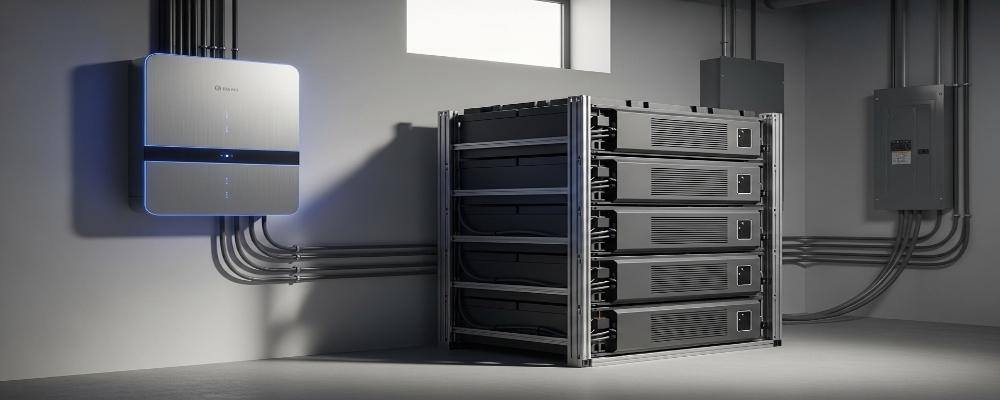
For medium-scale standalone microgrids, VoltaLink provides a modular LiFePO4 configuration with the following reference parameters.
| Specification | Parameter | Reference |
| Battery Chemistry | Lithium Iron Phosphate | Stationary Cycling Compatible |
| Rated Energy | ~28 kWh | Defines Nominal Stored Energy |
| Rated Voltage | 204V | Inverter Matching |
| Operating Voltage | 172.8 – 230.4V | Permissible DC Range |
| Rated Capacity | 140 Ah | Relation between Voltage and Energy Capacity |
| Continuous Charge Current | 30 A | Charge Speed |
| Continuous Discharge Current | 30 A | Continuous Output |
| Approximate Dimensions | 640 x 700 x 907 mm | Installation Planning |
| Approximate Weight | 252 kg | Handling and Floor Loading |
| Monitoring Options | Power Display and Bluetooth | Local System Monitoring |
The final off-grid battery storage configuration must be validated based on load demand, inverter specifications, PV input and communication protocols, backup duration, and the environment where the system will be installed.
What Makes LiFePO₄ Ideal for Off-Grid Battery Storage?
LiFePO₄ chemistry is commonly used in stationary energy storage applications due to its unique combination of excellent thermal stability, good cycling, and more uniform voltage.
• Cell Screening: Capacity and internal resistance measurements can help to minimize variations between cells.
• Balancing Modules: Uniform battery modules lead to even charging and discharging cycles.
• Designing for Heat: The heat generated during operation can be controlled by monitoring the temperature and by designing appropriate spacing along with insulating and ventilating the components.
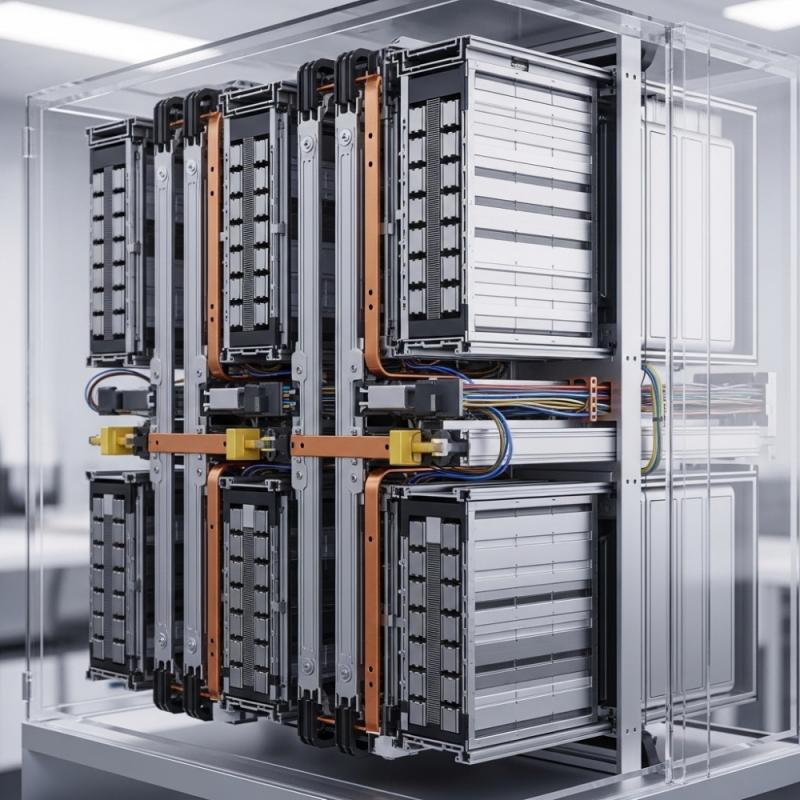
• Electrical Resistance: Internal resistance can be minimized by employing copper bus bars of adequate thickness.
• Mechanical Protection: Cells, wiring, and control electronics are protected by reinforced metal enclosures.
Battery chemistry is only a component of reliability. Production quality of the cells, BMS configurations, thermal management, conductor sizing, and manufacturing quality are also critical.
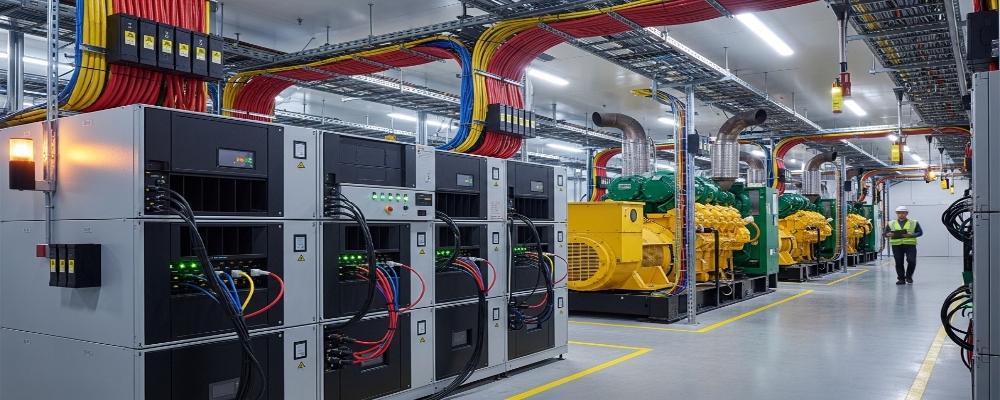
Battery Management and System Protection
The BMS observes off-grid battery storage and guarantees functioning within predetermined constraints both electrically and thermally.
• Voltage Protection: As the system nears its prescribed limits, actions for charging and discharging will automatically be initiated.
• Current Protection: Protective actions will be implemented if the charge or discharge currents exceed the prescribed range.
• Temperature Monitoring: The operational range will be assessed with sensors and will be determined for the range for which the system was designed.
• Cell Balancing: Disparity in cell voltages is controlled for better performance of the module.
• Fault Communication: Alarms and status information are communicated for compatible inverters or monitoring systems.
The BMS should be supported by breakers, fuses, isolators, grounding, surge protection, ventilation, and suitable emergency-shutdown procedures.
Comparing Application Requirements
| Application | Load Characteristic | Main Concern | Storage Priority |
| Fisheries and aeration | Long motor operating periods | Interruption of water circulation | Runtime and startup support |
| Telecom stations | Continuous electronic loads | Communication downtime | Monitoring and continuity |
| Data infrastructure | Sensitive IT equipment | Voltage interruption | UPS integration |
| Commercial buildings | Mixed essential loads | Simultaneous outage demand | Load prioritization |
| Remote facilities | Limited maintenance access | Extended grid absence | Autonomy and serviceability |
| Solar microgrids | Variable renewable generation | Low-generation periods | Recharge planning |
VoltaLink‘s Approach to Off-Grid Battery Storage
VoltaLink focuses the development of off-grid battery storage on the design of the complete system under real operational conditions rather than just on design based on nominal capacity.
• Modular Architecture: Stacked configuration offers the ability to plan different capacities and the ability to expand in the future.
• System Integration: Provides the ability to coordinate storage systems with solar PV systems, hybrid inverters, UPS systems, and generators.
• Application-Based Design: Provides the ability to configure systems based on load profile, how much power is demanded to start equipment, the operational schedule, and how long you want to maintain system autonomy.
• Production Control: Provides the ability to control the production process to ensure consistent quality of the final product.
• Monitoring Capability: The possibility of monitoring the system by using power displays, Bluetooth, and other communication interfaces provides operating data.
Closing Words
Effective off-grid battery storage planning requires coordinated evaluation of battery capacity, inverter output, critical loads, startup current, PV availability, protection design, environmental conditions, and future expansion.
A modular 28kWh LiFePO4 system may support fisheries, telecom sites, commercial backup, data infrastructure, renewable energy projects, and remote facilities. By combining load analysis, battery protection, modular engineering, and manufacturing control, VoltaLink develops off-grid battery storage configurations intended to support practical standalone microgrid requirements.
FAQ
Q1: Can this system be used for data centers?
A: Yes, it is designed for backup and UPS integration in data center environments.
Q2: Is it suitable for off-grid use?
A: Yes, it supports full off-grid and hybrid energy configurations.
Q3: Can it integrate with solar systems?
A: Yes, it works with PV systems and hybrid inverters.
Q4: How long is the cycle life?
A: It supports over 6000 charge cycles under standard operating conditions.
Q5: Does it support expansion?
A: Yes, multiple modules can be connected in parallel for larger capacity.

-

 OEM Residential Energy Storage Solutions: Passive vs. Active Cell Balancing
2026-09-30
-
 Smart Home Battery with BMS Communication: Cybersecurity and BMS Safety
 -
 10kWh Home Battery Backup System: Is 90% DoD Better for Daily Solar Storage?
2026-09-29
-
 Integrated Home Energy Storage System 150–430V MPPT Design
2026-09-28
-
 LiFePO₄ Residential Backup Battery SOC Accuracy in Parallel Systems
Share this:






.svg)






-899.svg)


