




DC-Coupled Solar + Storage: Efficiency & Layout
DC-Coupled Solar + Storage Systems are best for new PV homes where the battery is planned from day one. Solar power charges the battery on the DC side through a hybrid inverter, reducing conversion losses before storage. The tradeoff is commitment: inverter, battery, PV string design, backup loads, and future expansion must be planned together before installation.
A DC-coupled layout can make a new solar home cleaner, more efficient, and easier to control. But it also makes the hybrid inverter a major design choice, not a small add-on. If you choose the wrong inverter or battery ecosystem early, upgrades can become harder later. This guide explains the power flow, the efficiency claim, and the layout decisions to confirm before signing.
What is a DC-coupled solar + storage system?
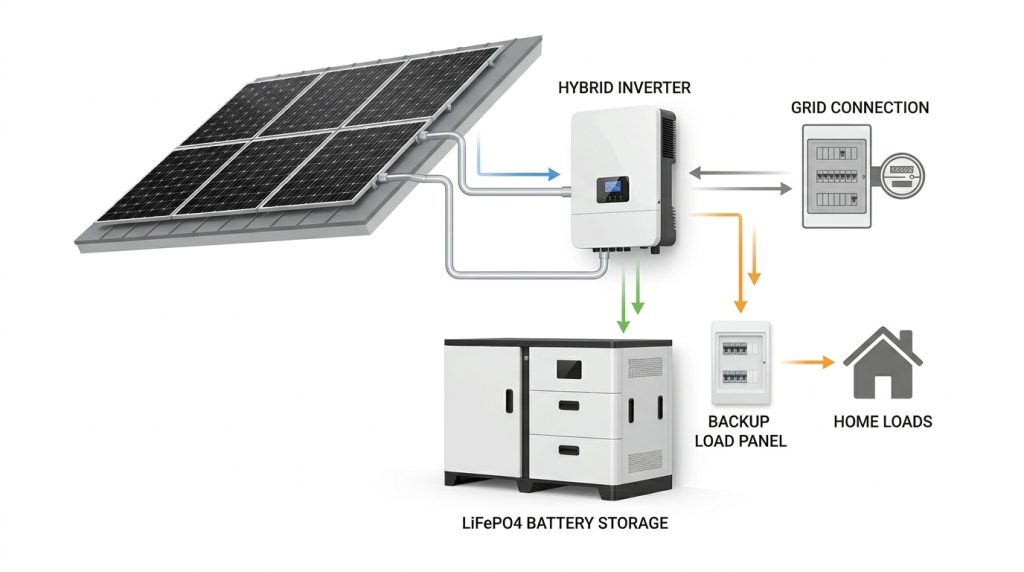
A DC-coupled solar + storage system lets PV power charge the battery on the DC side before one main inverter converts electricity for home use. It usually fits new solar installations better than battery retrofits.
Solar panels produce direct current, called DC power. In a DC-coupled home system, that DC power can charge the battery before it becomes alternating current, called AC power, for household use. The hybrid inverter controls the main conversion and connects the solar array, battery, home loads, and grid.
This layout is different from an AC-coupled battery retrofit, where solar power is converted to AC first and then converted again to charge the battery. For a homeowner building a new PV system, DC coupling can be the cleaner starting point because the storage plan is built into the system from day one. For broader storage planning, see VoltaLink’s home energy storage guide.
A DC-coupled design also supports a single solar battery system mindset. Instead of treating solar and storage as separate upgrades, the homeowner can size the inverter, PV array, battery, and backup loads as one working layout.
How does power move through a DC-coupled layout?
In a DC-coupled layout, PV power stays DC while charging the battery, then the hybrid inverter converts it to AC only when the home or grid needs usable power. This reduces unnecessary conversion steps.
The basic flow is simple. Solar panels create DC power. The hybrid inverter or MPPT input manages that solar power, charges the DC battery, and converts electricity to AC when the home needs power. The Energy Management System, or EMS, decides when to charge, discharge, export, or hold battery power.
NREL describes DC-coupled PV-plus-battery systems as layouts where PV and storage can share a bidirectional inverter. Home systems are smaller, but the idea is similar: keep solar energy on the DC side until AC power is needed.
Topology diagram callout
Use this layout in the article image or diagram:
| System point | What it does |
|---|---|
| PV array | Produces DC power from sunlight |
| MPPT or hybrid inverter input | Tracks solar output and manages PV charging |
| DC battery | Stores solar energy before AC conversion |
| Battery Management System | Protects the battery and communicates with the inverter |
| Energy Management System | Controls charging, discharge, grid use, and backup mode |
| AC output | Sends usable power to home loads |
| Backup load panel | Powers selected critical loads during outages |
| Grid connection | Allows import or export based on system settings |
A clear diagram matters because DC coupling is easy to misunderstand. The battery does not power the home directly in raw DC. The hybrid inverter is still needed to create safe AC power for normal household circuits.
Why does DC coupling improve battery-charging efficiency?
DC coupling improves battery-charging efficiency because solar power can enter the battery before being converted to AC. The strongest claim is fewer conversion losses, not a guaranteed whole-system 98% round-trip result.
An AC-coupled battery may convert PV power from DC to AC, then convert AC back to DC to charge the battery, then convert DC back to AC when the home uses stored energy. Each step creates some loss. DC coupling avoids one of those steps when charging from solar.
RatedPower explains that DC-coupled systems can improve battery charging efficiency because the battery charges before AC conversion. NREL also notes that DC coupling can reduce losses and capture energy that may otherwise be clipped or lost at low voltage.
| Layout | Solar-to-battery path | Main strength | Main caution |
|---|---|---|---|
| DC-coupled | PV DC to battery DC, then inverter to AC | Fewer charging conversions | Must plan inverter and battery together |
| AC-coupled | PV DC to AC, then AC to battery DC | Easier battery retrofit | More conversion steps for stored solar |
| Hybrid new-build | PV, battery, inverter, EMS designed together | Cleaner control and backup planning | Less freedom to change parts later |
This is why DC coupling often makes sense for a new home installing solar and battery storage together. But if the home already has a working solar inverter, the AC-coupled storage choice may be easier and cheaper.
Does DC coupling really mean 98% round-trip efficiency?
Treat 98% as a best-case charging or conversion-path figure unless the manufacturer proves whole-system round-trip efficiency. Homeowners should compare tested battery, inverter, and system-level efficiency, not one headline number.
The 98% figure can be useful, but only if it is framed correctly. It may describe a charging path or inverter conversion condition, not the full amount of energy you get back after storage. Full round-trip efficiency also includes battery losses, wiring, temperature, standby use, and control behavior.
For example, if 10 kWh of solar energy enters storage, do not assume 9.8 kWh is always usable later. A real system may return less after battery chemistry losses, inverter losses, and operating conditions. NREL’s PV-plus-battery model uses lower full round-trip assumptions than 98%, which shows why buyers should separate charging efficiency from system-level performance.
The best installer question is simple: “Can you show tested inverter, battery, and system-level efficiency for this exact combination?” If the answer is only a brochure number, treat it as a starting point, not a guarantee.
What equipment must you choose from day one?
DC coupling works best when the main equipment is selected together before installation. The hybrid inverter is the core decision because it controls solar input, battery charging, battery discharge, grid interaction, and backup power behavior.
For a new-build homeowner, this can be a real advantage. A well-matched hybrid home ESS can reduce design clutter and make monitoring easier. The risk is lock-in. If the inverter supports only certain batteries or limited expansion, future upgrades may become harder.
Before approval, confirm these items with the installer:
- Hybrid inverter model and rated output
- PV string voltage and MPPT operating range
- Battery voltage, capacity, and expansion path
- Battery Management System communication
- Approved battery brands and firmware compatibility
- Backup load panel design
- Surge load limits for pumps, HVAC, or large appliances
- Monitoring app and EMS control options
- Warranty coverage for inverter and battery pairing
- Local code, permitting, and safety listing requirements
A practical example: a homeowner chooses a hybrid inverter that only supports one battery ecosystem. Two years later, they want a different battery brand with better pricing. If the inverter cannot communicate with that BMS, the cheaper battery may not be usable.
When is DC coupling the right choice for a new-build homeowner?
Choose DC coupling when the solar array, battery, and hybrid inverter are designed as one system from the start. It is strongest for new builds where efficient solar charging and integrated backup control matter more than retrofit flexibility.
A new 8 kW PV system with a 10 kWh battery is a good example. During midday, solar power can charge the battery on the DC side. In the evening, the hybrid inverter converts stored energy to AC for lights, the refrigerator, internet equipment, and other selected loads.
DC coupling also works well when the homeowner wants backup power planned at the same time as solar. The installer can decide which circuits belong in the backup panel and which high-surge loads should stay off battery power. This gives the system a clearer job from day one.
| Homeowner situation | Better direction | Why |
|---|---|---|
| New solar and battery installed together | DC coupling | One integrated design from the start |
| Solar installed now, battery planned much later | Ask installer | Future inverter compatibility matters |
| Existing PV inverter still works well | AC coupling | Lower disruption in many retrofits |
| Solar charging efficiency is the top goal | DC coupling | Fewer solar-to-battery conversions |
| Brand flexibility matters most | AC coupling may fit better | Easier to separate PV and battery choices |
| Backup loads need careful planning | DC coupling or hybrid design | EMS and backup panel can be planned together |
For buyers who want to see how this works in practice, real hybrid storage builds can help connect the layout to actual home scenarios.
Where can DC coupling be the wrong choice?
DC coupling is not always the safer choice. If you already have solar, expect phased upgrades, or want maximum brand flexibility, AC coupling may be easier and cheaper to install.
The clearest problem is retrofit cost. A homeowner with an existing 6 kW solar system may already have a working PV inverter. Replacing that inverter just to force a DC-coupled layout can add cost and complexity. In that case, an AC-coupled retrofit option may be the better path.
A second issue is dependency. One hybrid inverter can simplify the system, but it also becomes a key point of control. If that inverter has limited battery compatibility, limited power output, or poor expansion support, the whole system may feel boxed in later.
A third issue is design recovery. DC coupling is not hard when designed well, but mistakes can be expensive. PV string voltage, inverter range, battery voltage, firmware support, and backup circuit planning should be checked before the system is installed, not after problems appear.
What should the installer confirm before approving the layout?
The installer should confirm the electrical layout, inverter compatibility, battery communication, backup plan, and safety requirements before the homeowner approves a DC-coupled system. This checklist is where the efficiency claim becomes a real installed system.
Ask for a one-page topology diagram and a written equipment list. The diagram should show the PV array, hybrid inverter, battery, BMS, EMS, grid connection, home loads, and backup load panel. It should also show which circuits remain powered during an outage.
Use this approval checklist:
- Does the PV string voltage fit the inverter’s MPPT range?
- Is the battery voltage compatible with the inverter?
- Does the BMS communicate with the hybrid inverter?
- What battery brands and models are approved?
- Can the battery capacity expand later?
- Which loads are backed up during outages?
- Are high-surge loads excluded or separately planned?
- What happens if the inverter fails?
- Does the monitoring app show PV, battery, grid, and load data?
- Are the battery and system safety requirements documented?
Battery safety should not be treated as a side note. UL 9540A is used to evaluate thermal runaway fire propagation behavior in energy storage systems. Homeowners should ask which safety listings, local code steps, and Authority Having Jurisdiction requirements apply to their installation.
Final decision: should you choose DC-coupled solar + storage?
Choose DC-Coupled Solar + Storage Systems when you’re building solar and storage together, want efficient PV-to-battery charging, and are ready to commit to a hybrid inverter from day one. Choose another layout if you already have solar, want phased battery upgrades, or need more brand flexibility.
| If your situation is… | Best next step |
|---|---|
| New PV home with planned battery | Ask for a DC-coupled hybrid layout |
| Existing solar with working inverter | Compare AC-coupled retrofit costs |
| Strong backup power goal | Confirm critical load panel design |
| Future expansion matters | Check inverter and battery ecosystem limits |
| Unsure about efficiency claims | Request tested system-level data |
Before signing, ask the installer for the topology diagram, compatible battery list, backup load plan, and efficiency assumptions. A good DC-coupled design should look simple on paper before it goes on your wall.
Frequently Asked Questions
What is the core difference between AC-coupled and DC-coupled solar battery systems?
DC coupling stores solar energy before it is converted to AC, while AC coupling converts solar power first and then charges the battery through another conversion step. This affects efficiency, inverter choice, retrofit flexibility, and system layout.
Is DC coupling better than AC coupling?
DC coupling is better for many new solar + battery installations, but it is not always better. AC coupling is often easier when adding a battery to an existing solar system because it avoids replacing the original solar inverter.
When to use DC coupling?
Use DC coupling when the homeowner is installing solar and battery storage together and wants efficient solar charging through one integrated hybrid inverter. It is strongest when the battery, inverter, PV strings, and backup loads can be designed as one system.
What is a Hybrid Inverter and where is it used?
A hybrid inverter manages solar input, battery charging, battery discharge, grid connection, and AC output in one device. In a DC-coupled home layout, it becomes the main control point between the PV array, battery, home loads, and grid.
Why is DC coupling more efficient for energy storage?
DC coupling is more efficient for battery charging because solar energy can enter the battery before being converted to AC. Fewer conversion steps usually mean less energy loss, especially when storing daytime solar for later use.
What is the round-trip efficiency of a DC-coupled solar system?
The round-trip efficiency depends on the battery, inverter, wiring, temperature, and control strategy. Some sources discuss very high DC-coupled charging efficiency, but homeowners should ask for tested system-level efficiency instead of relying on one headline number.

-

 OEM Residential Energy Storage Solutions: Passive vs. Active Cell Balancing
2026-09-30
-
 Smart Home Battery with BMS Communication: Cybersecurity and BMS Safety
 -
 10kWh Home Battery Backup System: Is 90% DoD Better for Daily Solar Storage?
2026-09-29
-
 Integrated Home Energy Storage System 150–430V MPPT Design
2026-09-28
-
 LiFePO₄ Residential Backup Battery SOC Accuracy in Parallel Systems
Share this:





.svg)






-899.svg)


