




On/Off-Grid Hybrid ESS: Switching Between Modes
An on off grid hybrid energy storage system stays grid-connected during normal operation, then isolates the home and enters backup mode during an outage. The transfer switch prevents unsafe backfeed, while the inverter forms a local island for selected circuits. In the app, homeowners should see grid status, battery level, live load, solar generation, and backup alerts.
A hybrid ESS sounds simple until the power actually goes out. That is when the system has to detect the outage, disconnect from the utility, protect the grid, and keep the right home circuits running. The homeowner usually sees only a flicker, an app alert, or a change in backup status. Behind that small moment, the inverter, transfer switch, battery, solar input, and load panel are all working together.
What does an on off grid hybrid energy storage system actually do?
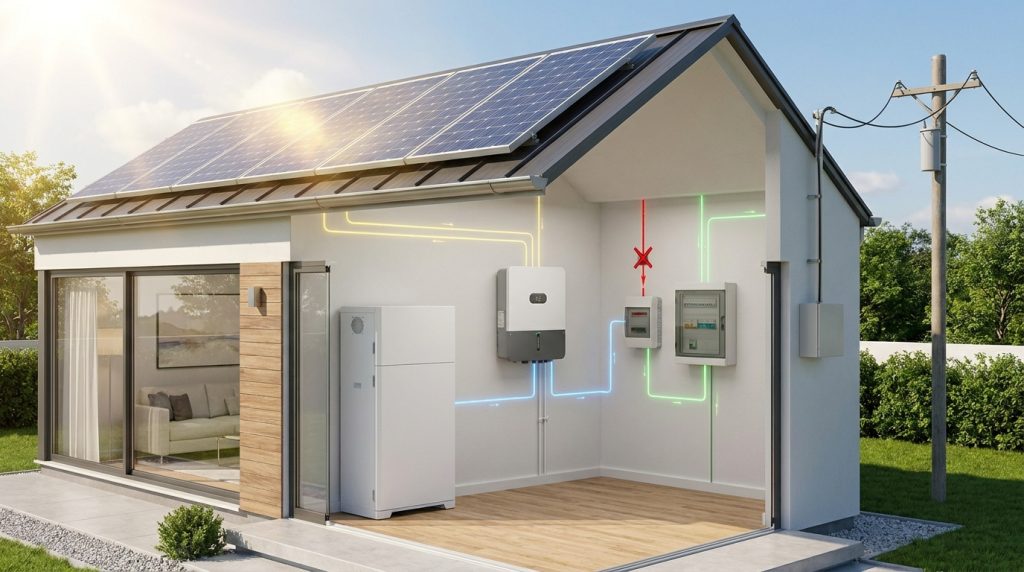
An on off grid hybrid energy storage system normally works with the utility grid, but can disconnect and run selected home circuits from the battery and solar during an outage. The inverter manages energy flow, while switching equipment isolates the home safely.
In normal mode, the system can use solar power, battery power, and grid power together. The inverter decides where energy should go based on the home load, solar production, battery state, and system settings. For broader home battery planning, see this home energy storage guide.
The key difference is backup behavior. A basic grid-tied solar system usually shuts down during an outage for safety. A hybrid ESS can keep approved backup circuits running because it can separate the home side from the utility side and operate as a small local power system.
| System type | Grid connection | Battery use | Outage behavior |
|---|---|---|---|
| Grid-tied solar | Yes | Usually no | Usually shuts down |
| Off-grid system | No | Required | Runs independently |
| Hybrid ESS | Yes | Yes | Can switch to backup mode |
Resilience guidance from the U.S. Department of Energy explains that solar and battery systems need islanding controls, transfer equipment, and critical load planning to support power during grid outages through a safe local circuit. Read the DOE resilience report on valuing resilience with solar and storage.
What happens in the first 60 seconds of a grid outage?
During an outage, the system first detects abnormal grid voltage or frequency, then isolates the home from the utility, then lets the inverter form a local backup circuit. Most homeowners experience this as a brief flicker, app alert, or smooth transition depending on equipment.
The first minute matters because it shows the real difference between a battery that stores energy and a backup system that can use that energy safely. Some systems switch very quickly. Others may let lights flicker or allow certain appliances to restart.
| Time after outage | System action | Hardware involved | What the homeowner sees |
|---|---|---|---|
| 0 to 1 second | Grid voltage or frequency becomes abnormal | Inverter sensors and controls | Lights may flicker, or nothing obvious happens |
| 1 to 5 seconds | Home backup side disconnects from utility | Transfer switch or static transfer switch | App may show grid outage or backup transition |
| 5 to 15 seconds | Inverter starts forming the backup circuit | Hybrid inverter and battery | Essential loads continue or restart |
| 15 to 30 seconds | Loads stabilize and battery discharge begins | Battery, BMS, inverter | App shows battery powering the home |
| 30 to 60 seconds | System updates monitoring data | EMS and app platform | Homeowner sees grid status, load watts, solar, and alerts |
Picture an evening outage at 8:14 PM. The battery is at 72 percent, solar is zero, and the backup panel includes the refrigerator, lights, router, and phone chargers. The HVAC is not connected to backup, so it shuts off, while the essential loads keep running.
A sunny midday outage can look different. If solar is producing 3 kW and the home is using 1.2 kW, a correctly designed hybrid system may keep loads running and recharge the battery during island mode. That depends on the inverter and system design.
How does the transfer switch protect your home and the grid?
The transfer switch is the safety gate between the home and the utility grid. When grid power fails, it disconnects backup circuits from the grid so the battery and inverter can power the home side without sending electricity back to utility lines.
This matters because backfeeding the grid is unsafe. Utility crews may be repairing lines during an outage. The home also needs a clean electrical boundary so the inverter can control voltage and frequency for the backup circuit.
A hybrid home ESS should be designed around this switching step, not treated as a battery-only upgrade. The transfer switch is not a minor accessory. It is the difference between stored energy and safe backup power.
| If this happens | The switch should do this | Why it matters |
|---|---|---|
| Grid fails | Disconnect backup circuits from utility | Prevents unsafe backfeed |
| Battery starts backup mode | Keep the home side isolated | Gives the inverter a safe boundary |
| Grid returns | Wait for safe reconnection logic | Avoids unstable switching |
| Home load exceeds backup rating | Keep protection logic active | Reduces overload risk |
Safety standards also matter when choosing equipment. UL explains that UL 9540 covers energy storage system safety and references related standards for batteries, inverters, interconnection, and electrical installation.
What is island mode, and why does the inverter need it?
Island mode means the home’s backup circuit runs as a small independent power system. Instead of following the utility grid, the inverter creates stable voltage and frequency for selected loads while the battery and solar supply usable energy.
In grid-connected mode, the inverter normally follows the utility grid. The grid provides the main electrical reference. When the utility fails, that reference disappears, so the inverter has to change its job.
In island mode, the inverter becomes the reference for the backup side. It has to balance battery output, solar input, and home demand in real time. If the load is too high, the inverter may trip, reduce output, or show an overload alert.
A hybrid solar battery system is useful here because it brings solar, battery, inverter, and backup controls into one design. The system should be checked for solar charging in island mode before purchase, since not every setup handles outage charging the same way.
| Mode | What the inverter does | Homeowner meaning |
|---|---|---|
| Grid-connected | Follows the utility grid | Normal solar, battery, and grid operation |
| Backup mode | Powers selected loads | Essentials stay on during outage |
| Island mode | Forms the local electrical reference | Home backup circuit runs apart from grid |
What will you see in the app during an outage?
The app should show that the grid is down, the home is in backup mode, and the battery is powering selected circuits. It may also show solar charging, live load watts, remaining battery percentage, and warnings if the load is too high.
This screen is often where homeowners understand the outage for the first time. Instead of guessing why some loads stayed on and others stopped, the app gives a live view of what the system is doing.
During an outage, look for these items:
- Grid status: outage, disconnected, grid unavailable, or backup mode
- Battery percentage: current stored energy
- Live load watts: how much power the home is using now
- Solar generation: whether PV is producing during backup mode
- Battery flow: charging, discharging, or idle
- Alerts: overload, low battery, grid return, or backup limit warning
Use the app as a decision tool, not just a status screen. If the battery falls to 15 percent overnight, the system may send a low-battery warning. That is the moment to turn off extra loads, preserve essentials, and avoid draining the battery too quickly.
In an overload scenario, the app becomes even more useful. If someone starts a microwave and kettle together during backup mode, the load may exceed the inverter rating. The app may show an overload alert, and the system may drop nonessential loads or ask for load reduction.
Which loads keep running during backup mode?
The loads that stay on are the loads connected to the backup side and supported by the inverter and battery. A hybrid ESS may run essentials smoothly, but large appliances can shut off if they exceed the backup rating or drain the battery too fast.
Backup power does not always mean whole-home power. Many homes use a critical loads panel, which may include the refrigerator, lights, Wi-Fi router, security system, and a few outlets. Heavy loads may need a larger inverter, load management, or a separate design.
This is where system layout matters. An AC-coupled storage setup may be a good retrofit path for homes that already have solar, but backup load behavior still depends on the inverter, panel design, and battery capacity.
| Load | Usually backed up? | Why |
|---|---|---|
| Refrigerator | Yes | Essential, moderate power use |
| LED lights | Yes | Low power, high comfort value |
| Wi-Fi router | Yes | Small load, useful during outages |
| Security system | Yes | Often placed on critical load circuit |
| Microwave | Sometimes | Short burst, but high power |
| HVAC | Sometimes | Needs careful sizing and load control |
| EV charger | Usually no | Very high load during backup mode |
| Water heater | Usually no | High draw and fast battery drain |
A hybrid ESS is not automatically a whole-home UPS. It works best when backup loads are planned around inverter output, battery capacity, and the homeowner’s real outage priorities. Running the right loads for longer is usually better than trying to run everything for a short time.
What happens when the grid comes back?
When utility power returns, the hybrid ESS does not reconnect instantly without checks. It verifies grid stability, closes the transfer path, returns the inverter to grid-connected mode, and updates the app so the homeowner can see grid import, solar use, and battery recharge status.
The system first confirms that grid voltage and frequency are stable enough for reconnection. Then the switchgear allows the home side to return to normal grid-connected operation. The inverter stops forming the backup island and goes back to normal energy management.
A DC-coupled storage design may handle solar-to-battery charging differently from an AC-coupled design, but the return process still needs controlled reconnection. The goal is a safe change from isolated backup to normal grid use.
Here is a simple return-to-grid sequence:
- Utility power returns.
- The system checks whether grid conditions are stable.
- The transfer path reconnects according to control logic.
- The inverter exits island mode.
- The app changes from backup status to grid-connected status.
- The battery may begin recharging or return to its normal schedule.
Imagine a two-hour outage ending at night. The app may shift from backup mode to grid-connected mode, then show grid import and battery recharge. If time-of-use settings are active, the system may delay charging depending on its programmed strategy.
When is a hybrid ESS the right choice, and when is it overkill?
A hybrid ESS is the right choice when a home still uses the grid but needs backup power, solar storage, or better control over energy use. It can be overkill for homes with rare outages, low electricity costs, and no need for backup circuits.
Hybrid is not always better than off-grid. Hybrid is better for homes that still benefit from utility service. True off-grid design is better when utility access is unavailable, unreliable, or not worth maintaining.
| Homeowner situation | Better fit | Why |
|---|---|---|
| Grid-connected home with outages | Hybrid ESS | Keeps grid benefits and adds backup |
| Remote cabin with no utility line | Off-grid system | Designed to run without grid support |
| Existing solar with no battery | AC-coupled or hybrid upgrade | Adds storage without rebuilding everything |
| New solar plus battery project | Hybrid solar battery system | Easier to design as one system |
| Stable grid and low bills | Simple grid-tied solar | Backup may not justify extra cost |
| Needs only short backup for essentials | Battery backup or smaller hybrid ESS | Avoids oversizing the system |
The buying decision should start with outage behavior, not product labels. Ask which loads stay on, how fast the switch happens, whether solar charges during outage mode, what the app shows, and which safety certifications apply.
For battery safety, UL explains that UL 9540A evaluates thermal runaway fire propagation, and UL 9540B addresses residential ESS fire propagation testing. These are useful references when comparing residential energy storage options.
Getting the Next Step Right
An on off grid hybrid energy storage system should be chosen for real outage behavior, not only for battery size or product claims. Ask your installer to walk through the first 60 seconds of an outage, the transfer switch setup, island mode behavior, solar charging during backup, and the app screen you will actually see.
The best system is the one that matches your home’s essential loads. For most homeowners, that means a safe backup design, clear monitoring, and enough battery capacity to keep important circuits running without pretending every appliance needs to stay on.
Frequently Asked Questions
Which is better, off-grid or hybrid solar system?
A hybrid system is usually better for a grid-connected home that wants bill savings and outage backup. A full off-grid system fits remote sites without utility access, but it usually needs larger batteries and stricter load planning.
Can you use a hybrid inverter for off-grid?
Yes, but only if the hybrid inverter is designed for standalone or backup operation. The system still needs correct transfer equipment, battery capacity, and load design before it can safely power a home without the grid.
What’s the difference between an off-grid inverter and a hybrid inverter?
An off-grid inverter works without utility grid connection, while a hybrid inverter can work with the grid and batteries together. During an outage, a suitable hybrid inverter can disconnect from the grid and power backup circuits.
What are the disadvantages of a hybrid solar inverter?
A hybrid inverter can cost more and requires careful system design. If the inverter, transfer equipment, battery, or backup panel is undersized, the homeowner may not get the smooth backup experience they expected.
Does a hybrid ESS switch automatically during a power outage?
Yes, a properly designed hybrid ESS should switch automatically after detecting a grid outage. The exact experience depends on the inverter, transfer switch, battery state, and whether the home uses whole-home backup or selected backup circuits.
Can solar panels keep charging the battery during an outage?
Yes, if the hybrid system supports solar charging in backup or island mode. Some systems limit solar input during outages, so homeowners should confirm this before choosing an inverter and battery configuration.
What will I see in the app when the grid is down?
The app should show grid outage or backup status, battery percentage, live home load, solar generation, and alerts such as low battery or overload. Exact labels vary by brand and monitoring platform.

-

 OEM Residential Energy Storage Solutions: Passive vs. Active Cell Balancing
2026-09-30
-
 Smart Home Battery with BMS Communication: Cybersecurity and BMS Safety
 -
 10kWh Home Battery Backup System: Is 90% DoD Better for Daily Solar Storage?
2026-09-29
-
 Integrated Home Energy Storage System 150–430V MPPT Design
2026-09-28
-
 LiFePO₄ Residential Backup Battery SOC Accuracy in Parallel Systems
Share this:





.svg)






-899.svg)


