




AC-Coupled ESS: When AC Coupling Is the Right Move
AC-Coupled Energy Storage Systems are usually the right move when you already have a working solar PV system and want to add battery storage without replacing the existing grid-tie inverter. The tradeoff is extra conversion loss, often around the 90-94% AC round-trip range versus up to 98% for DC-coupled designs. Choose AC for retrofits, modular backup, and lower installation disruption.
If your solar array is only a few years old, replacing the inverter can feel wasteful. AC coupling gives you another path: keep the existing solar system and add a battery inverter on the home’s AC side. The key is knowing when that setup is practical, when it costs you efficiency, and what your installer must verify before you trust it for backup power.
What is an AC-coupled ESS in a home solar setup?
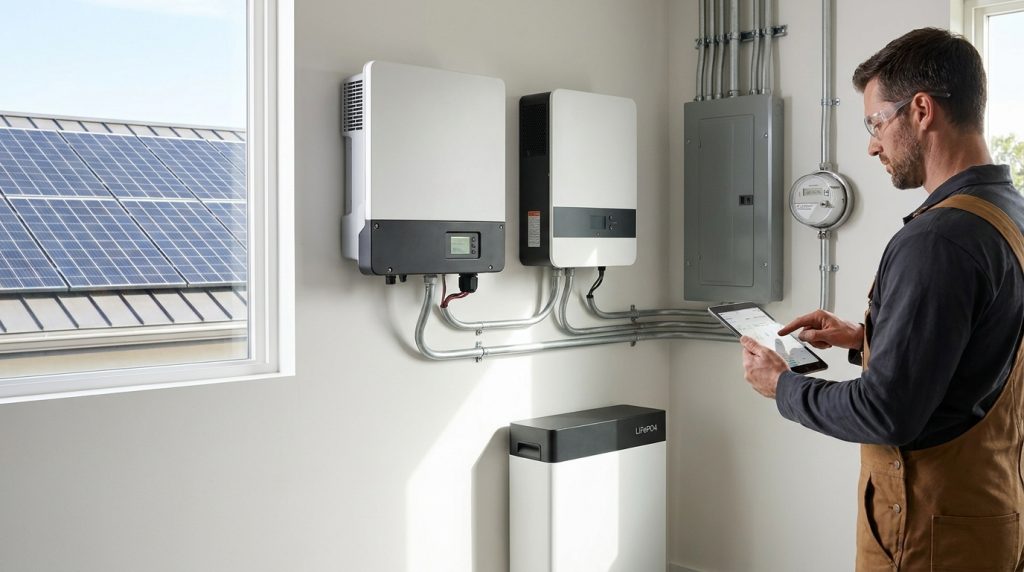
An AC-coupled ESS adds a battery with its own inverter on the home’s AC side, usually beside an existing solar inverter. It is common when a homeowner wants storage without replacing a working grid-tie PV inverter.
In a normal solar setup, panels produce DC power. Your grid-tie PV inverter turns that DC power into AC power for the home, the grid, or both. In an AC-coupled system, the battery does not sit directly on the solar DC side. It connects through a separate battery inverter on the AC side.
A simple home power flow looks like this:
- Solar panels produce DC power.
- The existing PV inverter converts DC to AC.
- The home uses AC power through the main panel or AC bus.
- The battery inverter converts AC to DC when charging the battery.
- The battery inverter converts DC back to AC when the home needs stored power.
The U.S. Department of Energy explains that solar-plus-storage systems can be designed in AC-coupled or DC-coupled layouts, and AC-coupled systems use both a PV inverter and a bidirectional battery inverter. For a wider overview of complete system planning, see this home ESS guide.
When is AC coupling forced by an existing PV system?
AC coupling is often the practical retrofit path when the solar array and grid-tie inverter are already installed and working. It lets the battery join on the AC side instead of redesigning the PV string, inverter, and DC wiring.
A 3-year-old solar system is a good example. The panels are still productive, the inverter may still be under warranty, and the wiring is already approved. In that case, replacing the PV inverter only to add a battery may create extra labor, permitting work, and downtime.
AC coupling is also common when the roof uses microinverters. Those systems already convert solar output into AC at the roof or module level, so adding a battery on the AC side often fits the existing layout better than rebuilding the solar side.
| Existing solar situation | Why AC coupling may be the practical choice |
|---|---|
| 3-year-old PV array with working inverter | Keeps useful equipment in place |
| Microinverter-based solar roof | Solar already outputs AC |
| Limited access to roof wiring | Reduces PV-side changes |
| Existing permits and inverter setup are stable | Avoids unnecessary redesign |
| Battery is being added later | Supports phased storage upgrades |
If you want to compare this retrofit logic with broader system layouts, review VoltaLink’s real hybrid builds. It helps show why the best architecture depends on what is already installed.
When would you choose AC coupling even if DC coupling is possible?
Choose AC coupling when retrofit simplicity, independent solar and storage operation, phased expansion, and backup flexibility matter more than maximum conversion efficiency. It is not always the most efficient option, but it is often the least disruptive one.
AC coupling is not only a compromise for older systems. Some buyers choose it because the solar inverter and battery inverter can operate as separate pieces of equipment. If one side needs service, the other side may still be easier to diagnose or maintain.
This also helps when the homeowner wants to expand storage later. A battery inverter and energy management system can often be planned around backup loads, time-of-use charging, and future battery capacity without disturbing the solar array.
Choose AC coupling when:
- You want to keep a working PV inverter.
- You plan to add storage in stages.
- Backup design matters more than peak efficiency.
- Your home layout makes AC-side equipment placement easier.
- You want a modular system with clear solar and storage roles.
AC coupling is not always the best choice. It works when preserving existing equipment matters, but DC-coupled or hybrid architecture can be safer for a clean new solar-plus-storage design. If you are comparing both directions, VoltaLink’s hybrid home ESS guide is the better next step.
What efficiency penalty should you expect from AC coupling?
Expect AC-coupled storage to lose more energy than DC-coupled storage because solar energy may convert DC to AC, AC to DC, and DC back to AC. Fetched sources show roughly 90-94% AC efficiency versus up to 98% for DC.
The penalty comes from extra conversions. With DC coupling, solar DC power can charge the battery with fewer conversion steps. With AC coupling, solar power usually passes through the PV inverter first, then the battery inverter, then the battery inverter again when discharged.
Storage is never 100% efficient, and the Department of Energy’s storage basics explain that stored energy always has some losses. For a homeowner, the key question is not “Does AC coupling lose energy?” It is “Is the loss large enough to justify replacing working solar equipment?”
Simple 10 kWh storage example
| Stored solar energy | AC-coupled usable output at 90-94% | DC-coupled usable output at up to 98% | Difference per cycle |
|---|---|---|---|
| 10 kWh | 9.0-9.4 kWh | Up to 9.8 kWh | About 0.4-0.8 kWh |
| 20 kWh | 18.0-18.8 kWh | Up to 19.6 kWh | About 0.8-1.6 kWh |
| 30 kWh | 27.0-28.2 kWh | Up to 29.4 kWh | About 1.2-2.4 kWh |
RatedPower reports AC-coupled BESS efficiency around 90-94% compared with about 98% for DC-coupled systems. That gap matters most for solar energy stored in the battery and used later. It does not mean every watt of daytime solar use takes the full battery round-trip loss.
AC-coupled vs DC-coupled ESS: which architecture fits your project?
AC coupling fits existing solar retrofits best. DC coupling or a hybrid inverter often fits new solar-plus-storage projects better because the system can be designed as one connected architecture from day one.
The Department of Energy’s solar-plus-storage guide explains that solar and storage can be connected through AC or DC coupling. Your best option depends on existing equipment, backup goals, wiring, inverter compatibility, and how much efficiency matters.
| Decision point | AC-coupled ESS | DC-coupled or hybrid ESS |
|---|---|---|
| Best fit | Existing solar retrofit | New solar plus battery |
| Existing PV inverter | Usually kept | Often replaced or avoided |
| Battery connection | AC side | DC side or shared hybrid inverter |
| Efficiency | Lower for stored solar | Usually higher for stored solar |
| Installation disruption | Often lower | Often higher in retrofits |
| Expansion | Modular | Cleaner if planned early |
| Backup design | Good if equipment coordinates | Good if designed as one system |
| Main risk | Compatibility assumptions | Replacing useful equipment |
For a new system, a single-system hybrid battery can be cleaner. For a 3-year-old PV array, AC coupling often wins because it avoids turning a battery upgrade into a full solar redesign.
Will an AC-coupled ESS keep solar running during an outage?
AC-coupled storage can support backup, but only when the battery inverter, PV inverter, transfer equipment, and controls are designed to work together off-grid. Do not assume the solar array will charge the battery during an outage without installer confirmation.
This is where many homeowners get confused. A battery backup system may power selected loads during a blackout, but that does not automatically mean the solar panels will keep charging the battery. Many grid-tie PV inverters shut down when the grid disappears for safety.
For solar charging during an outage, the battery inverter may need to create a stable off-grid AC signal. The PV inverter must also respond correctly to that signal. The Department of Energy explains that advanced inverters support important grid and off-grid functions when systems are designed for those roles.
Backup compatibility checks
Before you approve a quote, ask the installer to confirm:
- Will my existing PV inverter operate during backup mode?
- Does the battery inverter support grid-forming operation?
- Is a transfer switch or gateway included?
- Which circuits are in the critical loads panel?
- Can the system control solar output when the battery is full?
- Will the battery recharge from solar during a long outage?
- What happens if surge loads start at the same time?
Backup marketing claims are not enough. If the PV inverter and battery inverter cannot coordinate off-grid, the home may get battery backup without reliable solar charging during the outage.
What should you check before buying an AC-coupled battery?
Start with compatibility, not battery size. An AC-coupled battery must work with the existing PV inverter, the battery inverter, the home panel, the meter setup, the backup design, and local safety requirements.
A good installer should ask for your current inverter model, solar layout, utility rules, panel photos, load priorities, and backup expectations before recommending hardware. They should also explain whether the system is designed for self-consumption, time-of-use savings, backup power, or all three.
Use this checklist before approving the system:
- Existing PV inverter brand, model, age, and warranty status
- String inverter, microinverter, or optimizer-based layout
- Battery inverter model and compatibility notes
- Battery chemistry and usable capacity
- Smart meter, CT sensor, or energy meter placement
- Critical loads panel design
- Surge load plan for pumps, compressors, or HVAC
- Monitoring app and energy management system
- Permit and inspection responsibility
- Safety listing for the complete ESS
UL explains that UL 9540 covers energy storage system safety testing and certification. UL also provides UL 9540A testing for thermal runaway fire propagation in battery energy storage systems. If you are comparing battery chemistry at the same time, read VoltaLink’s LiFePO4 vs NMC guide before choosing the battery type.
Which buyer scenarios make AC coupling the right move?
AC coupling is the right move when the cost and disruption of replacing working solar equipment outweigh the efficiency gain of DC coupling. For new solar-plus-storage projects, compare DC or hybrid first before defaulting to AC.
The right choice depends on what you already own. A homeowner with a 7 kW PV array and a working inverter has a different decision than someone building solar and storage at the same time.
| Buyer scenario | Best direction | Why |
|---|---|---|
| 3-year-old 7 kW PV array with working grid-tie inverter | AC coupling likely | Keeps useful solar hardware in place |
| Microinverter roof | AC coupling likely | The solar system already works on the AC side |
| Backup-first home with fridge, lights, router, and sump pump | AC coupling can work | Confirm critical loads and off-grid control first |
| New solar plus battery installation | Compare DC or hybrid first | No existing inverter needs protection |
| Efficiency-first new build | DC or hybrid may win | Fewer conversion steps for stored solar |
| Phased storage expansion | AC coupling often fits | Battery side can be planned separately |
A simple decision flow helps:
- Do you already have working solar? If yes, look at AC coupling first.
- Is the inverter still performing well? If yes, avoid replacing it without a clear reason.
- Do you use microinverters? If yes, AC coupling may be simpler.
- Is backup the main goal? If yes, check off-grid inverter coordination.
- Is maximum efficiency the main goal? If yes, compare DC or hybrid.
- Are you installing solar and battery together? If yes, design both as one system.
What should you ask the installer before approving the quote?
Ask direct questions before you compare prices. A lower quote is not helpful if it leaves out backup hardware, monitoring, transfer equipment, or compatibility testing.
Your installer should be able to answer these clearly:
- Will my existing PV inverter stay in place?
- Will solar charge the battery during an outage?
- What loads will be backed up?
- What is the expected round-trip efficiency?
- How will the system handle a full battery during backup?
- Where will CT sensors or meters be installed?
- Which safety standards apply to this ESS?
- Who handles permits, inspection, and utility approval?
- Can I expand the battery later?
- What happens if the PV inverter fails in the future?
If an installer cannot explain these points in plain language, slow down. AC coupling can be a strong retrofit choice, but only when the full system design matches your home, your solar inverter, and your backup expectations.
Getting the Next Step Right
AC-Coupled Energy Storage Systems make the most sense when you want to protect a working solar investment and add storage with less disruption. They are not the highest-efficiency option, and they should not be treated as the default for every new system.
For an existing solar homeowner, the next step is simple: confirm your inverter model, decide which loads need backup, and ask whether solar charging will work during an outage. Then compare AC, DC, and hybrid options based on your actual equipment, not a generic sales pitch.
Frequently Asked Questions
What are AC-coupled systems?
AC-coupled systems connect the solar PV inverter and battery inverter on the AC side of the home or project. The battery has its own inverter, so it can be added beside an existing grid-tie solar inverter.
Can I add any battery to my existing solar panel system with AC coupling?
No, not any battery will work. AC coupling is flexible, but the battery, battery inverter, existing PV inverter, meter, and control system still need confirmed compatibility before installation.
Does AC coupling work during a power outage?
Yes, AC coupling can work during an outage if the system is designed for backup operation. The installer must confirm grid isolation, supported loads, and whether the PV inverter can operate with the battery inverter off-grid.
Is an AC coupled battery system less efficient than a DC coupled one?
Generally, yes. AC-coupled storage usually has more conversion steps for stored solar energy, while DC-coupled storage can charge the battery with fewer conversions.
Should I use an AC- or DC-coupled system?
Use AC coupling when you already have a working solar system and want a lower-disruption battery retrofit. Consider DC coupling or a hybrid inverter when you are installing new solar and battery storage together.
What are the advantages of AC-coupled battery systems?
The main advantages are retrofit flexibility, independent solar and battery operation, easier phased expansion, and practical backup design options. These benefits matter most when the homeowner wants to keep an existing PV inverter.
What is the difference between AC-coupled and DC-coupled battery storage?
AC-coupled storage connects the battery through a separate inverter on the AC side. DC-coupled storage connects the battery on the DC side, often sharing a hybrid inverter with the solar array.

-

 OEM Residential Energy Storage Solutions: Passive vs. Active Cell Balancing
2026-09-30
-
 Smart Home Battery with BMS Communication: Cybersecurity and BMS Safety
 -
 10kWh Home Battery Backup System: Is 90% DoD Better for Daily Solar Storage?
2026-09-29
-
 Integrated Home Energy Storage System 150–430V MPPT Design
2026-09-28
-
 LiFePO₄ Residential Backup Battery SOC Accuracy in Parallel Systems
Share this:





.svg)






-899.svg)


