




LiFePO4 vs NMC Home Battery: Pick the Right One
LiFePO4 vs NMC home battery choice usually comes down to safety and lifetime value. For most residential storage, LiFePO4 is the better pick because it offers stronger thermal stability, longer cycle life, and lower cost-per-cycle. NMC is better when compact size and weight matter, such as EVs, portable packs, or rare standby systems with strong engineering controls.
If two battery quotes are on your table, do not choose only by price or capacity. The chemistry affects safety, lifespan, space needs, warranty value, and long-term replacement cost. A fixed home battery has different priorities from an EV pack or a lightweight portable unit. Start with the use case, then compare the numbers behind each quote.
Which battery should most homeowners choose?
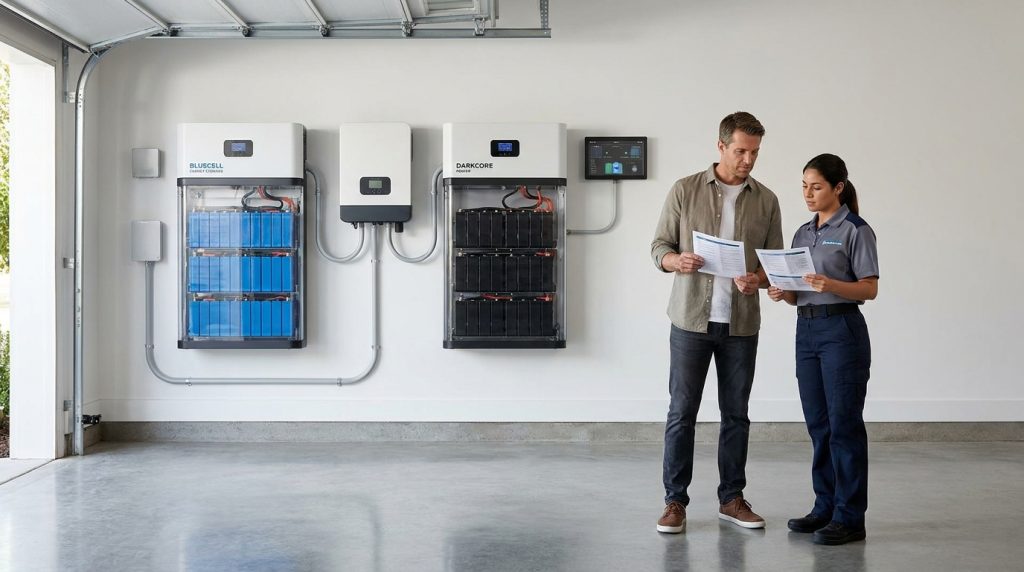
Most homeowners should choose LiFePO4 over NMC for a home battery because safety, cycle life, and long-term cost matter more than compact size. NMC is better for EVs, compact portable packs, or tightly engineered systems.
For a fixed residential battery, LiFePO4 is usually the safer and more practical choice. It fits daily solar storage, backup power, and time-of-use shifting because it handles repeated charge and discharge cycles well. If you need the wider system context before comparing chemistry, start with this home battery system basics guide.
Here is the quick buyer verdict:
| Decision point | Better choice | Why it matters |
|---|---|---|
| Most home battery quotes | LiFePO4 | Longer cycle life and stronger thermal stability |
| Daily solar charging | LiFePO4 | Better fit for repeated cycling |
| Smallest possible battery size | NMC | Higher energy density |
| RV and mobile power | LiFePO4 in most cases | Safer long-life option for regular use |
| EV battery packs | NMC or engineered EV chemistry | Weight and range matter more |
| Main check before signing | Both | BMS, warranty, certifications, and inverter match |
NMC is not a bad battery chemistry. It solves a different problem. It works when compact size and weight are top priorities, but LiFePO4 is usually the safer economic choice for a fixed home battery.
What is the real difference between LiFePO4 and NMC?
LiFePO4 uses a phosphate-based cathode that favors stability and long life. NMC uses nickel, manganese, and cobalt to increase energy density, which makes it useful for EVs and compact products.
LiFePO4 stands for lithium iron phosphate. NMC stands for nickel manganese cobalt. Both are lithium-ion battery types, but they behave differently because their cathode materials are different. A comparative study in ScienceDirect describes LFP and NMC as different choices across safety, cost, energy density, and application fit.
The short version for a homeowner is simple. LiFePO4 is built around stability and cycle life. NMC is built around storing more energy in less space. That makes NMC attractive for EVs and compact devices, but a home battery usually has more room to work with.
| Chemistry | Full name | Main strength | Main tradeoff |
|---|---|---|---|
| LiFePO4 or LFP | Lithium iron phosphate | Safety and long cycle life | Larger and heavier |
| NMC | Nickel manganese cobalt | Higher energy density | More sensitive to heat and controls |
A good battery management system, or BMS, matters for both. The BMS helps control charging, temperature, voltage, and protection features. Chemistry is important, but it is not a substitute for a well-designed battery system.
How do LiFePO4 and NMC compare on the numbers buyers care about?
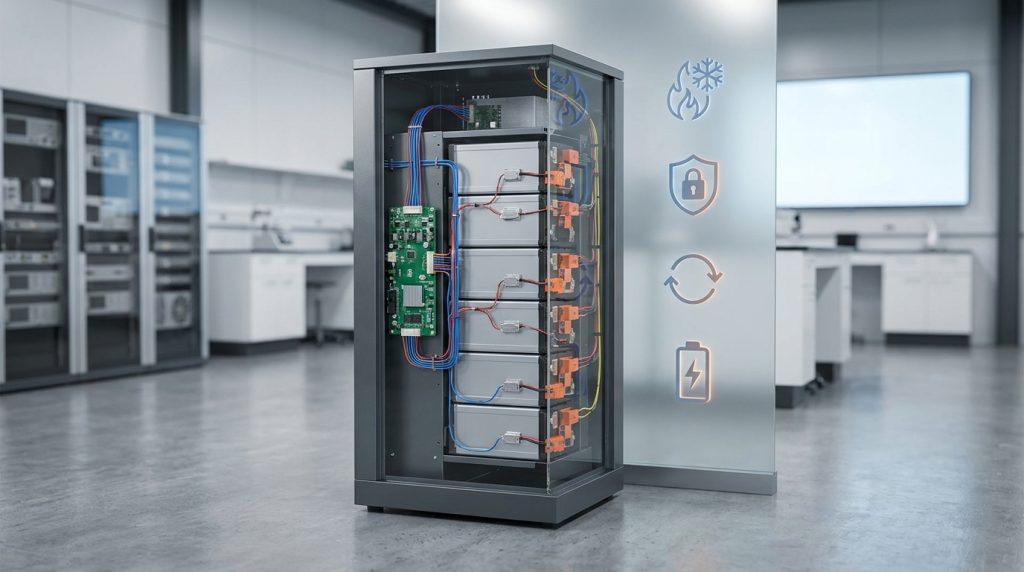
LiFePO4 usually wins on safety, cycle life, and cost-per-cycle. NMC usually wins on energy density. For a home battery, the first group often matters more because the battery is fixed in one place and may cycle for years.
| Factor | LiFePO4 | NMC | What it means for a homeowner |
|---|---|---|---|
| Cycle life | Usually stronger | Usually lower | LiFePO4 often fits daily solar cycling better |
| Energy density | Lower | Higher | NMC can store more energy in less space |
| Fire and heat behavior | More thermally stable | More sensitive to heat | Installation quality matters for both |
| Calendar life | Strong when managed well | Depends heavily on design and storage conditions | Check warranty terms, not only cycle claims |
| Daily cycling | Strong fit | Less ideal for frequent cycling | LiFePO4 usually gives better long-term value |
| Standby backup | Good fit | Can work if engineered well | Calendar life and support matter most |
| Cost-per-cycle | Often lower over time | Can be higher over time | Upfront price can mislead buyers |
| Installation sensitivity | Still needs correct setup | More dependent on controls | BMS and certification are key |
| Best fit | Home storage, solar, RV | EVs, compact packs | Use case should drive the choice |
This is why a lower NMC quote can still be the weaker deal. If your battery cycles almost every day, delivered energy over the warranty period matters more than the first invoice price.
Is LiFePO4 safer than NMC for a house?
LiFePO4 is generally the safer residential choice because its chemistry is more thermally stable and more tolerant of daily storage use. NMC is not automatically unsafe, but it depends more on design and controls.
“Safer” does not mean no risk. It means the battery is less likely to create serious problems when heat, charging stress, installation errors, or aging come into play. LiFePO4 has a safety advantage because its chemistry is more stable under stress.
NMC can be safe in a well-engineered system. The concern is that it needs strong protection from the BMS, enclosure, thermal design, and installation layout. For a home, those controls should be verified before you accept the quote.
What “safer” really means in a battery quote
Look beyond the chemistry name. Ask how the system handles overheating, overcharging, short circuits, cell imbalance, and communication with the inverter. A LiFePO4 pack with a weak BMS is still a bad choice.
For a deeper safety-focused page, use VoltaLink’s LiFePO4 fire safety resource when it is available on the site.
What to ask about UL 9540A, BMS, and spacing
Ask whether the battery has relevant safety testing and installation documentation. UL 9540A is used to evaluate thermal runaway fire propagation in battery energy storage systems. U.S. fire safety guidance also warns that energy storage system incidents can involve thermal runaway and fast fire growth if risks are not managed.
Use this quote checklist:
- Does the battery have a tested BMS?
- Is the system listed or tested for residential ESS use?
- Does the installer follow spacing and location rules?
- Are indoor, garage, and outdoor limits clearly stated?
- Does the warranty explain temperature and charging limits?
Which lasts longer: LiFePO4 or NMC?
LiFePO4 usually lasts longer than NMC in daily home storage because it tolerates more charge and discharge cycles. For rare backup use, calendar life, temperature, warranty terms, and BMS quality also matter.
Cycle life means how many charge and discharge cycles the battery can handle before its usable capacity drops. Calendar life means how long the battery ages over time, even if you do not cycle it much. Home buyers need both numbers.
A solar self-consumption battery may cycle almost every day. In that case, LiFePO4’s cycle-life advantage can be the main reason to choose it. A storm-only backup battery may sit at partial charge for long periods, so storage conditions and warranty details become more important.
Cycle life vs calendar life
| Use pattern | Main lifespan factor | Better default choice |
|---|---|---|
| Daily solar cycling | Cycle life | LiFePO4 |
| Time-of-use shifting | Cycle life and usable capacity | LiFePO4 |
| Rare outage backup | Calendar life and support | LiFePO4 or certified NMC |
| Hot garage install | Temperature control | LiFePO4 with proper setup |
| Tight cabinet install | Space and thermal design | Depends on certified system |
Do not accept a cycle-life claim without context. Ask for usable capacity, depth of discharge, charging limits, and warranty conditions. To understand this topic in more detail, see VoltaLink’s guide to long-cycle batteries.
Does NMC’s higher energy density matter for home batteries?
NMC’s higher energy density matters when weight and space are strict limits. For most fixed home batteries, that advantage is less important because the battery is installed once and does not move like an EV pack.
Energy density tells you how much energy a battery stores in a given size or weight. NMC often wins here. That is why it makes sense in EVs, where every kilogram can affect range, handling, and efficiency.
For most homes, extra battery size is not the top issue. A garage, utility wall, or outdoor storage area can often accept a larger unit if the tradeoff is longer life and better thermal stability. The real question is whether compact size is worth shorter life or stricter safety controls.
| If your situation is… | Energy density matters? | Better fit |
|---|---|---|
| Wall space is normal | Low | LiFePO4 |
| Battery must fit a tight cabinet | High | Compare both carefully |
| You need mobile power | Medium to high | LiFePO4 for most RV use |
| You need EV range | Very high | NMC or EV-specific chemistry |
| You need daily solar storage | Low | LiFePO4 |
A tight garage is the one home scenario where NMC may tempt a buyer. If you consider it, make sure the space advantage is real and the system has strong certification, enclosure design, and installer support.
Which quote is cheaper over time?
The cheaper quote is not always the lower upfront price. A LiFePO4 battery can cost less over time if it delivers more lifetime cycles, especially in solar self-consumption or time-of-use use cases.
A buyer comparing two 10 kWh quotes should not stop at installed price. The better question is how much usable energy each battery can deliver across its warranted life. That gives you a cleaner view of cost-per-cycle and cost per delivered kWh.
A lower upfront NMC quote can be a worse deal if the system cycles daily. For solar self-consumption, the winning number is not sticker price. It is delivered kWh over the warranty period.
Simple cost-per-cycle formula
Use this formula:
Installed price ÷ usable lifetime kWh = estimated cost per delivered kWh
| Quote item | LiFePO4 example | NMC example |
|---|---|---|
| Installed price | $8,500 | $7,500 |
| Usable capacity | 10 kWh | 10 kWh |
| Warranted cycles | 4,000 | 1,500 |
| Lifetime delivered energy | 40,000 kWh | 15,000 kWh |
| Estimated cost per delivered kWh | $0.21 | $0.50 |
This is a simple example, not a universal price claim. Your real calculation should use the exact quote, usable capacity, warranted depth of discharge, and cycle rating from the manufacturer.
Charging habits also affect life. A battery used daily needs correct charge settings, temperature control, and inverter communication. For deeper guidance, use VoltaLink’s charging best practices page when checking your system settings.
What tradeoffs matter after installation?
After installation, the biggest tradeoffs are charging profile, inverter compatibility, temperature, BMS quality, and warranty rules. A good chemistry choice can still perform poorly if the system is installed or configured badly.
This matters for both LiFePO4 and NMC. LiFePO4 is more forgiving, but it is not maintenance-free magic. It still needs a compatible inverter, correct charging profile, strong BMS, safe installation location, and clear warranty terms.
Temperature and cold-weather use
Cold charging can harm lithium batteries if the system does not manage it correctly. Heat can also shorten life and increase stress. If your battery will sit in a garage, shed, or outdoor enclosure, ask about the approved temperature range and low-temperature charging protection.
For colder regions, compare the quote with VoltaLink’s winter battery performance guide. This is especially useful for RV owners, outdoor cabinets, and homes with unheated storage rooms.
Inverter and BMS compatibility
Do not assume every inverter works with every chemistry. LiFePO4 and NMC can need different charging profiles, communication settings, and voltage windows. A good supplier should provide a compatibility list or written confirmation.
Ask these before signing:
- Does the inverter support this chemistry?
- Does the BMS communicate with the inverter?
- What happens during over-temperature or low-temperature events?
- What state of charge is recommended for standby storage?
- What actions can void the warranty?
When should you still choose NMC?
Choose NMC when compact size, weight, or EV-style power density matters more than maximum cycle life. For daily residential solar storage, LiFePO4 is usually stronger unless NMC has a clear engineering and space advantage.
NMC works best when space and weight carry real value. EVs are the clearest example because a lighter, smaller pack can help with driving range. Some portable power systems may also use NMC when compact packaging matters.
For a fixed home battery, NMC needs a stronger reason. If the NMC quote is smaller, cheaper, and fully certified, it may deserve a close look. But if the system will cycle daily, LiFePO4 usually gives the better long-term answer.
| Choose this option | When it makes sense | Main check |
|---|---|---|
| LiFePO4 | Daily home storage and solar cycling | Warranty cycle terms |
| LiFePO4 | RV power with regular use | Cold charging protection |
| NMC | Compact portable systems | Thermal design |
| NMC | EV battery packs | Pack engineering and cooling |
| NMC | Rare standby in tight space | Certification and installer support |
An EV buyer should not apply the home battery rule blindly. EV packs are designed around weight, range, cooling, crash protection, and power density. Those design goals are different from a wall-mounted home battery.
What should you ask before accepting either quote?
Before accepting either quote, ask for the details that affect safety, lifespan, and real value. The chemistry name alone is not enough to compare two home battery offers.
Start with the battery datasheet and warranty. Then ask the installer to confirm the inverter match, BMS communication, temperature limits, installation location, and service process. If the battery is imported, ask for transport documentation as well. Lithium batteries are regulated as hazardous materials by the U.S. Department of Transportation, and PHMSA explains that lithium cells and batteries offered for transport must meet UN 38.3 test requirements.
Use this checklist:
- What is the exact chemistry, LiFePO4 or NMC?
- What is the usable kWh, not only nominal capacity?
- What cycle life is covered by warranty?
- What depth of discharge is allowed?
- Is the system tested for residential ESS use?
- Does it reference UL 9540, UL 9540A, or local equivalents?
- Is the inverter listed as compatible?
- What temperature range is allowed?
- Who handles replacement and service?
- Are shipping documents available if importing?
For broader system planning, use VoltaLink’s complete ESS guide before comparing final installer proposals.
Final recommendation by use case
For residential storage, choose LiFePO4 in most cases. For RV and mobile power, LiFePO4 is usually still the safer long-life option. For EVs, NMC can make sense because energy density affects driving range.
The best chemistry depends on what the battery has to do every week. A home battery that cycles daily should favor safety, cycle life, and warranty value. A mobile or vehicle battery has tighter weight and space limits, so the decision can shift.
| Use case | Recommended chemistry | Why |
|---|---|---|
| Residential solar storage | LiFePO4 | Better fit for daily cycling and safety |
| Whole-home backup | LiFePO4 | Strong long-term value for fixed storage |
| Storm-only standby | LiFePO4 or certified NMC | Calendar life and support matter most |
| RV and mobile power | LiFePO4 in most cases | Safer long-life option for repeated use |
| Compact portable packs | Depends | Weight and size may matter more |
| EV packs | NMC or engineered EV chemistry | Energy density can support range |
For most homeowners, the LiFePO4 quote is the stronger starting point. Compare the final price only after you check usable capacity, warranty cycles, BMS protections, and installer support.
What to Do Next
If you are comparing a LiFePO4 vs NMC home battery quote, ask each supplier for the same details in writing. Request usable capacity, cycle rating, warranty limits, certification documents, inverter compatibility, BMS protections, and installation requirements.
Then run the cost-per-cycle calculation for your own use case. If you will cycle the battery daily, LiFePO4 will usually be the safer long-term choice. If space or weight is the main limit, compare NMC carefully and confirm the system is professionally engineered for that role.
Frequently Asked Questions
Can I switch from NMC to LiFePO4 in the same backup system?
Usually no, not without checking inverter, charger, voltage range, and BMS compatibility. LiFePO4 and NMC use different charging profiles, so a direct swap can damage the battery or shorten its life.
Is NMC battery chemistry unsafe?
NMC is not automatically unsafe when it is used in a certified, well-engineered system. It is less forgiving than LiFePO4 because it depends more on thermal design, BMS controls, spacing, and installation quality.
Why do electric vehicles use NMC batteries if LiFePO4 is safer?
EVs often use NMC because higher energy density can reduce weight and improve range. A professionally engineered EV pack also includes cooling, sensors, crash protection, and battery controls that a basic home retrofit may not have.
How does temperature affect LiFePO4 and NMC performance?
LiFePO4 usually handles heat better, and cold charging still needs careful control. NMC can perform well in compact systems, but heat stress and thermal management become more important over time.
What is the downside of an LFP battery?
The main downside of LiFePO4 is lower energy density. It is usually larger and heavier than NMC for the same stored energy, but that tradeoff matters less in a fixed home battery than in an EV.
Is it okay to charge LFP battery to 100% every day?
It depends on the manufacturer’s settings and warranty rules. For daily cycling, many systems preserve life better with a limited operating window, and occasional full charging can help before expected outages.
Are LFP batteries environmentally friendly?
LFP batteries avoid cobalt and nickel, which can reduce material supply and ethical concerns compared with NMC. They still require responsible manufacturing, safe transport, proper recycling, and compliant disposal.

-

 OEM ODM Home Energy Storage Manufacturer for Stackable Home Battery Solutions
2026-08-20
-
 High-Rate Discharge in Data Center UPS Battery Backup Systems Explained
 -
 LiFePO₄ RV Battery 48V System Design: Battery, Inverter, Solar and DC Load Integration
2026-08-19
-
 51.2V LiFePO₄ Server Rack Batteries: 100Ah Capacity, Energy Output and Runtime
2026-08-18
-
 51.2V 100Ah LiFePO₄ Battery for Inverter in Solar Energy Storage Systems
2026-08-17
Share this:





.svg)






-899.svg)


