




LiFePO4 Winter Performance: Cold-Climate Realities
LiFePO4 winter performance is reliable when the system is designed for cold, but it is not immune to freezing weather. Expect reduced usable capacity, more voltage sag, and strict charge control below 0°C. Discharge can often continue near -20°C with derating, but charging needs BMS cutoff, current reduction, internal heating, or a warmer installation space.
How does LiFePO4 winter performance change below freezing?
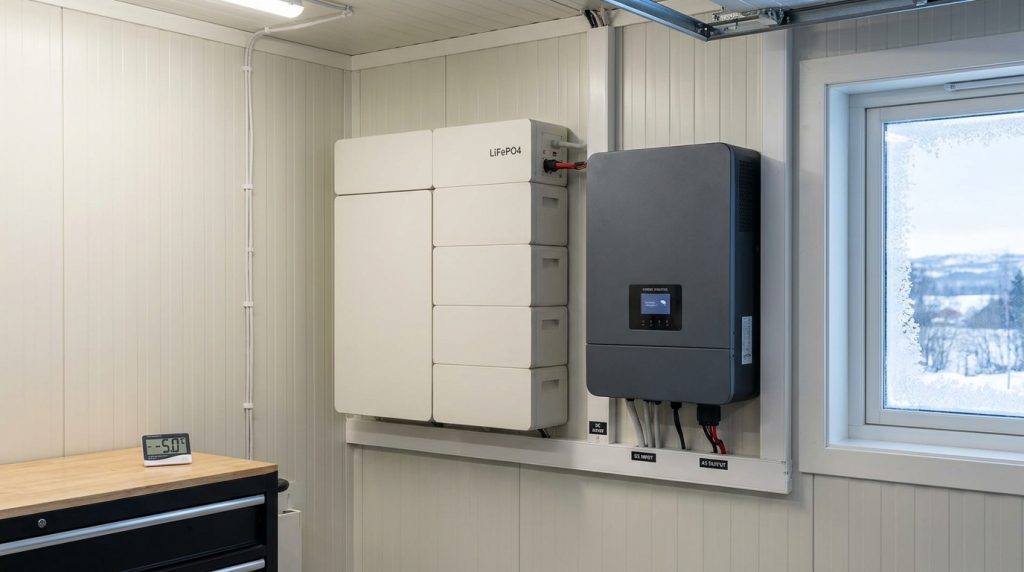
LiFePO4 winter performance is usually usable, but not nameplate-perfect. Cold reduces available capacity and increases voltage sag, so a 10 kWh system may feel smaller in an unheated garage even before the BMS limits charging.
The main issue is not that LiFePO4 stops working instantly in winter. The issue is that cold slows battery chemistry, raises internal resistance, and reduces the energy the system can deliver under load. The exact result depends on temperature, battery design, state of charge, load size, and BMS behavior.
Temperature-vs-capacity chart for planning
| Ambient temperature | Expected usable capacity range | Charging note | Planning meaning |
|---|---|---|---|
| 25°C | Around 100% | Normal charging if within datasheet limits | Baseline condition |
| 15°C | About 95-98% | Normal charging if within datasheet limits | Minor winter loss |
| 10°C | About 88-92% | Normal charging if within datasheet limits | Plan a small reserve |
| 5°C | About 80-88% | Charging depends on cell temperature | Garage installs may feel smaller |
| 0°C | About 72-90%, depending on source and test method | Charging may stop or de-rate | This is the key design threshold |
| -10°C | About 55-85%, depending on source and test method | Charging needs strong restriction or warming | Do not size from summer use only |
| -20°C | Source ranges differ widely | Discharge may continue, charging needs protection | Use the product datasheet and heater plan |
Use this chart as a planning range, not a warranty claim. For a full system decision, match winter capacity with your backup loads, inverter size, solar input, and reserve target in a broader home storage sizing plan.
Can you charge LiFePO4 batteries below 0°C?
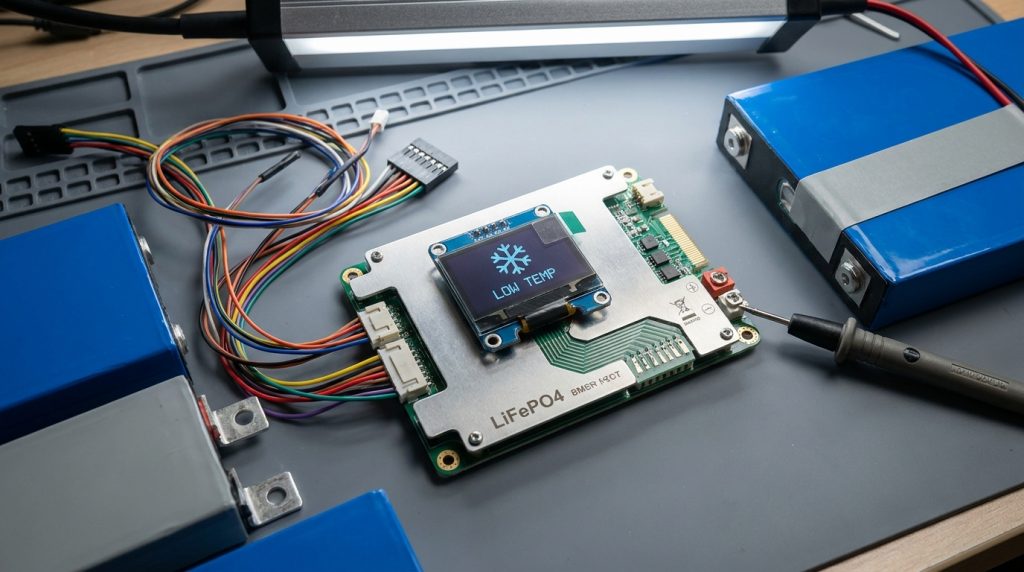
Do not treat sub-freezing charge cutoff as a defect. Below 0°C, a temperature-aware BMS may block or reduce charge to prevent lithium plating, and charging should resume only after the cells are warmed into the allowed range.
Charging is the main winter risk because cold charging can damage lithium cells. RELiON states that charge current should be reduced below freezing, including 0.1C below 0°C and 0.05C below -10°C. OSHA also warns that lithium battery safety risks can be linked to improper charging and exposure to excessive heat or cold.
| Cell temperature | Charging approach | What the article should tell the reader |
|---|---|---|
| Above 0°C | Charge within datasheet limits | Normal winter charging is possible if cells are above the allowed minimum |
| 0°C to -10°C | Reduce current or block charging unless the manufacturer allows it | Explain charge-current de-rating and BMS cutoff |
| Below -10°C | Very limited charging or no charging unless warmed | Recommend warming the battery before charging |
| Below charger or BMS limit | Do not bypass cutoff | Treat cutoff as battery protection |
If your battery stops charging on a freezing morning, the safer response is not to override the BMS. The safer response is to warm the battery environment, use a verified heated model, or install the system where the cells stay inside the approved charging range. For a deeper handoff, link this point to BMS charge cutoff.
Can LiFePO4 batteries discharge in deep winter?
Discharging is less sensitive than charging, but cold still reduces usable energy. Many LiFePO4 systems can discharge near -20°C with lower capacity, while charging below freezing needs stricter controls.
This is the key difference northern homeowners need to understand. A cold LiFePO4 battery may still power lights, routers, refrigeration, or small cabin loads, but it may not deliver the same usable energy or voltage stability it delivers at room temperature.
| If the battery is used for | Winter risk | Safer planning choice |
|---|---|---|
| Light cabin loads | Lower usable capacity | Keep extra reserve |
| High inverter loads | Voltage sag | Reduce peak load or size larger |
| Emergency backup | Early cutoff | Test the system under winter conditions |
| Solar charging after a cold night | No charging until cells warm | Use heated or indoor installation |
A cabin buyer should not think only in nameplate capacity. A 10 kWh battery can behave like a smaller battery in cold conditions, especially under heavier loads. Winter backup planning needs more reserve than summer planning.
Why does the battery look empty when it is just cold?
A LiFePO4 battery can appear empty in winter because cold increases internal resistance. When a large load starts, voltage can sag faster than it would at room temperature. The inverter or BMS may then trigger low-voltage disconnect even though some energy remains inside the pack.
This is why a battery can run normally in mild weather but cut off sooner during a cold night. The pack is not always defective. It may be reacting to cold cells, high load demand, and protective voltage settings at the same time.
Simple voltage-sag example
Imagine a 48V battery running a high inverter load. At room temperature, the voltage may stay stable enough to continue. At 0°C, the same load can pull voltage down faster. If the inverter sees that lower voltage as a cutoff condition, it may stop loads early to protect the system.
The practical fix is to reduce peak loads, keep more reserve, improve the battery’s ambient temperature, and follow the manufacturer’s voltage and BMS settings. Do not raise or bypass protection settings unless the battery and inverter documentation support the change.
Which Voltalink modules need heating or ambient management?
Based on the reviewed Voltalink pages, no residential module should be claimed to ship with an internal heater unless a current datasheet confirms it. The safe recommendation is ambient temperature management plus BMS protection.
| Voltalink module | Cold-relevant specs found | Internal heater verified? | Winter recommendation |
|---|---|---|---|
| Wall Mount Lithium Battery System | LiFePO4 chemistry, BMS, voltage/current/temperature monitoring, IP20 indoor use | Not verified on the reviewed page | Use an indoor or temperature-managed space |
| Off Grid Solar Battery System | LiFePO4 chemistry, built-in BMS, thermal protection, remote and cabin use cases | Not verified on the reviewed page | Use ambient management for sheds and cabins |
| 10kWh Stacked LiFePO4 System | BMS monitors cell status and temperature abnormalities | Not verified on the reviewed page | Verify the datasheet before cold-room installation |
This is an important honesty point. LiFePO4 chemistry is stable, but that does not automatically mean every module includes a heater. For cold-climate buyers, the question is not only “Is this LiFePO4?” The better question is “What does the BMS do below 0°C, and where will the battery be installed?”
If the article links deeper into controls, use integrated BMS controls as the next step. The article should not invent a heater feature unless Voltalink provides a current product datasheet confirming it.
What is the best winter setup for a northern home or cabin?
The best winter setup is the one that keeps the cells inside their safe operating range. For most homes, that means an indoor utility room, basement, or other temperature-managed space. For cabins, sheds, or garages, insulation and controlled heating may be necessary.
A self-heating battery can help, but only if the product page or datasheet clearly confirms the feature. Do not assume self-heating because the battery uses LiFePO4 chemistry.
| Situation | Best setup | Why it works |
|---|---|---|
| Heated basement or utility room | Standard LiFePO4 with BMS | Cells stay inside the charging range |
| Unheated garage | Insulated enclosure plus thermostat heater | Helps prevent cold charge cutoff |
| Remote off-grid cabin | Larger reserve plus ambient management | Solar input and battery capacity both drop in winter |
| Outdoor-adjacent shed | Only if enclosure and datasheet allow it | Weather and temperature risk are higher |
| Buyer wants automatic heating | Verified self-heating module | The heater must be confirmed, not assumed |
For a hybrid solar setup, winter design should also consider the inverter, MPPT charge controller, solar production, and backup loads. That broader planning belongs in a hybrid solar battery design guide, not in this cold-performance article.
What should you check before buying or installing?
Before buying, check the battery’s minimum charge temperature, discharge range, BMS low-temperature behavior, and installation environment. A cold-safe system is a match between chemistry, controls, and the room or enclosure around it.
- Check the minimum charging temperature.
- Check the minimum discharge temperature.
- Confirm whether the BMS blocks, limits, or delays cold charging.
- Confirm whether internal heating is included, optional, or not available.
- Check whether external heating is allowed by the battery documentation.
- Decide whether the battery will sit indoors, in a garage, in a shed, or at a remote cabin.
- Size winter reserve from cold-weather use, not only summer use.
- Protect cycle life protection by keeping the battery inside approved operating limits.
A BMS charge cutoff is not a nuisance to bypass. It is the feature protecting the battery from cold-charge damage, so the installation should solve temperature instead of disabling protection.
Which winter-ready path should you choose?
LiFePO4 is a strong choice for cold-climate home storage when the installation is realistic. It is not plug-and-forget in freezing garages, but it can work well when the cells are kept warm enough to charge safely.
| Buyer situation | Best path | Decision point |
|---|---|---|
| Northern homeowner with indoor utility space | Use indoor LiFePO4 storage with BMS protection | Best balance of safety and simplicity |
| Garage installation in freezing climate | Add insulation and controlled ambient heating | Do not rely only on chemistry |
| Remote cabin buyer | Use extra winter reserve and temperature management | Plan for cold, cloudy, low-solar days |
| Buyer who wants automatic heating | Choose a verified self-heating module | Confirm the heater in the datasheet |
| Buyer comparing battery chemistries | Review LiFePO4 safety tradeoffs | Compare safety, cycle life, and cold-use limits |
FAQ
Why does my LiFePO4 battery stop charging on cold mornings?
Your LiFePO4 battery stops charging on cold mornings because the BMS may block charging near or below 0°C. This protects the cells from cold-charge damage, and charging should resume after the battery warms into its allowed range.
What temperature is too cold for a LiFePO4 battery?
For charging, 0°C is the critical threshold for many LiFePO4 batteries. Discharge can often continue at lower temperatures, sometimes near -20°C, but capacity and voltage stability drop, so the product datasheet must set the final limit.
How much capacity does my battery lose in winter?
Capacity loss depends on temperature, load, and battery design. Source ranges show useful capacity can fall noticeably around 0°C and below, so winter systems should be sized with reserve instead of assuming full nameplate capacity.
Can I heat my battery to prevent winter performance loss?
Yes, heating can help if it is controlled and approved for the battery setup. The safest options are a warmer indoor location, insulated enclosure, thermostat-controlled heating, or a verified self-heating battery model.
Why does my system cut loads sooner in winter even though the battery isn’t empty?
Cold increases internal resistance, which can make voltage sag faster under load. The inverter or BMS may see that sag as a low-voltage condition and disconnect before the pack has delivered all usable energy.
How does the self-heating function work?
A self-heating LiFePO4 battery uses internal heating elements controlled by the BMS. When connected to charging power in cold conditions, the heater warms the cells first, then charging begins after the cells reach a safer temperature.
Is it possible to heat a LiFePO4 battery externally?
External heating is possible, but it should be controlled and compatible with the battery enclosure. A thermostat heating pad or heated cabinet is safer than uneven direct heat, and the battery datasheet should confirm the allowed method.

-

 OEM Residential Energy Storage Solutions: Passive vs. Active Cell Balancing
2026-09-30
-
 Smart Home Battery with BMS Communication: Cybersecurity and BMS Safety
 -
 10kWh Home Battery Backup System: Is 90% DoD Better for Daily Solar Storage?
2026-09-29
-
 Integrated Home Energy Storage System 150–430V MPPT Design
2026-09-28
-
 LiFePO₄ Residential Backup Battery SOC Accuracy in Parallel Systems
Share this:





.svg)






-899.svg)


