




BMS-Protected Energy Storage: What It Really Does
A BMS protected energy storage system uses cell-level monitoring and automatic cutoffs to keep lithium batteries inside safe operating limits. A good BMS watches voltage, current, temperature, SOC, SOH, balance, and fault signals. Then it limits charging, limits discharging, or disconnects the pack when needed. Buyers should ask for protection thresholds, balancing method, communications, fault logs, and safety test documentation.
What Does “BMS-Protected Energy Storage System” Actually Mean?
A BMS-protected energy storage system uses a Battery Management System to monitor the battery pack and respond when the battery moves outside safe operating limits. The BMS is the electronics and software layer that watches the cells during charging, discharging, standby operation, and fault conditions.
A BMS protected energy storage system uses electronics and software to monitor cell voltage, current, temperature, charge level, and faults. It should limit or disconnect operation before cells leave safe operating ranges, but it does not replace certified installation or fire protection.
In simple terms, the BMS is not just a display screen or app feature. It should be able to detect unsafe conditions and take action. That action may include limiting charge current, blocking discharge, opening contactors, logging faults, or communicating alarms to the inverter or energy management system.
The important point for homeowners and installers is that “BMS protected” should not be accepted as a vague marketing phrase. It should mean specific protection layers, clear thresholds, fault responses, and documented system behavior.
What Protection Layers Should a Real BMS Include?
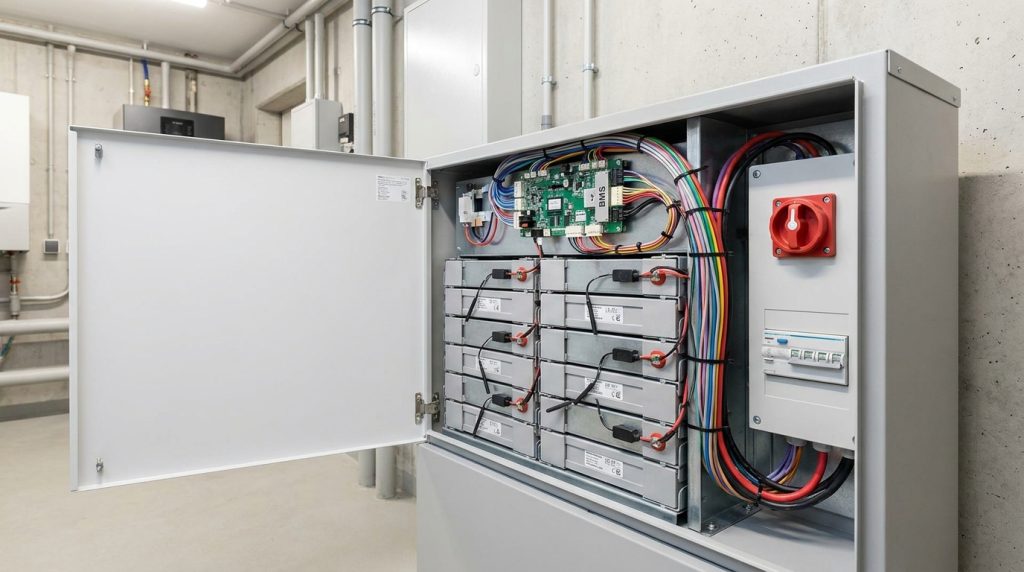
A real BMS protection stack includes cell voltage limits, current limits, temperature cutoffs, balancing, fault detection, contactor control, and data communication. Pack-level voltage alone is not enough because one weak cell can fail before the whole pack looks unsafe.
For home energy storage, the BMS should monitor the battery at the cell or module level, not only at the full pack level. This matters because cells in a series pack do not always age, charge, or discharge equally. One weak cell can reach an unsafe limit before the rest of the pack looks normal.
| Protection layer | What it watches | What the BMS should do | Buyer question |
|---|---|---|---|
| Cell voltage monitoring | Individual cell or module voltage | Stop charging or discharging when limits are reached | Does the system monitor cell-level voltage? |
| Overvoltage protection | Cells rising above safe voltage | Limit or stop charging | What is the overvoltage cutoff threshold? |
| Undervoltage protection | Cells dropping too low | Limit or stop discharge | What happens during deep discharge? |
| Overcurrent protection | Current above safe limits | Limit power or disconnect the pack | How does it respond to surge loads? |
| Temperature cutoff | Hot, cold, or abnormal cell temperature | Limit charging or discharging based on temperature | Where are the temperature sensors located? |
| Cell balancing | Cell charge differences | Reduce imbalance so one cell does not limit the pack | Is balancing passive or active? |
| Fault logging | Alarms, shutdowns, and abnormal events | Store events for installer diagnosis | Can fault history be exported? |
| Communication | SOC, SOH, limits, and alarms | Share data with inverter, EMS, or app | Which protocols and inverter brands are supported? |
The DOE BESSIE report describes battery energy storage systems as relying on data such as state of charge, battery temperature, voltage, current, and power flow. That is why BMS protection should be judged by what it measures and how it responds, not only by whether the product label says “protected.”
What Could Go Wrong Without a BMS?
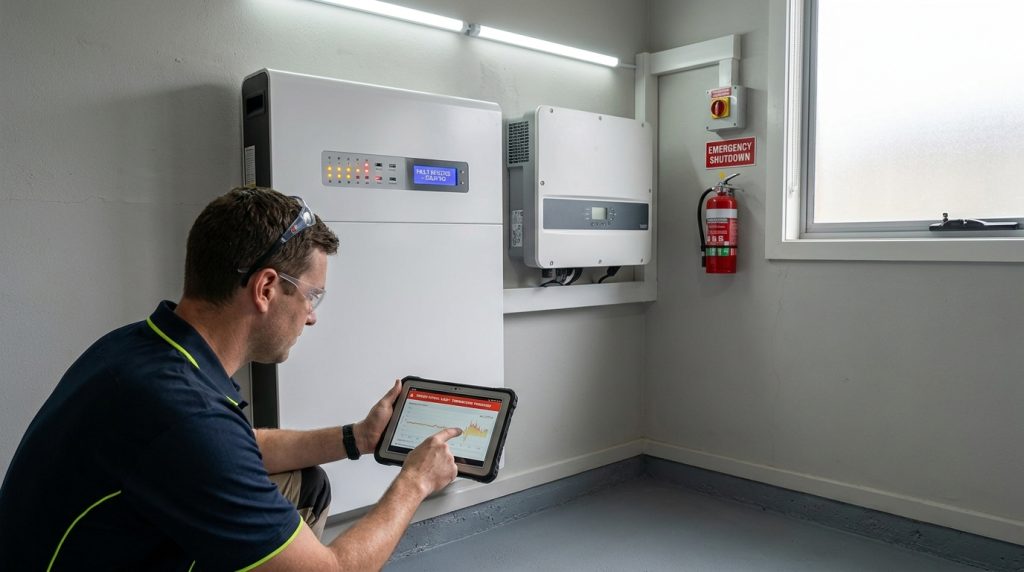
Without a BMS, a battery pack can overcharge, deep discharge, overheat, short, drift out of balance, or keep operating during abnormal conditions. The result may be lost capacity, nuisance shutdowns, damaged cells, or a higher fire and failure risk.
A battery pack is not one single object inside. It is a group of cells working together. If one cell becomes weak, too hot, too cold, overcharged, or over-discharged, the whole system can become unreliable. A strong BMS should catch these conditions before they turn into bigger failures.
| Scenario | Without proper BMS protection | With robust BMS protection | Homeowner warning sign |
|---|---|---|---|
| Overcharge | Cells may be pushed beyond safe limits | Charging is limited or stopped | Charging faults or repeated alarms |
| Deep discharge | Cells may be damaged and lose usable capacity | Discharge is stopped before cells fall too low | Battery shuts down earlier than expected |
| High current | Components may be stressed during heavy loads | Power is limited or disconnected if unsafe | Shutdown during motor or pump startup |
| Short circuit | Current can rise dangerously fast | The BMS triggers protection or disconnects | Immediate fault or system trip |
| Overheating | Heat can damage cells and increase safety risk | Charging or discharging is reduced or stopped | Temperature alarm or reduced output |
| Cold charging | Charging at unsafe temperatures can harm cells | Charging is blocked until temperature is safe | Battery refuses to charge in a cold garage |
| Cell imbalance | One weak cell limits the whole battery pack | Balancing reduces cell drift over time | SOC jumps or capacity seems inconsistent |
The DOE Energy Storage Safety Strategic Plan notes that BMS charge current limits can help reduce lithium deposition or plating risk. For a homeowner, the practical takeaway is simple: protection logic matters most when the system is under stress.
Does LiFePO4 Still Need a BMS?
Yes. LiFePO4 is often chosen because it has safety advantages compared with some other lithium battery chemistries, but it is not self-managing. It still needs voltage control, current control, temperature monitoring, cell balancing, and fault response.
This is one of the biggest buyer misunderstandings. A safer chemistry can reduce certain risks, but it does not remove the need for active protection. A LiFePO4 pack can still be damaged by overcharge, deep discharge, poor balancing, incorrect charging settings, high current, or charging in unsuitable temperature conditions.
The honest buying rule is simple: do not choose chemistry and ignore the BMS. Judge both together. A LiFePO4 home battery with weak BMS documentation is not the same as a LiFePO4 system with cell-level sensing, clear protection thresholds, communication support, and usable fault logs.
How Does Cell Balancing Protect Capacity and Lifespan?
Cell balancing keeps series-connected cells at similar charge levels so the weakest cell does not control the whole pack. For home systems, passive balancing is usually acceptable, but buyers should still ask for cell-level monitoring and balancing current.
In a series battery pack, every cell must work together. Over time, small differences between cells can grow. If one cell reaches a high-voltage or low-voltage limit before the others, the BMS may stop charging or discharging even when the rest of the pack still has room to operate.
| Balancing type | Basic idea | Buyer takeaway |
|---|---|---|
| Passive balancing | Bleeds extra energy from higher cells to reduce imbalance | Common and acceptable for many home systems if properly designed |
| Active balancing | Moves energy between cells more efficiently | More advanced, but not always necessary for every residential system |
The key buyer question is not only whether the system has balancing. Ask whether balancing is cell-level, whether imbalance alarms are visible, and whether the installer can see cell data during troubleshooting.
How Does the BMS Talk to the Inverter, EMS, and Monitoring App?
The BMS is not the same as the inverter, EMS, or mobile app. The BMS protects the battery. The inverter manages power conversion. The EMS may manage system-level energy flow. The app usually displays data, alarms, and settings for the user.
Communication matters because the inverter needs reliable battery data. The BMS may send SOC, SOH, charge limits, discharge limits, temperature warnings, and fault states. If communication is weak or incompatible, the system may charge poorly, shut down early, or show confusing data.
BMS vs EMS vs Inverter vs App
| System part | Main role | Why it matters |
|---|---|---|
| BMS | Protects and monitors the battery | Controls limits, alarms, and fault response |
| Inverter | Converts power between DC and AC | Must follow battery charge and discharge limits |
| EMS | Manages energy use across the system | Helps coordinate battery, solar, grid, and loads |
| Monitoring app | Shows status and alarms | Helps the homeowner understand system behavior |
Communication Questions to Ask Before Buying
- Which inverter brands has this BMS been tested with?
- Does it use CAN, RS485, Modbus, or another protocol?
- Can the installer export fault logs?
- Can the system show cell voltage, temperature, SOC, and SOH?
- What happens if communication between the BMS and inverter fails?
What Should a 2026 Home Buyer Demand in the BMS Spec?
A 2026 buyer should demand cell-level sensing, temperature sensors, overcurrent response, contactor disconnect, SOC and SOH logging, inverter communication, fault history export, and test documentation. The phrase BMS protected is not enough without these details.
Before buying a home battery system, ask the supplier or installer to explain the BMS in practical terms. A serious answer should include protection thresholds, data visibility, communication compatibility, and what the system does during faults.
- Cell-level voltage monitoring: Ask whether the BMS tracks individual cells or modules.
- Temperature sensing: Ask where sensors are placed and what happens during hot or cold conditions.
- Overvoltage and undervoltage cutoff: Ask for the thresholds and the recovery process.
- Overcurrent and short-circuit response: Ask how the system handles surge loads and faults.
- Contactor disconnect: Ask whether the BMS can physically disconnect the pack when needed.
- Cell balancing: Ask whether it is passive or active and when balancing occurs.
- SOC and SOH logging: Ask whether the system tracks charge level and battery health over time.
- Fault history export: Ask whether an installer can download logs for troubleshooting.
- Communication compatibility: Ask which inverter brands and protocols are supported.
- Safety documentation: Ask for relevant system-level testing and certification documentation.
UL explains that UL 9540 covers energy storage system safety review, including charging, discharging, protection, control, communication, and related functions. That is why the BMS spec should be reviewed together with system-level safety documentation.
What Does a BMS Not Protect You From?
A BMS is important, but it is not a complete safety system by itself. It is not a fire suppression system, not a replacement for certified product design, and not a substitute for a code-compliant installation.
A strong BMS can reduce risk by detecting abnormal battery conditions and responding quickly. However, it cannot fix poor enclosure placement, bad wiring, incompatible inverter settings, poor ventilation, missing clearances, or weak installer practices.
- A BMS does not replace proper installation.
- A BMS does not replace system-level safety testing.
- A BMS does not guarantee fire prevention in every abuse condition.
- A BMS does not make an incompatible inverter safe to use.
- A BMS does not remove the need for emergency planning and service access.
The NFPA ESS fact sheet describes the BMS as part of ESS safety and protection, but the broader safety picture also includes installation, code requirements, fire protection, and system-level controls. UL also describes UL 9540A as a test method for evaluating thermal runaway fire propagation in energy storage systems.
When Should You Treat BMS Behavior as a Warning Sign?
Some BMS actions are normal protection behavior. For example, a battery may stop charging when temperatures are outside the safe range. But repeated faults, confusing SOC changes, or missing diagnostic data should be treated as warning signs.
- Repeated shutdowns with no clear reason
- SOC jumps that do not match real battery use
- Frequent imbalance alarms
- Temperature alarms during normal conditions
- Communication loss between battery and inverter
- Charging blocked when temperature and settings appear normal
- Fault logs that cannot be read, exported, or explained
If these signs appear, the homeowner should not guess or bypass protection settings. The safer next step is to contact the installer or supplier and ask for a fault log review, inverter communication check, sensor check, and battery configuration review.
Practical Examples of BMS Protection in Real Home Systems
The Weak Cell in a 16-Cell Rack
A 16-cell battery rack may look healthy at the pack level, but one weak cell can reach its low-voltage limit first. A good BMS detects that cell and stops discharge before damage occurs. The homeowner may see the battery shut down earlier than expected, even when the app still shows remaining charge.
Cold Garage Charging
A battery installed in a cold garage may block charging when cell temperature is outside the safe charging range. This can feel like a fault, but it may be correct protection behavior. The buyer should ask where temperature sensors are placed and how the system reports low-temperature charging limits.
Well Pump Surge Load
A well pump or motor load can create a short current spike. A well-designed BMS should tolerate safe transient behavior but disconnect if current remains unsafe. This is why homeowners with motor loads should ask about surge handling, inverter compatibility, and overcurrent response.
Inverter Protocol Mismatch
If the battery reports SOC and alarms through one communication method, but the inverter does not read it correctly, the system may charge poorly or shut down early. This is not always a battery chemistry problem. It may be a BMS-to-inverter communication problem.
What Should You Read Next Before Choosing the Full System?
BMS protection is only one layer inside a full home energy storage system. Before choosing a complete system, buyers still need to evaluate battery chemistry, capacity, inverter compatibility, solar integration, installation method, monitoring, backup load design, and safety documentation.
The best next step is to use the BMS checklist as part of a broader system review. Do not buy based only on chemistry, capacity, or app screenshots. Ask how the battery protects itself, how the inverter responds, and what proof the supplier can provide.
FAQ
Does a LiFePO4 battery need a BMS?
Yes, a LiFePO4 battery still needs a BMS because safer chemistry does not manage voltage, current, temperature, or cell balance by itself. The BMS helps keep the pack inside safe operating limits.
What is the difference between a BMS and a battery controller?
A BMS protects and monitors the battery pack, while a controller may manage charging, power flow, or system behavior. In some products the terms overlap, so buyers should ask what protections are actually included.
Can a BMS extend battery life?
Yes, a good BMS can help extend battery life by preventing abuse conditions and keeping cells more balanced. It cannot make poor-quality cells good, but it can reduce avoidable stress.
What communication protocol should my BMS use?
The right protocol is the one your inverter or EMS supports reliably, often through CAN, RS485, or Modbus depending on the product. Ask the supplier for tested inverter compatibility, not just protocol names.
How do I know if my BMS is failing?
Common warning signs include repeated shutdowns, strange SOC jumps, imbalance alarms, temperature alarms, or communication loss. If the installer cannot read or export fault logs, the issue is harder to diagnose safely.
What does BMS stand for?
BMS stands for Battery Management System. In a home energy storage system, it is the electronics and software layer that monitors the battery and responds when operating limits are exceeded.
How does a BMS protect a battery?
A BMS protects a battery by measuring voltage, current, temperature, balance, and fault conditions, then limiting or disconnecting charge and discharge when needed. Better systems also record fault history for diagnosis.

-

 OEM Residential Energy Storage Solutions: Passive vs. Active Cell Balancing
2026-09-30
-
 Smart Home Battery with BMS Communication: Cybersecurity and BMS Safety
 -
 10kWh Home Battery Backup System: Is 90% DoD Better for Daily Solar Storage?
2026-09-29
-
 Integrated Home Energy Storage System 150–430V MPPT Design
2026-09-28
-
 LiFePO₄ Residential Backup Battery SOC Accuracy in Parallel Systems
Share this:





.svg)






-899.svg)


