




Lithium-Ion vs LiFePO4 Home Battery: Which Wins
Lithium-ion home battery storage is not one chemistry. For houses, LiFePO4 usually beats NMC and lead-acid because it offers stronger thermal stability, long cycle life, low maintenance, and better cost-per-cycle. NMC still wins where compact energy density matters most, especially EVs. Lead-acid is mainly a low-budget backup option, not the best daily solar storage choice.
A homeowner should not buy a battery only because the label says “lithium-ion.” That word can hide very different chemistries underneath. NMC, LiFePO4, and lead-acid batteries behave differently in heat, daily cycling, lifespan, maintenance, and long-term cost. This guide compares them clearly, so you can judge the material behind the marketing claim.
Is “lithium-ion” one battery type or a family of chemistries?
Lithium-ion is not one single home battery chemistry. In residential storage, the important comparison is usually NMC lithium-ion vs LiFePO4/LFP vs lead-acid, because each chemistry behaves differently in cycle life, safety, size, and long-term cost.
Lithium-ion is a battery family, not a single material. NMC means lithium nickel manganese cobalt. LiFePO4, also called LFP, means lithium iron phosphate. Both are lithium-ion chemistries, but they are built for different priorities.
This matters because many battery pages use “lithium-ion” as a premium word without saying which chemistry is inside. For home storage, that detail affects daily cycling, thermal behavior, usable capacity, and warranty expectations. NREL’s residential battery storage model also separates lithium-ion batteries into NMC and LFP chemistries for stationary storage analysis.
Lead-acid is different. It is an older battery chemistry, often cheaper upfront, but it usually needs more space, more care, and more replacement planning. So the real question is not “Is lithium-ion good?” The better question is: which chemistry fits your home?
NMC vs LiFePO4 vs lead-acid: what is the real difference?
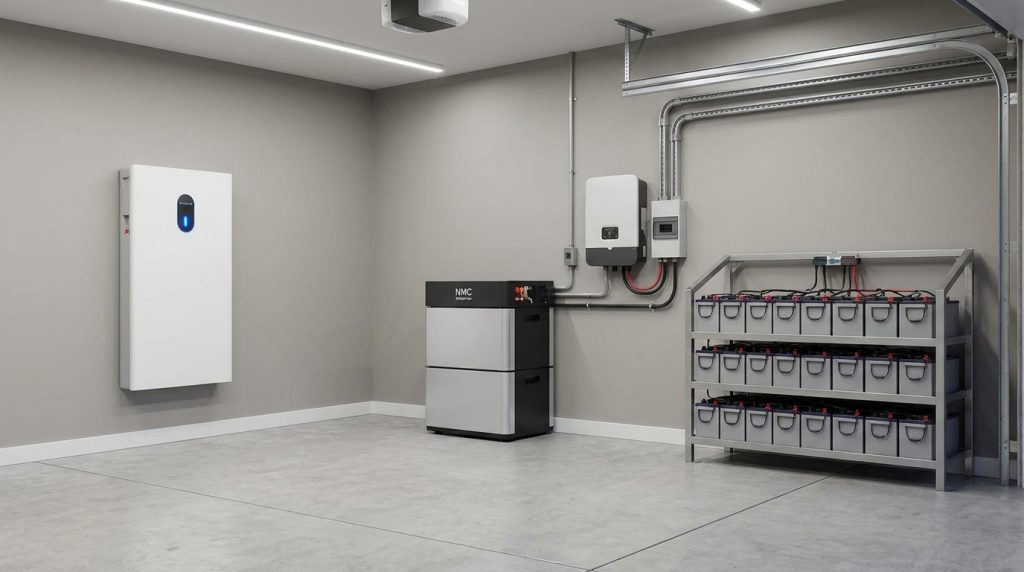
For most homes, LiFePO4 is the strongest residential chemistry because it balances safety, cycle life, calendar life, and cost-per-cycle better than NMC or lead-acid. NMC still matters where compact, high-energy battery packs are more important.
The fastest way to compare these batteries is by job. NMC is common where high energy density matters. LiFePO4 is favored where long service life and stable behavior matter. Lead-acid fits basic backup needs when the budget is tight and cycling is light.
| Battery chemistry | Main strength | Main weakness | Best fit |
|---|---|---|---|
| NMC lithium-ion | Higher energy density | Less ideal for heat-sensitive stationary use | EVs, compact energy packs |
| LiFePO4 / LFP | Long cycle life and safer thermal behavior | Lower energy density than NMC | Residential solar and backup storage |
| Lead-acid | Lower upfront price | Shorter life, more maintenance, less usable capacity | Occasional backup on a tight budget |
NMC is not a bad battery chemistry. It is simply optimized for compact energy. That makes sense in EVs, where weight and space are strict limits. A wall-mounted home battery usually has different priorities: safety, cycle life, service life, and stable daily use.
For complete system planning beyond chemistry, use a broader home energy storage system guide. This article stays focused on the battery material decision.
Which battery lasts longer in daily home use?
LiFePO4 usually lasts longer in daily residential cycling because it is designed for many repeated charge-discharge cycles with low maintenance. Lead-acid may be cheaper upfront, but daily cycling can make it more expensive over time.
A home battery may charge from solar in the afternoon and discharge every evening. That daily pattern is hard on weak chemistries. For this use, cycle life and depth of discharge matter more than the sticker price.
Cycle life vs calendar life
Cycle life means how many charge and discharge cycles the battery can handle before its useful capacity drops. Calendar life means how many years the battery can stay in service. A battery can age from both use and time, so both numbers matter.
LiFePO4 is usually stronger for daily residential cycling. Lead-acid can work for backup, but repeated deep discharge can reduce its useful life faster. If you are comparing battery modules, connect this section with your battery pack sizing plan.
Why DoD changes real usable value
Depth of discharge, or DoD, means how much of the battery you can safely use before recharging. A 10 kWh battery with limited usable depth may not give you 10 kWh in real use. That affects both backup time and cost-per-cycle.
| Factor | Why it matters for homeowners |
|---|---|
| Cycle life | Shows how well the battery handles daily use |
| Calendar life | Shows expected service years |
| DoD | Changes usable energy from the rated capacity |
| Maintenance | Adds hidden time and replacement cost |
| Temperature | Affects aging and safe operation |
Which chemistry is safer for a house?
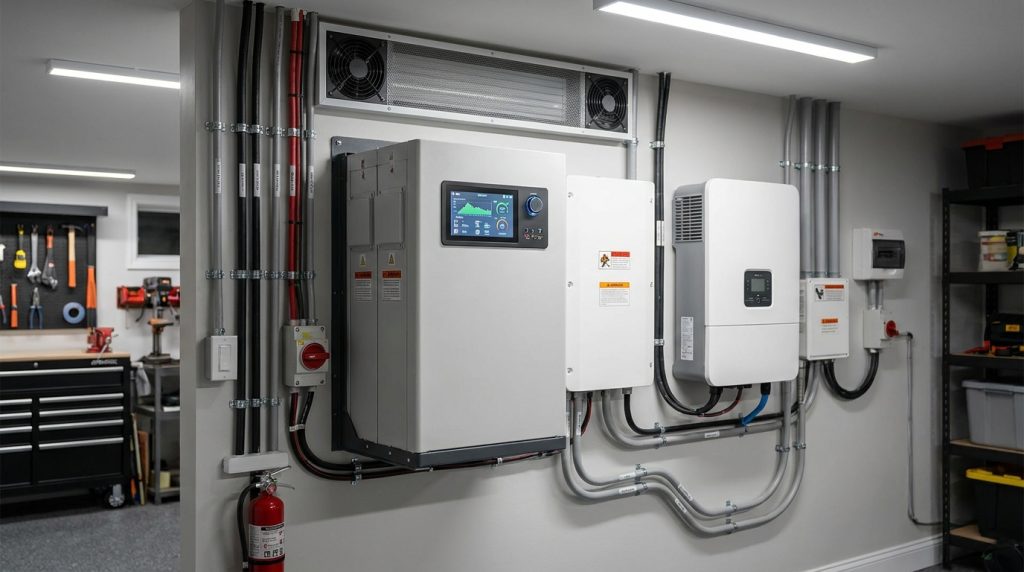
LiFePO4 is usually the safer residential choice because it is more thermally stable than NMC, but chemistry alone is not enough. A safe home battery also needs a good BMS, certified hardware, correct installation, and suitable placement.
Safety is a system question. Chemistry matters, but it does not replace a battery management system, certified components, correct wiring, and a suitable installation area. A good home battery should manage charge, discharge, temperature, voltage, and fault conditions.
The EPA notes that lithium-ion battery energy storage fires can be difficult to manage and may create cleanup concerns. That does not mean home batteries are unsafe by default. It means the buyer should care about design quality and installation discipline.
What safety depends on besides chemistry
Use this checklist before buying:
- Confirm the exact battery chemistry, not only “lithium-ion”
- Check for a battery management system, or BMS
- Ask about UL 9540 and related ESS safety testing
- Confirm inverter compatibility
- Check indoor or outdoor placement guidance
- Ask how the system handles overheating, overcharge, and fault protection
UL’s energy storage system testing and certification explains how UL 9540 connects to ESS safety. For a homeowner, the practical takeaway is simple: do not separate battery chemistry from the full system.
Does NMC win because it has higher energy density?
NMC does not automatically win for home storage just because it has higher energy density. Energy density matters more in EVs, while residential batteries usually reward safer thermal behavior, longer cycle life, and predictable long-term service.
Energy density means how much energy a battery stores for its size or weight. NMC often looks attractive here. That is why it appears in many EV discussions, where every kilogram and every inch of space matters.
A home battery has a different job. It may sit on a wall, in a garage, or in a utility area. If the system has enough space, the homeowner may benefit more from long cycle life, thermal stability, and lower maintenance than from maximum compactness.
| If your priority is… | Better fit | Why |
|---|---|---|
| Compact energy for a moving vehicle | NMC | Higher energy density helps reduce size and weight |
| Daily home solar cycling | LiFePO4 | Long cycle life and stable behavior matter more |
| Low-cost emergency backup | Lead-acid | Lower upfront price can fit light use |
| Long-term residential value | LiFePO4 | Better balance of safety, life, and cost-per-cycle |
So NMC can win in the right place. For most homes, that place is not the main battery wall. It is the EV in the driveway.
Is lead-acid still worth considering?
Lead-acid can still make sense for occasional backup when the budget is very tight. It is usually not the best choice for daily solar cycling because it has lower usable depth, shorter service life, and more maintenance needs.
Lead-acid is not useless. It can work for a cabin, a small backup setup, or a buyer who needs the lowest entry cost and will not cycle the battery every day. The tradeoff is that cheaper upfront cost can turn into replacement cost later.
Use lead-acid only when these conditions fit:
- You need backup only a few times per year
- You have enough space for a larger battery bank
- You accept more maintenance and replacement planning
- You do not need deep daily cycling
- Lowest purchase price matters more than long-term value
For a daily solar home, LiFePO4 is usually the stronger benchmark. It is easier to maintain, better suited to repeated cycling, and more practical for homeowners who want predictable service.
What does cost-per-cycle reveal that upfront price hides?
Cost-per-cycle shows why the cheapest battery is not always the lowest-cost battery. A more expensive LiFePO4 system can deliver lower lifetime cost when it provides more usable cycles, less maintenance, and fewer replacements.
Upfront price tells you what you pay today. Cost-per-cycle tells you what each useful charge-discharge cycle may cost over the battery’s life. That second number is closer to how a daily-use home battery actually performs.
Simple homeowner cost-per-cycle example
These numbers are only an example. A real quote depends on brand, capacity, inverter design, warranty, labor, and local conditions.
| Example option | Upfront cost | Usable capacity | Expected cycles | Lifetime delivered energy | Rough cost per delivered kWh |
|---|---|---|---|---|---|
| Lead-acid backup bank | $2,000 | 5 kWh | 800 | 4,000 kWh | $0.50 |
| NMC home battery | $4,500 | 8 kWh | 3,000 | 24,000 kWh | $0.19 |
| LiFePO4 home battery | $5,000 | 9 kWh | 5,000 | 45,000 kWh | $0.11 |
The point is not that every LiFePO4 battery has the same price. The point is that daily cycling changes the math. If a homeowner uses the battery every evening, usable energy and cycle life can matter more than the first invoice.
Final verdict: which battery should a homeowner choose?
Choose LiFePO4 for most residential home battery storage, NMC for EV-style high-energy compact packs, and lead-acid only for low-budget or low-cycle backup. The simple verdict is: LiFePO4 for residential, NMC for EV.
For a normal solar home, LiFePO4 gives the best balance. It handles daily cycling well, offers strong thermal behavior, needs little routine maintenance, and fits the long-service goal of stationary storage. That is why it is often the practical choice for residential ESS design.
| Use case | Best choice | Reason | Verdict |
|---|---|---|---|
| Daily solar charging and evening use | LiFePO4 | Strong cycle life and stable operation | Best residential choice |
| Garage wall battery with long service goal | LiFePO4 | Good fit for stationary storage | Best long-term fit |
| EV battery pack | NMC | Higher energy density helps mobile use | Best EV fit |
| Small cabin backup | Lead-acid | Lower entry cost for light cycling | Acceptable budget option |
| Whole-home backup with frequent cycling | LiFePO4 | Better lifetime value and lower maintenance | Strongest homeowner option |
A battery is not safe just because the chemistry sounds safer. The full system still matters. For homeowners who want a deeper chemistry-focused guide, read more about LiFePO4 home storage.
What should you check before buying a home battery?
Before buying, ask for the exact chemistry, usable capacity, warranty terms, BMS features, safety certifications, and inverter compatibility. Do not buy only by the kWh label because rated capacity and usable capacity are not always the same.
Use this buyer checklist when comparing quotes:
- What chemistry is inside: NMC, LiFePO4, or lead-acid?
- What is the usable capacity, not only rated capacity?
- What cycle life and warranty terms are stated?
- Does the warranty mention throughput or usage limits?
- What BMS protections are included?
- Is the ESS tested to recognized safety standards?
- Is the inverter compatible with this battery?
- Where can the battery be installed safely?
- What monitoring app or display is included?
- What are the self-install limits for this system?
Warranty language deserves special attention. Some batteries look strong on paper, but the warranty may limit claims by cycles, years, temperature, installation method, or total energy throughput. Use a battery warranty checklist before you sign.
How to Choose the Right Option
For lithium-ion home battery storage, start with the real chemistry, then check the full system. LiFePO4 is the safer default for most residential solar and backup projects. NMC belongs where compact energy matters most, and lead-acid belongs only where low upfront cost matters more than daily-use value.
Your next step is simple: ask the supplier for the exact chemistry, usable capacity, BMS details, safety certification, warranty limits, and inverter match. If they only say “lithium-ion,” ask again.
Frequently Asked Questions
Can I use a lithium battery storage system without solar panels?
Yes, a lithium battery can work without solar if it charges from the grid and discharges during outages or peak-rate periods. The value depends on electricity tariffs, backup needs, and whether your inverter setup supports grid charging.
What can I power with a lithium battery storage system during an outage?
A lithium battery can power essential loads such as lights, Wi-Fi, refrigeration, device charging, and selected appliances if the system is sized and wired for backup. Whole-home backup needs more capacity and a suitable inverter.
How long does a lithium battery storage system typically last?
A quality lithium home battery commonly lasts around a decade or more, but real life depends on chemistry, cycle count, depth of discharge, temperature, and BMS quality. LiFePO4 is usually preferred for frequent residential cycling.
How much maintenance does the system require?
LiFePO4 and NMC home batteries usually need little routine maintenance beyond monitoring, clear ventilation, and periodic system checks. Lead-acid batteries can require more maintenance and replacement planning.
How should I dispose of lithium-ion batteries?
Lithium-ion batteries should go to specialized recycling or hazardous waste collection points, not household trash or normal recycling bins. The EPA explains that damaged batteries can create fire risk during transport or waste processing.
Why shouldn’t Li-ion batteries be put in the municipal or household recycling bin?
Li-ion batteries can be crushed or damaged in municipal recycling facilities and become a fire hazard. The recycling symbol means specialized battery recycling, not normal curbside recycling.
Is a lead-acid battery still good for home backup?
Lead-acid can still work for low-budget, occasional backup where space and maintenance are not major concerns. For daily solar cycling, LiFePO4 usually gives better long-term value.

-

 OEM Residential Energy Storage Solutions: Passive vs. Active Cell Balancing
2026-09-30
-
 Smart Home Battery with BMS Communication: Cybersecurity and BMS Safety
 -
 10kWh Home Battery Backup System: Is 90% DoD Better for Daily Solar Storage?
2026-09-29
-
 Integrated Home Energy Storage System 150–430V MPPT Design
2026-09-28
-
 LiFePO₄ Residential Backup Battery SOC Accuracy in Parallel Systems
Share this:





.svg)






-899.svg)


