




LiFePO4 Home Battery Packs: Module-by-Module Guide
LiFePO4 Home Battery Packs are rated by voltage and amp-hours, but runtime comes from kWh. A 51.2V 100Ah pack stores 5.12 kWh, a 51.2V 200Ah pack stores 10.24 kWh, and a 48V 100Ah pack stores 4.8 kWh. Divide usable watt-hours by your load in watts to estimate backup time.
Battery labels can look simple until you try to size a real backup system. A homeowner may see 51.2V 100Ah and wonder whether it can run a refrigerator overnight. An installer may need to translate a data sheet into usable runtime. This guide explains the pack ratings, the cell layout behind them, and the checks that matter before choosing a module.
What is a LiFePO4 home battery pack?
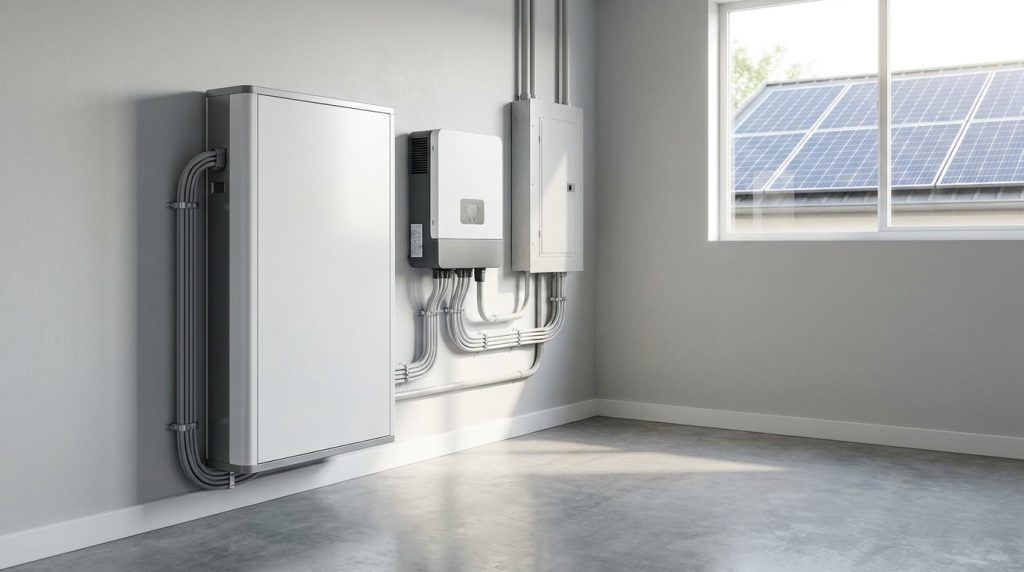
A LiFePO4 home battery pack is the storage module inside a home energy system. It stores DC electricity, uses a BMS for protection, and works with an inverter or all-in-one ESS to power household loads.
The pack is only one part of the full system. It stores energy, but it does not turn that energy into household AC power by itself. That job belongs to the inverter or all-in-one energy storage system. For full system planning, use a broader home storage system guide.
LiFePO4 means lithium iron phosphate. It is a lithium battery chemistry used in many home storage systems because it fits high-cycle, stationary backup use. The battery management system, or BMS, monitors voltage, current, temperature, and protection limits inside the pack.
A safe home battery setup also depends on installation rules, product testing, and correct equipment matching. UL explains that UL 9540 covers energy storage systems and equipment, including protection, control, charging, discharging, and communication parts.
What does 51.2V 100Ah mean in kWh?
A 51.2V 100Ah LiFePO4 pack stores 5.12 kWh of gross energy because 51.2 × 100 = 5,120Wh. Usable runtime depends on depth of discharge, inverter efficiency, and the load in watts.
The formula is simple:
Volts × Amp-hours = Watt-hours
So for a 51.2V 100Ah pack:
51.2V × 100Ah = 5,120Wh
5,120Wh ÷ 1,000 = 5.12 kWh
That 5.12 kWh number is gross energy. Real backup time is usually lower because the system may keep a reserve, limit depth of discharge, and lose some energy during DC-to-AC conversion. BSL Battery gives the same basic 51.2V × 100Ah calculation for a 5.12 kWh pack in its 51.2V 100Ah explainer.
This is why amp-hours alone can mislead buyers. A 100Ah battery at 12V is not the same as a 100Ah battery at 51.2V. Voltage changes the total energy. For a deeper look at why this chemistry is used for residential backup, see Voltalink’s guide to LiFePO4 storage benefits.
Why do 48V and 51.2V labels describe the same battery class?
In home storage, “48V” often names the system class, while 51.2V is the nominal voltage of a 16-cell LiFePO4 pack. The real compatibility question is whether the inverter supports the battery’s voltage range and BMS communication.
A LiFePO4 cell is commonly treated as about 3.2V nominal. When 16 cells are connected in series, the pack becomes 51.2V nominal. Lipower’s LiFePO4 voltage guide explains this 16-cell layout for the common 48V battery class.
| Label on product | What it often means | What to check |
|---|---|---|
| 48V battery | System voltage class | Actual nominal voltage and voltage range |
| 51.2V battery | 16S LiFePO4 nominal voltage | Inverter compatibility |
| 48V inverter | Inverter class | Supported battery voltage window |
Do not choose by label alone. A battery may be sold as 48V because it fits a 48V inverter class, but the data sheet may list 51.2V nominal voltage. Check charge voltage, discharge cutoff, BMS communication, and approved inverter list before matching parts.
How are cells arranged inside a LiFePO4 pack?
Series connections increase voltage, while parallel connections increase capacity. A 16S LiFePO4 pack reaches about 51.2V nominal, and adding compatible modules in parallel increases stored kWh without changing the system voltage class.
Think of series as stacking voltage. If each LiFePO4 cell is about 3.2V nominal, putting 16 cells in series creates a 51.2V nominal pack. This is why many home battery modules fit the 48V class but show 51.2V on the data sheet.
Series raises voltage
Series wiring connects the positive end of one cell group to the negative end of the next. The amp-hour rating stays the same, but voltage increases. That higher voltage lets the battery work with common residential hybrid inverters and ESS equipment.
Parallel raises capacity
Parallel wiring keeps the same voltage class but increases amp-hours and kWh. At the pack level, two matching 51.2V 100Ah modules in parallel can act like a 51.2V 200Ah system if the manufacturer supports that design.
Parallel expansion is useful, but it is not casual mixing. Use the same model, voltage class, firmware, cable sizing, and BMS protocol when possible. The manufacturer’s maximum parallel count matters more than a simple math shortcut.
How do 51.2V 100Ah, 51.2V 200Ah, and 48V 100Ah compare?
A 51.2V 200Ah pack stores about twice the energy of a 51.2V 100Ah pack. A 48V 100Ah pack stores 4.8 kWh gross, slightly less than a 51.2V 100Ah pack at 5.12 kWh.
Use this decoder before comparing price, weight, rack space, or inverter match. It keeps the main rating math visible before you move into deeper data sheet details or a battery buyer reference.
| Pack rating | Gross energy calculation | Gross kWh | Best-fit use | Buyer caution |
|---|---|---|---|---|
| 51.2V 100Ah | 51.2 × 100 | 5.12 kWh | Short essential backup or modular expansion | Runtime depends on load and usable capacity |
| 51.2V 200Ah | 51.2 × 200 | 10.24 kWh | Longer backup with fewer modules | Heavier and harder to move |
| 48V 100Ah | 48 × 100 | 4.8 kWh | 48V-class systems and compact backup | Check actual nominal voltage on the data sheet |
A 51.2V 200Ah pack is not always the best choice. It works when you need longer backup from fewer modules, but 51.2V 100Ah modules can be easier to move, expand, and service.
How long will each pack run real home loads?
Runtime depends on usable watt-hours divided by the load in watts. For planning, a 5.12 kWh pack with about 4.6 kWh usable energy can run a 500W load for roughly 9 hours before inverter losses and reserve settings.
The practical formula is:
Runtime = usable Wh ÷ load W
Haisic uses the same basic runtime logic in its home battery backup guide. For a simple planning estimate, the table below uses 90% usable energy. It does not include every real-world loss, surge event, temperature effect, or battery reserve setting.
| Average load | 51.2V 100Ah, 5.12 kWh gross, 4.61 kWh usable | 51.2V 200Ah, 10.24 kWh gross, 9.22 kWh usable | 48V 100Ah, 4.8 kWh gross, 4.32 kWh usable | Practical note |
|---|---|---|---|---|
| 300W | About 15.4 hours | About 30.7 hours | About 14.4 hours | Essential-load night backup |
| 500W | About 9.2 hours | About 18.4 hours | About 8.6 hours | Refrigerator, router, lights, fans |
| 1,000W | About 4.6 hours | About 9.2 hours | About 4.3 hours | Medium backup load |
| 2,000W | About 2.3 hours | About 4.6 hours | About 2.2 hours | High draw, check inverter limits |
Here is a real essential-load example. A router at 25W, lights at 60W, a refrigerator averaging 150W, and a fan at 60W create about a 295W load. A 51.2V 100Ah pack with about 4.61 kWh usable energy could cover roughly one night in this scenario.
Ah alone is a weak sizing shortcut. It only becomes useful when paired with voltage, usable depth of discharge, and the actual load in watts. A 100Ah rating does not mean 100 hours of runtime.
When should you add modules in parallel?
Add modules in parallel when you need more kWh at the same voltage class. Parallel expansion usually improves backup duration, but the inverter rating still decides how much power can be delivered at one time.
Parallel expansion fits homeowners who want longer outage coverage without changing the system voltage class. For example, two matched 51.2V 100Ah modules can double the gross energy from 5.12 kWh to 10.24 kWh if the battery maker allows that setup.
| Situation | Good next step | Why |
|---|---|---|
| Runtime is too short, but load size is reasonable | Add a matching module in parallel | More kWh at the same voltage class |
| Appliances exceed inverter output | Upgrade inverter or reduce loads | More battery capacity does not fix AC output limits |
| You want future expansion | Choose modules with approved parallel support | Easier to add capacity later |
| Modules are different brands or ages | Avoid mixing unless approved | BMS behavior and balance may differ |
| Solar charging is planned | Check the hybrid battery system design | Battery, inverter, and PV input must match |
Parallel expansion is useful for runtime, not a free pass for heavier appliances. The inverter, wiring, BMS limits, and surge rating still decide what the system can safely power.
What data sheet specs should you check before buying?
Check voltage range, usable capacity, current limits, communication, certifications, and shipping documents before buying. These specs decide whether the pack fits your inverter, your backup goal, and your installation plan.
Use this checklist when comparing a Voltalink data sheet or any LiFePO4 battery pack:
- Nominal voltage, such as 51.2V
- Full charge voltage and discharge cutoff
- Rated Ah and gross kWh
- Recommended usable depth of discharge
- Max continuous charge current
- Max continuous discharge current
- Peak or surge discharge limit
- BMS communication, such as CAN or RS485
- Approved inverter brands or protocols
- Parallel connection limit
- Warranty terms and cycle rating
- Certification and transport documents
For transport, PHMSA explains that lithium batteries are regulated as hazardous materials during shipping, and its lithium battery page also refers to UN 38.3 test summary requirements. PHMSA also provides a lithium battery guide for shippers, updated for scenario-based shipping checks.
Do not treat shipping paperwork as a minor detail. Large lithium battery packs may face transport, customs, and classification checks. CBP’s lithium-ion battery pack ruling page gives an example of tariff classification activity for lithium-ion battery packs under HTSUS 8507.60.0020.
Before power-up, pair this data sheet review with a proper commissioning checklist. For long-term ownership, review the warranty checklist before assuming cycle life, replacement coverage, or expansion terms.
What is the safest way to use this guide before installation?
Use this guide for sizing logic, not wiring instructions. The safest next step is to calculate your loads, check battery and inverter compatibility, then confirm installation requirements with the supplier, installer, and local rules.
A simple pre-install path looks like this:
- List your essential loads in watts.
- Add the average load you expect during an outage.
- Convert the pack rating into gross kWh.
- Apply a usable-capacity planning margin.
- Compare runtime against your outage target.
- Confirm inverter voltage range and output rating.
- Check BMS communication and approved parallel count.
- Ask for the data sheet, warranty terms, and safety documentation.
Home energy storage safety is bigger than pack math. EPA lists NFPA 855, UL 9540, and UL 9540A among key BESS standards and safety considerations on its battery energy storage systems page. UL also explains the UL 9540A test method for evaluating thermal runaway fire propagation.
If you plan any hands-on work, treat the calculation as planning support only. Use Voltalink’s self-install safety guidance before deciding what you can do yourself and what should be left to a qualified installer.
What to Do Next
LiFePO4 Home Battery Packs become easier to compare once you translate the label into kWh and runtime. Start with voltage times amp-hours, then reduce the result for usable capacity and real system losses. After that, check inverter match, BMS communication, current limits, and parallel support.
For most homeowners, the right choice is not the biggest pack on the page. It is the module that matches the load, runtime target, installation space, and future expansion plan. If the data sheet is unclear, ask the supplier for the missing numbers before buying.
Frequently Asked Questions
How many kWh is a 51.2V 100Ah battery?
A 51.2V 100Ah battery stores 5.12 kWh of gross energy. Multiply 51.2 volts by 100 amp-hours to get 5,120 watt-hours, then divide by 1,000.
How long will a 51.2V 100Ah battery last?
It depends on the load. If usable capacity is about 4.6 kWh, a 500W load can run for about 9 hours before real-world losses and reserve settings.
What is the difference between a 48V and a 51.2V battery?
In many LiFePO4 home systems, 48V is the system class and 51.2V is the nominal pack voltage. A 16S LiFePO4 pack uses 16 cells at about 3.2V each.
Can I connect multiple 51.2V 100Ah batteries in parallel?
Yes, if the manufacturer allows it and the modules match. Parallel connection increases capacity at the same voltage, but cable sizing, BMS communication, and inverter limits still matter.
What inverter is compatible with a 51.2V 100Ah battery?
Use an inverter designed for the 48V battery class and confirm its voltage range, charge settings, and BMS communication. Do not rely only on the “48V” label.
How many cycles does a 51.2V 100Ah LiFePO4 battery last?
Cycle life depends on cell quality, depth of discharge, temperature, and the manufacturer rating. Many LiFePO4 home battery pages reference several thousand cycles, but the buyer should verify the exact data sheet.
Is a 51.2V 100Ah battery safe for indoor installation?
It can be safe when certified, properly installed, and used within the manufacturer’s limits. Indoor use still requires correct clearance, protection, ventilation guidance, and local electrical or fire-code compliance.

-

 OEM Residential Energy Storage Solutions: Passive vs. Active Cell Balancing
2026-09-30
-
 Smart Home Battery with BMS Communication: Cybersecurity and BMS Safety
 -
 10kWh Home Battery Backup System: Is 90% DoD Better for Daily Solar Storage?
2026-09-29
-
 Integrated Home Energy Storage System 150–430V MPPT Design
2026-09-28
-
 LiFePO₄ Residential Backup Battery SOC Accuracy in Parallel Systems
Share this:





.svg)






-899.svg)


