




LiFePO4 Home Energy Storage: Why It Won the Home
LiFePO4 home energy storage won homes because it trades maximum energy density for safer, longer-lived daily storage. Its iron phosphate cathode is more thermally stable than NMC, supports high cycle counts under normal use, and usually lowers cost per delivered cycle. For a homeowner, the key question is not peak specs. It is safety, usable life, warranty proof, and installed system design.
What is LiFePO4 home energy storage?
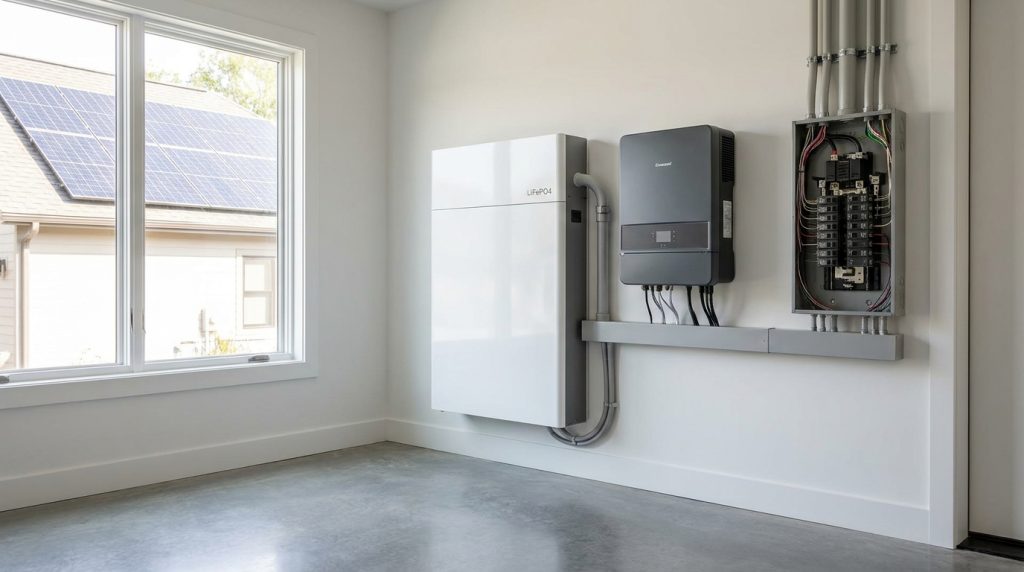
LiFePO4 home energy storage uses lithium iron phosphate cells to store solar or grid electricity for home backup and daily load shifting. It became popular because homes value safety, cycle life, and stable performance more than maximum energy density.
LiFePO4 is often shortened to LFP. It is a type of lithium-ion battery chemistry, not a completely separate battery family. In a residential energy storage system, LFP cells are usually combined with a battery management system, enclosure, inverter connection, and monitoring controls.
For homeowners, the chemistry matters because a home battery is not carried like a phone or electric vehicle pack. It sits in or near the house and may cycle every day. That makes safety behavior, usable life, warranty clarity, and long-term cost more important than having the smallest possible battery pack.
Why did LiFePO4 become the home battery default by 2026?
LiFePO4 became the residential default because stationary batteries reward long life, safer thermal behavior, and lower delivered energy cost. NMC can store more energy in less space, but most homes benefit more from durable daily cycling.
In home energy storage, weight and compact size are usually not the top priorities. A homeowner is more likely to care about safe backup power, daily solar storage, predictable life, and fewer replacement concerns. This is where LFP fits the residential use case well.
- Safety: LFP is known for stronger thermal stability than many nickel-rich lithium chemistries.
- Cycle life: It is well suited for daily charging and discharging.
- Lifetime value: A higher upfront price can make sense if the battery delivers more usable lifetime energy.
- Home fit: Stationary storage can accept a larger battery footprint when safety and life are better.
Why is LiFePO4 safer than NMC for a house?
LiFePO4 is safer for homes because its cathode chemistry is more thermally stable than nickel-rich lithium chemistries. The right conclusion is not “impossible to burn,” but “harder to push into dangerous failure when designed correctly.”
Thermal runaway means uncontrolled self-heating inside a battery cell. In a severe failure, a lithium-ion cell can release heat, flammable gas, smoke, or flame. LFP chemistry reduces this risk compared with less stable chemistries, but the full system still needs proper protection.
| Buyer concern | What it means | What to check |
|---|---|---|
| “Is the chemistry safer?” | LFP is more thermally stable than many NMC-style lithium batteries. | Ask for the battery chemistry, cell documentation, and safety certifications. |
| “Is the system safe?” | Good chemistry alone does not guarantee a safe installation. | Check the BMS, enclosure, inverter compatibility, spacing, and installer guidance. |
| “Can it still fail?” | Any battery can fail under abuse, poor installation, or electrical faults. | Look for protection against overcharge, short circuit, overheating, and misuse. |
A safety-driven buyer should treat LFP as a strong starting point, not the whole answer. The safer choice is a certified LiFePO4 system installed and commissioned correctly.
What does “no thermal runaway” really mean in abuse tests?

In abuse testing, “no thermal runaway” should mean the tested cell or system does not enter uncontrolled self-heating or spread failure under defined test conditions. It does not mean the battery can be abused without heat, gas, smoke, or damage.
Battery abuse tests may involve overcharge, external heating, short circuit, crushing, puncture, or propagation from a nearby failing cell. The question is not only whether the first cell is damaged. The bigger question is whether the failure becomes uncontrollable or spreads through the battery system.
What the cell does
Under abuse, a LiFePO4 cell may heat up, vent gas, lose capacity, or become permanently damaged. A strong result does not mean the cell stays perfect. It means the cell does not enter the kind of uncontrolled failure that creates rapid propagation risk.
What the system must contain
The battery system must limit the damage if a cell fails. That is where the BMS, thermal management, module spacing, enclosure design, and installation environment matter. For residential ESS, safety is a system-level result, not just a chemistry label.
| Abuse condition | What the cell may do | What the BMS should do | Homeowner takeaway |
|---|---|---|---|
| Overcharge | Heat, swell, vent, or degrade | Stop charging before voltage becomes unsafe | Ask how the system prevents overcharge. |
| External heat | Rise in temperature or lose stability | Trigger alarms or shutdown protection | Installation temperature limits matter. |
| Short circuit | Rapid heating or electrical failure | Cut current through protection circuits | Wiring and breaker protection are critical. |
| Crush or puncture | Internal damage, heat, gas, or cell failure | Limit further electrical stress | Physical placement and enclosure quality matter. |
| Neighboring cell failure | Possible heat transfer | Slow or stop propagation | System-level test evidence is important. |
How long does a LiFePO4 home battery really last?
A LiFePO4 home battery can last many years, but the cycle count alone is not enough. Buyers should check depth of discharge, temperature range, end-of-life capacity, calendar warranty, and whether the warranty covers real home cycling.
A “6,000+ cycles” claim can be useful, but only when the test conditions are clear. A cycle-life number should state the depth of discharge, test temperature, charge and discharge rate, and remaining capacity at end of life.
- Cycle life: How many charge and discharge cycles the battery can deliver before reaching its end-of-life capacity.
- Calendar life: How long the battery lasts over time, even if it is not cycled heavily.
- Depth of discharge: How much of the battery is used during each cycle.
- End-of-life capacity: The remaining capacity when the battery is considered aged.
- Warranty terms: The document that shows what the seller actually promises.
This is why a homeowner should never judge the battery by cycle count alone. The better question is whether the cycle claim matches the way the battery will be used at home.
Is LiFePO4 cheaper than NMC over its life?
LiFePO4 is often cheaper over its life when it delivers more warranted cycles and usable energy. The buyer should compare cost per delivered kWh, not only battery price, because a cheaper NMC pack may cycle out sooner.
Sticker price can be misleading. A battery with a lower upfront price can cost more over time if it has fewer usable cycles, lower depth of discharge, weaker warranty support, or shorter calendar life. For home storage, lifetime delivered energy is the more useful comparison.
Simple formula: installed battery cost ÷ usable lifetime kWh = cost per delivered kWh.
For example, a homeowner comparing two quotes should not only ask which battery is cheaper today. They should compare usable capacity, warranted cycles, allowed depth of discharge, and expected daily cycling. The better battery is the one that delivers safe, reliable energy at the lower lifetime cost.
How does LiFePO4 compare with NMC and lead-acid on one page?
LiFePO4, NMC, and lead-acid can all store energy, but they solve different problems. For residential storage, the best chemistry is usually the one that balances safety, usable life, cost, and installation reality.
| Chemistry | Safety behavior | Cycle-life profile | Energy density | Cost logic | Best fit | Buyer caution |
|---|---|---|---|---|---|---|
| LiFePO4 | More thermally stable than many nickel-rich lithium chemistries | Strong fit for daily cycling | Lower than NMC | Often stronger over lifetime when cycles are considered | Home ESS, solar storage, backup, daily load shifting | Still needs certified system design and proper installation |
| NMC | Less thermally stable than LFP under severe abuse | Useful, but often selected for compact energy density | Higher than LFP | May look cheaper or more compact upfront | Applications where space and weight matter more | Needs careful safety and thermal design |
| Lead-acid | Known older technology with different safety profile | Weaker usable cycle life in many daily-use setups | Low | Lower upfront cost, weaker lifetime value for frequent cycling | Budget backup or light-use systems | Limited usable depth of discharge and shorter practical life |
The practical takeaway is simple. LFP is not always the smallest or cheapest battery on day one. It wins in many homes because it fits the way residential batteries are actually used.
What should a safety-driven buyer check before choosing LiFePO4?
A safety-driven buyer should verify the full system, not only the cell chemistry. Ask for battery certifications, BMS protections, installation limits, warranty conditions, and code-aware design before treating any LiFePO4 system as home-safe.
The safest buying process starts with proof. A seller may say the battery is LiFePO4, but the homeowner should still ask how the system prevents overcharge, overheating, short circuit, and unsafe operating conditions.
- Ask whether the system has a battery management system with voltage, current, and temperature protection.
- Check whether the battery has clear operating temperature limits.
- Ask for relevant safety certification or testing documentation.
- Confirm whether installation location, spacing, and ventilation are specified.
- Check whether the warranty explains cycle count, depth of discharge, and end-of-life capacity.
- Review the commissioning checklist before the system is put into service.
For a homeowner, this is the difference between buying a good chemistry and buying a safe home energy storage system. The chemistry helps, but system proof is what reduces real installation risk.
When is LiFePO4 not the best choice?
LiFePO4 is a strong residential battery choice, but it is not perfect for every buyer. NMC can be better where compact size and weight are the most important factors. LFP can also need extra care in cold charging conditions.
A good recommendation should not say LFP is always the best. It should explain when LFP fits and when another chemistry, design, or installation plan may be safer.
| Situation | Better decision | Why it matters |
|---|---|---|
| The battery space is very tight | Compare physical dimensions before choosing LFP | LFP usually has lower energy density than NMC. |
| The installation area gets cold | Check low-temperature charging protection | Charging limits can affect safety and performance. |
| The quote has no certification proof | Pause before buying | Good chemistry does not fix weak documentation. |
| The warranty hides test conditions | Ask for depth of discharge and end-of-life capacity | A cycle claim without conditions is not buyer-grade evidence. |
| The homeowner wants to self-install | Review self-install risks | Safer chemistry does not remove electrical and code risks. |
What should you read next before choosing a home ESS?
Chemistry is only the first decision. After choosing LiFePO4, the next questions are system sizing, inverter compatibility, solar integration, installation location, commissioning, and warranty proof.
- For space-limited homes, review a small-space ESS guide.
- Before final approval, check the warranty proof.
- For broader system planning, read the complete home ESS guide.
The safest path is to treat LiFePO4 as the chemistry foundation, then verify the complete system. A home battery should be judged by chemistry, BMS, certification, installation, monitoring, and warranty together.
FAQ
Are LiFePO4 batteries safe indoors?
LiFePO4 batteries can be safe indoors when they are part of a certified, correctly installed system. The chemistry is more thermally stable than many nickel-rich lithium chemistries, but buyers still need BMS protection, proper location, ventilation, and installer guidance.
Can LiFePO4 catch fire?
LiFePO4 can still fail, heat, vent gas, or burn under severe abuse, but it is harder to push into dangerous runaway than many NMC-style lithium cells. The system still needs protection against overcharge, short circuit, overheating, and poor installation.
How long does home battery storage really last?
A LiFePO4 home battery’s real life depends on cycles, calendar age, temperature, depth of discharge, and warranty terms. A 6,000-cycle claim is useful only when the test conditions and end-of-life capacity are clear.
Why is LiFePO4 so expensive?
LiFePO4 often costs more upfront because buyers are paying for longer usable life, BMS protection, enclosure design, and home-storage integration. The better comparison is cost per delivered lifetime kWh, not battery price alone.
Can LiFePO4 batteries be used for off-grid solar systems?
Yes, LiFePO4 batteries are widely used for off-grid and hybrid solar storage because they handle repeated cycling better than lead-acid in many daily-use setups. The final design still depends on load size, inverter compatibility, solar input, and backup duration.
What are the real disadvantages for home storage?
LiFePO4’s main disadvantages are higher upfront cost, lower energy density than NMC, heavier physical size, and possible low-temperature charging limits. These are usually manageable in homes, but they matter in tight spaces or cold installation areas.

-

 OEM Residential Energy Storage Solutions: Passive vs. Active Cell Balancing
2026-09-30
-
 Smart Home Battery with BMS Communication: Cybersecurity and BMS Safety
 -
 10kWh Home Battery Backup System: Is 90% DoD Better for Daily Solar Storage?
2026-09-29
-
 Integrated Home Energy Storage System 150–430V MPPT Design
2026-09-28
-
 LiFePO₄ Residential Backup Battery SOC Accuracy in Parallel Systems
Share this:





.svg)






-899.svg)


