




All-in-One ESS Warranty: Read This Before Buying
All-in-one ESS warranty terms should be judged by two numbers first: the capacity-retention percentage at year 10 and the cycle-count or throughput limit. A “10-year warranty” is not enough if heavy cycling ends coverage early or exclusions void the claim. Check temperature limits, DoD rules, inverter compatibility, registration, monitoring, labor, shipping, and claim-document requirements before buying.
A warranty can look simple on a sales sheet and become complicated during a claim. Homeowners need to know whether the battery will still support real backup loads years later. Distributors need clean records, serial numbers, shipping documents, and claim rules before delivery. Start with the written warranty, then compare the clauses that decide real coverage.
What does an all-in-one ESS warranty actually cover?
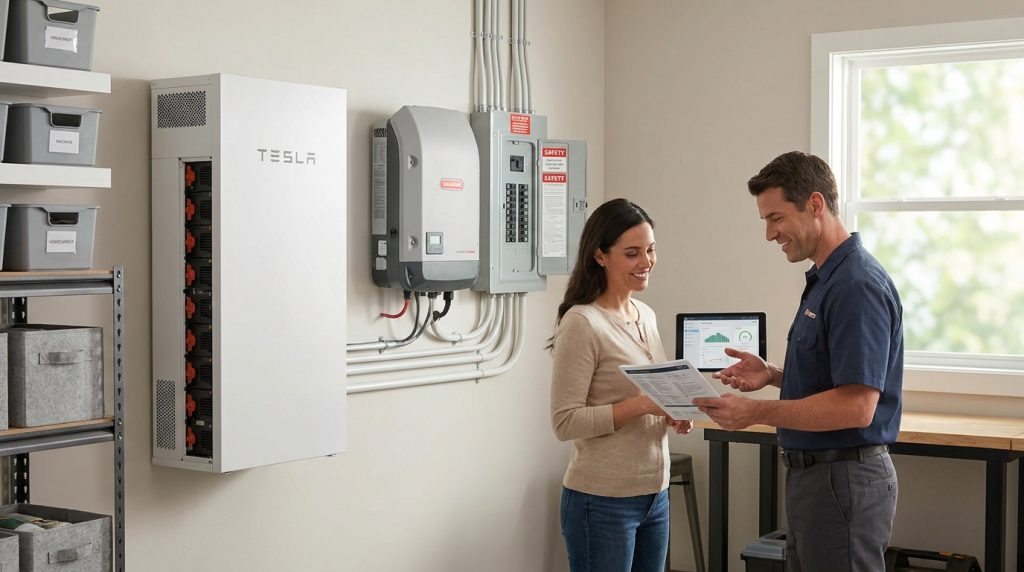
An all-in-one ESS warranty usually covers manufacturing defects and some battery performance loss, but coverage may differ for the battery, inverter, EMS, accessories, labor, shipping, and software. Ask for the full written warranty, not only the sales-sheet promise.
An all-in-one ESS puts the battery, inverter, battery management system, energy management system, and cabinet into one packaged system. That does not always mean every part has the same coverage. The battery may have a performance warranty, but the inverter, display, EMS, cables, and accessories may have different terms.
Ask for the full written warranty before paying. The FTC’s warranty guidance explains that written warranty terms should be available before purchase for covered consumer products, so the buyer can review them first through clear pre-sale access to warranty information from the seller or warrantor. FTC warranty guidance
- What components are covered?
- What is covered as a defect?
- What is covered as performance loss?
- Who pays for labor, shipping, and reinstallation?
- What actions can void coverage?
For broader system basics, read Voltalink’s home energy storage system guide before checking warranty clauses.
Which two warranty numbers should you check first?

Check capacity retention and cycle or throughput limits first. A 10-year warranty is weak if it allows low remaining capacity or expires early after daily cycling. Convert the percentage into final-year usable kWh before comparing quotes.
The first number is capacity retention. It tells you how much usable battery capacity should remain near the end of the warranty. A warranty that promises 70% capacity at year 10 gives a different real value than one that promises 80%, even if both say “10 years.”
The second number is the usage limit. Some warranties use cycle count. Others use throughput, which means total energy charged or delivered over time. The World Bank’s BESS warranty guidance shows why buyers should check lifecycle, cycles, throughput, duty cycle, operating limits, monitoring, labor, shipping, and excluded costs in warranty documents. World Bank BESS warranty guidance
| Warranty item | What it tells you | Why it matters |
|---|---|---|
| Capacity retention | Remaining usable capacity after years of use | Shows how much backup value remains |
| Cycle count | Number of covered full charge-discharge cycles | Shows risk for daily-use homes |
| Throughput | Total covered energy moved through the battery | Helps compare heavy-use systems |
| Warranty years | Calendar coverage period | Useful only with clear performance and use limits |
A 10-year warranty is not automatically strong. It works when capacity retention, usage limits, and claim support match the owner’s real use. It becomes weak when the battery reaches cycle or throughput limits early.
How do you read capacity-retention warranty terms?
Capacity retention tells you how much usable battery energy should remain near the end of the warranty. For example, a 10 kWh system with 70% retention should still provide about 7 kWh before normal conversion losses and warranty measurement rules.
Use a simple formula first: usable capacity multiplied by the retention percentage. If a 10 kWh all-in-one ESS has a 70% retention warranty, the final-year covered capacity is about 7 kWh. If the same system promises 80%, the final-year covered capacity is about 8 kWh.
This matters for backup planning. A backup-only homeowner may need 8 kWh overnight for lights, refrigerator, router, fans, and basic outlets. In that case, a 10 kWh battery with 70% retention may no longer match the homeowner’s real backup target at the end of the warranty.
| Starting usable capacity | Retention term | Approximate covered capacity |
|---|---|---|
| 10 kWh | 60% | 6 kWh |
| 10 kWh | 70% | 7 kWh |
| 10 kWh | 80% | 8 kWh |
| 15 kWh | 70% | 10.5 kWh |
Also check how the manufacturer measures state of health. The World Bank notes that degradation is affected by chemistry, environment, depth of discharge, and cycle count. That means the warranty should clearly define operating conditions and measurement rules. World Bank BESS warranty guidance
Which matters more: cycle count, throughput, or years?
Cycle count or throughput matters most when the system is used daily for solar self-consumption or time-of-use shifting. Calendar years matter more for backup-only buyers, but only if capacity retention and claim terms are still strong.
A cycle warranty counts charge-discharge use. One full cycle means the battery used energy equal to its full usable capacity, even if that happened through partial charges. Throughput works differently. It counts total energy moved through the battery, often in kWh or MWh.
A daily solar self-consumption user has different risk than a backup-only homeowner. If the system charges from solar each day and discharges each evening, the owner may use hundreds of cycles per year. That use pattern can reach the usage limit before the 10-year calendar term.
| Buyer situation | Main warranty number to check | Why |
|---|---|---|
| Backup-only homeowner | Capacity retention and calendar years | The system cycles less often |
| Daily solar self-consumption | Cycle count or throughput | Heavy daily use can age the battery faster |
| Time-of-use shifting | Throughput and cycle limits | Energy moves through the system often |
| Distributor selling to mixed users | Both usage limits and exclusions | Different customers use the same model differently |
For daily-use buyers, a higher cycle or throughput allowance can be more valuable than a longer headline warranty. For backup-only buyers, capacity retention and claim support may matter more.
What exclusions can void an ESS warranty?
The most common warranty risks are not normal aging. They are operation outside approved temperature, DoD, inverter, accessory, installation, monitoring, or registration rules. Treat exclusions as operating limits, not legal afterthoughts.
Exclusions are the fine print that decides whether a claim survives. A system can be high quality and still lose coverage if it is installed in a hot, poorly ventilated space or paired with unsupported equipment. Depth of discharge, state of charge limits, charge rates, and monitoring rules can also matter.
Exclusions homeowners should check
A hot garage is a simple example. If the ESS is installed where ambient temperature exceeds the approved range, capacity loss may not qualify as a warranty claim. Poor ventilation can create the same risk, especially for compact utility rooms or outdoor cabinets exposed to heat.
| If this happens | Warranty risk | What to confirm before buying |
|---|---|---|
| Extreme heat or cold | Capacity claim may be denied | Operating temperature range |
| Poor ventilation | Heat-related damage risk | Clearance and airflow rules |
| Deep discharge violation | Performance claim risk | DoD and SOC limits |
| Unauthorized repair | Coverage can be voided | Approved service process |
Exclusions distributors should check
A distributor also needs to check system matching. An off-spec inverter pairing or unsupported accessory can create a denied-claim risk. All-in-one ESS does not remove fine-print risk. It can simplify installation, but the warranty may still treat the battery, inverter, EMS, accessories, and labor differently.
For safety-related scope, confirm the system’s listed configuration. UL explains that UL 9540A is a test method for assessing thermal runaway fire propagation in battery energy storage systems, so buyers should avoid assuming one safety reference covers every cabinet layout or accessory choice.
Is a 10-year ESS warranty actually enough?
A 10-year ESS warranty can be enough when the capacity-retention percentage, usage limit, exclusions, and claim support match the buyer’s use case. It is not enough when the seller only gives a headline year count without explaining performance, labor, or usage limits.
For a backup-only homeowner, the system may cycle lightly. In that case, the main concern is whether the final-year capacity still supports essential loads. For a daily solar user, cycle count or throughput can become the real limit. The same 10-year promise can feel strong for one buyer and risky for another.
- Good sign: clear capacity retention at year 10.
- Good sign: cycle or throughput limit fits your use pattern.
- Good sign: labor, shipping, and claim process are written clearly.
- Red flag: no warranty start-date rule.
- Red flag: vague exclusions for temperature, DoD, inverter, or monitoring.
- Red flag: seller will not share written terms before payment.
A cheap distributor offer is risky when the warranty start date, registration process, serial-number record, and lithium battery transport documents are unclear. A lower unit price is not a saving if the first claim fails.
Who pays for labor, shipping, removal, and replacement?
A warranty may replace the defective unit but still exclude removal, reinstallation, labor, shipping, travel, diagnostics, or site access costs. Ask for a written cost-responsibility table before purchase.
Many buyers focus on whether the battery is covered and miss the service cost. If the cabinet must be removed, transported, tested, replaced, and recommissioned, someone pays for that work. The warranty should say whether the manufacturer, installer, distributor, or owner carries each cost.
Some warranties replace a part but do not restart the full warranty period. Others may offer a repair, replacement unit, or prorated value. The World Bank’s BESS warranty guidance lists labor, materials, shipping, and excluded costs as items that should be reviewed in warranty documentation. World Bank BESS warranty guidance
| Cost item | Ask this question | Red flag |
|---|---|---|
| Diagnostics | Who pays to confirm the fault? | Buyer pays even if defect is valid |
| Removal | Who removes the cabinet? | No written responsibility |
| Shipping | Who pays return freight? | “Buyer responsible for all freight” |
| Reinstallation | Who recommissions the system? | Installer cost not covered |
| Replacement | Does the warranty restart? | Replacement only carries remaining term |
For distributors, this table should be part of the sales file. It helps prevent disputes after the end customer discovers that “covered” does not mean “free to replace.”
What documents and logs should you keep for a claim?
Build the claim folder before the system is energized. Store the invoice, serial numbers, warranty version, registration proof, commissioning record, installer details, monitoring exports, alarm logs, and cabinet photos in one shared folder.
A warranty claim often fails because evidence is missing. Keep a digital folder for every unit or customer site. Add the purchase order, invoice, serial numbers, model numbers, bill of materials, warranty document version, and installation date before handover.
After installation, add the commissioning record, nameplate photos, cabinet photos, monitoring screenshots, alarm history, temperature logs, and service notes. If the manufacturer requires internet connection or remote monitoring, save proof that monitoring was enabled after commissioning.
- Save the written warranty before purchase.
- Record serial numbers and model numbers.
- Photograph cabinet labels and installation layout.
- Save commissioning and registration proof.
- Export monitoring and alarm logs regularly.
- Keep every service visit note.
- Store shipping and handover records for distributor sales.
This evidence is useful for both sides. Homeowners can prove correct use. Distributors can prove delivery timing, model identity, and warranty handover.
What should distributors check before shipment or delivery?
Distributors should check warranty start date, model numbers, serial records, lithium battery documents, registration responsibility, and claim support before shipment. These items reduce delivery disputes and protect margin when a customer later requests service.
A delayed shipment creates a common problem. If the warranty starts at factory shipment but the units sit during customs clearance, the customer may lose covered time before installation. Ask whether the warranty starts at shipment, invoice, delivery, commissioning, registration, or online activation.
For lithium batteries, shipping documents matter. PHMSA states that lithium batteries are regulated as hazardous materials in U.S. transportation and must meet applicable HMR requirements. PHMSA lithium battery guidance
The eCFR section for lithium batteries also includes UN 38.3 test record and test-summary requirements, including details such as manufacturer, model, watt-hour rating, test lab, and test results. 49 CFR 173.185
- Match PO, invoice, model numbers, and BOM.
- Record every serial number before dispatch.
- Confirm warranty start trigger in writing.
- Keep shipping and customs records.
- Store lithium battery transport documents.
- Define who completes warranty registration.
- Confirm who supports first-line diagnostics.
Clause-by-clause all-in-one ESS warranty checklist
A clause-by-clause checklist helps you compare real warranty strength before you buy. Use it for homeowner quotes, distributor purchase orders, and installer handover documents. If the seller cannot answer these items in writing, pause the purchase.
| Clause | What to ask | Good sign | Red flag | Proof to save |
|---|---|---|---|---|
| Warranty start date | When does coverage begin? | Starts at commissioning or registration | Starts at factory shipment only | Invoice, delivery note, registration |
| Covered components | What parts are included? | Battery, inverter, BMS, EMS listed clearly | “System covered” with no detail | Warranty PDF, BOM |
| Capacity retention | What percentage is promised? | Clear percentage and test method | No end-of-warranty capacity | Datasheet, warranty terms |
| Cycle or throughput limit | What usage limit applies? | Limit fits use case | Limit missing or too low | Warranty schedule |
| DoD and SOC rules | What use limits apply? | Clear operating window | Vague “misuse” wording | Commissioning settings |
| Temperature limits | What ambient range is allowed? | Clear range and ventilation rules | No installation-condition detail | Site photos, logs |
| Inverter compatibility | What pairings are approved? | Approved list or integrated scope | Third-party pairing unclear | System design file |
| Registration | Is registration required? | Clear deadline and process | No one owns registration | Registration receipt |
| Monitoring | Is internet or remote access required? | Clear monitoring rule | Claim can fail without logs | Portal screenshots |
| Labor and shipping | Who pays service costs? | Written responsibility table | Parts only, costs unclear | Service terms |
| Claim process | How is a claim filed? | Clear documents and response path | “Contact seller” only | Claim form, support email |
| Replacement terms | Does replacement restart coverage? | Remaining term explained | Replacement terms missing | RMA record |
| Transferability | Can a new owner use coverage? | Clear transfer rule | Not stated | Ownership transfer file |
This checklist is the main buying tool. The World Bank’s BESS warranty guidance supports checking lifecycle, duty cycle, operating requirements, repair schedule, labor, materials, shipping, and excluded costs when reviewing BESS warranties. World Bank BESS warranty guidance
When should you reject the warranty before buying?
Reject or pause the purchase if the seller cannot provide written warranty terms, capacity-retention data, cycle or throughput limits, exclusions, start-date rules, claim process, and cost responsibility before payment.
A weak warranty usually looks vague before it becomes expensive. The biggest warning sign is a seller who repeats “10-year warranty” but cannot provide the actual document. Another red flag is missing capacity-retention data. Without that number, you cannot estimate final-year backup value.
| Situation | Decision |
|---|---|
| Warranty document is available before purchase | Continue review |
| Seller only shares a sales-sheet promise | Pause |
| Capacity retention is clear | Compare final-year kWh |
| Cycle or throughput limit is missing | Pause |
| Labor and shipping are written clearly | Continue review |
| Warranty start date is unclear | Pause |
| Registration deadline is unclear | Pause |
| Claim process is written | Continue review |
| Exclusions are broad and vague | Ask for clarification or reject |
Do not treat warranty review as paperwork after purchase. It is part of product selection, especially for cost-aware homeowners and distributors carrying after-sales responsibility.
What to Do Next
Before choosing an ESS, ask for the complete warranty PDF, datasheet, approved installation rules, and claim process. Then compare the all-in-one ESS warranty terms against your real use case: backup-only, daily solar self-consumption, or distributor resale. If the numbers and clauses are clear, you can compare price with less risk.
If the seller cannot explain capacity retention, cycle or throughput limits, temperature rules, DoD limits, labor costs, shipping costs, and registration steps, do not rush the purchase. A clear warranty protects the system value long after installation.
Frequently Asked Questions
What does an all-in-one ESS warranty cover?
It usually covers manufacturing defects and limited battery performance, but coverage can differ for the battery, inverter, EMS, accessories, labor, and shipping. Always ask for the full written warranty before purchase.
What is the difference between a cycle warranty and a throughput warranty?
A cycle warranty limits how many full charge-discharge cycles are covered, and a throughput warranty limits total delivered energy. Daily cycling can reach either limit before the calendar warranty ends.
What does 70% capacity retention mean?
It means the battery should retain 70% of its original usable capacity under the warranty’s measurement rules. A 10 kWh battery at 70% retention should have about 7 kWh usable capacity before conversion losses.
Can my installer affect my warranty?
Yes, installer choice can affect warranty validity if the manufacturer requires authorized or certified installation. Incorrect wiring, ventilation, commissioning, relocation, or unsupported inverter pairing can also create denied-claim risk.
Do I need to register my ESS warranty?
Many warranties require registration within a specific period after installation or activation. Keep registration proof, serial numbers, installation date, and the warranty document version in one claim folder.
Does an ESS warranty include labor and shipping?
Not always. Some warranties cover parts only and exclude labor, removal, reinstallation, shipping, travel, diagnostics, or site-access costs, so buyers should ask for a written cost-responsibility table.
What documents should a distributor keep for warranty support?
A distributor should keep the PO, invoice, serial-number list, BOM, warranty version, shipping records, lithium battery transport documents, and handover proof. These records help resolve start-date, customs-delay, and claim disputes.

-

 OEM Residential Energy Storage Solutions: Passive vs. Active Cell Balancing
2026-09-30
-
 Smart Home Battery with BMS Communication: Cybersecurity and BMS Safety
 -
 10kWh Home Battery Backup System: Is 90% DoD Better for Daily Solar Storage?
2026-09-29
-
 Integrated Home Energy Storage System 150–430V MPPT Design
2026-09-28
-
 LiFePO₄ Residential Backup Battery SOC Accuracy in Parallel Systems
Share this:





.svg)






-899.svg)


