




Modular Battery Storage Systems: Why Modularity Wins
Modular battery storage systems win when your future energy needs may grow. Instead of buying one fixed-capacity battery, you start with the capacity you need now and expand later through compatible modules, voltage architecture, and parallel-stack design. For Voltalink, the 314Ah, 51.2V, 16.07kWh module gives homeowners and installers a clear building block for staged expansion.
A battery system should fit the home you have now and the home you may have later. More appliances, longer outages, EV charging, heat pumps, and solar upgrades can change the right battery size over time. That’s why modularity matters. It gives buyers a practical way to plan backup capacity without guessing every future load on day one.
What is a modular battery storage system?
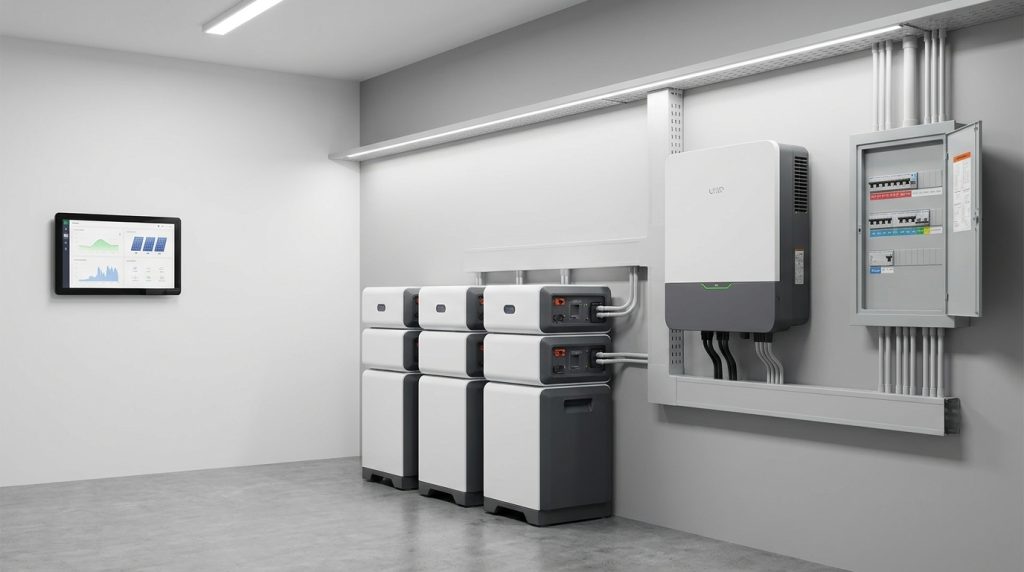
A modular battery storage system uses repeatable battery modules that can be combined to create the required storage capacity. The value is not only adding more kWh later, but choosing an architecture that can grow without replacing the whole battery.
In simple terms, a modular battery is built from separate battery blocks. Each block stores energy, connects to the system, and works with the battery management system, inverter, and communication setup. A fixed battery gives you one set capacity. A modular system gives you a platform.
This matters because home storage is part of a larger energy system. Battery storage helps balance power supply and demand, especially when paired with solar or other renewable energy, as explained in the U.S. International Trade Administration’s guidance on renewable energy generation and storage. For a wider overview of complete home storage design, see Voltalink’s home energy storage guide.
Why does modularity beat a single-chassis battery when future capacity is uncertain?
Modularity wins when future energy demand is uncertain because the owner can start with today’s required capacity and expand later. A fixed battery is simpler, but it can force replacement or oversized upfront spending when loads grow.
A single-chassis battery can be the cleanest option for a home with stable needs. If the owner only wants short backup for lights, a router, and a refrigerator, a fixed system may be enough. The problem starts when the home changes after installation.
A modular system reduces that risk. A homeowner may start with essential backup today, then add capacity later after buying an EV or adding more solar. Installers also get a clearer platform for staged upgrades, as long as the inverter and battery limits are checked first.
| Decision point | Modular battery system | Single-chassis battery |
|---|---|---|
| First purchase | Can start with current needs | Capacity is fixed from day one |
| Future load growth | Can expand if the system supports it | May need another full battery or replacement |
| Budget planning | Supports staged investment | Often requires larger upfront sizing |
| Service and layout | Modules may be easier to handle | One larger unit may be simpler |
| Best fit | Homes with uncertain future demand | Homes with stable backup needs |
This is also where runtime planning matters. If the reader wants to connect capacity choices with backup hours and cost, send them to the guide on battery runtime cost.
What are the three dimensions of battery modularity?
Battery modularity has three dimensions: capacity, voltage, and parallel-stack design. A system is truly expandable only when its battery modules, voltage window, communication protocol, and inverter limits all support future additions.
Many buyers think modularity only means “add another battery later.” That is only one part of the design. A better way to judge a platform is to check how it handles storage capacity, system voltage, and parallel expansion.
Large battery storage systems often include battery cabinets or modules, power conversion, battery management, and power management controls, as shown in Socomec’s BESS overview. Home systems are smaller, but the same logic applies: every part must work together.
| Modularity dimension | What it means | Why it matters | What the installer must verify |
|---|---|---|---|
| Capacity modularity | Adding more kWh through more modules | Helps the owner grow backup time later | Maximum units, usable capacity, warranty terms |
| Voltage modularity | Matching battery voltage to inverter design | Keeps the system inside safe operating limits | Battery voltage range and inverter compatibility |
| Parallel-stack modularity | Connecting modules in parallel for more capacity | Supports staged growth without changing the whole platform | BMS support, communication, cable sizing, protection |
Capacity modularity
Capacity modularity is the easiest to understand. One module gives a set amount of energy. More modules increase rated storage. This helps when a homeowner wants backup for today’s essential loads but expects future demand to rise.
Voltage modularity
Voltage modularity is about electrical fit. A battery must match the inverter’s supported voltage range. A 51.2V battery platform, for example, must be paired with compatible low-voltage inverter equipment.
Parallel-stack modularity
Parallel-stack modularity is where expansion becomes practical. Modules connect side by side to increase capacity while keeping the voltage architecture stable. This is why the battery, inverter, battery management system, and communication protocol must be planned together. For solar-connected systems, this topic belongs beside the wider hybrid battery setup.
How does Voltalink’s 314Ah module architecture support expansion?
Voltalink’s 314Ah architecture gives installers a large 16.07kWh building block at 51.2V. Because the verified product supports parallel expansion up to 6 units or 96kWh, homeowners can plan staged capacity growth instead of replacing the battery platform.
Voltalink’s high-capacity home battery page lists a 51.2V, 314Ah module with 16.07kWh rated energy, 300A continuous discharge, and RS485, RS232, and CAN communication. Those details matter because modularity depends on both energy storage and system communication, not only battery size.
The same Voltalink product page lists parallel expansion up to 6 units or 96kWh. That gives installers a clear upper limit to design around. The first install can be sized for the current home, while space, wiring, inverter choice, and future commissioning can be planned for the full stack.
Example: one module now, more modules later
A homeowner may install one 16.07kWh module for core outage loads: refrigerator, lights, router, home office equipment, and a small pump. If that home later adds EV charging or wants longer backup time, the installer can evaluate extra modules within the platform’s documented limits.
The simple rated-energy math is clear:
| Setup | Rated energy calculation | Rated energy |
|---|---|---|
| 1 module | 16.07kWh × 1 | 16.07kWh |
| 3 modules | 16.07kWh × 3 | 48.21kWh |
| 6 modules | 16.07kWh × 6 | 96.42kWh |
The product page rounds the maximum expansion to 96kWh. Real usable energy will depend on system settings, depth of discharge, inverter behavior, and installation design. The important point is that the module creates a repeatable building block for staged growth.
Where can modularity go wrong?
Modularity fails when expansion is promised without checking inverter limits, communication compatibility, battery age matching, warranty rules, and physical clearance. A modular battery is only future-ready if the whole system is designed for future additions.
Modular is not automatically better. It works best when future load growth is likely, but a fixed single-chassis battery can be cleaner when the home’s backup target is stable. The mistake is treating stackable hardware as proof of future-ready design.
A bad modular install can cost more later. For example, a battery stack placed too close under an inverter may leave no room for future modules. Two years later, the owner wants more capacity, but the installer must relocate equipment before expansion can happen.
Before calling any system expandable, check these points:
- Does the inverter support the future battery capacity?
- Does the battery management system support the planned number of modules?
- Do all modules use compatible communication settings?
- Does the warranty allow later expansion?
- Is there enough wall or floor space for the full stack?
- Are cable size, breakers, and protection devices planned for future growth?
- Will old and new modules need state of charge matching before connection?
This also helps avoid confusion between small backup devices and full home energy storage. If the reader is comparing short backup power with a larger ESS, link them to UPS versus ESS.
How should homeowners and installers size the first modular system?
The first modular system should be sized for today’s critical loads, with clear headroom for tomorrow’s expansion. Do not size only around the cheapest first install. Size around the first useful stage and the maximum future configuration.
Start with the loads that must run during an outage. For many homes, that means refrigeration, lighting, internet, work devices, a pump, and selected outlets. After that, choose the first battery stage based on backup hours, not full-home consumption.
Use this simple sizing flow:
- List the critical loads the home must support.
- Estimate how many hours those loads need to run.
- Choose the first-stage battery capacity.
- Check inverter output and surge needs.
- Leave physical space for extra modules.
- Confirm the maximum future stack before commissioning.
A named example helps. A homeowner wants backup for a refrigerator, lights, router, home office, and a small pump. The installer chooses one module for the first stage, then documents the maximum battery stack, compatible inverter model, and future expansion path. If the same homeowner later wants multi-day outage support, the deeper planning belongs in 72-hour backup planning.
What should you check before choosing a modular battery platform?
Before choosing a modular battery platform, verify the module capacity, maximum expansion limit, inverter compatibility, communication protocol, certifications, warranty terms, and installation clearance. The safest modular system is the one whose expansion path is documented before installation.
A battery is not truly expandable just because another module can sit beside it. Expansion only counts when the battery, inverter, BMS, protocol, warranty, and physical layout all support the future setup. This is where a buyer checklist protects both the homeowner and installer.
Large storage suppliers often document system parts such as battery modules, BMS, EMS, and supporting subsystems, as shown in Honeywell’s BESS documentation. A residential buyer should expect the same mindset at a smaller scale: clear specs, limits, and installation rules.
| Checkpoint | What to ask | Why it matters |
|---|---|---|
| Per-module energy | How many kWh does one module provide? | Sets the first-stage capacity |
| Maximum expansion | How many modules can be connected? | Defines the upgrade ceiling |
| Voltage fit | Does the inverter support this battery voltage? | Prevents electrical mismatch |
| Communication | Does the system support CAN, RS485, or required protocol? | Helps BMS and inverter work together |
| Warranty | Are later modules covered under clear terms? | Avoids expansion disputes |
| Certification documents | What safety and compliance records are available? | Gives proof beyond marketing claims |
| Space planning | Is there room for the full future stack? | Prevents costly relocation |
| Commissioning process | Who adds new modules and updates settings? | Keeps expansion controlled |
Some homes also want backup first and solar later. In that case, the platform should support storage use before the solar upgrade. That next step fits naturally with battery backup without solar.
When is a fixed single-chassis battery still the better choice?
A fixed single-chassis battery is better when the load is stable, the backup target is small, and future expansion is unlikely. Modular systems are stronger when the home may add EV charging, solar, heat pumps, or longer outage coverage later.
This is an honest tradeoff. A fixed battery can mean fewer separate parts, simpler installation, and a cleaner layout. A modular system may cost more planning time upfront, but it can prevent a poor second installation when the home’s needs change.
| Situation | Better choice | Reason |
|---|---|---|
| Small home needs short backup only | Fixed battery | Simpler and easier to specify |
| Future EV charging is likely | Modular battery | Capacity needs may grow later |
| Solar may be added later | Modular battery | Storage can be staged with solar plans |
| No space for future modules | Fixed battery | Expansion may become impractical |
| Installer can document full expansion path | Modular battery | Future upgrades are easier to plan |
| Budget allows only one stable backup target | Fixed battery | No need to pay for unused flexibility |
A small household may only need lighting, router backup, and refrigeration. If there is no EV, no heat pump, no solar plan, and no long outage target, a fixed system can be the smarter choice. Modularity wins when future uncertainty is real.
Getting the Next Step Right
The right battery choice depends on how much your home may change. If your loads are stable, a fixed battery can be simple and practical. If you expect more backup demand later, modular battery storage systems give you a cleaner path to grow.
Before buying, ask the installer to document the first-stage capacity, maximum module count, inverter compatibility, communication protocol, warranty terms, and physical space plan. A good modular system should make the second install easier, not more expensive.
Frequently Asked Questions
What is the difference between a modular and a traditional energy storage system?
A modular energy storage system uses separate battery modules that can be combined or expanded. A traditional single-chassis battery usually has a fixed capacity, so major expansion may require adding another full unit or replacing the system.
How many modules can be connected together in one system?
The number depends on the manufacturer, battery model, inverter, and commissioning rules. For Voltalink’s verified high-capacity module, the product page lists parallel expansion up to 6 units or 96kWh.
Can I expand my modular battery system after it is already installed?
Yes, but only if the battery platform, inverter, communication protocol, warranty, and physical layout support later expansion. The installer should confirm the maximum stack size and commissioning process before the first installation.
What certifications should a modular energy storage system have?
Certification requirements vary by market, but buyers should ask for documented safety and compliance records before installation. Common battery safety documents may include recognized standards such as UL, IEC, or CE records, depending on the product and target market.
Is modular battery storage suitable for home use?
Yes, modular battery storage can suit homes that may add solar, EV charging, heat pumps, or longer backup needs later. It works best when the installer designs the inverter, space, wiring, and battery stack for future growth.
What is the lifespan of a modular LiFePO4 battery system?
Lifespan depends on cell quality, depth of discharge, temperature, charge rate, and BMS control. Buyers should avoid universal lifespan claims unless the supplier provides a verified cycle-life figure for the exact battery model.
Are modular battery installations as easy as they sound?
They can be easier than adding a second fixed battery, but they are not DIY plug-and-play. A qualified installer still needs to check state of charge matching, communication settings, inverter limits, protection devices, and physical clearance.

-

 OEM Residential Energy Storage Solutions: Passive vs. Active Cell Balancing
2026-09-30
-
 Smart Home Battery with BMS Communication: Cybersecurity and BMS Safety
 -
 10kWh Home Battery Backup System: Is 90% DoD Better for Daily Solar Storage?
2026-09-29
-
 Integrated Home Energy Storage System 150–430V MPPT Design
2026-09-28
-
 LiFePO₄ Residential Backup Battery SOC Accuracy in Parallel Systems
Share this:






.svg)






-899.svg)


