




Solar Battery Backup: Runtime, Sizing & Real Cost
A solar battery backup system for home is worth considering when you want quiet outage power and your solar array can help recharge the battery during multi-day outages. The best system is not always the largest battery. It is the system sized around your essential loads, realistic solar production, inverter output, and the backup runtime you actually need.
This guide explains how solar-coupled battery backup works, how to estimate runtime, how PV recharge changes a 3-day outage plan, and how to compare the real cost against a grid-charged-only backup battery.
What Does a Solar Battery Backup System Actually Do During an Outage?

A solar battery backup system keeps selected home circuits running during an outage by using stored battery energy and, when designed for it, fresh solar production. The system must safely disconnect from the grid before sending backup power to the home.
In a normal setup, solar panels produce electricity during daylight hours. The battery stores energy from solar or the grid. The inverter converts battery power into usable home electricity. During an outage, the system powers either selected circuits or a larger home backup panel, depending on the design.
The key detail is blackout operation. Not every solar system can keep producing power during a grid outage. A solar battery backup system must support safe islanding, battery discharge, and solar charging while disconnected from the utility grid. For broader system basics, see this home energy storage system guide.
Should You Power the Whole Home or Only Essential Loads?
Essential-load backup is usually the better starting point because it protects refrigeration, lights, Wi-Fi, medical devices, and basic comfort for less battery capacity. Whole-home backup is possible, but it raises inverter, battery, and installation costs.
Many homeowners start by asking whether a battery can power the whole house. A better first question is what must stay on during an outage. Essential-load backup gives more runtime from the same battery because it avoids high-draw appliances that quickly drain stored energy.
| Backup style | Best for | Tradeoff |
|---|---|---|
| Essential-load backup | Refrigerator, freezer, lights, Wi-Fi, phones, laptop, medical device, small fans | Longer runtime, but not every appliance is backed up |
| Partial-home backup | Essentials plus selected larger loads | Better comfort, but needs more careful sizing |
| Whole-home backup | Homeowners who want most circuits available | Higher battery, inverter, and installation cost |
A critical-load panel can make outage planning easier. It separates the circuits that should stay on from loads that are not worth running during a long outage. For a more detailed emergency planning path, use a 72-hour backup plan.
How Long Will a Solar Battery Backup System Run Your Home?
Runtime equals usable battery energy divided by the loads you choose to run, adjusted for losses and reserve. A 10 kWh battery may not provide 10 kWh of usable backup once depth of discharge, inverter losses, and safety margin are included.
The simple formula is:
Estimated runtime = usable battery kWh ÷ average backed-up load kW
For outage planning, usable kWh matters more than nameplate capacity. A battery may have a rated capacity, but the real backup energy depends on usable capacity, battery reserve, inverter losses, system settings, and how deeply the battery is allowed to discharge.
Simple Runtime Example
If your essential loads use 5 kWh per day and your battery provides 10 kWh of usable backup, the battery may cover about two days before solar recharge. If your loads rise to 10 kWh per day, the same battery may cover only one day.
Specs That Change Runtime
- Usable capacity: The battery energy available for real backup use.
- Continuous output: The power the inverter can supply steadily.
- Surge output: The short burst needed by motors, pumps, and refrigerators.
- Reserve setting: The energy kept aside to protect the battery or preserve emergency backup.
- Load selection: The circuits you choose to run during the outage.
Can Solar Panels Recharge the Battery During a 3-Day Outage?
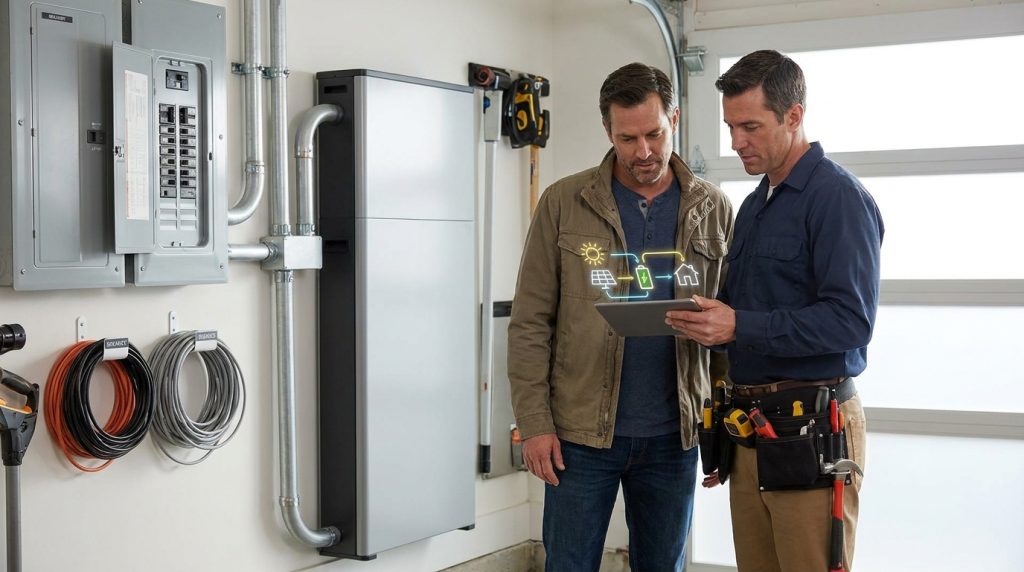
Solar panels can recharge a backup battery during a multi-day outage only if the inverter and system design allow solar operation while islanded from the grid. The key calculation is daily critical-load kWh minus realistic daily PV recharge.
PV recharge is what separates a solar-coupled backup system from a grid-charged-only battery. Without solar recharge, the battery is limited to stored energy. With solar recharge, daytime production can run loads and refill part of the battery for the next night.
3-Day Outage Example With PV Recharge
Assume a homeowner wants to run essential loads that use 6 kWh per day. The system starts with 12 kWh of usable battery energy. On sunny days, the solar array can provide 5 kWh of useful recharge after losses and household daytime use.
| Day | Starting usable battery | Essential load | Estimated PV recharge | Net battery change | Ending usable battery |
|---|---|---|---|---|---|
| Day 1 | 12 kWh | 6 kWh | 5 kWh | -1 kWh | 11 kWh |
| Day 2 | 11 kWh | 6 kWh | 5 kWh | -1 kWh | 10 kWh |
| Day 3 | 10 kWh | 6 kWh | 5 kWh | -1 kWh | 9 kWh |
In this sunny example, the battery does not simply drain from 12 kWh to zero. Solar recharge slows the drawdown each day. That is why solar-coupled backup can be valuable for longer outages.
Cloudy-Day Adjustment
The same setup looks different in poor weather. If PV recharge drops from 5 kWh to 2 kWh per day, the battery loses 4 kWh per day instead of 1 kWh. After three days, the ending battery level would be much lower. This is why solar sizing should include a cloudy-day assumption, not only a sunny-day estimate.
Should You Oversize the Battery or Oversize the Solar Array?
Oversize the battery when you need longer night or cloudy-weather autonomy. Oversize the solar array when outages are likely during sunny periods and the inverter can accept enough PV input to recharge the battery quickly.
This is one of the most important buyer decisions. More battery helps when the sun is not available. More solar helps when the sun is available and the battery system can accept the extra charging power. The right answer depends on your outage pattern, roof space, inverter limits, and backed-up loads.
| Situation | Favor more PV | Favor more battery | Why | Quote question to ask |
|---|---|---|---|---|
| Short sunny outages | Yes | Sometimes | Daytime solar can support loads and refill the battery | How much PV can charge during an outage? |
| Multi-day outages with sun | Yes | Yes | You need both recharge and overnight storage | What is the 3-day battery state estimate? |
| Cloudy winter outages | Less helpful | Yes | Low solar output makes stored energy more important | What cloudy-day derating did you use? |
| Overnight medical or pump load | No | Yes | The load must run when solar is unavailable | Can the battery handle overnight load and surge? |
| Limited roof space | Limited | Often | There may not be enough PV area to add meaningful recharge | What is the maximum practical PV input? |
What Is the Real Cost Versus a Grid-Charged-Only Battery Backup?
A grid-charged-only battery is usually simpler for short outages, while solar-coupled backup costs more because it needs solar integration and compatible inverter design. The added value is PV recharge during long outages and reduced dependence on the grid.
A grid-charged-only backup battery can be a practical choice if outages are short and the main goal is keeping essentials on for several hours. It may avoid the added solar design work. However, once the stored energy is gone, it cannot refill itself until the grid returns.
A solar-coupled battery backup system adds more design decisions. It may require solar panels, compatible inverter equipment, backup panel work, permitting, monitoring, and installer setup. The benefit is that the system can use daytime solar production during a long outage if it is designed for that function.
| Option | Lower-cost strength | Main limitation | Best fit |
|---|---|---|---|
| Grid-charged-only battery | Simpler backup design | No PV recharge during outage | Short outages and essential loads |
| Solar-coupled battery backup | Can recharge from PV during outages | Higher system complexity and cost | Longer outages and solar-curious homeowners |
Before comparing quotes, ask each installer to define the same backup scope. Compare usable kWh, inverter output, backed-up circuits, solar recharge assumptions, permit work, monitoring, and warranty. If you are still considering a non-solar option, compare it with backup without solar.
Which Specs Matter Before You Ask for Quotes?
The best quote is not just the lowest price. It is the quote that clearly explains what the system can run, for how long, under which solar and weather assumptions. Ask for numbers that can be compared side by side.
- Usable battery capacity: Ask for usable kWh, not only rated capacity.
- Continuous inverter output: Check what the system can power steadily.
- Surge output: Confirm support for refrigerators, pumps, and motor loads.
- Solar input limit: Ask how much PV can charge the battery during an outage.
- Backup circuit design: Confirm whether the system backs up essentials, partial home, or whole home.
- Battery chemistry: Ask how the product handles safety, cycle life, and monitoring.
- Warranty: Compare coverage terms, capacity retention, and service process.
- Monitoring: Confirm whether the app shows battery state, load, solar input, and outage mode.
- Safety documentation: Ask for relevant listings, installer credentials, and permit details.
Do not treat a small UPS and a home ESS as the same product. A UPS may protect electronics for short interruptions, while a home ESS is designed around larger loads, installed equipment, solar integration, and longer backup planning. Use this UPS vs ESS comparison when explaining the difference to buyers.
Can You Add Solar Battery Backup to an Existing Solar System?
You can often add battery backup to an existing solar system, but the design depends on inverter compatibility, backup circuits, and whether the system can keep charging from PV during an outage. A site-specific installer review is required.
Some existing solar homes can use an AC-coupled battery. This can be useful when the current solar inverter stays in place. Other homes may be better served by a hybrid inverter or a deeper system redesign, especially if the homeowner wants stronger backup behavior during outages.
| Retrofit path | When it may fit | Question to ask |
|---|---|---|
| AC-coupled battery | Existing solar system with a separate battery inverter | Can it recharge from PV during an outage? |
| Hybrid inverter upgrade | Homeowner wants deeper solar and battery integration | What equipment must be replaced? |
| Backup panel upgrade | Home needs selected circuits protected | Which loads will be moved to the backup panel? |
What Installation, Safety, and Incentive Checks Should You Verify?
Before buying, verify local permits, safety listings, installer qualifications, battery placement, monitoring, and current tax-credit eligibility. Safety and incentive rules are not generic, so the quote should identify the code path and documentation.
Battery systems are installed electrical equipment. The installer should explain where the battery will be placed, what clearances are required, how the system will be monitored, how emergency shutoff works, and which permits are included.
- Confirm local permitting and inspection requirements.
- Ask whether the system follows applicable battery safety standards and manufacturer instructions.
- Verify battery placement, clearance, and access requirements.
- Ask for monitoring details, including battery state and fault alerts.
- Confirm installer qualifications and commissioning steps.
- Ask whether emergency guidance is included for the homeowner.
- Check current incentive eligibility before signing a contract.
Some buyers also look at imported lithium battery products. If that applies, treat shipping and documentation as a serious compliance issue. Lithium batteries can require correct packaging, labels, documentation, and state-of-charge controls, especially for air transport.
What Should You Ask an Installer Before Buying?
End the buying process with a clear quote checklist. The goal is to compare systems by backup performance, not just battery size or headline price.
- Which circuits are included in backup mode?
- What is the usable battery capacity?
- What daily load estimate did you use?
- How many outage hours or days does the quote assume?
- Can solar panels recharge the battery during a grid outage?
- What PV recharge estimate did you use for sunny and cloudy days?
- What are the continuous and surge output ratings?
- Does the quote include a backup panel, permits, monitoring, and commissioning?
- What warranty and service support are included?
- What happens if I add more battery or more solar later?
A good installer should be able to show the runtime math, explain the solar recharge assumption, and identify the loads that are not realistic for the selected system. If those answers are missing, the quote is not ready for a serious comparison.
FAQ
How long will a solar battery backup system power my home during an outage?
It depends on usable battery kWh and the loads you run. A system powering only essentials can last much longer than one running AC, ovens, pumps, and other high-draw loads. Solar recharge can extend runtime if the system supports PV charging during outages.
How does a solar home battery backup work during a blackout?
It disconnects safely from the grid, then powers selected circuits from stored battery energy. If the inverter supports solar charging while islanded, daytime PV production can run loads and recharge the battery.
How much battery capacity does a home solar backup system need?
Start with the daily kWh of your essential loads, then add reserve for nights, cloudy weather, and inverter losses. For outage planning, usable capacity matters more than nameplate capacity.
How much does a solar back up power system cost?
Cost depends on battery size, inverter design, backup panel work, solar integration, labor, and permits. Compare local quotes using the same usable kWh and backup-scope assumptions.
Can I add battery storage to my existing solar panel system?
Yes, many existing solar systems can add battery backup, but the design depends on inverter compatibility and backup requirements. Some homes use AC-coupled batteries, while others may need hybrid inverter changes or panel upgrades.
Are solar batteries safe for indoor installation?
They can be safe when installed according to local code, manufacturer instructions, safety listings, spacing rules, and installer requirements. The quote should confirm placement, ventilation or clearance needs, monitoring, permits, and emergency guidance.
Can a solar battery backup system lower electric bills?
It can lower bills when the system stores solar energy for later use or avoids expensive time-of-use rates. Savings depend on the utility tariff, net metering rules, solar production, battery controls, and household load pattern.

-

 OEM Residential Energy Storage Solutions: Passive vs. Active Cell Balancing
2026-09-30
-
 Smart Home Battery with BMS Communication: Cybersecurity and BMS Safety
 -
 10kWh Home Battery Backup System: Is 90% DoD Better for Daily Solar Storage?
2026-09-29
-
 Integrated Home Energy Storage System 150–430V MPPT Design
2026-09-28
-
 LiFePO₄ Residential Backup Battery SOC Accuracy in Parallel Systems
Share this:





.svg)






-899.svg)


