




Compact Home ESS: Apartment & Townhouse Picks
A compact home energy storage system works best when the unit matches your space, mounting surface, clearance, IP rating, and backup goal. For apartments, consider balcony or portable modular systems. For townhouses, wall-mounted or stackable systems may fit better. Choose by location first, then capacity, solar input, and installer approval.
Small homes create a different battery problem. You’re not only asking how many kilowatt-hours you need. You’re also asking where the unit can sit, how much air and service space it needs, and whether the product rating matches a closet, garage corner, or balcony alcove. This guide compares compact ESS options by real living situation, so you can choose the right VoltaLink-style setup before you buy or quote an installation.
Can a compact home energy storage system fit a small home?
A compact home energy storage system can fit small homes when the unit matches the space, mounting surface, ventilation, and local electrical rules. Wall-mount units suit utility walls, stackable units suit expandable floor space, and balcony systems suit urban layouts.
Fit starts with the location, not the battery capacity. A 2.4kWh modular balcony system may fit an apartment better than a larger wall-mounted unit, even if the larger unit offers more backup time. A townhouse buyer may have the opposite problem, with enough garage wall space but limited room for floor cabinets.
Home energy storage stores electricity and releases it later when needed, often from solar or grid power. The U.S. Department of Energy explains that storage design depends on both energy capacity and power capacity, so buyers should check runtime and output before choosing a unit. For broader basics, read VoltaLink’s home energy storage basics.
Use this quick fit check before comparing models:
- Do you own the wall, floor, or balcony area where the battery will sit?
- Is the unit rated for the exposure level in that location?
- Can an installer access the unit for wiring and service?
- Is there enough clearance around the battery?
- Does your building allow balcony solar, battery storage, or fixed mounting?
Which compact ESS type fits your floor plan best?
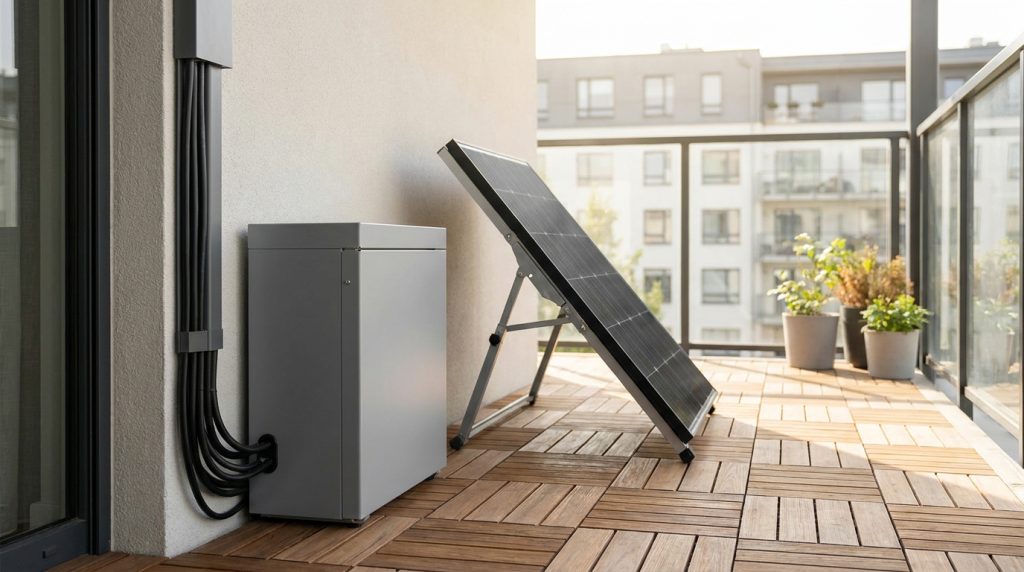
Choose wall-mount if you have a strong indoor utility wall, stackable if you need future expansion, and balcony storage if rooftop solar is unavailable. Renters should prioritize movable or non-permanent systems where building rules allow them.
A wall-mounted battery saves floor space, but it is not always renter-friendly. It works best for owners with a suitable indoor utility wall. A stackable cabinet or modular tower works better when future expansion matters. Balcony storage is useful for apartment-style solar, but only when the product rating and building rules support that setup.
| Living situation | Best compact ESS type | Best fit location | Avoid if |
|---|---|---|---|
| Apartment renter | Portable balcony or movable modular system | Balcony alcove or protected equipment area | Building rules ban batteries or solar panels |
| Apartment owner | Balcony storage or compact wall-mounted system | Balcony alcove, utility area, or service closet | The battery is indoor-rated only and the balcony is exposed |
| Townhouse buyer | Wall-mount or stackable storage | Garage corner, utility wall, or small equipment room | There is no safe clearance or service access |
| Small-footprint installer | Stackable or wall-mounted system | Pre-checked wall, floor, or cabinet area | Site conditions are unknown |
| Balcony solar user | Balcony battery storage | Protected balcony area near PV input | Weather exposure exceeds product rating |
| Garage-corner user | Wall-mounted or stackable ESS | Dry indoor garage corner | Clearance is blocked by storage boxes or tools |
A balcony ESS is not always the best compact choice. It works when the product rating, building rules, weather exposure, and installer approval match the site. A protected indoor wall-mounted unit is safer when the balcony is exposed or unapproved.
Which VoltaLink units suit apartments, townhouses, and small installers?
VoltaLink-style compact selection should start with the living situation. A product that looks perfect on capacity can still be wrong if the mounting style, IP rating, or relocation needs do not match the home.
| Buyer scenario | Suitable VoltaLink unit type | Key fit reason | Watch point |
|---|---|---|---|
| Apartment renter with no rooftop access | Portable Balcony Storage Battery System | Better for semi-mobile use and small backup goals | Confirm building rules and charging setup |
| Apartment owner with balcony solar | Home Balcony Battery Storage System | BM2400 PRO format supports 2400Wh modules and 1-5 module expansion | Balcony exposure and approval still matter |
| Townhouse buyer with garage space | Wall Mount Lithium Battery System | 51.2V 314Ah and 16.07kWh rated energy suit longer backup goals | IP20 means protected indoor placement |
| Small installer quoting a retrofit | Stackable Energy Storage System | Modular design helps match different capacities and tight layouts | Check floor space, wiring path, and service access |
| Balcony PV user with limited wall space | Solar Balcony Storage System | 2400Wh modules and expandable layout suit urban PV storage | Verify PV input, mounting, and enclosure needs |
The smallest battery is not always the smartest apartment battery. A 2.4kWh module can support essentials, but it may not satisfy a townhouse buyer who wants longer outage protection. In that case, expandable stackable storage or a larger wall-mounted battery can be the cleaner long-term pick.
For an installer, the right quote is not only the unit price. It should include the mounting surface, clearance plan, IP rating, wiring route, inverter compatibility, and access for future inspection.
How much capacity is enough for a compact setup?
Size a compact ESS by essential loads, not by room count. Add the wattage of devices you need during an outage, multiply by hours of use, then compare that number with usable battery capacity.
Capacity is the amount of stored energy, usually shown in watt-hours or kilowatt-hours. Power is the output the system can deliver at one time. The DOE’s solar and storage basics separates these two ideas because both affect system design.
For apartments, start with the devices you truly need during an outage. A router, LED lights, laptop, phone charging, and a refrigerator are realistic essential loads. HVAC, electric cooking, and large appliances can change the system size quickly, so do not assume a small battery will cover everything.
Example: fridge, router, lights, and laptop for 6 hours
Use this simple method:
| Essential load | Estimated watts |
|---|---|
| Router | 15W |
| 4 LED lights | 40W |
| Laptop | 60W |
| Small fridge average draw | 120W |
| Total running load | 235W |
Now multiply total watts by backup hours:
235W × 6 hours = 1,410Wh before efficiency losses
A 2400Wh module may handle this kind of essential set better than it handles HVAC, cooking, or high-draw tools. A 16.07kWh wall-mounted battery suits larger townhouse backup goals, but it also needs the right indoor location and installer design.
Where should you install a compact home ESS?
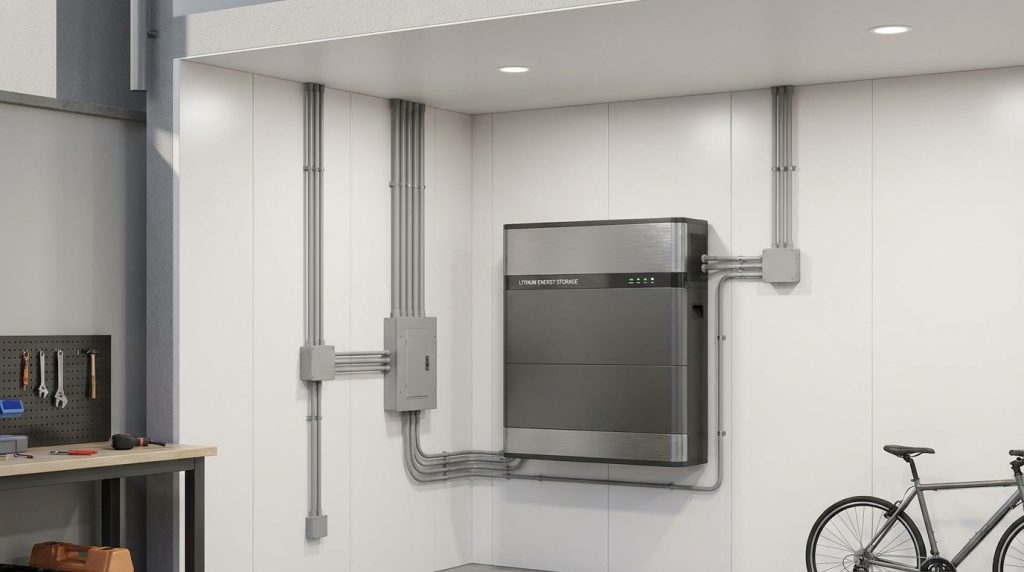
Install a compact ESS where the rating, access, ventilation, and mounting structure match the unit. Indoor-rated batteries belong in protected spaces, while balcony or semi-outdoor placements need suitable enclosure protection and installer approval.
The best location is dry, accessible, and matched to the product’s rating. A wall-mounted IP20 battery should be treated as an indoor unit, not a balcony battery. IP20 protects against limited solid object contact, but it does not make the unit suitable for rain, splash, or exposed outdoor use.
Use the location table below before choosing a product type.
| Location | Good fit for | Main check |
|---|---|---|
| Utility closet | Small wall-mounted or compact indoor unit | Ventilation, service access, and clearance |
| Garage corner | Wall-mounted or stackable unit | Dry area, clear access, and no clutter |
| Balcony alcove | Balcony battery storage | Weather exposure, drainage, and building permission |
| Small equipment room | Stackable modular system | Floor space and wiring path |
| Living room wall | Usually not preferred | Noise, access, aesthetics, and safety concerns |
Lithium-ion systems can have a smaller footprint than some other storage options, and the DOE notes that this can support installation in many locations. Still, small footprint does not remove the need for safe placement, qualified installation, and a clear service area.
What clearance should you leave around the battery?
Use the manufacturer’s clearance first. If a compact ESS manual does not provide a closer tested clearance, plan for 3 feet of clear space around the unit and keep flammable material out of that zone.
Exact VoltaLink mounting clearance was not available from the fetched product pages in the research brief. That means the article should not invent a number for a specific model. The correct rule is simple: follow the product manual first, then use a conservative safety plan when the manual does not list closer tested clearances.
EPRI’s residential energy storage safety guidance says to maintain manufacturer-recommended clearance or 3 feet of clearance, and to remove debris and flammable material around the ESS. That matters in small homes because closets, balconies, and garages often become storage zones.
Use this clearance checklist:
- Confirm the official installation manual before mounting.
- Leave the manufacturer’s required side, top, and front access space.
- Use 3 feet of clear space if no closer tested clearance is available.
- Keep curtains, boxes, tools, paper, and chemicals away from the unit.
- Keep access open for inspection, service, and emergency response.
- Do not hide the unit behind furniture or packed storage shelves.
For tight apartments, this rule may eliminate some locations. A closet that looks perfect on paper may fail once you account for clearance, airflow, and service access.
Do you need solar, grid charging, or both?
You do not always need solar panels for compact storage. Solar improves self-consumption, but grid charging can still support backup and peak-rate shifting when rooftop or balcony PV is not allowed.
Solar-plus-storage is useful because stored energy can support the home when solar is not producing. The DOE explains that battery storage can help with backup power and time-of-use energy use when paired with solar. For townhouse buyers with roof access, that pairing can be a strong long-term setup.
Apartment owners often have fewer options. Rooftop solar may be unavailable, and balcony PV may need building approval. In that case, a grid-charged compact ESS can still make sense for essential backup or peak-rate planning, if the unit supports that charging method and local rules allow it.
Use this simple decision path:
- Choose solar-plus-storage if you have approved PV access.
- Choose grid charging if solar is not allowed but backup is the main goal.
- Choose balcony storage only when exposure, rating, and permission match.
- Choose a larger wall-mounted or stackable unit when longer backup matters.
What should installers verify before recommending a compact ESS?
Installers should verify the site before recommending the product. A tight retrofit can fail because of a wall, cable route, IP rating, clearance zone, or building restriction, even when the battery itself is suitable.
Use this installer pre-check before final selection:
- Confirm ownership or permission for the mounting area.
- Check wall strength or floor support.
- Confirm the product’s IP rating against the real exposure.
- Check clearance, ventilation, and service access.
- Confirm inverter compatibility and battery voltage range.
- Check overvoltage, short-circuit, surge, and overheating protection.
- Confirm local permit, utility, and AHJ requirements.
- Review the manual before drilling, wiring, or cabinet placement.
- Explain relocation limits to renters and apartment owners.
Fire and electrical safety should stay part of the installation plan. EPRI’s residential ESS guidance focuses on clearance, safe surroundings, and manufacturer instructions, which are especially important in garages and utility closets where clutter builds up fast.
What mistakes should small-space buyers avoid?
Do not buy a compact ESS by kWh alone. Capacity matters, but the wrong location can turn a good battery into a bad fit. IP rating, mounting style, clearance, service access, and building rules are just as important in small homes.
Avoid these common mistakes:
- Choosing an IP20 indoor battery for an exposed balcony.
- Mounting a fixed wall unit in a rental without approval.
- Blocking clearance with shelves, boxes, or laundry items.
- Assuming one 2.4kWh module can run all home appliances.
- Ignoring inverter compatibility.
- Forgetting that service access matters after installation.
- Buying balcony solar storage before checking building rules.
- Choosing the smallest unit when the real goal is long outage backup.
A wall-mount battery saves floor space, but it is not the best choice for every home. It works well for owners with a suitable utility wall. Renters and balcony users should think harder about mobility, approval, and exposure before choosing a fixed system.
How to Choose the Right Option
Choose the compact home energy storage system that fits your space before chasing the largest capacity. For an apartment, start with balcony approval, grid charging needs, and movable options. For a townhouse, check the garage wall, utility room, or stackable floor space first.
Your next step is simple: list your essential loads, choose the likely install location, check the IP rating, and confirm clearance with the manual or installer. After that, compare VoltaLink wall-mount, balcony, and stackable options by fit, not only by battery size.
Frequently Asked Questions
Can a compact home energy storage system work without solar panels?
Yes, a compact ESS can work without solar if it supports grid charging. Solar improves self-consumption, but grid charging can still help with backup power and time-of-use energy shifting when rooftop or balcony PV is not allowed.
Should I choose a high-voltage or low-voltage battery system?
Choose based on inverter compatibility, installer design, and your backup goal, not voltage alone. Compact residential systems often use lower-voltage modular designs, and larger whole-home systems may use different battery and inverter architectures.
What are the primary components of a home energy storage system?
A home ESS usually includes batteries, an inverter, protection devices, and an energy management or monitoring system. Solar-compatible setups also need PV input control, and grid-charged systems need safe AC charging design.
Does a BESS require maintenance and servicing?
Yes, a residential BESS needs periodic inspection, even when daily maintenance is low. The owner or installer should check alarms, casing condition, airflow, clearance, firmware, wiring condition, and any unusual heat or odor.
Are home energy storage systems safe?
Certified home energy storage systems are designed with protections, but safety depends on correct product selection and installation. Keep clearances open, avoid unsuitable outdoor exposure, use qualified installers, and follow the manufacturer manual.
How much battery capacity do I need for an apartment?
Start with essential loads, not total apartment size. A router, lights, laptop, and refrigerator may need far less capacity than HVAC or kitchen appliances, so calculate wattage multiplied by backup hours before choosing modules.

-

 OEM Residential Energy Storage Solutions: Passive vs. Active Cell Balancing
2026-09-30
-
 Smart Home Battery with BMS Communication: Cybersecurity and BMS Safety
 -
 10kWh Home Battery Backup System: Is 90% DoD Better for Daily Solar Storage?
2026-09-29
-
 Integrated Home Energy Storage System 150–430V MPPT Design
2026-09-28
-
 LiFePO₄ Residential Backup Battery SOC Accuracy in Parallel Systems
Share this:





.svg)






-899.svg)


