




Plug-and-Play Home Battery: How Plug-Ready Is It
A plug and play home battery system is rarely “plug in and power the whole house.” Small units may connect to a wall outlet, but many products use the phrase to mean pre-wired battery, inverter, BMS, and monitoring components. A real installer may still handle circuits, permits, backup loads, inspection, and commissioning.
Plug-and-play sounds simple because it borrows language from phones, laptops, and small appliances. Home batteries are different. They store serious energy, may connect to solar, and can interact with your home wiring. The real question is not “does it have a plug?” The better question is, “what exactly is already integrated, and what still needs safe site work?”
Does a plug and play home battery system literally plug into the wall?
A plug and play home battery system may plug into a wall outlet, but many “plug-and-play” ESS products are only plug-ready for installers. The phrase usually means fewer components, cleaner wiring, and faster setup, not zero electrical work.
Some compact batteries really do connect through a standard outlet. These are usually designed for small backup loads, renters, balcony solar setups, or selected appliances. They may be simple to set up because the battery, inverter, app, and basic controls are already built into one product.
A larger home energy storage system is different. It may still be marketed as plug-and-play because the battery cabinet, inverter, battery management system, and communication cables are pre-matched. That can help, but the system may still need wiring, inspection, and commissioning before it is safe to use.
| Product type | What “plug” usually means | Typical use | Installer needed? |
|---|---|---|---|
| Portable power station | AC plug or solar input | Devices, router, fridge, laptop | Usually no, if used as instructed |
| Wall-outlet battery | Standard outlet connection | Small storage or selected backup | Sometimes, depending on system rules |
| All-in-one ESS | Pre-wired battery and inverter | Home backup or solar storage | Often yes |
| Hybrid battery system | Battery connects to inverter system | Solar and backup loads | Yes |
| BESS cabinet | Factory-integrated cabinet | Installer-ready storage | Yes |
A good buyer should ask one direct question: “What exactly plugs into what?” If the answer involves your home panel, solar circuits, transfer equipment, or grid export control, treat it as an electrical system, not a simple appliance. For broader planning, see VoltaLink’s guide to an integrated solar battery.
What does “plug-and-play” actually mean in home battery marketing?
In battery marketing, “plug-and-play” usually means pre-integrated electronics, matched inverter communication, app setup, and fewer field wiring steps. It does not automatically mean code-free, permit-free, or safe to connect to any household circuit.
The term can be useful, but it needs context. A plug-in battery for a balcony solar kit is not the same as a fixed all-in-one ESS cabinet. Both may use similar marketing language, but they solve different problems and carry different installation duties.
The safest way to read “plug-and-play” is to separate factory integration from site installation. Factory integration means the manufacturer has already matched key parts. Site installation means someone still checks the home, wiring path, backup loads, and local rules.
| Marketing phrase | What it may really mean | What it does not guarantee |
|---|---|---|
| Ready to use | Basic setup is simple | Whole-home backup |
| No complex wiring | Internal wiring is already done | No electrical review |
| Plug-and-play solar battery | Solar input or AC coupling is supported | Universal inverter compatibility |
| All-in-one ESS | Battery, inverter, and controls are integrated | Permit-free installation |
| Installer-ready cabinet | Less field wiring and setup | DIY home connection |
Plug-and-play is useful when it means pre-tested battery, inverter, BMS, and EMS communication. It becomes misleading when it makes homeowners think every battery can connect to any outlet without checking circuit, code, or warranty limits. If you are comparing layouts, the all-in-one vs split structure matters.
Can you install one yourself, or do you still need an electrician?
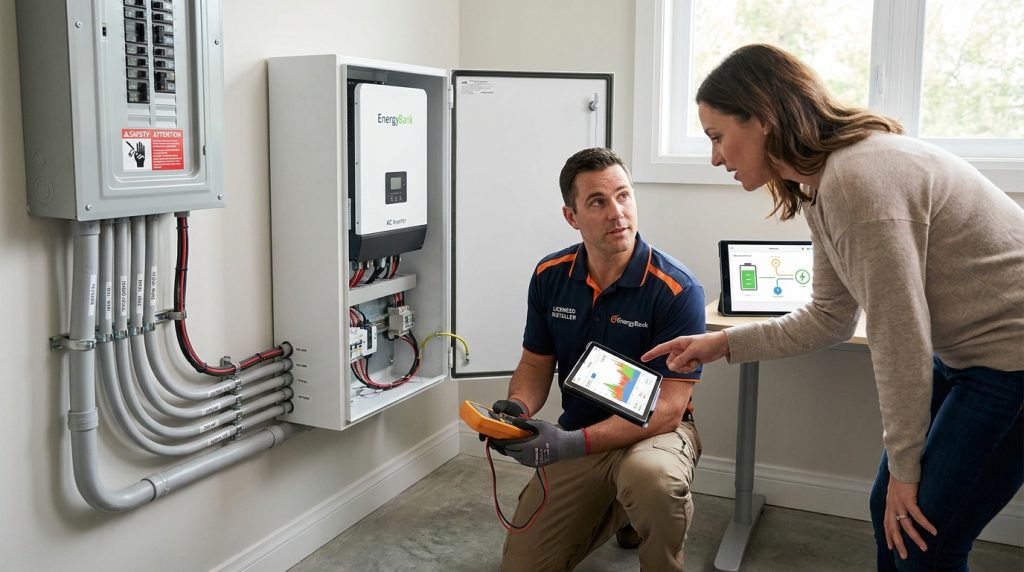
You can usually set up a small outlet-connected battery as instructed by the manufacturer. You need a qualified installer when the battery connects to home wiring, solar circuits, a transfer device, a critical-loads panel, or grid-interactive equipment.
DIY setup can make sense for portable units used exactly as the manual allows. For example, a renter may connect a compact battery to keep a Wi-Fi router, laptop, light, and small fridge running during an outage. That is very different from wiring a battery into a breaker panel.
Fixed storage should be handled as a home electrical project. The U.S. Department of Energy says proper installation and qualified vendors help reduce safety risk for solar and battery systems. That same mindset applies when a battery connects to solar, backup circuits, or home wiring through a fixed installation.
| If your battery use case is… | DIY may be reasonable? | Call an electrician or installer? |
|---|---|---|
| Charging a portable unit from a wall outlet | Yes | Usually no |
| Powering devices from the unit’s own outlets | Yes | Usually no |
| Connecting to a home panel | No | Yes |
| Adding a transfer switch | No | Yes |
| Backing up a critical-loads panel | No | Yes |
| Connecting to rooftop solar circuits | No | Yes |
| Exporting or controlling grid power | No | Yes |
The installer is not just adding cost. For fixed systems, the installer turns a factory-ready product into a safe, inspected, site-ready system. For a wider view of system components and installation planning, use VoltaLink’s home storage system basics.
What does a real installer still have to do?
A real installer still has to make the battery match the home. Even when the cabinet is pre-wired, the home is not pre-wired for that exact battery, load plan, location, and backup goal. That is where site work matters.
This is also where plug-ready systems can still save time. The installer may spend less time matching separate parts and troubleshooting communication. But they still need to confirm the electrical path, protection devices, labeling, settings, and handover.
Installer Still Does Checklist
- Review the homeowner’s backup goals and list essential loads
- Check the main panel, breaker space, grounding, and circuit capacity
- Confirm battery placement, clearance, access, and environment
- Review the installation manual and warranty conditions
- Plan transfer equipment or critical-loads wiring if backup is needed
- Connect battery, inverter, meter, CTs, or communication cables where required
- Set operating modes, charge limits, backup reserve, and app access
- Apply warning labels and system documentation
- Coordinate inspection or local approval where required
- Teach the homeowner what the system can and cannot power
A simple example helps. If a homeowner wants to keep lights, Wi-Fi, a refrigerator, and a few outlets running, the installer may design a small critical-loads setup. If the homeowner wants air conditioning, pumps, microwave use, and whole-home backup, the installer has to plan a larger system with different equipment.
Where does pre-integration genuinely save installation time?
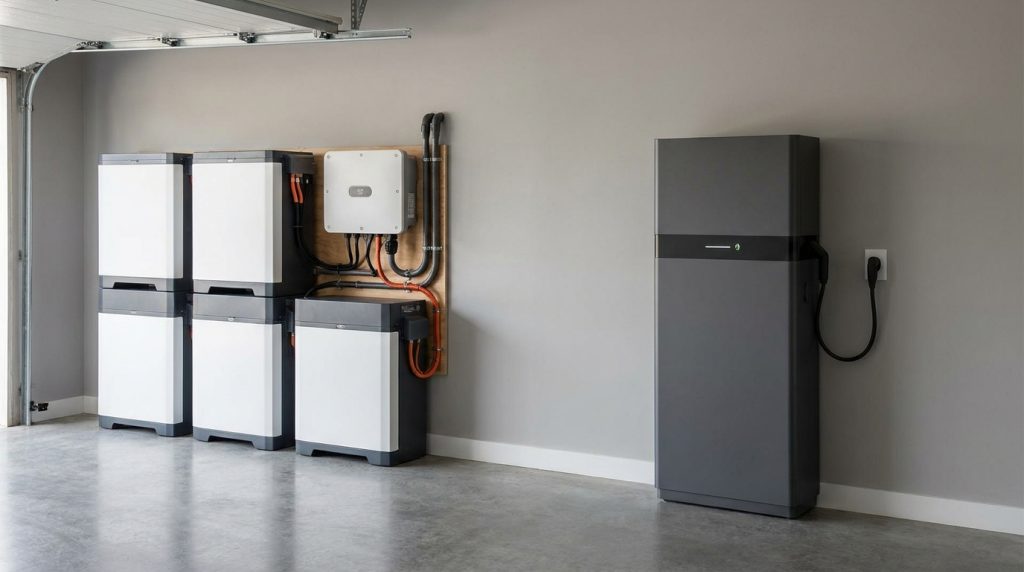
Pre-integration saves time by reducing component matching, cabinet wiring, communication setup, and commissioning checks. It helps installers work faster, but it does not remove site assessment, safe connection, labeling, inspection, or utility compliance.
The best all-in-one systems reduce messy field work. The battery modules, inverter, BMS, EMS, monitoring, and cabinet layout may already be designed to work together. That can reduce wiring errors and make the installation more predictable.
This matters most for installers and OEM buyers. A pre-integrated cabinet can be easier to quote, easier to train teams on, and easier to support after installation. It also gives homeowners a cleaner equipment layout with fewer separate boxes on the wall.
| Task | Split system | Pre-integrated system |
|---|---|---|
| Battery and inverter matching | Installer checks compatibility | Mostly handled by manufacturer |
| Communication setup | More field configuration | Often pre-matched |
| Cabinet wiring | More site work | Less site work |
| Troubleshooting | More variables | Fewer component variables |
| Site safety checks | Still required | Still required |
| Inspection and labeling | Still required | Still required |
This is the honest value: plug-and-play saves labor, not responsibility. A pre-integrated BESS cabinet can make a project faster, but it does not make home wiring disappear.
Will a plug-and-play battery back up the whole house?
Most plug-in home batteries do not back up the whole house. They usually support selected essential devices unless the system is designed, wired, and approved as a whole-home or critical-load backup system.
A small plug-in battery is not a bad product. It is simply a different product from a whole-home ESS. It works best for renters, essential devices, and small solar self-consumption, while a fixed ESS is safer for full-home backup.
The U.S. Department of Energy explains that storage systems are described by both energy capacity and power capacity. In plain terms, kWh tells you how much energy is stored. kW tells you how much power the battery can deliver at one time.
Power rating versus battery capacity
Think of a 5 kWh battery running a 500 W load. In simple math, 5 kWh divided by 0.5 kW equals about 10 hours. Real runtime will be lower because of inverter losses, reserve settings, temperature, and battery protection limits.
Now compare that with a microwave, well pump, air conditioner, and several kitchen loads starting at the same time. Those loads need much higher output. A wall-outlet battery may keep a router, laptop, light, and fridge going, but it is not the same as a planned whole-home backup system.
| Load goal | Better fit |
|---|---|
| Router, laptop, light, small fridge | Portable or plug-in battery |
| Fridge, outlets, lights, internet | Critical-loads battery setup |
| AC, pump, kitchen, whole home | Professionally designed ESS |
| Solar self-consumption at night | Solar battery with compatible controls |
Can it connect to solar panels, a smart meter, or an existing inverter?
Some plug-and-play batteries can connect to solar panels, smart meters, CT clamps, or an existing inverter. Compatibility is never automatic. The safe answer depends on voltage range, inverter type, export control, communication protocol, and the manufacturer’s approved wiring method.
This is one reason many buyers get confused. A product page may show solar panels, an app, and home backup in the same image. That does not mean every setup supports every connection path. The manual should say what inputs, outputs, and operating modes are allowed.
| Connection question | What to check before buying |
|---|---|
| Can solar panels connect directly? | PV voltage, current, connector type, MPPT limits |
| Can it work with an existing inverter? | AC-coupled support, export rules, monitoring method |
| Does it need a smart meter? | Meter brand, CT clamp setup, communication cable |
| Can it prevent backfeed? | Anti-backfeed method and approved installation path |
| Can it charge from the grid? | Local rules, app settings, warranty terms |
| Can it power backup loads? | Transfer method, output rating, circuit design |
A solar self-consumption buyer should be specific. If daytime PV is wasted and they want to use it at night, they need a battery setup that can measure home demand and control charging or discharging correctly. A simple solar battery setup may work only when the product is designed for that connection path.
What permits, standards, and safety documents should buyers check?
Before buying, ask for the product listing, installation manual, warranty conditions, and any fire-test or code documents required in your region. For fixed ESS, the local AHJ and installer decide what documentation is acceptable.
Battery systems store high energy in a small space, so documentation matters. UL explains that ESS installation codes and fire safety requirements may involve standards such as UL 9540, UL 9540A, NFPA 855, and fire code requirements for certain systems. Your installer should know what applies locally.
Buyer Compliance Checklist
- Product listing or certification documents
- Installation manual for the exact model
- Battery chemistry and safety documentation
- UL 9540 or relevant ESS listing where required
- UL 9540A fire-test data where required
- Warranty terms tied to installation method
- Approved inverter or meter compatibility list
- Local AHJ or permit requirements
- Installer license or qualification details
- Clear battery placement and clearance rules
Do not treat a marketing phrase as a permit answer. A brand can say “easy install,” but your local authority, utility, insurer, and installer may still require specific steps. The safest purchase is one where the product paperwork, installer plan, and home conditions all match.
Can shipping or customs delay a plug-and-play home battery order?
Yes, imported lithium battery systems can face shipping or customs delays if documents, labeling, classification, or compliance evidence are incomplete. The safe buyer move is to ask the supplier for shipping classification, test documentation, and import support before payment.
Lithium batteries are not ordinary parcels. PHMSA provides a lithium battery guide for shippers that separates guidance by battery type, size, configuration, and transport situation. That means paperwork and packaging details can matter before the battery even reaches customs.
There is no honest fixed customs timeline without shipment details. Delays can happen when invoice descriptions, labels, classification, test documents, or compliance evidence are incomplete. A distributor importing home batteries should ask for documents before the shipment leaves the factory.
Pre-Shipment Document Checklist
- UN 38.3 test summary
- Battery type and chemistry
- Watt-hour or kWh rating
- Shipping classification
- Safety data sheet if required
- Packing and labeling details
- Commercial invoice description
- Product certification documents
- Importer or broker contact
- Warranty and after-sales process
The Federal Register has also discussed lithium battery transport safeguards such as packaging to reduce short-circuit and damage risks. For buyers, the lesson is simple: a plug-ready product still needs serious shipping paperwork.
Who is a plug-and-play battery actually right for?
A plug-and-play battery is right for buyers with a clear, limited use case. It is not the best shortcut for every home. The right choice depends on whether you need small backup, solar self-consumption, clean installation, or full-home resilience.
A homeowner who only needs emergency power for internet and a fridge may not need a fixed ESS. A homeowner who wants backup for AC, pumps, and kitchen loads needs a designed system. Cost-focused buyers should also compare installation scope with the expected battery payback period.
| Buyer situation | Best fit | Main decision point |
|---|---|---|
| Renter in an apartment | Portable or outlet-connected battery | No fixed wiring |
| Homeowner with balcony solar | Plug-in solar battery if approved | Solar and meter compatibility |
| Homeowner with rooftop solar | Integrated or AC-coupled battery | Inverter and export control |
| Backup for fridge, router, lights | Critical-loads setup | Load list and runtime |
| Whole-home backup | Fixed ESS | Output rating and transfer equipment |
| Installer or OEM buyer | Pre-integrated cabinet | Faster setup and support |
| Import buyer or distributor | Documented lithium battery system | Shipping and compliance papers |
The simplest decision rule is this: buy a plug-in battery for selected devices, and choose a professionally installed ESS for home wiring, solar integration, or whole-home backup.
What to Do Next
A plug and play home battery system can be a smart choice when the product type matches the job. Start by listing what you want to power, how long you need backup, and whether the battery will touch home wiring or solar equipment. Then ask the supplier for the manual, certifications, wiring diagram, and warranty rules.
If the system needs a panel connection, transfer equipment, or solar integration, involve an installer before purchase. That step can prevent unsafe DIY work, wrong sizing, permit issues, and customs surprises.
Frequently Asked Questions
Is it really ready to use?
A small socket-connected battery may be ready to use after basic setup. A fixed home ESS is usually only installer-ready because it still needs safe electrical connection, commissioning, and local compliance checks.
Do I need an electrician to install a plug-in battery?
You may not need an electrician for a portable or outlet-connected unit used exactly as the manual allows. You do need one when the system connects to household wiring, solar circuits, transfer equipment, or critical loads.
Do I need a permit for my home battery installation?
A fixed home battery often needs local approval, but requirements vary by location and system type. Ask your installer or local authority before ordering equipment that connects to wiring, solar, or backup circuits.
What autonomy can be expected?
Backup time depends on battery capacity and the load you connect. A 5 kWh battery can theoretically run a 500 W load for about 10 hours before efficiency losses and reserve settings.
Can it be connected to an inverter or a solar panel?
Some plug-and-play batteries connect to solar panels, microinverters, or an existing inverter, but compatibility is not universal. Check voltage, communication protocol, export-control method, and the manufacturer’s approved wiring path.
Can I use more than one plug-and-play battery at the same time?
Some systems support multiple batteries, but they must be designed to coordinate safely. Do not assume you can add several outlet-connected units to one circuit without checking load limits, sequencing, and manufacturer rules.
Can a plug-and-play battery power my whole house?
Most outlet-connected batteries are for selected devices, not whole-home backup. Whole-house backup normally needs higher output, transfer equipment, circuit planning, and professional installation.

-

 OEM Residential Energy Storage Solutions: Passive vs. Active Cell Balancing
2026-09-30
-
 Smart Home Battery with BMS Communication: Cybersecurity and BMS Safety
 -
 10kWh Home Battery Backup System: Is 90% DoD Better for Daily Solar Storage?
2026-09-29
-
 Integrated Home Energy Storage System 150–430V MPPT Design
2026-09-28
-
 LiFePO₄ Residential Backup Battery SOC Accuracy in Parallel Systems
Share this:





.svg)






-899.svg)


