




Hybrid Solar + Battery: A Single-System Approach
Hybrid Solar + Battery Storage is usually best bought as one system when you already expect to need backup power, evening solar use, or future energy independence. Bundling can reduce repeated labor, permitting, wiring, inverter, and commissioning costs. PV-only still works when budget is tight, but the quote should include a battery-ready upgrade path.
A PV-only quote can look simple because the first invoice is lower. The real question is whether that quote protects your next step. If you already know you may add storage within a few years, the design choices you make today can affect your inverter, permits, labor, wiring, and future battery compatibility. That is why a single-system plan deserves attention before you sign.
Should you buy solar and battery storage together in 2026?
A hybrid solar + battery storage system is usually smarter when you already want backup, evening solar use, or future energy independence. The main savings come from designing the PV, battery, inverter, wiring, permits, and monitoring as one project.
Buying everything together makes the most sense when storage is already part of your plan. You may pay more on day one, but you avoid treating the battery as a second electrical project later.
The best single-system candidates usually have one of these needs:
- You use a lot of power after sunset.
- You want backup for outages.
- You expect peak electricity rates to matter.
- You plan to add storage within 1 to 3 years.
- You want one monitoring and control setup from the start.
PV-only is not automatically the cheapest path. It is only cheaper if the system is designed with a clean battery upgrade route, or if you truly do not expect to need storage. For broader planning around whole-home storage, start with this home energy storage guide.
What is a hybrid solar + battery storage system?
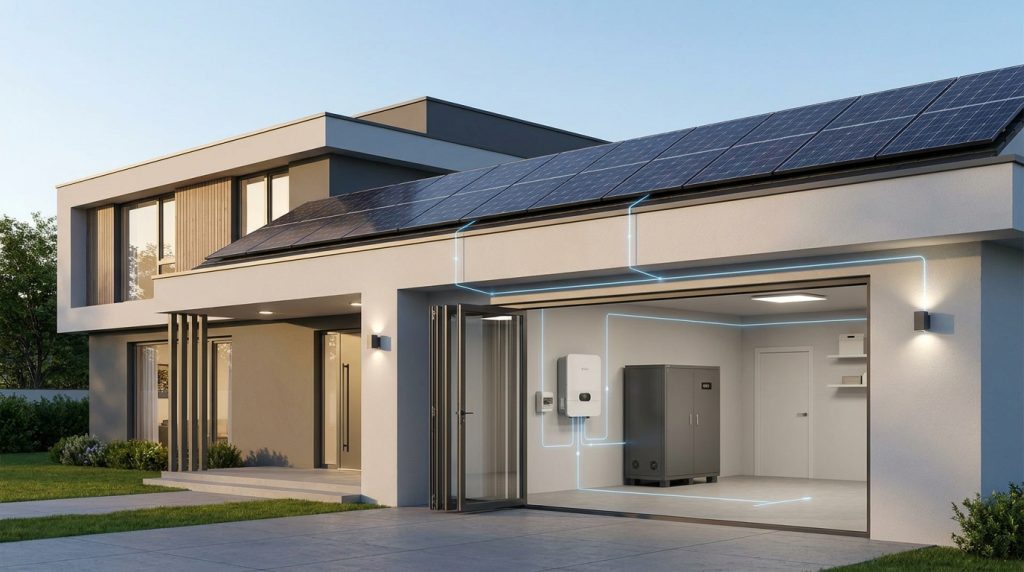
A hybrid solar + battery storage system combines rooftop PV, battery storage, inverter control, and grid connection into one coordinated home energy system. It stores surplus solar power and releases it when solar production is low, grid prices are high, or backup is needed.
A basic PV-only system sends solar power to your home first, then exports extra power to the grid. A hybrid system adds a battery, so some of that extra solar can stay at home. The inverter controls how power moves between panels, battery, home loads, and the grid.
The U.S. Department of Energy explains solar-plus-storage as a battery system charged by a connected PV system, with stored energy available later when the home needs it. That could mean evening use, outage support, or less grid use during expensive hours.
A practical setup often includes rooftop panels, a hybrid inverter, a LiFePO4 battery pack, a battery management system, monitoring software, and selected backup circuits. If you want a deeper system-level explanation, see this guide to hybrid home ESS.
Why does bundling solar and storage often cost less than phasing?
Bundling saves money because the installer designs, permits, wires, commissions, and inspects one coordinated system instead of returning later to modify the first project. DOE also notes that co-located PV and storage can share hardware and reduce labor, permitting, and interconnection costs.
The day-1 bundle costs more than PV-only because you’re buying the battery, compatible inverter, and backup components at the same time. The saving comes from avoiding duplicate work. One crew visit, one design plan, one commissioning process, and one upgrade path can reduce friction.
The DOE says co-located solar and storage can share hardware and reduce costs tied to site preparation, labor, permitting, interconnection, and overhead. That matters for homeowners because a later battery retrofit can require a second round of electrical planning.
| Cost area | PV-only now | Battery later | Bundled day-1 system | Risk level |
|---|---|---|---|---|
| Design | Solar-only layout | Redesign for storage | One full system design | Medium |
| Inverter | Standard inverter possible | May need battery inverter | Hybrid inverter planned | High |
| Labor | One PV install | Second crew visit | One coordinated install | Medium |
| Permits | PV permit | Updated storage permit | One planned permit path | Medium |
| Inspection | PV inspection | Second inspection | One coordinated review | Medium |
| Monitoring | Solar app only | New battery integration | One control platform | Low |
| Troubleshooting | Split responsibility possible | More compatibility checks | One system plan | Medium |
This is the core reason bundling is attractive. It doesn’t make the battery free. It reduces the chance that you pay twice for work that could have been planned once.
What extra costs can appear when you add a battery later?
Adding a battery later can be simple if the original system is battery-ready, but costly if it is not. The biggest upgrade risks are inverter replacement, extra electrical work, repeat permitting, new inspection, and separate labor.
A phased upgrade works well when the first solar system was designed for storage. It gets expensive when the PV-only quote used hardware that was never meant to manage a battery. That is where the “we’ll add it later” plan can become frustrating.
Phased upgrade cost triggers
| If your PV-only system has this issue | Later battery upgrade may require this |
|---|---|
| Standard solar inverter only | Separate battery inverter or inverter replacement |
| No protected loads panel | Extra electrical work for backup circuits |
| No battery space planned | Layout changes and longer installation time |
| Basic monitoring only | New app, gateway, or controls |
| Permit covered PV only | Updated local permit and inspection |
| Limited compatibility list | Fewer battery choices later |
A retrofit is not a mistake. The mistake is signing a PV-only quote without knowing whether the inverter, permits, wiring, and monitoring are ready for storage. Ask for the future battery path in writing before you decide.
For practical installation context, review these real hybrid builds before comparing quotes. They can help you see how design choices show up in real homes.
Is a hybrid inverter worth choosing on day 1?
A hybrid inverter is worth choosing on day 1 if storage is likely within the system’s life. It can reduce later equipment changes because it is already designed to manage PV generation, battery charging, grid interaction, and backup behavior.
The inverter is the control center of the system. A standard solar inverter mainly converts PV power for home or grid use. A hybrid inverter is designed to work with both solar panels and a battery.
A hybrid inverter is not worth buying just because it sounds advanced. It is worth buying when the homeowner has a real storage plan, backup need, or energy-shifting use case.
Hybrid inverter vs standard inverter
| Question | Standard solar inverter | Hybrid inverter |
|---|---|---|
| Best for | PV-only systems | Solar plus battery systems |
| Battery support | Often limited | Built for storage control |
| Upgrade path | May need extra hardware | Easier future storage planning |
| Backup support | Usually not enough alone | Can support backup design |
| Day-1 cost | Lower | Higher |
| Later risk | Higher if storage is added | Lower if compatible battery is chosen |
Hybrid inverters still need careful matching with the battery voltage, chemistry, communication protocol, and backup design. Do not accept “battery-ready” as a vague promise. Ask which battery models are supported and what extra parts are needed.
AC-coupled retrofit or bundled DC/hybrid design: which path fits?
AC-coupled retrofits are often useful for existing solar homes. A bundled DC or hybrid design is often cleaner for new installations because solar, battery, inverter, and backup circuits can be planned together from day one.
In an AC-coupled setup, the solar system and battery system each have their own conversion path. This can be practical when panels and a solar inverter already exist. It may also reduce disruption when the original PV system still works well.
A DC-coupled or hybrid design can make more sense for a new install. The solar array, battery, and inverter are selected as one system. This can simplify energy flow, monitoring, and future service.
| Path | Best fit | Main advantage | Main caution |
|---|---|---|---|
| AC-coupled retrofit | Existing PV homes | Easier add-on path | More equipment layers |
| DC-coupled design | New solar plus storage | Cleaner system planning | Needs upfront decision |
| Hybrid inverter system | New installs or planned storage | Better battery coordination | Compatibility must be checked |
The DOE also explains that solar and storage can improve flexibility by storing energy when solar production is high and using it later. That benefit is stronger when the system design matches your daily usage pattern.
How large should the first battery be if you bundle?
The first battery should match your actual goal, not your fear of running out of power. Many homeowners should start with essential backup or evening self-consumption, then expand later if the battery system is modular.
Battery sizing depends on three simple questions: what loads need backup, how long they must run, and how much solar can recharge the battery during the day. A full-home backup plan needs more storage than a fridge, lights, Wi-Fi, and a few outlets.
| Buyer scenario | Main goal | Practical starting point | Decision point |
|---|---|---|---|
| Almost-Certain Battery Buyer | Add storage within 12 to 24 months | Bundle now or choose hybrid inverter | Avoid redesign later |
| Evening-Load Family | Use solar after sunset | Size for evening loads | Focus on self-consumption |
| Outage-Concerned Homeowner | Keep essentials on | Plan protected loads | Do not assume all circuits run |
| Budget-Limited PV Buyer | Install solar now | Choose battery-ready PV | Document retrofit path |
| Expansion Planner | Start smaller | Use modular battery design | Confirm future capacity support |
The IRS residential clean energy credit includes qualifying battery storage technology, and the IRS states that battery storage must have at least 3 kWh of capacity to qualify. Check current eligibility with your tax professional before using incentives in your budget.
Battery chemistry also affects safety, cycle life, weight, and long-term performance. If you’re comparing chemistry options, review this guide on LiFePO4 vs NMC before choosing your pack.
When is PV-only still the better first step?
PV-only can still be the better first step when budget is tight, battery needs are unclear, or the home exports under favorable terms. The safer compromise is choosing a battery-ready inverter or at least confirming the future retrofit path before signing.
A bundled system is not the right answer for every homeowner. If the battery stretches the budget too far, a clean PV-only system can still reduce grid use and lower daytime energy costs.
PV-only may fit better when:
- You rarely have outages.
- Your evening electricity use is low.
- Your local export credit is strong.
- You don’t know which loads need backup.
- Your panel upgrade or roof plan is still uncertain.
- The installer can document a clean battery upgrade path.
The strongest compromise is not “battery now or never.” It is a PV design that does not block storage later. If the quote uses a standard inverter, ask for the cost difference to choose a hybrid or battery-compatible option.
What should you ask before accepting a PV-only quote?
Before choosing PV-only, ask whether the inverter, wiring, monitoring, permits, and electrical panel plan are battery-ready. A cheap PV-only quote is not always cheaper if the later battery upgrade requires a second design and new hardware.
Use this checklist before signing. It turns a vague future upgrade promise into a real plan.
- Is the inverter hybrid or battery-compatible?
- Which battery brands and models are supported?
- Will the battery need a separate inverter later?
- Is there space for the battery and disconnect equipment?
- Will the system need a protected loads panel?
- Does the quote include backup capability or only self-consumption?
- Will adding storage require new permits or utility paperwork?
- What is the estimated labor cost for adding a battery later?
- Will the same monitoring app show solar, battery, and grid use?
- What charging settings will protect battery life?
Charging behavior matters after installation, especially for LiFePO4 systems. Before you choose a storage path, ask your installer how they handle daily charge limits, reserve settings, and charging best practices.
Final decision: bundle now or phase later?
Bundle now if you already expect to use storage for backup, evening solar use, or peak-rate control. Phase later if the battery need is unclear, the budget is tight, or your current export setup makes storage less urgent.
| Your situation | Better path | Why |
|---|---|---|
| You plan to add battery within 1 to 3 years | Bundle now | Avoid second design and labor visit |
| You want outage backup | Bundle now | Backup circuits need early planning |
| You mainly want cheaper daytime solar | PV-only may work | Storage may not pay off yet |
| Your budget is tight | PV-only with upgrade path | Keeps cost lower today |
| You’re unsure about future loads | Battery-ready design | Keeps options open |
| Your installer offers only a basic PV inverter | Recheck the quote | Compatibility risk is high |
The safest buying move is to compare two quotes: PV-only with a documented retrofit path, and a day-1 hybrid system. Do not compare only the first invoice. Compare the full 2026 path, including inverter choice, permits, labor, inspection, monitoring, and backup design.
Getting the Next Step Right
Hybrid Solar + Battery Storage works best when the system is planned around your real home, not a generic package. Before you commit, ask your installer for two designs: one bundled system and one PV-only system with a written battery upgrade path.
If the bundled quote avoids repeat labor, extra permits, inverter changes, and monitoring problems, it may be the cleaner long-term choice. If PV-only still wins, make sure it does not lock you into an expensive retrofit later.
Frequently Asked Questions
Can you add a battery to an existing solar system?
Yes, most solar systems can add battery storage later, but the cost depends on inverter compatibility, wiring, permits, and installation layout. A battery-ready inverter makes the process easier and reduces the chance of a major redesign.
Do I need to replace my solar inverter to add a battery?
Not always. If your inverter is hybrid or battery-compatible, you may not need replacement, but a standard PV inverter may require a separate battery inverter or a full upgrade.
What size battery do I need for solar panels?
The right size depends on your evening load, backup goal, and solar generation. Many homes start with essential backup or partial-home coverage, then expand if the battery system is modular.
Can a solar battery charge from the grid?
Yes, many modern home batteries can charge from the grid if the inverter and local rules allow it. This can help with off-peak charging and peak-rate avoidance.
Is solar battery storage worth it?
Solar battery storage is worth it when you value backup power, use more energy at night, face high peak rates, or want more self-consumption. It is less urgent when export credits are strong and outages are rare.
Do solar batteries work during a power outage?
Yes, but only if the system is designed for backup operation. A standard grid-tied solar system can shut down during outages unless it has suitable storage, inverter controls, and safe isolation.
Is it cheaper to install solar and battery together?
Often, yes. Bundling can reduce repeated labor, permitting, commissioning, and compatibility costs, especially when the system needs a hybrid inverter or protected backup-load design.

-

 OEM Residential Energy Storage Solutions: Passive vs. Active Cell Balancing
2026-09-30
-
 Smart Home Battery with BMS Communication: Cybersecurity and BMS Safety
 -
 10kWh Home Battery Backup System: Is 90% DoD Better for Daily Solar Storage?
2026-09-29
-
 Integrated Home Energy Storage System 150–430V MPPT Design
2026-09-28
-
 LiFePO₄ Residential Backup Battery SOC Accuracy in Parallel Systems
Share this:





.svg)






-899.svg)


