




LiFePO4 Fire Safety: Myths vs Standards Reality
LiFePO4 fire safety is stronger than many lithium-ion chemistries because lithium iron phosphate is more thermally stable and less likely to feed oxygen-driven fire behavior. It is not fireproof. For home batteries, the safer choice is a certified LiFePO4 system with BMS protection, correct installation, clear documentation, and standards support such as UL 9540A and IEC 62619.
Many homeowners hear “lithium battery” and think of fires, explosions, or insurance problems. That fear is understandable, but it often mixes different battery chemistries into one risk category. A home energy storage system should be judged by chemistry, testing, installation quality, and protection design. This guide separates the common myths from the standards reality.
Are LiFePO4 batteries actually fire safe?
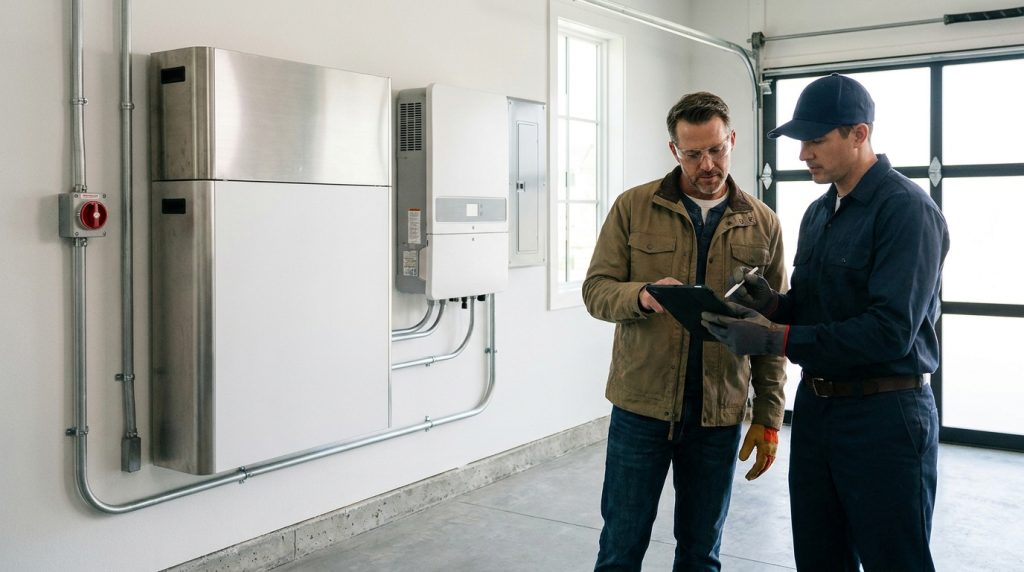
LiFePO4 fire safety is better than many lithium-ion chemistries because its phosphate-based structure is more thermally stable. It is not fireproof, but a certified system with BMS protection and proper installation carries much lower risk than poorly managed lithium systems.
LiFePO4, also called lithium iron phosphate or LFP, sits in a different safety class from many high-energy lithium-ion chemistries. It is widely used in stationary storage because home batteries need stable operation, long service life, and predictable behavior more than extreme compact energy density.
The right question is not only, “Is the cell chemistry safe?” It is, “Is the full system safe?” A safe home battery needs a reliable Battery Management System, correct inverter settings, suitable placement, clear disconnects, and installation that follows the product manual.
If you are comparing safety as part of a full home storage plan, use this article as the safety layer and connect it with a broader home energy storage system guide for sizing, backup loads, and system design.
Myth 1: Do lithium batteries explode, or is LiFePO4 different?
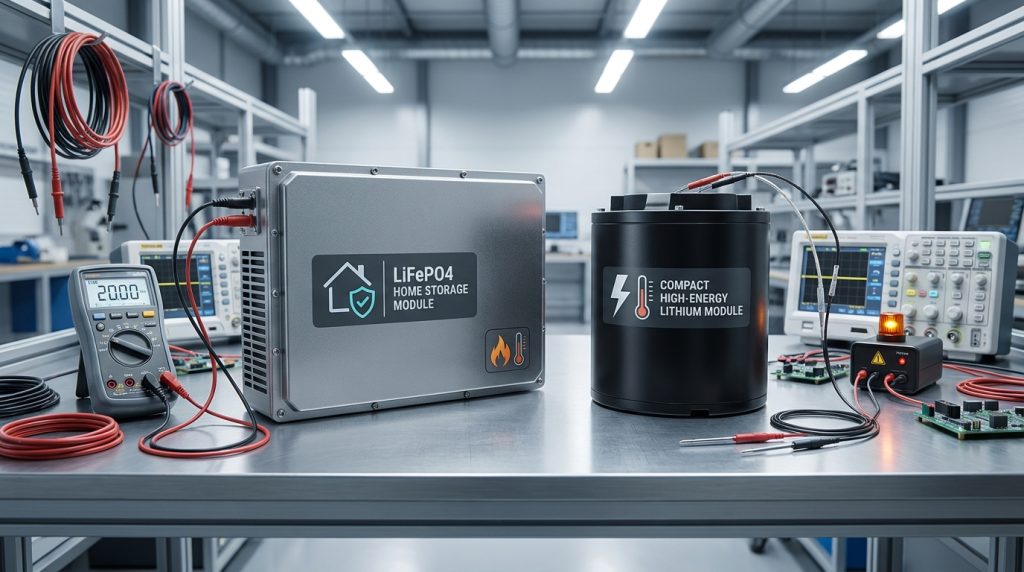
LiFePO4 is different from NMC and LCO because its phosphate-based cathode is more chemically stable under stress. That makes violent fire behavior less likely, but the final safety outcome still depends on product quality and installation.
“Lithium battery” is not one single chemistry. A phone battery, an EV battery, and a home storage battery may use different materials, safety controls, and packaging. LiFePO4 uses lithium iron phosphate, which behaves differently from chemistries such as NMC and LCO.
That does not mean a seller should claim “it can never explode.” A damaged, uncertified, or badly installed battery can still become dangerous. The safer claim is more precise: LiFePO4 has a stronger safety profile for stationary storage when the system is built and installed correctly.
| Buyer myth | What is partly true | Standards reality | What to check |
|---|---|---|---|
| “Lithium batteries explode.” | Some lithium systems can fail violently under abuse. | Chemistry, pack design, testing, and installation change the risk level. | Battery chemistry, certification, BMS, and installer plan |
| “LiFePO4 still has thermal runaway.” | Severe abuse can still cause failure. | Test data helps show how the system behaves under forced failure. | UL 9540A report or fire-test information |
| “Home batteries are a fire risk.” | Any stored-energy system needs control. | A listed system with safe placement is judged differently from an unknown battery pack. | System listing, manual, clearances, disconnects |
A 10 kWh garage battery is a good example. The chemistry matters, but the reviewer should also ask where it will be mounted, how it disconnects, what inverter it uses, and what safety documents come with it.
Myth 2: Can LiFePO4 still have thermal runaway?
LiFePO4 can still fail under severe abuse, but it is more resistant to thermal runaway than NMC or LCO. The practical question is not “can it ever fail,” but whether the system prevents fault conditions before they escalate.
Thermal runaway means a battery cell heats itself faster than the system can cool or stop it. In a weak design, that heat can spread to nearby cells. In a safer design, the BMS, pack layout, fusing, and enclosure reduce the chance that a fault becomes a fire event.
A good BMS watches voltage, current, and temperature. It can stop charging or discharging when values move outside safe limits. This is why BMS safety layers matter in a real home system, especially when the battery works with solar input and inverter loads.
| If this happens | Why it matters | What should reduce the risk |
|---|---|---|
| Charger settings are wrong | Overcharge can stress cells | BMS limits and correct inverter setup |
| A cable is undersized | Heat can build at connections | Proper cable sizing and inspection |
| The battery is crushed or pierced | Cell damage can create internal faults | Protected mounting and safe handling |
| The battery is exposed to high heat | Heat reduces safety margin | Location planning and temperature monitoring |
| The BMS is unclear or low quality | Faults may not be stopped early | Verified BMS specs and protection data |
A BMS improves safety, but it does not erase chemistry risk. LiFePO4 starts with a safer chemistry, then adds electronic protection. That combination is why it is often favored for stationary home batteries.
What do UL 9540A and IEC 62619 actually prove?
UL 9540A does not mean “this battery can never burn.” It shows how an energy storage system behaves if thermal runaway is forced, giving fire officials and designers data on propagation, spacing, and installation risk.
Standards are not marketing badges. They help reviewers understand what was tested and what the result means. For a homeowner, HOA, or insurer, the goal is simple: ask for documents that show the battery is more than a generic lithium box.
UL 9540A in plain language
UL 9540A is a test method for energy storage systems. It looks at how fire can spread when thermal runaway is forced inside a battery system. This matters because fire officials and installers need evidence about propagation, spacing, and installation limits.
UL 9540A is tied to building and fire-code review. UL explains that it supports code needs linked with standards such as NFPA 855, NFPA 1, the International Fire Code, and the International Residential Code.
IEC 62619 in plain language
IEC 62619 covers safety requirements and tests for secondary lithium cells and batteries used in industrial applications, including stationary applications. For home storage buyers, it supports the idea that the battery has been tested beyond normal brochure claims.
UN 38.3 is different. It relates to transport safety, not home fire approval. PHMSA explains that lithium batteries offered for transport must pass UN Manual of Tests and Criteria Section 38.3, and manufacturers must make test summaries available on request.
| Document | What it helps show | What it does not prove |
|---|---|---|
| UL 9540 | System-level safety listing | Exact fire behavior under forced thermal runaway |
| UL 9540A | Fire propagation behavior during abuse testing | That a battery can never burn |
| IEC 62619 | Safety testing for lithium cells and batteries in stationary or industrial use | Full local installation approval |
| UL 1973 | Battery safety for stationary and motive auxiliary power use | Complete site safety by itself |
| UN 38.3 | Transport test compliance | Home installation fire approval |
Myth 3: Are home batteries a fire risk in a garage or utility room?
A LiFePO4 home battery is not automatically a fire risk because it is installed indoors or in a garage. The real risk depends on certified equipment, safe placement, clearances, wiring quality, BMS protection, and local code approval.
A garage or utility room can be suitable for a home battery when the product manual, local rules, and installer plan allow it. The risk rises when a battery is placed near flammable storage, blocked exits, water exposure, heat sources, or unprotected impact areas.
This is where integrated BMS design becomes practical. It is not only a technical feature. It helps the system monitor unsafe conditions before they become homeowner problems.
Use this quick placement check during review:
- Is the battery listed or supported by recognized safety documentation?
- Does the installation manual allow the proposed location?
- Are clearances, ventilation needs, and mounting instructions followed?
- Is there a visible disconnect or shutdown process?
- Are flammable items kept away from the unit?
- Is the installer qualified for battery and inverter work?
- Does the owner know what to do if an alarm appears?
For example, a homeowner asking to install a 10 kWh LiFePO4 wall battery in a garage should not receive approval from the product image alone. The better approval path is documentation first, location plan second, installer details third.
What can still make a LiFePO4 system unsafe?
A LiFePO4 system becomes unsafe when the installation or equipment removes the safety margin that the chemistry provides. Common triggers include wrong charger settings, weak BMS design, physical damage, water intrusion, poor cable sizing, high heat, and missing certification documents.
Do not accept “safe chemistry” as a complete answer. A cheap battery with unknown cells, no clear BMS data, and no test summary can create real risk even if the label says LiFePO4. This is especially important when buyers compare low-cost imports with fully documented home ESS products.
| Risk condition | What it can cause | Better decision |
|---|---|---|
| Wrong inverter or charger settings | Cell stress during charge | Confirm battery profile and installer setup |
| Unknown BMS | Poor fault control | Request BMS specs and protection limits |
| Damaged enclosure | Higher internal fault risk | Reject damaged units and document shipment condition |
| Water exposure | Short circuits or corrosion | Use approved locations only |
| Poor cable sizing | Hot connections | Follow manual and electrical code |
| Extreme temperature exposure | Reduced safety margin | Check temperature performance limits |
| Missing documents | Weak approval confidence | Ask for safety and transport records |
PHMSA treats lithium batteries as regulated hazardous materials during transport. That does not mean a home battery is unsafe by default. It means lithium products need correct documentation, handling, and test records across the supply chain.
What should an HOA, insurer, or homeowner ask before approving a LiFePO4 battery?
An HOA or insurer should not approve a LiFePO4 battery from chemistry claims alone. They should review the system listing, fire-test documentation, installation manual, BMS protections, placement plan, emergency disconnect, and installer qualifications.
This is the strongest way to turn safety claims into an approval process. A homeowner may care most about peace of mind. An HOA may care about building rules. An insurer may care about risk control and documentation. All three need clear proof, not broad reassurance.
A proposal that only says “LiFePO4 is safe” is incomplete. A stronger proposal explains the battery protection system, shows the installation location, lists safety documents, and names who will install it.
| Review item | What to ask for | Why it matters |
|---|---|---|
| System safety | UL 9540 or equivalent listing | Shows system-level review |
| Fire behavior | UL 9540A report or summary | Helps assess propagation risk |
| Cell and battery safety | IEC 62619 or UL 1973 documents | Supports battery safety claims |
| Transport record | UN 38.3 test summary | Confirms required shipping test record |
| Installation | Product manual and site plan | Confirms allowed placement and clearances |
| Protection | BMS functions and alarms | Shows how faults are controlled |
| Shutdown | Emergency disconnect instructions | Helps owners and responders act safely |
| Installer | License or battery-installation experience | Reduces wiring and setup risk |
If an HOA receives only a brochure, the next step is simple: request the document set before approval. If an insurer asks whether the system is “lithium,” the better answer is chemistry, certification, placement, and shutdown details.
When is LiFePO4 safer than NMC for home storage?
LiFePO4 is usually the safer choice for home storage when safety margin, service life, and stable stationary operation matter more than compact size. NMC can still make sense when high energy density is the main goal, but homes often reward safer chemistry and clear documentation.
This is where expert judgment helps. NMC is not always the wrong choice. It works when compact energy density matters most. For a garage, utility room, or solar-plus-storage system, LiFePO4 often fits better because the battery can be slightly larger without hurting the main use case.
| Buyer situation | Better fit | Reason |
|---|---|---|
| Home backup battery in a garage | LiFePO4 | Safety margin and long service life matter |
| Compact mobile power design | NMC may fit | Higher energy density can be useful |
| Solar battery for daily cycling | LiFePO4 | Stationary use values cycle life |
| HOA or insurer review | LiFePO4 with documents | Easier to explain safety class and controls |
| Low-cost battery with missing data | Neither | Missing documents create avoidable risk |
A buyer comparing a compact NMC battery with a slightly larger LiFePO4 system should ask what matters more. For stationary storage, safety behavior, cycle life, and approval confidence usually matter more than saving a small amount of wall space. For deeper battery-life planning, review long-cycle home batteries.
Getting the Next Step Right
LiFePO4 fire safety should be judged with practical evidence, not fear or sales language. Start with the chemistry, then check the system listing, UL 9540A information, IEC 62619 support, BMS design, installation plan, and emergency disconnect.
For a homeowner, the next step is to ask for the full document set before purchase. For an HOA or insurer, the next step is to approve the installed system, not the chemistry label alone. A well-documented LiFePO4 system gives everyone a clearer path to safe home energy storage.
Frequently Asked Questions
Do LiFePO4 batteries catch fire?
LiFePO4 batteries can catch fire under severe abuse, but they are much less prone to fire than many lithium-ion chemistries. The biggest risks are poor installation, physical damage, wrong charging settings, short circuits, and uncertified equipment.
Is a LiFePO4 battery a fire hazard?
A LiFePO4 battery is not automatically a fire hazard, but any stored-energy system needs proper controls. Certification, BMS protection, safe wiring, suitable placement, and professional installation make the system more acceptable for home use.
What does UL 9540A compliance really signify?
UL 9540A shows how an energy storage system behaves when thermal runaway is forced during testing. It helps fire officials, designers, and installers understand fire propagation risk, spacing needs, and installation safety limits.
Can I install a home battery myself?
A home battery should not be treated as a simple DIY appliance. Professional installation helps ensure correct wiring, disconnects, inverter settings, code compliance, spacing, and warranty protection.
What safety certifications should I look for in a LiFePO4 battery?
For home storage, ask for system-level safety documentation first, not only cell claims. Useful documents may include UL 9540, UL 9540A test information, UL 1973, IEC 62619, UN 38.3 transport summary, installation manual, and BMS specifications.
Does a BMS make other lithium batteries as safe as LiFePO4?
A BMS improves safety in any lithium battery, but it does not change the battery’s chemistry. LiFePO4 combines electronic protection with a more stable cathode structure, which is why it is often preferred for stationary home storage.

-

 OEM Residential Energy Storage Solutions: Passive vs. Active Cell Balancing
2026-09-30
-
 Smart Home Battery with BMS Communication: Cybersecurity and BMS Safety
 -
 10kWh Home Battery Backup System: Is 90% DoD Better for Daily Solar Storage?
2026-09-29
-
 Integrated Home Energy Storage System 150–430V MPPT Design
2026-09-28
-
 LiFePO₄ Residential Backup Battery SOC Accuracy in Parallel Systems
Share this:





.svg)






-899.svg)


