




Hybrid Inverter Sizing: Match Battery to Loads
Hybrid inverter sizing for home battery systems should start with the home’s simultaneous backup loads, then check surge loads, PV input, and battery discharge limits. A 5 kW continuous / 10 kW surge inverter may fit a typical critical-load setup, but only if the battery C-rate and BMS can deliver the required power safely.
A hybrid inverter quote can look simple, but the number on the datasheet does not tell the full story. A 5 kW inverter may run the lights, fridge, router, TV, microwave, and one small AC, yet still trip if the battery or surge rating is wrong. The right size comes from matching real loads to the inverter, battery, and solar array.
What does hybrid inverter sizing actually mean?
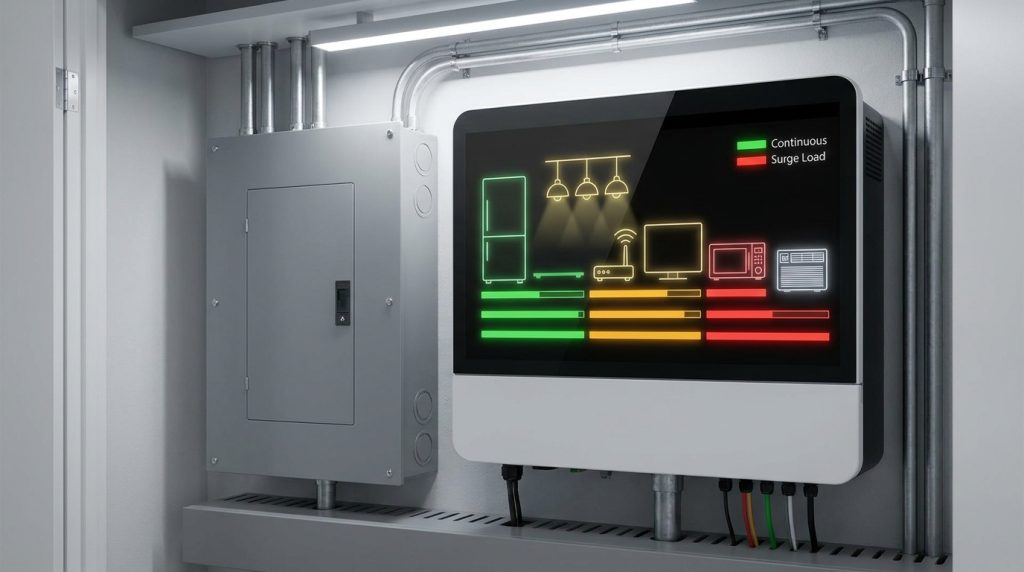
Hybrid inverter sizing means matching the inverter’s continuous AC output, short surge capability, solar input range, and battery discharge limit to the home’s real loads. A correct system must satisfy all four, not only the battery’s kWh capacity.
A hybrid inverter sits between the solar panels, battery, home loads, and grid connection. It changes DC electricity into usable AC power and controls how the home uses solar, battery storage, and grid power. Energy.gov describes inverters and other power conditioning equipment as key parts of renewable energy balance-of-system design.
The most common mistake is treating battery size as inverter size. Battery kWh shows stored energy. Inverter kW shows how much power the system can deliver at one time. For broader system planning beyond inverter sizing, use VoltaLink’s home energy storage system guide.
| Sizing limit | What it controls | Where to check it | Common mistake | Quote question |
|---|---|---|---|---|
| Continuous AC output | Steady load the inverter can run | Inverter AC output rating | Adding all appliances instead of simultaneous loads | What loads can run at the same time? |
| Surge output | Short motor or compressor startup power | Surge rating and duration | Assuming surge power is continuous power | What is the largest starting load? |
| PV input | Solar array size and MPPT limits | PV input voltage, current, and MPPT range | Oversizing panels beyond datasheet limits | What is the PV-to-inverter ratio? |
| Battery discharge | Power the battery can safely deliver | BMS current and C-rate | Assuming 10 kWh means 10 kW output | What is the max battery discharge power? |
| Grid and code approval | Safe connection and compliance | Local utility, NEC, UL, IEEE rules | Ignoring approval limits | Is this inverter approved for this site? |
How do you choose the right continuous inverter output?
Choose continuous inverter output from the loads that may run at the same time, not from total daily energy use. If the backup load panel can draw 4.2 kW continuously, a 5 kW inverter may fit only when surge and battery discharge limits also pass.
Start with the backup load panel, not the whole home. Add the running watts of the appliances that may operate together during an outage. A refrigerator, lights, WiFi router, TV, microwave, and one small AC may be realistic. An EV charger, water heater, and oven may not belong on the backup panel.
Energy.gov notes that inverter sizing should consider the AC wattage required by loads and the starting surge of some equipment. That means continuous output is only the first check. It tells you what the inverter can run steadily before motors or compressors start.
- List only loads that should work during backup.
- Add loads that may run at the same time.
- Keep large non-critical loads off the backup panel.
- Add a practical safety margin.
- Confirm whether the quote uses kW or kVA.
kW versus kVA on the quote
kW is real usable power. kVA is apparent power, and it depends on power factor. For most homeowners, appliance labels in watts are easier to understand than kVA ratings. If an inverter datasheet lists kVA, ask the installer to show the real kW output for the expected load type.
Why does surge rating matter for motors and compressors?
Surge rating matters because motors and compressors can draw much more power for a few seconds than they use while running. A 5 kW inverter with 10 kW surge can handle short starts only if the surge duration and battery discharge limit also support it.
Surge is the short burst needed when a motor starts. A fridge, water pump, freezer, or AC compressor may run at a modest wattage after startup, then demand much more power for a few seconds. If that surge is higher than the inverter can supply, the system may shut down even when the running load looks safe.
This is why backup design should match real operating behavior. In backup operating modes, loads can shift quickly when the grid drops. The inverter, battery, and load panel must handle that change without nuisance trips.
| If the home has this load | What to check | Better design choice |
|---|---|---|
| Refrigerator or freezer | Starting wattage and restart behavior | Keep enough surge margin |
| Water pump | Motor start surge | Use soft start or load control if needed |
| Small AC compressor | Surge duration and inverter overload rating | Confirm 10 kW surge is long enough |
| Microwave plus AC | Simultaneous running load | Avoid stacking peak loads |
| EV charger or water heater | High steady draw | Keep off the backup panel |
A bigger inverter is not the only fix. For motor-heavy homes, load control or a soft starter can be safer than upsizing the inverter without checking the battery.
Can the battery actually support the inverter output?
A battery supports the inverter only if its BMS and C-rate allow enough discharge power. For example, a 10 kWh battery at 0.5C can deliver about 5 kW, so it may not support a 10 kW surge unless short-term discharge is allowed.
This is the sizing limit many quotes hide. A battery’s kWh rating tells you how long it may run loads. It does not prove how much power it can deliver at one time. The battery management system, or BMS, sets safe current limits for charge, discharge, temperature, and protection.
C-rate connects battery capacity to power output. A 10 kWh battery at 0.5C gives about 5 kW continuous discharge. The same 10 kWh battery at 1C gives about 10 kW, if the BMS, cells, cables, and inverter all support it.
Simple C-rate check
Use this simple check before approving the inverter size:
Battery kWh × allowed C-rate = approximate continuous discharge power
Example:
10 kWh × 0.5C = 5 kW continuous discharge
This means a 5 kW inverter may match the battery well. A 10 kW surge event still needs special checking because short-term discharge can be different from continuous discharge. NREL’s residential battery storage reference uses both power capacity and energy capacity, which shows why kW and kWh should be reviewed separately.
A 10 kWh battery does not mean 10 kW output. If the homeowner wants higher backup power, adding battery modules may be better than selling a larger inverter on a small battery bank. For chemistry, cycle life, and BMS-related buyer checks, review VoltaLink’s LiFePO4 battery limits.
How much PV can you connect to a hybrid inverter?
PV capacity can be larger than inverter AC output, but only within the inverter datasheet, MPPT limits, and local rules. A common quote-check is PV kW divided by inverter AC kW, then confirm whether clipping and approval limits are acceptable.
The PV-to-inverter ratio compares the solar array’s DC size with the inverter’s AC output. A 6.6 kW PV array on a 5 kW inverter gives a ratio of 1.32. That may be acceptable in some designs, but it must match the inverter’s voltage, current, MPPT, warranty, and local approval rules.
Solar Victoria notes that hybrid inverter sizing depends on battery bank output capability, connected loads, and backup needs. It also gives a practical example where 6.6 kW of panels can be paired with a 5 kW inverter under its rebate context. Always check the rules for the project location.
| PV design item | What it means | What the quote should show |
|---|---|---|
| PV-to-inverter ratio | Solar DC kW divided by inverter AC kW | The ratio and expected clipping |
| MPPT range | Voltage window where panels operate well | String voltage and current design |
| Clipping | Lost solar output when PV exceeds AC output | Whether the loss is acceptable |
| Local approval | Utility or rebate limit | Compliance path for the site |
PV oversizing can be smart when morning, evening, or cloudy-day production improves. It is not smart when the installer cannot explain the datasheet limits. If the system uses a solar-first architecture, the PV design may connect naturally with DC-coupled storage.
Worked example: Is a 5 kW continuous / 10 kW surge inverter enough?
A 5 kW continuous / 10 kW surge inverter is enough only if the running loads stay below 5 kW, the largest startup event stays within the surge rating, and the battery can deliver the needed power. The example below shows how to check it without overcomplicating the quote.
Assume a homeowner wants backup for a refrigerator, lights, router, TV, microwave, and one small AC. The installer should place only these critical loads on the backup panel. Large loads such as an EV charger, electric oven, or water heater stay off backup unless the system is designed for them.
Load check
| Backup load | Running power |
|---|---|
| Refrigerator | 200 W |
| Lights | 300 W |
| Router | 50 W |
| TV | 150 W |
| Microwave | 1,200 W |
| Small AC | 1,800 W |
| Estimated simultaneous load | 3,700 W |
This 3.7 kW load fits under a 5 kW continuous inverter rating. There is also about 1.3 kW of headroom for small load changes. The design becomes risky if the homeowner expects the microwave, AC, pump, and other devices to start or run together.
Now check surge. If the small AC runs at 1.8 kW and starts near 4 kW for a few seconds, the temporary total could rise to around 5.9 kW. That fits inside a 10 kW surge rating, but the installer must confirm the surge duration and exact appliance behavior.
Battery and PV check
Next, check the battery. A 10 kWh battery at 0.5C can provide about 5 kW continuous discharge. That matches the inverter’s continuous output, but it may not support every surge event unless the BMS allows higher short-term output.
Now check PV. If the quote uses 6.6 kW of panels with a 5 kW inverter, the PV-to-inverter ratio is:
6.6 kW ÷ 5 kW = 1.32
That ratio may work in some systems, but only after checking the inverter datasheet, MPPT limits, and local approval path. The final decision is simple: this system can pass for a critical-load home if the battery discharge rating, surge duration, and PV input limits are documented in the quote.
What should a homeowner check before approving the inverter quote?
Before approving a quote, ask the installer to show the continuous load calculation, largest surge load, battery maximum discharge rating, PV-to-inverter ratio, and grid-connection approval path. If one is missing, the inverter size is not fully justified.
A good quote should explain why the inverter size fits the home. It should not only list a product model and price. Ask for the backup load list, expected simultaneous running load, largest motor or compressor surge, battery discharge rating, PV design, and compliance notes.
Grid-connected systems also need safety and power quality equipment, utility approval, and standards compliance. Energy.gov references IEEE 1547, UL 1741, and NEC in grid-connected renewable system planning. The exact requirement depends on the market, installer, utility, and equipment.
- What loads are on the backup panel?
- What is the maximum simultaneous running load?
- What is the largest surge load?
- How long can the inverter support surge output?
- What is the battery’s maximum continuous discharge?
- What is the battery’s short-term discharge limit?
- What is the PV-to-inverter ratio?
- How many MPPTs are used?
- Which grid, code, and utility requirements apply?
- What happens if the homeowner adds future loads?
Retrofit projects may need a different design path than new solar-plus-storage projects. If the home already has solar, an AC-coupled ESS may change how the inverter and battery are specified.
When is a bigger hybrid inverter not the better choice?
A bigger inverter is better only when the battery, PV array, wiring, backup panel, and future loads can use it. If the battery cannot deliver the power, the larger inverter may cost more without improving real backup performance.
Oversizing feels safe, but it can create a false sense of capacity. An 8 kW inverter connected to a battery system that can deliver only 5 kW will still be limited by the battery. The homeowner pays more, yet the backup panel may not gain useful power.
A bigger inverter works when future loads are real and the battery system can scale with them. It is weaker when the home only needs critical-load backup. In that case, moving the water heater or EV charger off backup may be smarter than buying more inverter capacity.
| Situation | Better choice | Why |
|---|---|---|
| Battery discharge is the limit | Add battery modules | More usable output and runtime |
| One motor causes trips | Add soft start or load control | Reduces surge stress |
| Backup panel is too broad | Move non-critical loads off backup | Keeps 5 kW design practical |
| Future loads are planned | Size inverter and battery together | Avoids later redesign |
| Homeowner wants simpler equipment | Consider all-in-one ESS design | Keeps inverter, battery, and controls matched |
A larger inverter is not automatically safer. It works when the full system is sized around it. A smaller inverter with clean load control is often safer when battery discharge is tight.
Getting the Next Step Right
Hybrid inverter sizing for home battery projects should end with a documented match between loads, surge, PV input, and battery discharge. Ask the installer to show the load list, the largest startup event, the C-rate calculation, and the PV-to-inverter ratio before approving the quote.
If the numbers do not line up, do not solve every problem by upsizing the inverter. Adjust the backup panel, add battery modules, use soft starts, or change the system architecture. The right inverter is the one the whole ESS can support safely.
Frequently Asked Questions
What size hybrid inverter do I need for a 3000W load?
A 3000W continuous load usually needs more than a 3 kW inverter once surge, power factor, efficiency, and safety margin are included. For motor loads, the quote should show both continuous kW and surge rating.
How many batteries do I need for 8 hours backup?
Battery count depends on the backup load in kW, desired runtime, usable capacity, system voltage, and battery discharge limit. This article covers the inverter power side, so full kWh planning should be handled in the broader home battery sizing guide.
Should I use 24 V or 48 V for my hybrid inverter system?
For most home systems above about 3 kW, 48 V or higher-voltage battery architecture is usually more practical because current is lower for the same power. The installer should confirm cable sizing, BMS current, and inverter compatibility.
What’s the difference between inverter kVA and kW ratings?
kW is real usable power, and kVA is apparent power affected by power factor. Homeowners should compare appliance loads in kW or watts and ask the installer to explain any kVA rating on the inverter datasheet.
How do I account for temperature derating in hot climates?
Temperature derating should be checked against the inverter datasheet and installation location. If the inverter is installed in a hot garage or outdoor cabinet, the installer may need ventilation, spacing, or a larger rated inverter.
What are Peak Sun Hours and how do they affect PV sizing?
Peak Sun Hours estimate how much useful solar energy a location can produce in a day. They affect battery recharge planning, but the PV-to-inverter ratio must still stay within inverter input limits and local approval rules.
Can a 10 kWh battery run a 10 kW inverter?
Not always. A 10 kWh battery can run a 10 kW inverter only if its BMS and C-rate allow that discharge power, and many battery systems need multiple modules to support high inverter output safely.

-

 OEM ODM Home Energy Storage Manufacturer for Stackable Home Battery Solutions
2026-08-20
-
 High-Rate Discharge in Data Center UPS Battery Backup Systems Explained
 -
 LiFePO₄ RV Battery 48V System Design: Battery, Inverter, Solar and DC Load Integration
2026-08-19
-
 51.2V LiFePO₄ Server Rack Batteries: 100Ah Capacity, Energy Output and Runtime
2026-08-18
-
 51.2V 100Ah LiFePO₄ Battery for Inverter in Solar Energy Storage Systems
2026-08-17
Share this:





.svg)






-899.svg)


