




LiFePO₄ RV Battery 48V System Design: Battery, Inverter, Solar and DC Load Integration
A LiFePO₄ RV Battery 48V system is best understood as an electrical architecture rather than simply a larger battery. Its real advantage appears when an RV begins operating high-power loads such as air conditioners, induction cooktops, microwave ovens or large inverter systems.
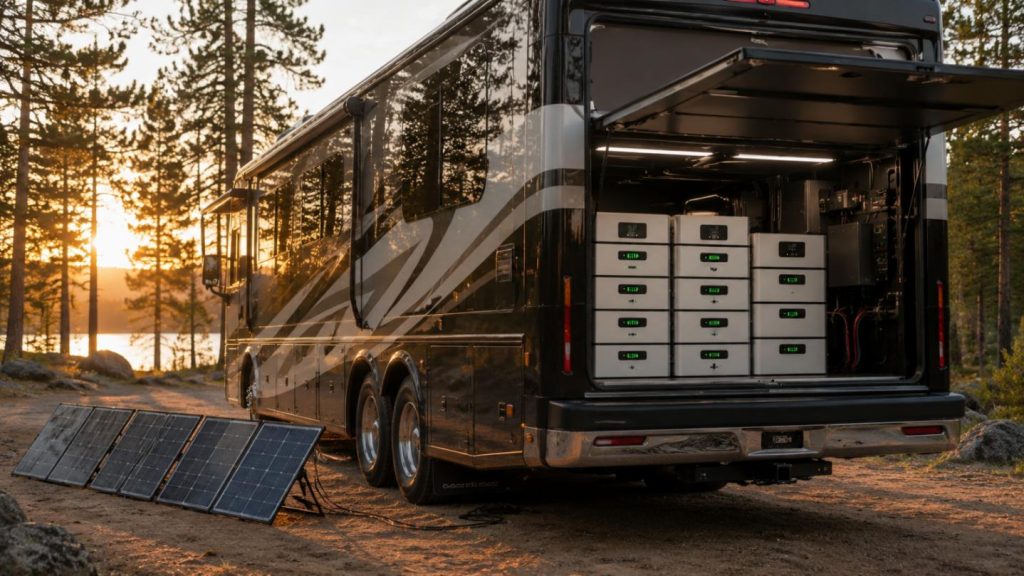
The design question is not just “How many amp-hours does the battery have?” It is how battery voltage, inverter power, BMS current, solar charging and existing 12V loads work together.
Why 48V Changes the Electrical Design
Electrical power follows a simple relationship:
Power = Voltage × Current
For the same power demand, increasing voltage reduces current.
• DC System Current at 3,000W* Typical Effect
• 12V 250A Very high DC current
• 24V 125A Moderate current
• 48V 62.5A Lower current
*Ideal calculation before inverter losses.
This matters because cable heating is strongly related to current. Resistive loss follows approximately:
Power Loss = I²R
If current is reduced, cable loss and voltage drop can also be reduced considerably.
This is why a LiFePO₄ RV Battery 48V becomes increasingly attractive as inverter power rises. The benefit is not that 48V creates more energy; it allows the same power to move through the DC side at lower current.
Ah Does Not Tell You How Much Energy the RV Has
Battery discussions often focus too heavily on amp-hours.
A 100Ah battery does not have the same energy at every voltage.
Battery energy is approximately:
Energy (Wh) = Nominal Voltage × Capacity (Ah)
For example:
• 12.8V × 100Ah ≈ 1.28kWh
• 25.6V × 100Ah ≈ 2.56kWh
• 51.2V × 100Ah ≈ 5.12kWh
This is why kWh is more useful than Ah when comparing systems with different voltages.
For a LiFePO₄ RV Battery 48V, energy capacity answers one question—how long the system can operate—but it does not determine how much instantaneous power the battery can supply.
Why a Large Battery Can Still Trip Under Heavy Loads
Suppose an RV uses a 5kW inverter. At roughly 48–51V, the battery may need to supply around 100A before considering conversion losses.
If the battery BMS only permits a lower continuous discharge current, the system may shut down even when plenty of stored energy remains.
This separates two important concepts:
Energy Capacity
Measured in kWh. It determines runtime.
Power Capability
Determined largely by voltage, cell capability and BMS discharge-current limits. It determines whether the battery can operate a large inverter.
A well-designed LiFePO₄ RV Battery 48V therefore needs both sufficient energy and sufficient current capability.
Motor-driven loads make this more important. Air conditioners and compressors can produce short starting surges significantly higher than their steady running power, so inverter surge capability and BMS peak-current behavior must work together.
The Inverter Sits Between Battery Power and AC Loads
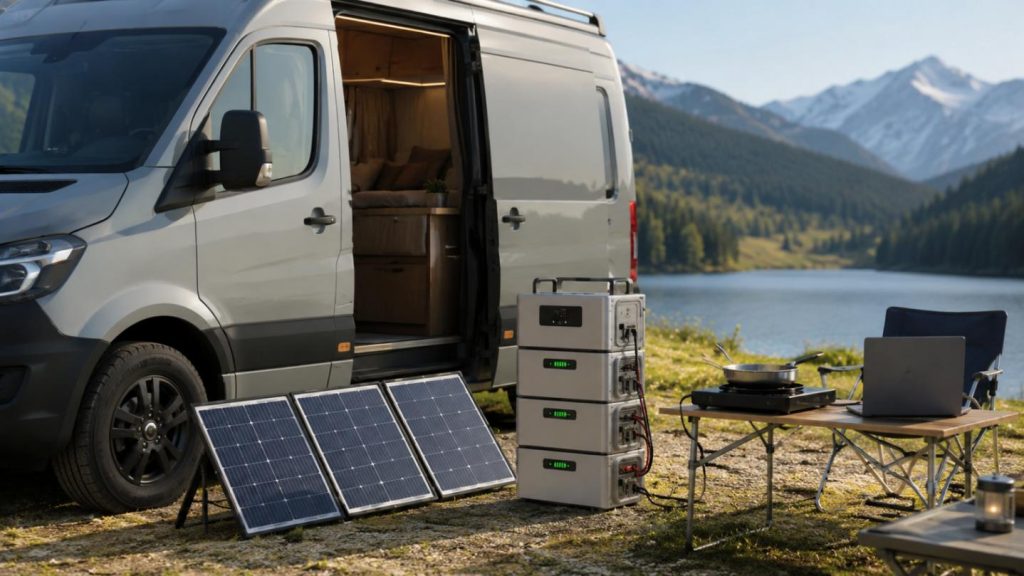
A 48V inverter converts battery DC into AC for appliances.
The battery and inverter must share a compatible DC operating range. Battery voltage changes during charging and discharging, so “48V” should never be interpreted as an exact fixed voltage.
In practice, system behavior depends on:
Battery operating voltage → inverter input range → low-voltage cutoff → BMS protection
If the inverter shuts down before the battery reaches its normal lower operating range, usable capacity is reduced. If its cutoff is set too low, the BMS may disconnect first.
The best system therefore coordinates these voltage thresholds rather than treating the battery and inverter as independent products.
Solar Charging Adds Another Conversion Stage
Solar power in an RV normally follows this path:
PV Panels → MPPT Controller → LiFePO₄ RV Battery 48V
The MPPT controller performs two different jobs.
First, it operates the solar array at a useful voltage and current point. Second, it converts that energy into a charging profile appropriate for the battery.
This means PV voltage and battery voltage should not be compared directly.
Three electrical limits matter:
• The solar string must remain inside the MPPT input-voltage range;
• MPPT output must suit the battery charging-voltage range;
• Charging current must remain within the battery/BMS limit.
Increasing panel capacity therefore does not always shorten charging time. Once the MPPT or battery reaches its current limit, additional available PV power may no longer increase battery charging power.
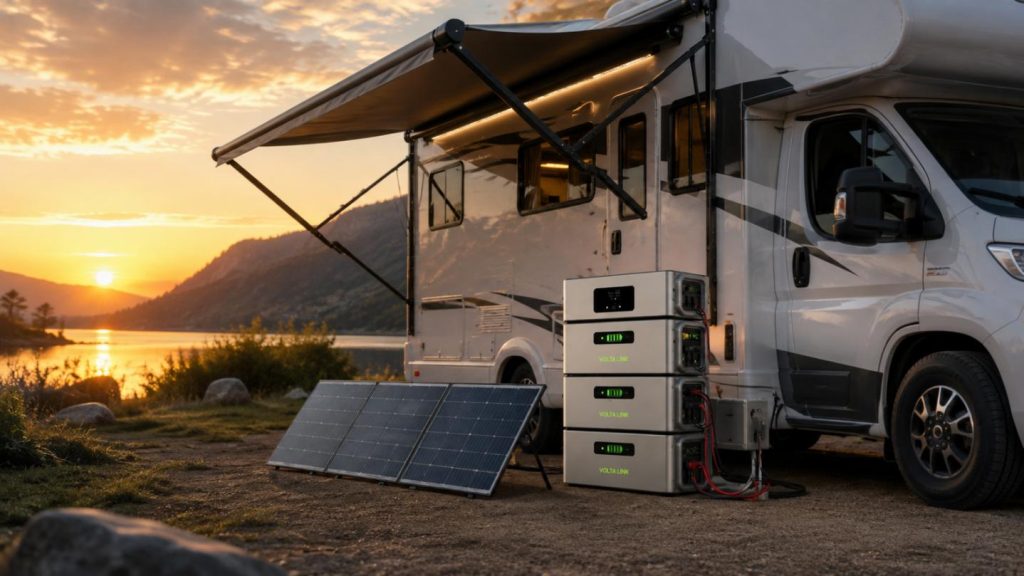
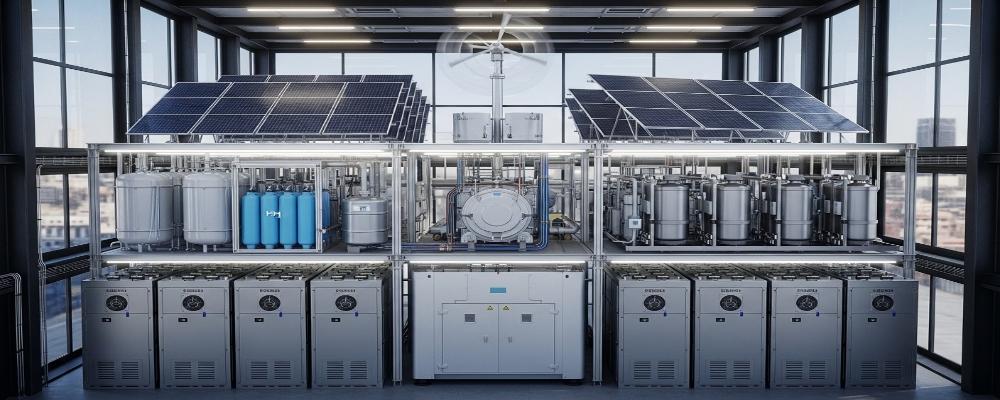
VoltaLink’s existing DC48V energy-storage engineering illustrates this same system-level approach, combining modular battery architecture, multiple charging paths, protection functions and external energy communication rather than treating storage as an isolated battery pack.
Can a 48V House Battery Support Mixed-Voltage RV Loads
This is one of the biggest differences between theory and practical RV integration.
Many established RV components remain 12V:
• Lighting;
• Water pumps;
• Refrigerator control electronics;
• Ventilation fans;
• USB outlets;
• Control and monitoring devices.
A common architecture is therefore:
LiFePO₄ RV Battery 48V → 48V/12V DC-DC Converter → 12V Distribution Bus
The high-power inverter stays on the 48V side, while existing low-voltage equipment remains on the familiar 12V bus.
This hybrid structure allows the RV to gain the current-reduction benefits of 48V without replacing every DC appliance.
Alternator Charging Requires a Different Path
Most vehicles still use a 12V starting and alternator system. That electrical system cannot simply be connected directly to a 48V house battery.
Instead, driving energy normally requires an appropriate DC-DC charging stage between the vehicle electrical system and the LiFePO₄ RV Battery 48V.
The RV can therefore have three independent energy sources:
Solar → MPPT → Battery
Shore AC → Inverter/Charger → Battery
Alternator → DC-DC Charger → Battery
All three ultimately meet at the battery, so their charging behavior still has to remain inside the battery’s permitted charge-current and voltage limits.
48V Is a System Choice, Not Automatically a Better Battery
A 48V architecture is especially logical when the RV needs substantial AC power. Lower DC current can make several-kilowatt inverter systems easier to engineer.
But it also introduces additional conversion and control requirements, especially when a vehicle retains a 12V alternator and 12V appliances.
The real design sequence is therefore:
RV load → required inverter power → DC current → battery/BMS capability → energy capacity → solar and charging architecture → 12V DC integration
That sequence explains why a LiFePO₄ RV Battery 48V should be designed as part of the complete energy system.
For RV manufacturers and system integrators developing higher-power electrical platforms, VoltaLink can work from actual load profiles, inverter requirements, charging sources and DC-bus architecture to define an appropriate battery configuration. This system-first approach helps turn a 48V battery from an isolated component into a properly integrated RV energy platform.
FAQs
Q1. Can solar panels charge a LiFePO₄ RV Battery 48V?
Yes, with the right MPPT charge controller, you can do that. To charge your RV battery with solar, only the solar array voltage needs to remain under the range of your MPPT. The charging voltage and current of your battery on the controller side need to meet the requirements of LiFePO₄ batteries. VoltaLink shows solar charging integration with their DC48V battery-energy storage system.
Q2. Why does VoltaLink use 48V architecture for high-power energy systems?
High-power energy systems require a lot of current. For a particular energy system, the use of 48V reduces the amount of current and therefore the amount of wiring voltage drop and heating of the wire. VoltaLink has developed high powered energy storage systems using 48V DC modular batteries and integrated charging and control systems.
Q3. Can a VoltaLink LiFePO₄ RV Battery 48V work with a 3kW or 5kW inverter?
Yes, VoltaLink 48V batteries are engineered to support 3kW and 5kW inverters, provided that the system configuration aligns with the continuous and peak discharge current limits of the BMS. Inverter surge ratings and expected RV loads must be evaluated together. But 5kW is not the only factor that determines compatibility. The battery has to have a voltage range that is within specifications, a BMS continuous discharge current, peak current, and the inverter surge. In order to match the battery to your situation, VoltaLink needs to know the specifications of the intended inverter and your expected RV load.
Q4. How should the capacity of a LiFePO₄ RV Battery 48V be selected?
Capacity has to take into account how much energy is consumed. A capacity above 48 volts does not mean that there is a larger battery. Add up the energy used by air conditioning or refrigeration, your lights, and cooking appliances, and convert that into a usable battery size. It is vital to account for conversion losses.
Q5. Can a 48V VoltaLink battery supply regular 12V RV appliances?
Yes. Connecting a high-efficiency 48V-to-12V DC-DC converter to the battery can safely power most standard in-vehicle 12V appliances The high-power inverter is supplied by the 48V battery while the DC-DC converts the rest of the power to the standard 12V power supply for the lighting, pumps, control units, and other RV appliances.

-

 OEM Residential Energy Storage Solutions: Passive vs. Active Cell Balancing
2026-09-30
-
 Smart Home Battery with BMS Communication: Cybersecurity and BMS Safety
 -
 10kWh Home Battery Backup System: Is 90% DoD Better for Daily Solar Storage?
2026-09-29
-
 Integrated Home Energy Storage System 150–430V MPPT Design
2026-09-28
-
 LiFePO₄ Residential Backup Battery SOC Accuracy in Parallel Systems
Share this:





.svg)






-899.svg)


