




OEM ODM Home Energy Storage Manufacturer for Stackable Home Battery Solutions
Choosing an OEM ODM Home Energy Storage Manufacturer for modular and stackable residential batteries requires more than comparing nominal voltage, cell chemistry, or total kWh. A scalable home energy storage system should coordinate the battery PACK, BMS, inverter, communication protocol, mechanical structure, protection strategy, and future capacity expansion.
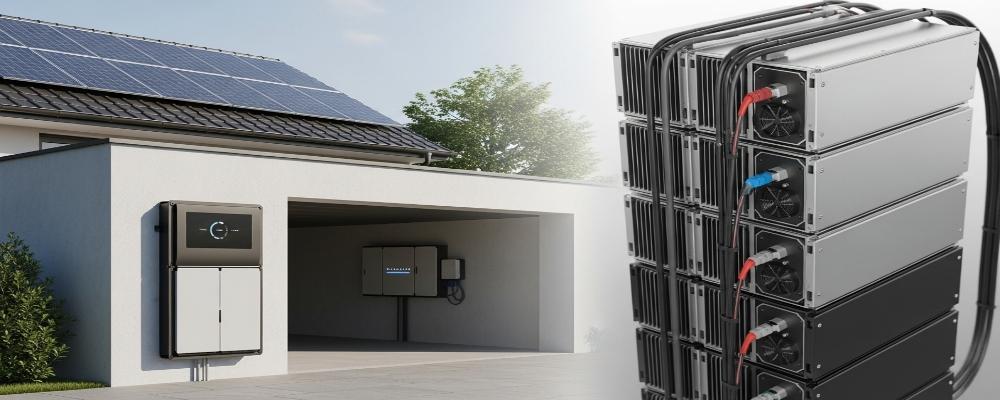
VoltaLink New Energy Co., Ltd. focuses on the R&D and production of energy storage lithium battery packs and complete lithium battery system solutions. With an in-house R&D and production team, VoltaLink develops battery packs, residential energy storage systems, solar inverters, and portable power products. For modular residential projects, this broader engineering scope is important because key components including hybrid inverters, BMS, EMS, and PCS systems can be developed and evaluated within the same system architecture.
Why Modular Battery Systems Need More Than PACK Assembly
A fixed-capacity battery is designed around one predefined energy configuration. A modular battery must allow additional modules to be connected without compromising electrical stability, communication, or protection.
Stackable systems introduce another layer of complexity because each module needs repeatable mechanical, electrical, and communication interfaces.
An OEM ODM Home Energy Storage Manufacturer therefore needs to consider:
• Module voltage and capacity consistency
• Power connector and cable current ratings
• Parallel or series connection logic
• BMS communication between modules
• SOC synchronization and current sharing
• Inverter communication
• Thermal protection
• Mechanical stacking strength
• Future expansion strategy
A stackable system is not simply several batteries placed on top of each other. The modules need to operate as one coordinated energy storage system.
How Capacity, Voltage, and Power Work Together
Battery capacity is commonly expressed in kWh:
Energy (kWh) ≈ Nominal Voltage × Capacity (Ah) ÷ 1000
However, stored energy and available power are different parameters.
For example, increasing a battery bank from 10 kWh to 20 kWh can extend backup duration, but it does not necessarily increase AC output power. Maximum system power may still be limited by:
• BMS discharge current
• Battery terminal rating
• Cable cross-section
• Inverter DC input limit
• Cell discharge capability
• Operating temperature
This is why VoltaLink treats lithium battery PACK design as part of a wider system design process rather than defining a residential battery only by capacity.
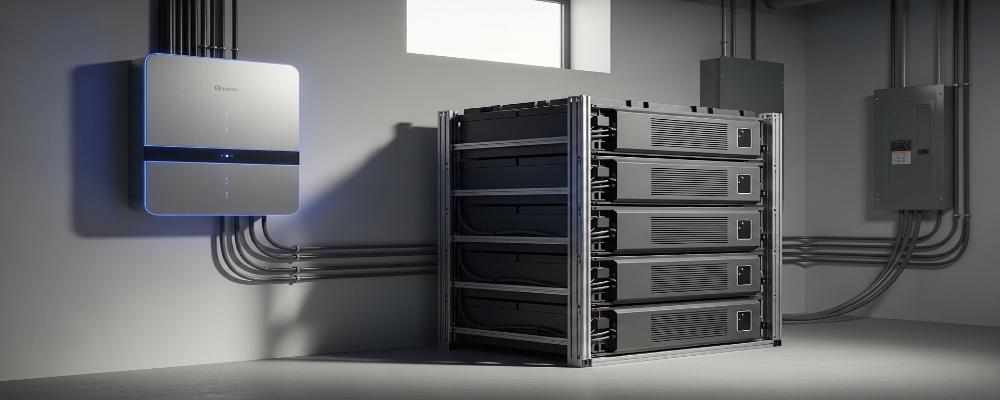
Modular vs. Stackable Home Battery Architecture
| Design Factor | Modular Battery | Stackable Battery |
| Capacity expansion | Add compatible battery modules | Add standardized stacked modules |
| Installation | Rack, cabinet, wall or distributed | Usually compact floor-standing stack |
| Mechanical design | Flexible | Standardized interface required |
| Communication | Module-to-system coordination | Module-to-module and system coordination |
| Expansion focus | Electrical scalability | Electrical + structural scalability |
| OEM/ODM challenge | Configuration flexibility | Repeatable interfaces and control |
A stackable system is therefore a form of modular architecture, but it requires tighter control of physical interfaces and module-to-module communication.
BMS Design Becomes More Important as Modules Increase
The BMS is responsible for more than overcharge or over-discharge protection. In a modular battery bank, it becomes a major part of system coordination.
Typical BMS functions include:
Cell-Level Management
• Cell voltage monitoring
• Overcharge and over-discharge protection
• Temperature monitoring
• Cell balancing
• Short-circuit and overcurrent protection
Module and System Management
• Pack voltage and current monitoring
• SOC and SOH calculation
• Charge/discharge current limits
• Fault reporting
• Module identification
• CAN or RS485 communication
VoltaLink provides BMS customization and lithium battery PACK solution design services. For an OEM/ODM project, this allows protection thresholds, communication logic, battery configuration, and inverter protocols to be matched to the intended residential system rather than relying entirely on fixed standard settings.
Battery-to-Inverter Compatibility Requires Three Levels of Matching
Two batteries with similar nominal voltages are not necessarily compatible with the same inverter.
Electrical Compatibility
The battery and inverter need compatible:
• Operating voltage ranges
• Maximum charging voltage
• Continuous charge/discharge current
• Peak current requirements
• Low-voltage protection conditions
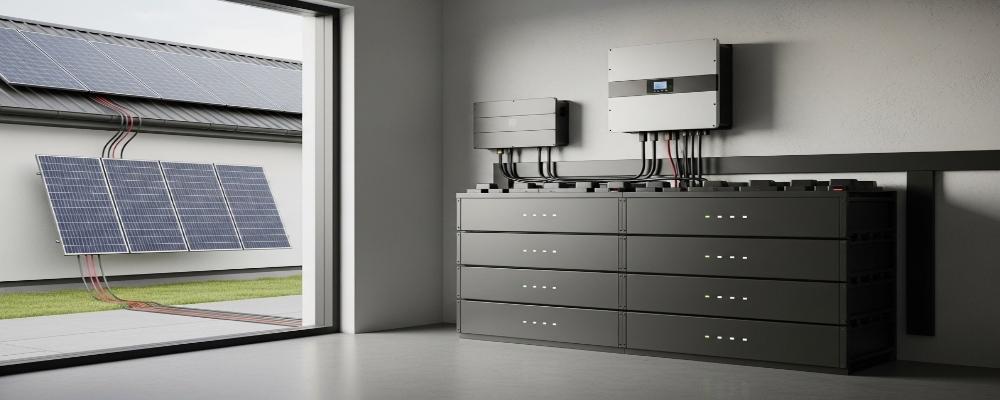
Communication Compatibility
CAN or RS485 communication may transfer:
• SOC
• SOH
• Battery voltage
• Available charging current
• Available discharge current
• Temperature
• Alarm and fault status
System Control Compatibility
The inverter, BMS, and energy management system need to respond correctly when battery temperature, SOC, or current limits change.
VoltaLink independently develops key energy storage components including hybrid inverters, BMS, EMS, and PCS systems. This gives its OEM ODM Home Energy Storage Manufacturer projects a practical advantage when validating interfaces between the battery and the wider energy storage system.
Low-Voltage vs. High-Voltage Modular Batteries
| Technical Factor | Low-Voltage System | High-Voltage System |
| Typical architecture | 48/51.2 V class | Multiple modules forming higher DC voltage |
| Current at equal power | Higher | Lower |
| Expansion | Often parallel | Often series/module stack |
| Cable design | High-current capability is important | Insulation and voltage control are important |
| Inverter | LV-compatible | HV-compatible |
| Control complexity | Relatively simple | Greater system coordination |
Neither system is automatically better.
The correct architecture depends on:
• Required inverter power
• Battery capacity
• Installation distance
• Cable design
• Expansion method
• System voltage
• Application requirements
A capable OEM ODM Home Energy Storage Manufacturer should define these relationships before locking the battery enclosure or module configuration.
What Happens When New Battery Modules Are Added?
Battery expansion should be designed into the system from the beginning.
Important technical issues include:
• The SOC difference: Battery modules/packs with significantly different SOC levels can create a high equalization current.
• The Voltage level: The pack voltage should remain within the accepted voltage limits for a valid pack connection.
• The level of aging: Older batteries will have higher internal resistance and a lower useful capacity.
• The balanced current: Parallel packs in parallel should be balanced within their design limits.
• BMS detection: Should detect added modules and adapt capacity and current Limits.
• Inverter modification: Additional kWh will not change inverter output.
These are some design aspects of modular lithium battery applications where VoltaLink’s PACK and BMS customization can be employed.
OEM/ODM Customization Should Cover the Whole Battery Platform
For residential storage, customization can include several engineering layers.
Battery PACK
• Voltage and Ah configuration
• Module quantity
• Charge/discharge capability
• Low-voltage or high-voltage platform
BMS
• Protection thresholds
• SOC control strategy
• CAN/RS485 protocol
• Inverter communication
• Module expansion logic
Mechanical Design
• Enclosure dimensions
• Stack connection
• Terminals and cable routing
• Floor-standing or wall-mounted format
Brand Configuration
• Product labels
• Logo
• Packaging
• Manuals and available technical documents
VoltaLink supports these development activities with its own R&D, production, quality inspection, and after-sales management system. Its broader product portfolio also includes lithium battery energy storage systems, solar inverters, and portable outdoor power stations, supporting applications from residential and commercial backup power to PV off-grid systems, communication base stations, data centers, and modular battery installations.
Safety and Compliance Need Configuration-Level Verification
Residential lithium battery systems should include protection against overcharge, over-discharge, excessive current, abnormal temperature, short circuits, and cell-level faults.
VoltaLink products are supported by certifications or documentation including UN38.3, MSDS, CE, FCC, and RoHS. Buyers should still verify which document applies to the exact battery model, inverter combination, integrated ESS, and destination market.
This is especially important in OEM/ODM projects because changing the battery configuration or complete system architecture may affect the applicable compliance scope.
Closing Words
A technically capable OEM ODM Home Energy Storage Manufacturer should be able to explain how a modular battery behaves when capacity is expanded, current demand changes, communication is interrupted, or the inverter adjusts charge and discharge limits.
For brands, distributors, and system integrators developing modular or stackable residential batteries, VoltaLink can support projects from lithium battery PACK design and BMS customization through inverter, EMS, PCS, and broader energy storage system integration. Providing the intended battery capacity, inverter platform, communication protocol, expansion plan, and destination market early in the project helps our engineering team define a more coherent system architecture before production begins.
FAQs
Q1. What does VoltaLink customize for an OEM home energy storage project?
VoltaLink provides residential energy storage project solutions with customizable lithium battery PACK and BMS. We provide customization for battery capacity, voltage structure, module configuration, protection, parameters, communication, matching to an inverter, configuration of the enclosure and other system-related requirements.
Q2. Does VoltaLink manufacture modular and stackable home battery systems?
Yes, VoltaLink manufactures lithium battery packs and complete energy storage systems for modular lithium battery applications. The system can be designed and configured to the required capacity, format of installation, strategy for module expansion, and architecture of compatible inverters.
Q3. Can VoltaLink customize the BMS for different residential battery projects?
Customization of the BMS is an OEM/ODM service offered by VoltaLink. Depending on the project, customization may include charge and discharge limits, setting protection thresholds, SOC management, module control, and communication.
Q4. Can VoltaLink home batteries communicate with hybrid inverters?
Battery-to-inverter communication may be developed using CAN or RS485 communication depending on the system selected. VoltaLink offers compatibility assessment for the specific inverter model, the targeted voltage, and the communication protocol and BMS data required before the production of battery energy storage systems.
Q5. Does VoltaLink develop its own inverters and energy management components?VoltaLink develops hybrid inverters, BMS, EMS, and PCS systems. This supports an integrated approach to considering batteries and power conversion within energy storage systems.

-

 OEM Residential Energy Storage Solutions: Passive vs. Active Cell Balancing
2026-09-30
-
 Smart Home Battery with BMS Communication: Cybersecurity and BMS Safety
 -
 10kWh Home Battery Backup System: Is 90% DoD Better for Daily Solar Storage?
2026-09-29
-
 Integrated Home Energy Storage System 150–430V MPPT Design
2026-09-28
-
 LiFePO₄ Residential Backup Battery SOC Accuracy in Parallel Systems
Share this:





.svg)






-899.svg)


