




Battery Energy Storage for Industrial Parks: Shared Loads, Solar and Resilience
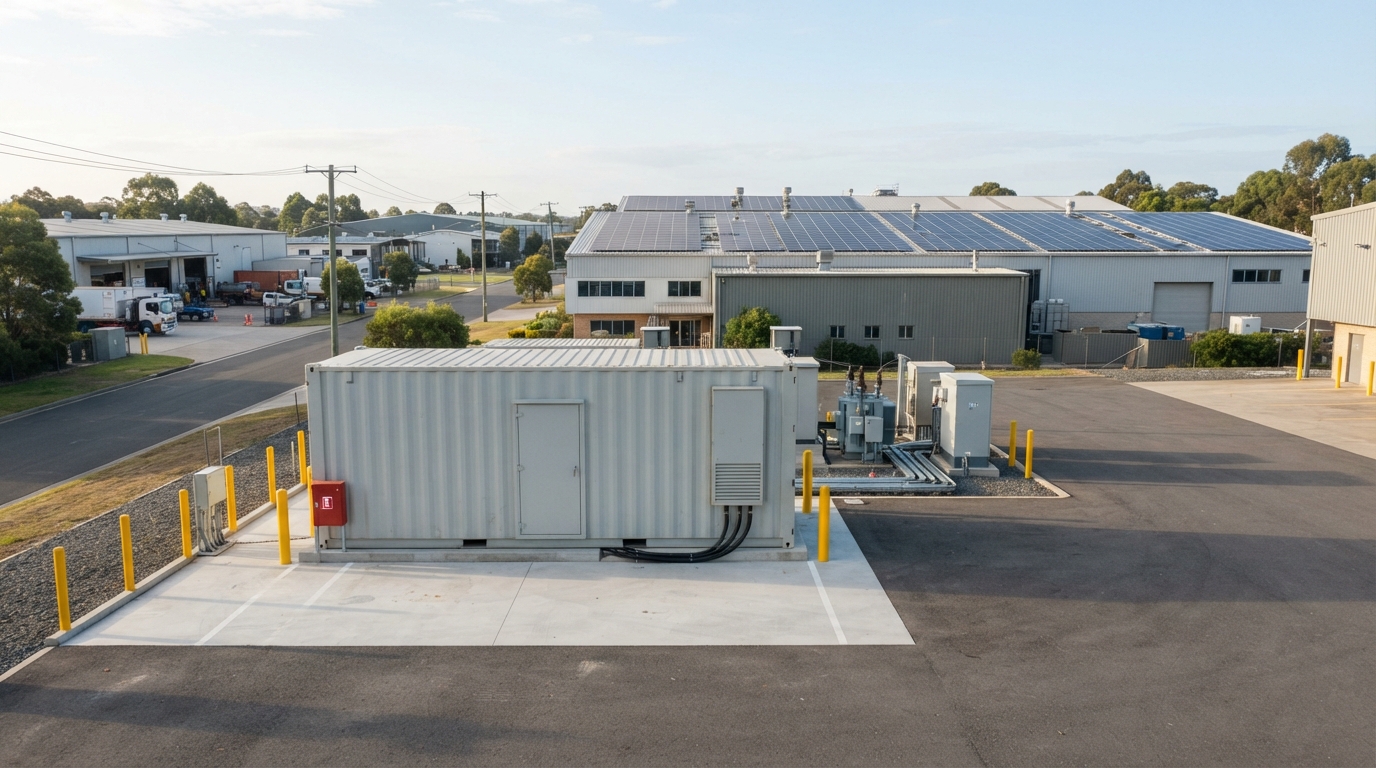
An industrial park is not one factory. It is a collection of facilities sharing land, infrastructure, and often a single grid connection. That changes how battery energy storage should be planned. Instead of sizing a system around one production line, the BESS must be designed around the park’s combined demand, on-site solar, and critical loads.
Battery energy storage for industrial parks can reduce shared peak demand, improve solar self-consumption, and support critical loads during outages — when it is deployed as shared infrastructure and controlled by an energy management system. This guide explains how industrial-park BESS planning differs from factory-level storage, which use cases matter, how to think about sizing, and what to request from a supplier.
What Makes Industrial-Park BESS Different from a Factory Battery System
A factory BESS is usually designed for one owner, one meter, and one load profile. An industrial-park system is different because it sits behind a shared electrical boundary that serves multiple tenants.
Those tenants may include manufacturers, warehouses, cold-storage facilities, logistics buildings, and offices. Their operating hours, load shapes, and power requirements are not identical. Some may run three shifts. Others may operate only during the day. The park’s combined load profile is therefore more important than any single tenant’s profile.
A shared BESS can be connected at the park’s main electrical interconnection, where it can serve the aggregate load rather than one building. That arrangement creates value by managing the park’s combined demand, storing solar energy from shared or rooftop PV, and supporting selected loads when the grid fails.
But it also creates decisions that a single-factory project does not face. The park must decide who owns the system, who controls it, and how operating benefits are allocated among tenants. Without that agreement, a technically sound system can become difficult to manage.
If you are planning storage for a single facility, the decision process is different. See our battery storage for factory guide for that use case.
Main Industrial-Park BESS Use Cases: Peak Shaving, Load Shifting, Solar and Resilience
Industrial parks typically consider battery storage for one or more of four reasons:
- peak shaving and load shifting;
- solar self-consumption;
- resilience and outage support;
- a combination of these objectives.
These use cases overlap, but they do not always behave the same way. A battery that is fully discharged to cut the morning peak cannot also hold a reserve for an afternoon outage. The park’s objectives must be defined before the system is sized.
Peak Shaving and Load Shaving
Peak shaving reduces the highest measured demand in a billing period. Many commercial and industrial tariffs include a demand charge based on the park’s peak interval, often measured over 15 or 30 minutes. Even a small number of high-demand intervals can raise electricity costs for the entire month.
A BESS charges when demand is low and discharges when demand approaches the park’s target limit. The result is a flatter grid import profile and a lower demand charge.
Load shifting is a related but slightly different strategy. Instead of reducing peak demand, it moves energy use from expensive tariff periods to cheaper ones. The battery charges at night or during midday solar surplus and discharges during more expensive grid periods.
Neither strategy works without good data. You need interval load data for the whole park, the applicable tariff structure, and a clear operating policy. For a deeper explanation of peak-shaving mechanics, see battery storage for peak shaving.
Solar Self-Consumption and Solar-Plus-Storage
Many industrial parks have rooftop solar, carport PV, or ground-mounted arrays. Solar generation is intermittent. When the sun is strong, the park may generate more power than it can use, and some of that energy may be exported or curtailed.
A battery changes that. Instead of sending surplus solar energy to the grid, the BESS stores it and discharges it when park demand rises. This increases the share of on-site solar energy that is actually consumed by the park.
Solar-plus-storage also helps with peak shaving because the battery can be charged by PV rather than from the grid. That can reduce both demand charges and energy costs.
Research on an industrial park in Vietnam found that combining solar PV with battery storage could reduce electricity costs, increase renewable energy use, and improve resilience during outages. The exact results depend on the park’s load, tariff, and solar profile, but the principle is consistent: storage makes PV more valuable.
Resilience and Outage Support
Resilience is often the most misunderstood use case. A battery system does not automatically back up an entire industrial park. The park may have multiple transformers, many tenants, and loads that are far larger than a reasonably sized BESS can support for a meaningful length of time.
Resilience planning starts by defining critical loads. These might include:
- emergency lighting and safety systems;
- communication and monitoring equipment;
- refrigerated storage or cold-chain loads;
- servers and control systems;
- pumps, ventilation, or process equipment that must shut down safely.
Once the critical load and required outage duration are known, the battery can be sized to support that portion of the park. This may require islanding controls, transfer switches, and coordination with the utility.
The BESS does not need to replace the grid or a generator. It can provide short-duration ride-through, cover an expected outage window, or support selected buildings while the rest of the park shuts down.
For more detail on designing backup operation around commercial and industrial loads, see commercial backup energy storage solutions.
Sizing an Industrial-Park BESS: Power, Energy, and Runtime
There is no universal “industrial-park size.” The right system depends on the park’s load profile, tariff structure, solar generation, critical-load requirements, and outage objectives.
Sizing work should start with data collection. A responsible supplier should not offer a meaningful quotation without reviewing interval load data and the site’s electrical architecture. The same battery size could be perfect for one park and far too small for another with identical building area.
Two values matter more than any others: power and energy.
Power (kW) vs. Energy (kWh)
Power and energy are often confused, but they describe different things.
| Term | Unit | What It Tells You |
|---|---|---|
| Power | kW | How quickly the battery can charge or discharge |
| Energy | kWh | How much energy the battery can store and deliver |
| Capacity | Ah | Charge capacity of a cell, module, or battery pack |
| Voltage | V | Electrical potential of the battery string |
For example, a 1 MWh battery rated at 500 kW can supply a 500 kW load for roughly two hours, before accounting for efficiency losses and the minimum state-of-charge reserve. A 1 MWh battery rated at 250 kW can supply that same load for four hours, but it cannot discharge as quickly.
C-rate links power and energy. A 1C discharge rate means the battery can deliver its full stored energy in one hour. A 0.5C rate means it takes two hours at the rated power.
Total stored energy is not the same as usable energy. Most systems do not operate from 0% to 100% every cycle. Depth-of-discharge limits and a reserve state of charge reduce the amount of capacity that can be used while maintaining battery life and outage readiness.
From Load Data to a First-Level Estimate
Before speaking with a supplier, collect the following:
- interval load data for the entire park, ideally for 12 months;
- the park’s coincident peak demand — the moment when combined tenant loads are highest;
- tenant operating schedules and known seasonal variations;
- the current electricity tariff, including demand-charge intervals;
- solar production data if PV is operating;
- planned load changes such as new tenants or electrification projects;
- critical loads and required outage duration;
- the desired state-of-charge reserve for backup operation;
- the assumed round-trip efficiency of the battery system.
With this information, a supplier can estimate how much peak demand can be shaved, how much solar energy can be stored, and how long critical loads can be supported. Without this data, any size is a guess.
Key Components and How They Work Together
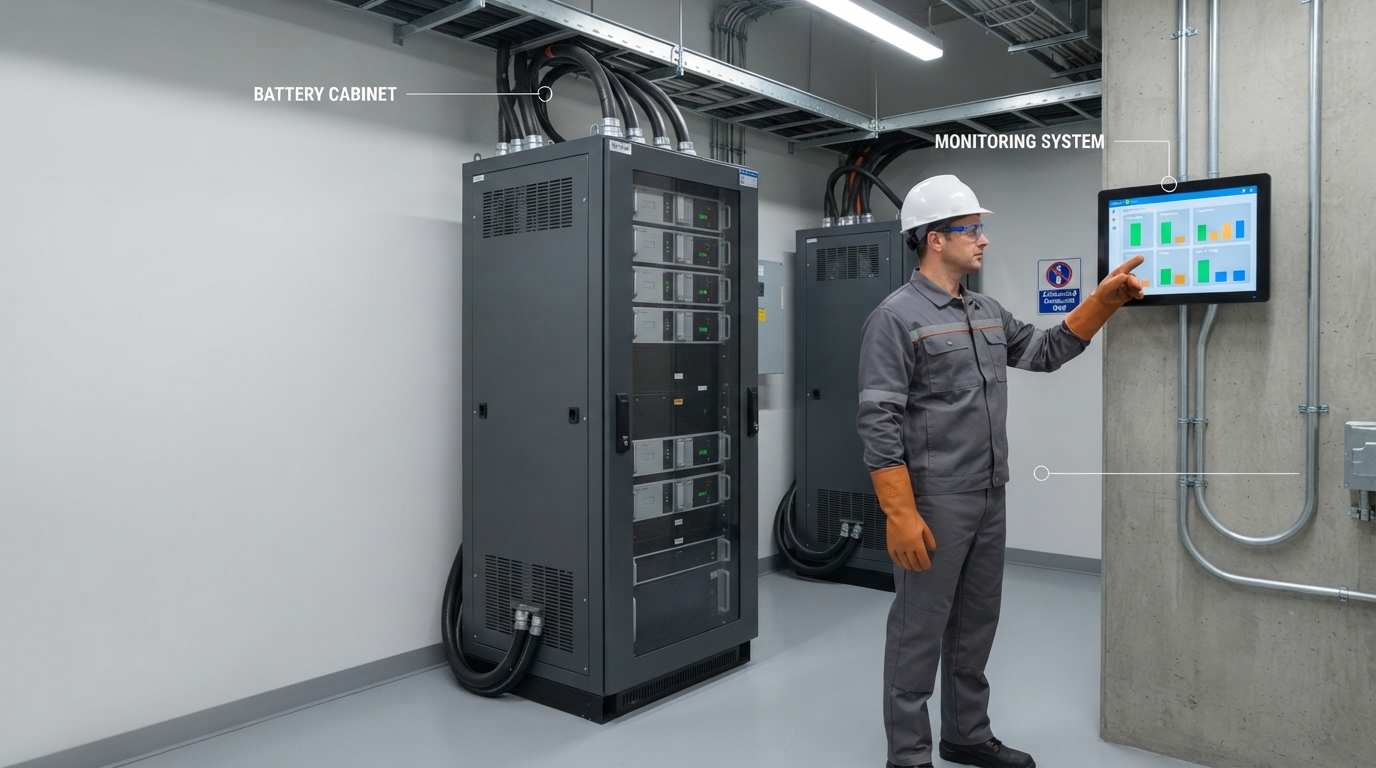
A BESS is more than a stack of battery modules. It includes the battery itself, protection systems, power conversion, and controls that decide when to charge and discharge.
| Component | What It Does | Why It Matters |
|---|---|---|
| Battery cells, modules, and racks | Store DC electrical energy | Determines energy capacity, voltage range, and physical footprint |
| Battery management system (BMS) | Monitors cell voltage, temperature, and current; protects the battery | Prevents overcharge, over-discharge, and thermal problems |
| Power conversion system (PCS) or inverter | Converts DC battery power to AC facility power and reverses the flow when charging | Determines how the battery connects to the park’s electrical system |
| Energy management system (EMS) | Coordinates the BESS with solar, grid imports, and tenant loads | Controls peak shaving, solar charging, and backup reserve |
| Monitoring and communication | Provides real-time visibility and remote control | Helps the park operator track performance and respond to alarms |
Battery chemistry also matters. Many modern commercial and industrial systems use lithium iron phosphate, or LiFePO₄, because of its thermal stability and long cycle life. But every supplier’s system must be evaluated on its own specifications, not on a chemistry name alone.
The BMS, PCS, and EMS must be designed to work together. The EMS is effectively the operating logic of the system. It decides whether the battery charges from solar, discharges to avoid a peak, or holds its energy in reserve for an outage. That logic should be configurable to match the park’s priorities.
For a complete-system view of commercial and industrial storage, see our ci energy storage system page.
Centralized, Tenant-Level, or Hybrid: Which Architecture Fits?
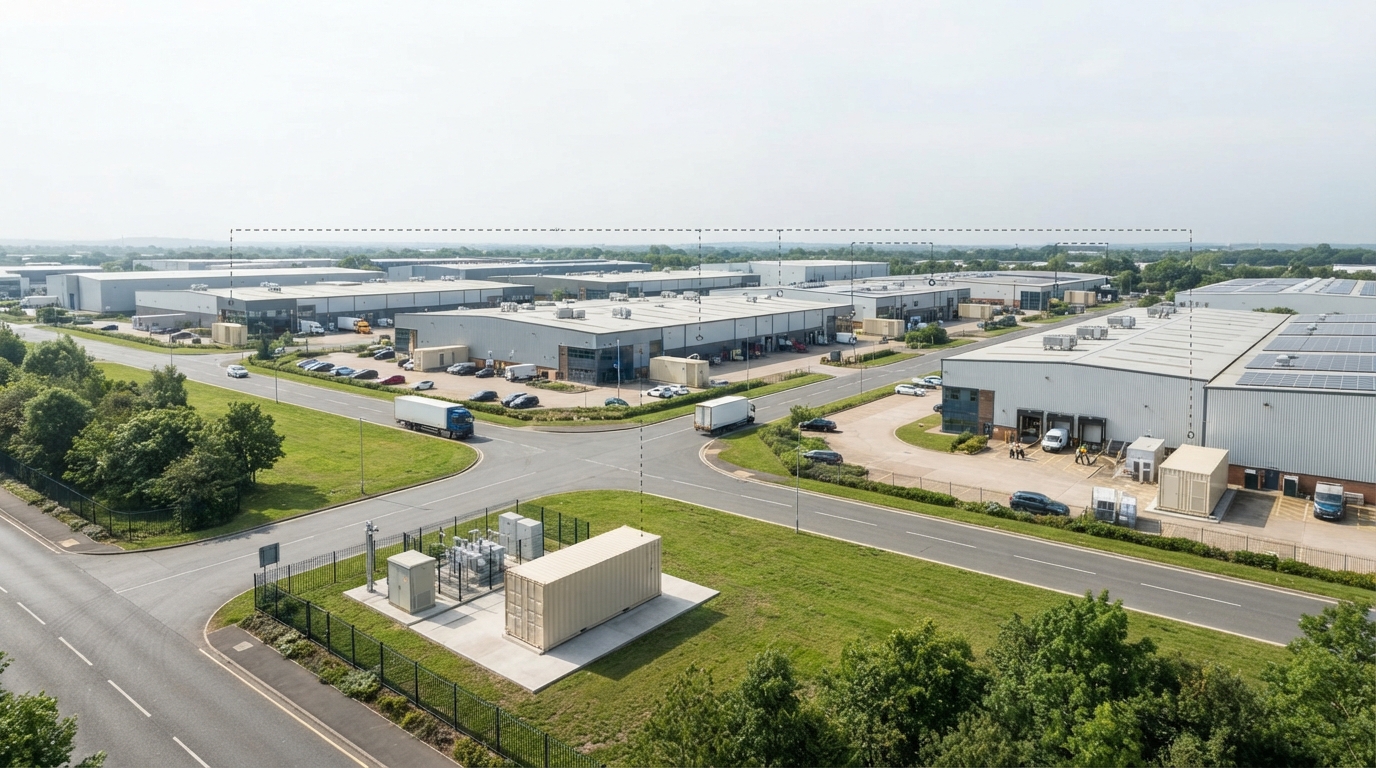
Industrial-park storage can be deployed in more than one way. The right architecture depends on metering, ownership, tenant agreements, and existing electrical infrastructure.
| Architecture | How It Works | Best For |
|---|---|---|
| Centralized | One larger BESS at the park’s main interconnection serves the aggregate load | Parks with one landlord, common infrastructure, and a desire to manage the whole site |
| Tenant-level | Smaller BESS units are installed at individual factory or building connections | Parks where tenants control their own energy costs or have separate utility meters |
| Hybrid | A central system covers shared loads while targeted tenant systems meet specific needs | Large parks with a mix of common loads and individual high-demand facilities |
Centralized systems are easier to manage as one asset and can capture diversity across tenants. If tenants peak at different times, the combined park peak may be lower than the sum of individual peaks. A central battery can serve that combined profile efficiently.
Tenant-level systems give tenants more control and can be sized for their specific loads, but they may be more expensive overall and miss opportunities to share capacity.
Hybrid designs add flexibility, but they also add complexity. The EMS must coordinate multiple systems, and the park must decide how costs and benefits are split.
There is no universal winner. The correct choice depends on how the park is metered, who owns the electrical infrastructure, and how the operating model will be managed.
AC-Coupled vs. DC-Coupled Solar Integration
If the industrial park has solar, the connection between PV and storage must be planned early.
In an AC-coupled system, the PV inverter and the battery PCS are separate. The battery is connected on the AC side, so it can be added to an existing solar installation without replacing the PV inverter. This is often the simpler option for retrofits.
In a DC-coupled system, the battery shares a DC link with the PV array, typically through a hybrid inverter. Solar energy can charge the battery before it is converted to AC, which can improve efficiency in certain conditions. DC coupling is often better suited to new solar-plus-storage projects where PV and battery are designed together.
| Architecture | Connection Point | Typical Use |
|---|---|---|
| AC-coupled | Battery connects on the AC side of the existing solar inverter | Retrofitting storage to existing PV |
| DC-coupled | Battery connects on the DC side of a hybrid PV/battery inverter | New combined solar-plus-storage designs |
Both approaches can work at an industrial park. The best choice depends on the age and configuration of the PV system, whether the BESS is intended to back up critical loads, and how the EMS will dispatch the system.
Site, Electrical, and Safety Requirements for Industrial-Park BESS
Battery storage for industrial parks is not just a battery question. It is also a site-planning and electrical-engineering question.
Site considerations include:
- available space for a cabinet or containerized system;
- access for installation, maintenance, and emergency response;
- foundation and environmental conditions;
- separation from buildings and other equipment;
- enclosure rating appropriate for the local climate;
- thermal management, which may use air or liquid cooling depending on system size and layout;
- fire detection and suppression as part of the overall site safety plan.
Electrical considerations include:
- the park’s main switchgear and protection;
- the location of the point of interconnection;
- metering arrangements for the park and individual tenants;
- isolation and lockout for safe maintenance;
- coordination between the BESS and existing transformers.
Interconnection is often the most overlooked requirement. The utility must approve how the BESS connects to the grid and how it behaves during normal operation, peak shaving, and outages. An interconnection study may be required before installation can proceed.
The U.S. Department of Energy’s procurement guidance advises buyers to verify the physical location of the system, its interconnection requirements, monitoring capabilities, and applicable electrical codes and standards before purchasing. The same principle applies in most markets: safety and grid integration should be confirmed before equipment is ordered.
NFPA also emphasizes the importance of electrical codes for safer energy-storage and PV installations. Local codes differ, so the system design must be reviewed against the rules that apply in the country and region where the park operates.
How to Evaluate a BESS Supplier and Start a Feasibility Study
A good BESS supplier should be as interested in your load data as you are in their equipment. If a supplier offers a size without asking about the park’s interval demand, tariff, and critical loads, that is a warning sign.
Start the process with a site-data package. Include the load data, tenant schedule, tariff information, PV output, critical-load description, and outage objectives listed earlier. The supplier can use this information to model the system before proposing a quotation.
Then ask for specific technical documentation:
- a single-line diagram showing how the BESS will connect to the park’s electrical system;
- system datasheets with clear power and energy ratings in kW and kWh;
- BMS, PCS, and EMS specifications that match the proposed configuration;
- communication and monitoring details;
- thermal management and enclosure specifications;
- fire-safety design and emergency-response information;
- warranty terms and degradation assumptions;
- commissioning, training, and after-sales service scope.
Certifications should be tied to the exact model or system being offered. A certificate that applies to one cell, module, or product line does not automatically apply to another. Ask the supplier to state which certificates apply to the proposed equipment and to provide the supporting documentation.
Finally, define the delivery scope. Some suppliers provide equipment only. Others work with EPC partners to handle engineering, installation, commissioning, and testing. Industrial-park projects often benefit from a single responsible party, but the important thing is that every scope gap is identified before contracts are signed.
If you are ready to move from conceptual planning to system evaluation, start with an experienced C&I energy-storage supplier. Reviewing a real ci energy storage system proposal is the most practical way to test whether the architecture, controls, and pricing fit your industrial park’s shared-load profile.

-

 OEM Residential Energy Storage Solutions: Passive vs. Active Cell Balancing
2026-09-30
-
 Smart Home Battery with BMS Communication: Cybersecurity and BMS Safety
 -
 10kWh Home Battery Backup System: Is 90% DoD Better for Daily Solar Storage?
2026-09-29
-
 Integrated Home Energy Storage System 150–430V MPPT Design
2026-09-28
-
 LiFePO₄ Residential Backup Battery SOC Accuracy in Parallel Systems
Share this:





.svg)






-899.svg)


