




Battery Storage for Wastewater Treatment Plants: Resilience and Load Management
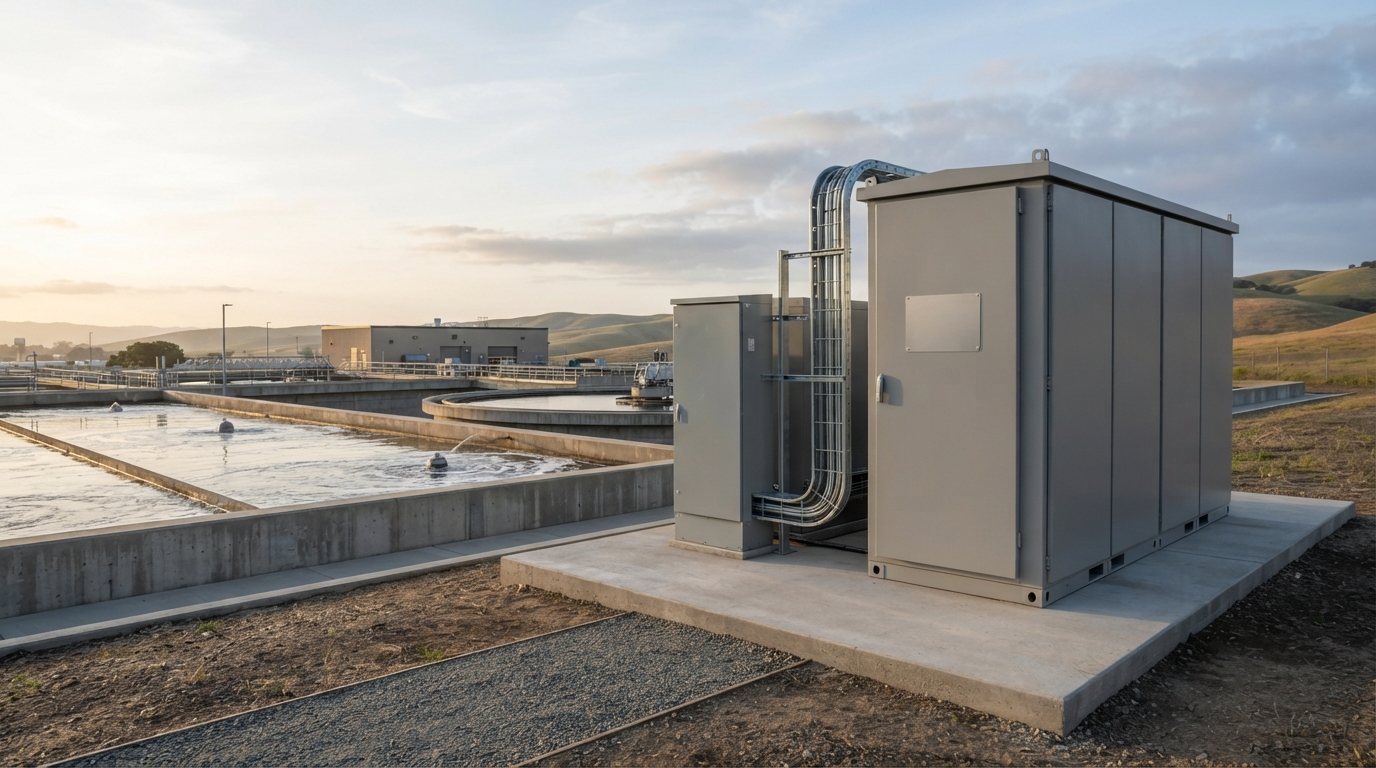
When a wastewater treatment plant loses grid power, the consequences are not limited to darkened control rooms. Raw sewage continues to arrive, pumps may stop, aeration can shut down, and the plant may be forced to discharge partially treated water. Battery energy storage can reduce that risk. It can carry critical loads through short outages, shave demand peaks, and help the plant use solar or on-site generation more effectively. But battery storage for a wastewater treatment plant is not simply an off-the-shelf backup product. The right system depends on the plant’s loads, outage scenarios, generator assets, and control strategy.
This guide explains how to evaluate battery storage for wastewater treatment plants. It covers critical-load identification, power versus energy sizing, grid-connected and islanded operating modes, the equipment that makes up a complete system, and the information to gather before requesting supplier proposals.
Why Wastewater Treatment Plants Need Battery Storage
Wastewater treatment is an electrically dependent process. Pumps move water through the plant, blowers supply oxygen to biological treatment, controls keep the process stable, and monitoring systems alert operators to problems. The EPA’s Power Resilience guide identifies power as a critical vulnerability for water and wastewater utilities, and it encourages utilities to plan for outages rather than assume the grid will always be available.
Battery storage fits into that plan in two ways. It can provide power quickly when the grid fails, and it can manage how the plant buys and uses electricity when the grid is operating normally.
The Cost of Losing Power at a Wastewater Plant
A power interruption at a wastewater plant is not the same as a power interruption at an office building. If influent pumping stops, wastewater can back up in the collection system. If aeration stops, the biological treatment process can lose the oxygen it needs. If controls and monitoring lose power, operators may have little visibility into what is happening inside the plant.
The actual impact depends on the outage length, the season, the process design, and which loads are affected. That is why the first task in any battery-storage project is not battery selection. It is defining which loads are critical enough to keep online.
What Battery Storage Can and Cannot Do
Battery storage is a powerful tool, but it has limits.
What it can do:
- Provide immediate power to defined critical loads for minutes to hours.
- Reduce demand peaks when the plant is connected to the grid.
- Shift energy use from high-cost periods to lower-cost periods.
- Support solar photovoltaic generation by storing excess energy for later use.
- Work with diesel generators, CHP, or biogas systems to create a more complete resilience solution.
What it cannot do:
- Provide days of fuel-independent power without a very large energy capacity.
- Replace the need for fuel supply planning if the plant depends on generators for long outages.
- Solve process constraints, control-system weaknesses, or utility interconnection issues by itself.
The distinction matters. A battery can be the right solution for short outages and load management, while a generator or CHP system may be the right solution for extended outages. Many wastewater plants need both.
Resilience and Load Management Defined
Resilience means the ability to continue critical operations when the grid is disrupted. Load management means controlling when and how the plant uses electricity. A single battery system can serve both goals if it is designed for the plant’s operating strategy.
The rest of this guide walks through that design process in order: first the loads, then the size, then the operating modes, then the equipment, and finally the procurement steps.
First Step: Define the Plant’s Critical Loads
Every wastewater battery design starts with one question: which loads must remain online, at what power level, and for how long? Without a clear answer, a battery is likely to be either too small to protect the plant or too large to be cost-effective.
Must-Run, Flexible, and Shed-able Wastewater Loads
A practical way to organize the plant’s loads is to split them into three categories.
| Load Category | Examples | Design Question |
|---|---|---|
| Must-run | Influent pumps, effluent pumps, controls, instrumentation, communications, safety systems | What happens if these loads lose power? |
| Flexible | Aeration blowers or process equipment that can tolerate a short adjustment | Can this load be reduced or shed for 30 to 60 minutes? |
| Shed-able | Nonprocess heating, lighting, maintenance loads | Can this load wait until grid power returns? |
The exact assignment depends on the plant’s permit requirements, process design, and operating procedures. For example, aeration is often the largest electrical load at a wastewater plant, but it may be possible to manage or reduce it for short periods. That decision must be made by the process engineers who understand the biological treatment limits.
Why Load Data Should Drive the Design
Battery sizing should be based on site-specific load data, not on another plant’s project summary. Useful information includes:
- Utility interval data for a full 12-month period.
- Electrical single-line drawings.
- Seasonal, diurnal, and wet-weather load changes.
- Outage history and operating records.
- Operator knowledge of which equipment can be started or stopped during an emergency.
The University of Illinois EnergySense benchmarking guidance shows how water and wastewater plants can use baseline data to understand their energy use. That same data becomes the foundation for battery sizing.
Sizing a Battery for Wastewater Operations
Once the critical loads are defined, the next question is how large the battery must be. There are two numbers to understand first: power and energy.
Power (kW) versus Energy (kWh)
Power and energy are often confused, but they answer different questions.
| Battery Rating | What It Measures | Wastewater Question |
|---|---|---|
| Power (kW) | The maximum instantaneous load the battery can serve | Can it start and run pumps and blowers? |
| Stored energy (kWh) | The total amount of energy the battery can deliver over time | How long can critical loads run? |
A good analogy is a pump and a fuel tank. Power is the size of the pump. Energy is the size of the fuel tank. A battery can have enough power to start a large motor, but if its energy capacity is too low, it will not run the motor very long.
Battery power also depends on the PCS or inverter. The battery’s DC output must be converted to AC power for plant equipment, so the usable power rating of the complete system is not just a battery-cell specification.
Estimating Backup Runtime
Runtime is not a fixed number. It is the result of a calculation that depends on the plant’s loads and the battery’s usable energy.
A simple estimate looks like this:
Estimated runtime = usable energy (kWh) ÷ average critical load (kW)
Then the result must be adjusted for:
- Reserve capacity that the operator wants to keep in the battery.
- Round-trip efficiency losses in the battery and PCS.
- Auxiliary loads such as cooling, controls, and monitoring.
Usable energy is not the same as nominal energy. A battery with 100 kWh of nameplate capacity may have a usable capacity of 90 kWh if the depth of discharge is limited to 90%. If the average critical load is 20 kW, the theoretical runtime is about 4.5 hours before efficiency and reserve adjustments. Every plant’s number will be different.
How Solar, Generators, and CHP Affect Battery Sizing
Battery sizing becomes clearer when other on-site resources are included. A battery can bridge short gaps, smooth solar output, and support loads during the first minutes of an outage. A diesel generator or CHP system can then provide long-duration power if the outage continues. A microgrid controller can decide when to use each resource.
A California Energy Commission report describing a wastewater treatment facility microgrid documents a system that combined a 2 MW / 480 kWh battery with solar, CHP engines, and plant-load controls. Those capacities fit that plant’s specific loads and resilience goals. They are examples, not templates for other facilities.
Operating Modes and System Architecture
A complete battery storage system is more than a battery. It includes a battery management system (BMS) to protect the cells, a power conversion system (PCS) to connect to the plant’s AC system, a controller or energy management system (EMS), and a communication path back to the plant’s operators.
Grid-Connected Operation: Peak Shaving and Load Shifting
When the grid is available, the battery can operate in a grid-connected mode. This is the load-management half of the title. The battery charges during low-cost periods or when solar production is high, then discharges during periods when the plant’s demand drives up utility charges.
This is commonly called peak shaving. Aeration blowers and large pumps are often the loads that create those peaks. For a fuller explanation of the demand-side mechanics, see our guide to battery storage for peak shaving.
The key point for a wastewater plant is that peak shaving does not interrupt the treatment process. The battery simply reduces the amount of power drawn from the grid at the moment of peak demand.
Islanded or Microgrid Operation
When the grid fails, the battery can switch to islanded operation. That means the plant, or a designated portion of the plant, disconnects from the grid and operates on local resources.
In this mode, the battery supplies power to the prioritized critical loads. A microgrid controller or EMS manages the sequence: which loads stay online, whether solar or CHP can continue operating, and how the battery reserve is protected.
Islanded operation is not automatic just because a battery is installed. The system must be designed to detect the outage, disconnect safely, manage the loads, and reconnect when the grid returns. This is one of the most important parts of a wastewater microgrid project.
Integrating with SCADA, EMS, and Plant Controls
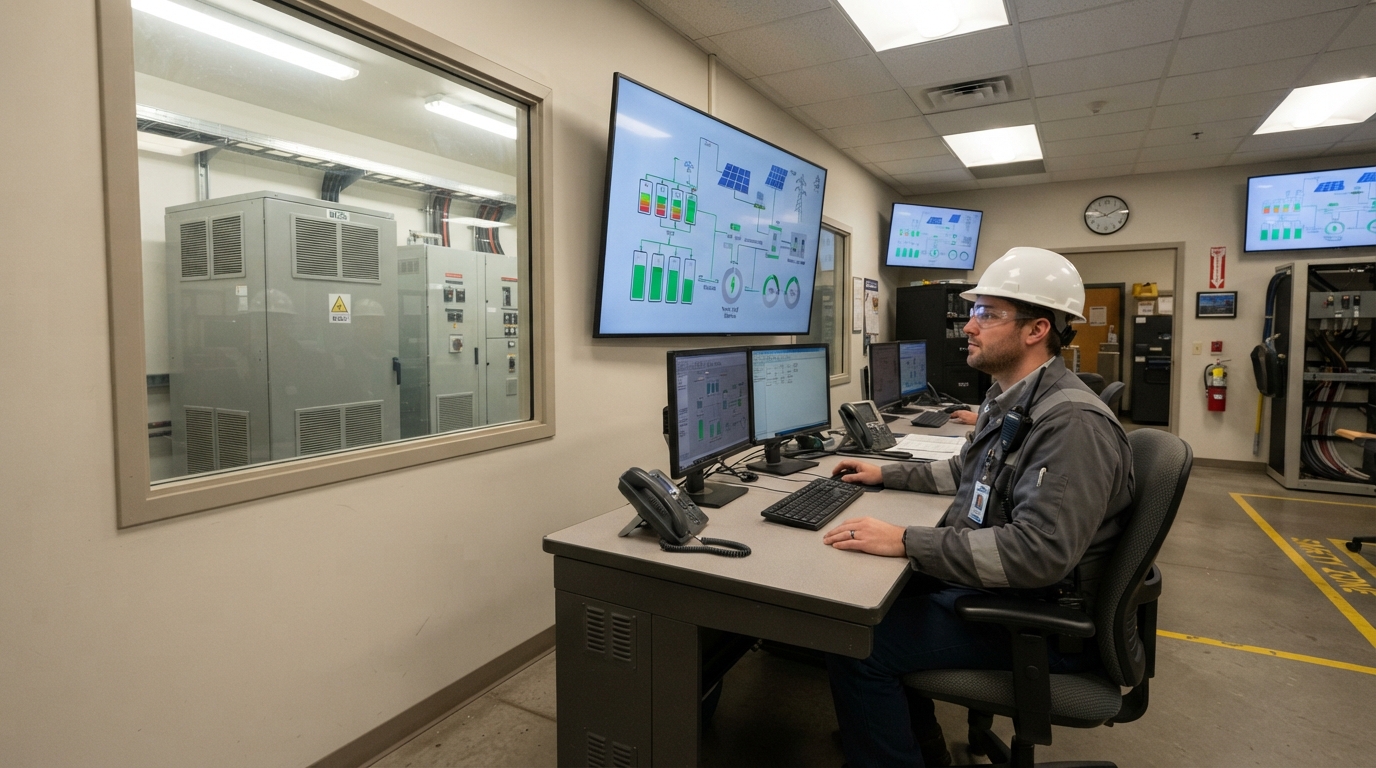
Operators will not trust a battery they cannot see. The battery’s state of charge, operating mode, alarms, and available runtime need to be visible through the plant’s SCADA or control system.
That requires a clear integration plan. The battery supplier should define its communication protocols, data points, and control limits. The plant’s EMS or microgrid controller then coordinates the battery with other resources. This is where a battery-storage project becomes a controls project, not just an equipment installation. For a broader look at how commercial and industrial storage systems are assembled, see our ci energy storage system guide.
Selecting a Battery Storage System for a Wastewater Plant
Battery selection should happen after the loads, operating modes, and integration requirements are understood. A supplier conversation is more productive when the plant can explain what it is protecting and how the system must behave.
Chemistry and Battery Architecture Options
Lithium iron phosphate, or LiFePO4, is a common chemistry in commercial and industrial energy-storage systems. It is often considered where thermal stability and cycle life matter. But chemistry is only one layer of the decision.
The physical architecture also matters. A battery system can be built from cells, modules, packs, racks, cabinets, or containers. A cabinet-sized system is very different from a containerized system, and the difference affects installation space, ventilation, cooling, and maintenance access.
One warning: do not take a module-level specification and apply it to a complete system. A module may have a nominal voltage and capacity, but the full system’s usable power and energy depend on the PCS, BMS, thermal management, and system configuration.
BMS, PCS, Communications, and Monitoring
The BMS protects the battery by monitoring voltage, current, temperature, and cell balance. It also controls protection actions and communicates with the PCS.
The PCS converts the battery’s DC power into AC power for the plant. Its power rating helps determine how much equipment the system can start and run.
Communications and monitoring connect the battery to the outside world. The plant should ask which protocols are supported, what data points are available, and whether the system can be monitored both locally and remotely.
Thermal Management, Enclosure, and Environmental Protection
Batteries are sensitive to temperature. Air cooling and liquid cooling are two common approaches, but neither is automatically better. The right choice depends on the site’s climate, enclosure placement, available maintenance access, and system size.
The enclosure’s IP rating also matters, especially on a wastewater site. Humidity, washdown water, corrosive gases, dust, and temperature extremes can all affect battery performance and life. The equipment must be specified for the actual installation environment.
Fire Safety, Electrical Installation, and Permitting
Fire safety and permitting are not afterthoughts. The local authority having jurisdiction, or AHJ, will review fire detection, suppression, ventilation, access, and emergency response. The electrical installation must follow local codes. The utility must approve the interconnection, including any export or import arrangements.
Buyers should request model-specific certificates, test reports, and installation documentation. A general certificate for one battery model does not prove that another model meets the same requirements. The equipment being offered must be documented as the equipment being installed.
From Load Study to Procurement
Once the plant has a load study, a draft operating strategy, and a shortlist of suppliers, the procurement process becomes more straightforward.
Wastewater-Site Information to Gather Before Requesting Quotes
A good supplier request should include:
- Electrical single-line drawings.
- Utility interval data if available.
- A critical-load list with kW estimates and runtime targets.
- Outage scenarios and resilience goals.
- Details about existing generators, solar, CHP, and microgrid plans.
- Space, environmental, and access constraints.
- SCADA or control-system integration requirements.
The more complete the information, the more useful the supplier responses will be.
Questions to Ask a BESS Supplier or EPC

At a minimum, ask for the following:
- What are the rated power (kW) and energy (kWh) for this exact model?
- What usable energy is available at the planned depth of discharge?
- What BMS functions, protections, and alarm points are included?
- Which PCS and EMS are compatible with the plant’s voltage and controls?
- What communication protocols are supported for SCADA or PLC integration?
- What cooling and enclosure options are available for the site conditions?
- What fire detection and suppression equipment is included?
- Which certificates and test reports apply to this exact system configuration?
- What warranty, degradation assumptions, maintenance requirements, and support are included?
Warranty, Maintenance, and Lifecycle Expectations
Battery performance changes over time. Cycle life, depth of discharge, and operating temperature all influence how quickly the system degrades. The plant should understand the expected lifetime under the proposed operating plan, not just under a manufacturer’s ideal test condition.
Maintenance should also be defined before purchase. Monitoring, cleaning, periodic inspection, software updates, and replacement planning all affect the system’s long-term value.
VoltaLink Solutions for Industrial and Commercial Energy Storage
VoltaLink’s website presents the company as an energy-storage provider serving industrial and commercial, household, and outdoor energy-storage scenarios. For wastewater buyers, the relevant starting points are the commercial and industrial solution pages.
If the plant’s first concern is continuity for critical loads, start with commercial backup energy storage solutions. If the priority is understanding how a complete commercial and industrial system is designed, review the ci energy storage system guide. For facilities that also need demand management, the peak-shaving guide provides additional detail. And for a comparison with another critical-facility application, battery storage for hospital backup shows a different approach to continuity planning, although wastewater loads and process priorities are different.
Regardless of which page you start with, the same rule applies: verify that the exact model’s ratings, controls, enclosure options, and safety documentation match the wastewater operating scenario defined in your load study.
The short version is this: battery storage can make wastewater treatment plants more resilient and easier to manage, but only when it is selected against a clear critical-load list and a realistic outage plan. Use this guide to build that list, complete the load study, and ask suppliers to prove the system fits the plant—not the other way around.

-

 OEM Residential Energy Storage Solutions: Passive vs. Active Cell Balancing
2026-09-30
-
 Smart Home Battery with BMS Communication: Cybersecurity and BMS Safety
 -
 10kWh Home Battery Backup System: Is 90% DoD Better for Daily Solar Storage?
2026-09-29
-
 Integrated Home Energy Storage System 150–430V MPPT Design
2026-09-28
-
 LiFePO₄ Residential Backup Battery SOC Accuracy in Parallel Systems
Share this:





.svg)






-899.svg)


