




Battery Storage for Cold Storage Warehouses: Peak Loads and Backup Strategy
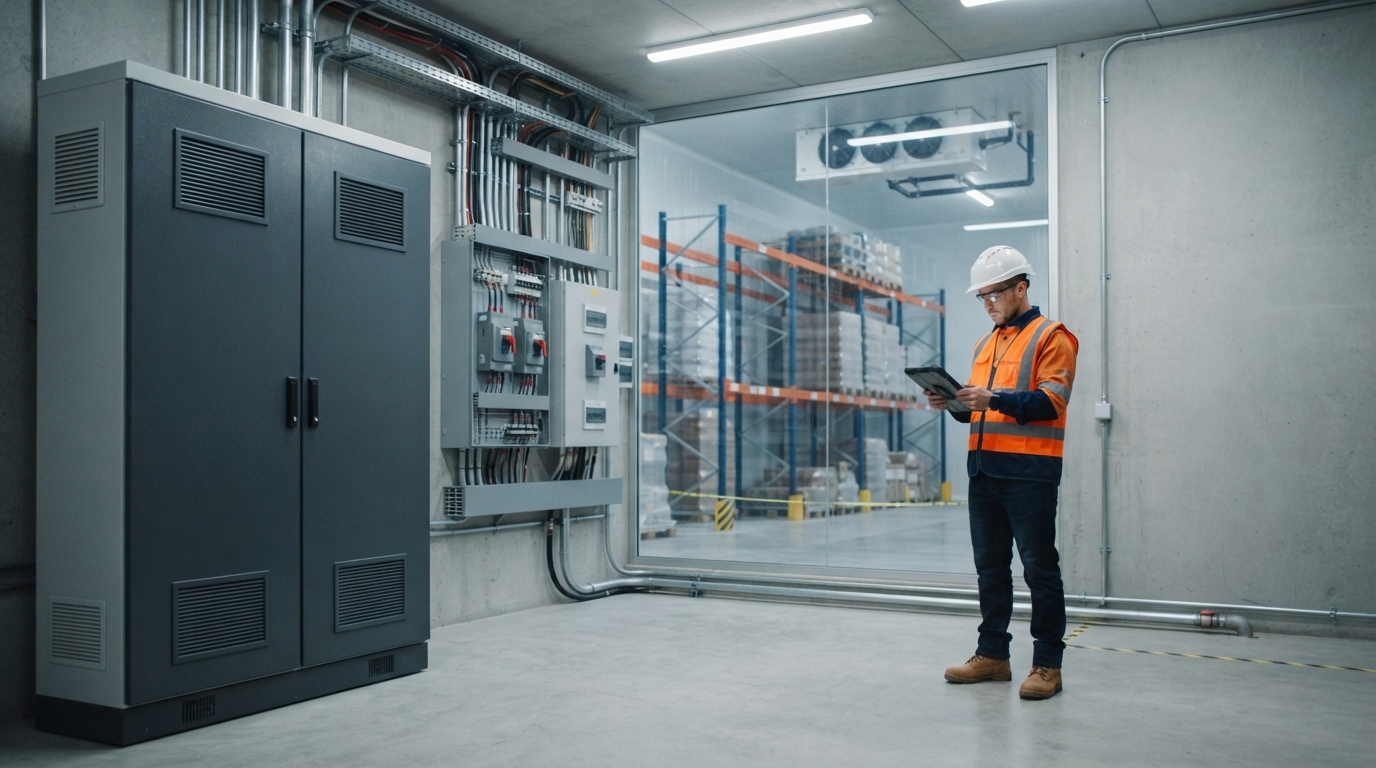
Battery storage can help a cold storage warehouse solve two problems at once: the high demand charges created by refrigeration peaks, and the product-protection risk of a grid outage. The key is to plan for both jobs from the start. A system sized only for peak shaving will not hold enough reserve for a long outage. A system sized only for backup will be oversized for daily economic duty.
This guide explains how to evaluate battery energy storage for a refrigerated warehouse, which loads to back up first, how to think about power and energy, and what to ask a supplier before committing.
Why Cold Storage Warehouses Need a Different Battery Storage Strategy
A refrigerated warehouse is not like a typical commercial building. Refrigeration systems run around the clock, summer and winter. Compressors start and stop, defrost cycles add temporary spikes, and the facility must keep product at a safe temperature at all times. The result is a load profile with high peaks, long operating hours, and little tolerance for interruption.
Lawrence Berkeley National Laboratory describes refrigerated warehouses as strong candidates for demand response through load shifting and load shedding. That same flexibility is what makes battery storage attractive. A battery can shave the peaks that drive demand charges, and it can hold energy in reserve for the moments when the grid disappears.
But the two functions are not the same. A battery that is good at one is not automatically good at the other.
What Drives the Load: Refrigeration, Defrost, and Auxiliary Systems
Before sizing anything, it helps to separate the load into pieces:
- Compressors are usually the largest electrical load and the main source of starting current. They are also the most critical for product protection.
- Evaporator and condenser fans run for long periods. Some can be cycled or slowed for short periods without risking product.
- Pumps and controls keep the refrigeration system operating. Loss of controls means loss of visibility and safe operation.
- Defrost cycles create temporary demand spikes that can coincide with the facility’s peak.
- Dock equipment, lighting, and office loads are useful but rarely critical during an outage.
Each of these loads behaves differently during a peak event and during an outage. That difference drives the design.
Peak Shaving or Backup: Two Different Storage Jobs
Peak shaving and backup are often discussed as if they were the same feature. They are not.
Peak shaving is a daily economic function. The battery charges when power is cheap or demand is low, then discharges during the utility’s peak window to reduce the facility’s billed kW. The goal is to lower demand charges without affecting operations.
Backup is an emergency resilience function. When the grid fails, the battery powers a defined set of critical refrigeration loads until power returns or a generator comes online. The goal is to protect product and avoid interruption.
One battery system can do both, but only if both jobs are sized separately and then combined into one operating strategy. If you size only for peak shaving, you may not have enough energy for an outage. If you size only for backup, you will pay for capacity you rarely use.
The practical answer is an outage reserve. The energy management system (EMS) keeps the battery above a defined state of charge so that daily cycling never consumes the energy needed for an emergency. For a fuller explanation of peak-shaving principles, see our guide on battery storage for peak shaving. For a broader view of outage-oriented storage, see commercial backup energy storage solutions.
Which Refrigeration Loads Should Be Backed Up First?
Not everything in a cold storage warehouse needs battery backup. Trying to back up every circuit is expensive and unnecessary. The better approach is to map loads by criticality.
- Tier 1 — Controls, safety and communication. Refrigeration controllers, sensors, alarm systems, and network equipment. Without these, the rest of the system cannot operate safely.
- Tier 2 — Core refrigeration. Compressors, pumps, and fans serving the most temperature-sensitive product. This is where the battery does its real work.
- Tier 3 — Deferrable refrigeration. Freezer or chiller loads that can be rotated, shed, or allowed to rise within acceptable limits for a defined period.
- Non-critical — Facility loads. Dock levelers, office HVAC, general lighting, and forklift battery chargers. These can be disconnected automatically.
The facility’s electrical distribution must make this separation possible. In many cases, a dedicated critical-load panel is needed so the battery can serve Tier 1 and Tier 2 loads without energizing the whole building.
The same critical-load mindset appears in other sectors. Our guide on battery storage for hospital backup explains how outage planning revolves around load prioritization. A warehouse is different in the details, but the logic is the same: define what must run, then size the system around that.
Sizing Battery Storage for a Cold Storage Warehouse
Sizing starts with data. The supplier should ask for electrical load-interval data, typically 15-minute intervals, covering at least a full year. That captures seasonal peaks and defrost patterns. Without that data, any size estimate is guesswork.
Two numbers matter most.
Power in kW. The inverter or power conversion system must be able to carry the instantaneous load. If compressors start directly across the line, the starting current can be several times the running current. The inverter must be sized for that surge, or the system will trip at the moment it is needed most.
Energy in kWh. The battery must store enough usable energy to carry the critical load for the required duration. Usable energy is not the same as nameplate capacity. It depends on the depth of discharge allowed, the reserve state of charge needed for outage protection, and the round-trip efficiency of the system.
A simple conceptual estimate for runtime is:
approximate runtime = usable energy (kWh) ÷ average supported load (kW)
This is an estimate, not a guarantee. It does not account for every inefficiency, motor surge, or operating condition. The final design must be completed by a qualified engineer using site-specific measurements.
Power in kW: Handling Compressor Demand
Compressor demand is the reason a cold-storage battery cannot be sized like a simple backup unit. Several motors may start at once after a power event, and the combined starting current can be far higher than the steady-state load.
Mitigation options include:
- Staged restart, where the EMS brings loads back one at a time.
- Soft starters or variable-frequency drives on larger motors.
- A control sequence that prevents all compressors from restarting simultaneously after an outage.
These measures reduce the peak kW the inverter must supply, which can lower the size and cost of the system.
Energy in kWh: How Long Can the Battery Carry the Load?
The energy side is where most sizing mistakes happen. A battery’s nameplate capacity is not the energy you can actually use.
- Depth of discharge (DoD) defines how much of the battery’s capacity is available in normal operation.
- Reserve state of charge is the portion held back for outage protection.
- Round-trip efficiency accounts for energy lost while charging and discharging.
Example: if Tier 1 and Tier 2 loads average 100 kW and the target is 4 hours, the delivered energy must be about 400 kWh. The battery’s usable capacity will need to be larger than 400 kWh once reserve and losses are included.
The exact numbers depend on the load profile, the battery chemistry, the EMS settings, and the facility’s outage objectives. That is why the calculation belongs in an engineering study, not on a brochure.
Operating Modes: One System, Several Jobs
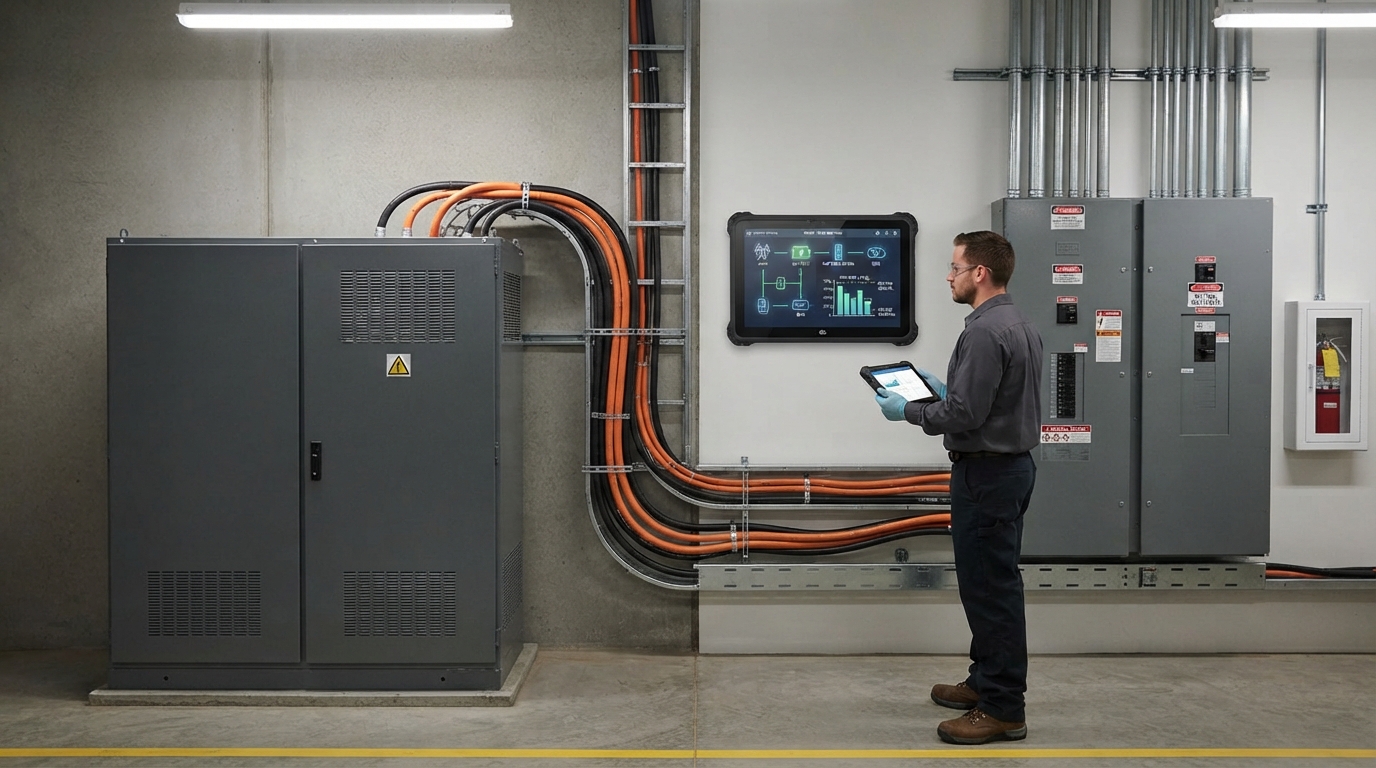
A well-designed system switches between modes automatically.
- Peak shaving. The EMS discharges during the utility’s peak window to reduce imported kW.
- Load shifting. The battery charges during low-cost periods and discharges during high-cost periods, where the tariff supports it.
- Reserve protection. The EMS never discharges below the defined reserve state of charge, so outage energy is always available.
- Outage response. On grid failure, the system isolates and powers the critical-load panel within the transfer time allowed by the equipment.
- Solar integration. If the warehouse has PV, the battery can be recharged from solar when the grid is available, or support loads during daylight outages with the right architecture.
- Generator coordination. The battery can bridge the gap until a generator synchronizes, then either hold critical loads or reduce generator loading.
- Demand response. The same load-shedding logic can support demand-response events, as long as product temperature remains protected.
The energy management system is the brain that coordinates these modes. It maintains the reserve, decides when to charge and discharge, and communicates with the building’s controls.
Cold Environment, Enclosure, and Fire Safety Requirements
Cold storage sites create conditions that need attention.
- Low temperatures affect battery behavior. Charging at very low temperatures may require reduced current or may be restricted entirely. The battery’s thermal management system must keep the cells inside their operating window.
- Moisture and condensation are real risks if the battery is placed inside a refrigerated space. Most systems should be installed in a controlled indoor space or in an enclosure rated for the location.
- Outdoor installations require the enclosure to handle temperature swings, weather, and humidity. The enclosure’s IP rating and thermal management must match the site.
- Fire detection and suppression are mandatory considerations. Requirements vary by jurisdiction and installation type. Local fire and electrical codes, and applicable standards such as NFPA or IEC frameworks, must be verified before installation.
- The supplier must name the specific system and model. A generic statement like “certified” is not enough. Ask for model-specific documentation and have a licensed professional engineer review the design where required.
Comparing BESS, Generators, and Thermal Storage for Cold-Chain Resilience
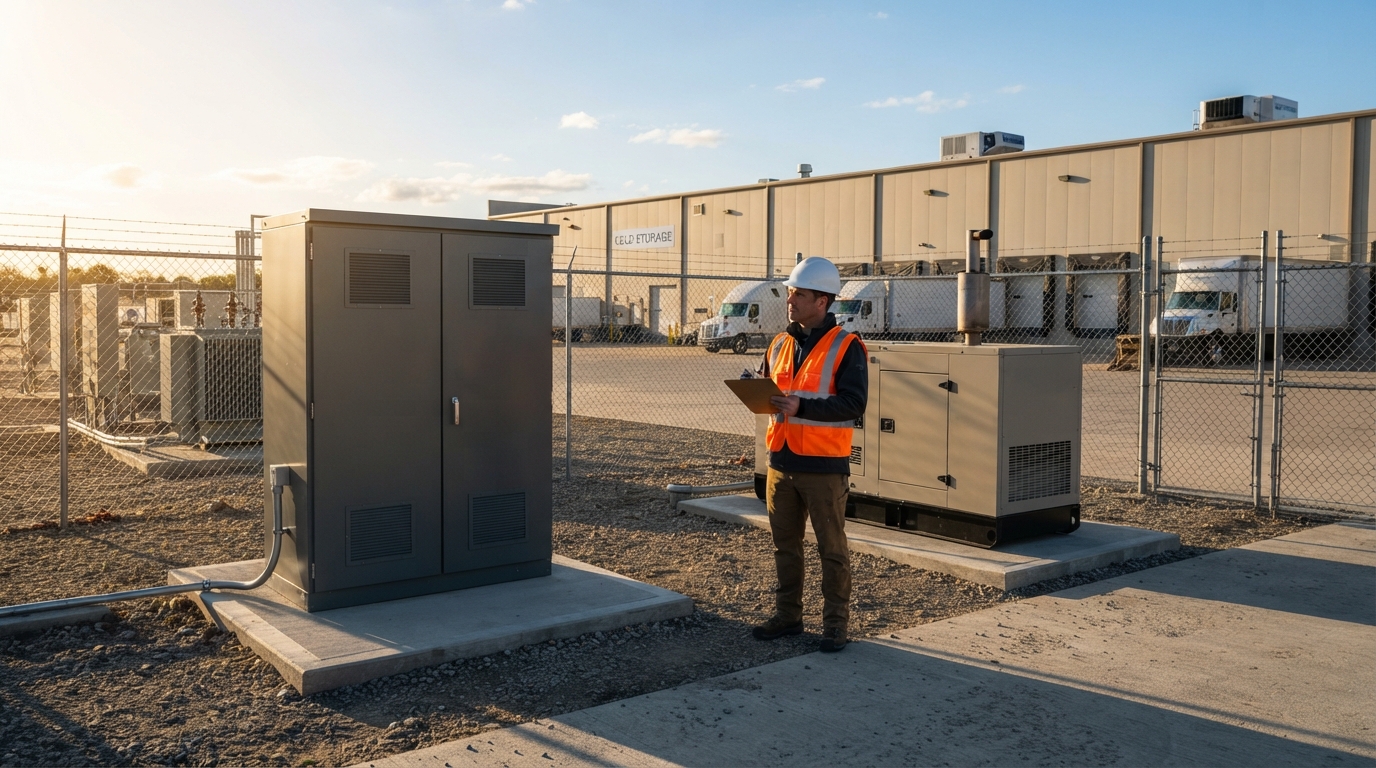
A battery is not the only way to protect a cold chain. The right solution may be a battery, a generator, thermal storage, or a combination.
| Option | Strengths | Limitations | Best Fit |
|---|---|---|---|
| Battery energy storage | Instant response, quiet, no fuel logistics, delivers daily peak shaving and backup | Duration limited by energy capacity; higher upfront cost for long runtime | Facilities that want bill savings plus short-to-medium outage protection |
| Generator | Long-duration and essentially unlimited runtime with fuel | Startup time, fuel storage, emissions, noise, maintenance | Long outages, extended resilience, sites with existing generator infrastructure |
| Thermal energy storage | Pre-cools the space or uses phase-change materials to ride through short events | Limited event duration; does not help other electrical loads | Short interruptions, temperature-sensitive product, integration with existing refrigeration |
| Hybrid | Battery bridges first seconds/minutes; generator covers long duration; thermal storage reduces cooling load | More complex design and controls | Large facilities where both daily economics and long-duration resilience matter |
There is no universal winner. The right mix depends on outage frequency, outage duration, product tolerance, available space, budget, and maintenance capacity.
What to Ask a Battery Storage Supplier
A good supplier will welcome specific questions. A weak one will offer answers before seeing your data.
- Load study. Confirm the supplier will base the design on your load-interval data, not on a rule of thumb.
- System architecture. Ask for the battery type, inverter/PCS rating, BMS/EMS functionality, communication interfaces, and monitoring.
- Thermal management and enclosure. Request the operating temperature range, cooling method, enclosure rating, and recommended placement.
- Safety evidence. Ask for model-specific test reports and installation requirements. Verify them against your local code.
- Warranty. Check the conditions around cycles, depth of discharge, throughput, and performance.
- Integration. Confirm compatibility with existing controls, transfer switches, generators, solar, and utility interconnection requirements.
- Commissioning and service. Ask about factory testing, site commissioning, operator training, spare parts, and after-sales support.
- Documentation. Request datasheets, drawings, operation and maintenance manuals, and verifiable project references where available.
For context on how a complete commercial and industrial system is structured, see our overview of a ci energy storage system.
From Load Data to Commissioning: A Practical Workflow
The path from idea to installed system follows a clear sequence.
- Collect data. Gather load-interval data and an inventory of refrigeration equipment.
- Define goals. Set the economic target (demand charge reduction, load shifting, demand response) and the resilience target (critical loads, duration).
- Run a rough sizing pass. Estimate the kW and usable kWh needed for both jobs.
- Compare options. Evaluate battery, generator, thermal storage, and hybrid configurations.
- Request proposals. Ask suppliers for model-specific documentation and design assumptions.
- Engage an engineer. Design, code review, and permitting should be handled by qualified professionals.
- Commission with real tests. Verify staged restart, outage response, and transfer behavior.
- Monitor and tune. Track performance, adjust settings, and train operators.
A battery for a cold storage warehouse is best understood as two systems in one: a daily tool for managing refrigeration peaks and an emergency reserve for protecting product. Each job needs its own sizing logic. When they are designed together, the same BESS can lower energy costs and improve cold-chain resilience.
If you are evaluating battery storage for a refrigerated warehouse, bring your load-interval data, a list of critical loads, your utility tariff, and your outage objectives to the conversation. That information separates a serious design from a guess. To see how an energy-storage manufacturer approaches commercial and industrial systems, you can start at VoltaLink Battery.

-

 OEM Residential Energy Storage Solutions: Passive vs. Active Cell Balancing
2026-09-30
-
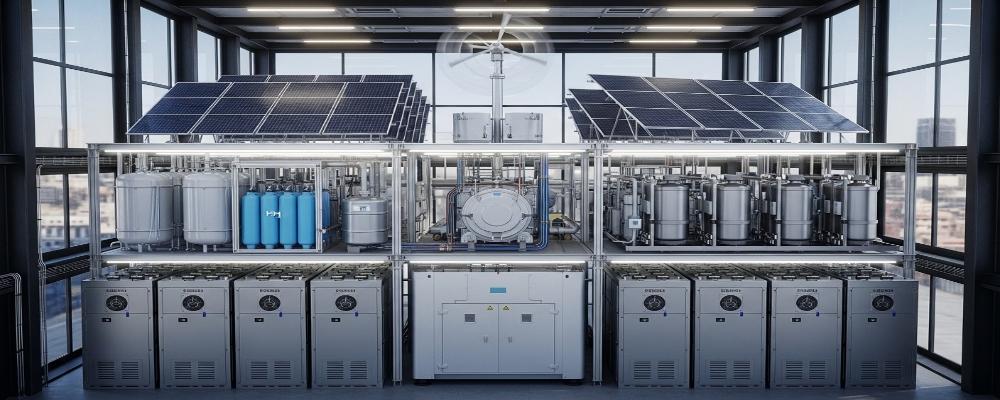 Smart Home Battery with BMS Communication: Cybersecurity and BMS Safety
 -
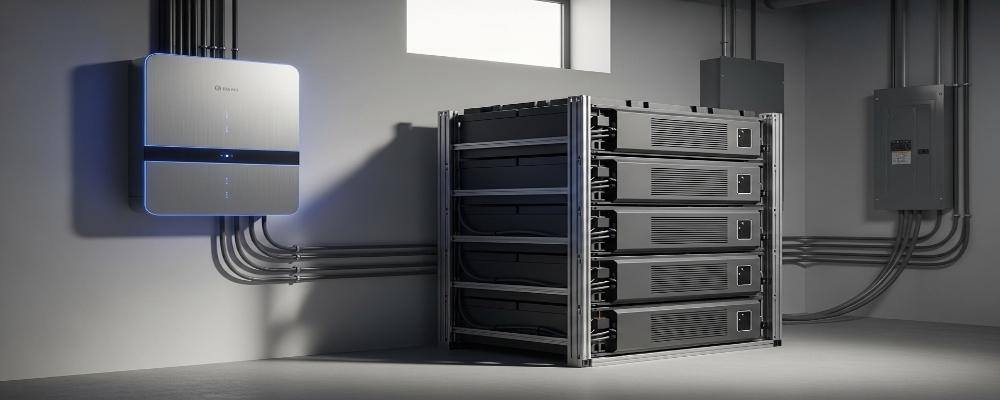 10kWh Home Battery Backup System: Is 90% DoD Better for Daily Solar Storage?
2026-09-29
-
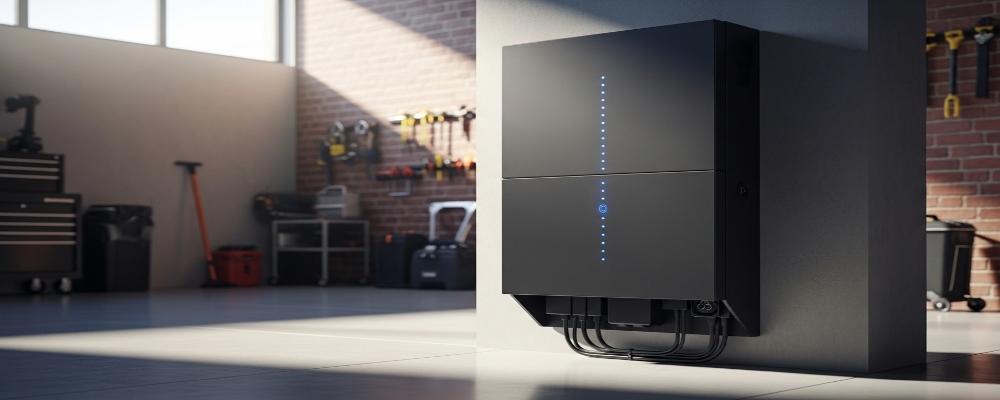 Integrated Home Energy Storage System 150–430V MPPT Design
2026-09-28
-
 LiFePO₄ Residential Backup Battery SOC Accuracy in Parallel Systems
Share this:





.svg)






-899.svg)


