




Battery Storage for Hospital Backup: Critical Loads and Resilience Planning
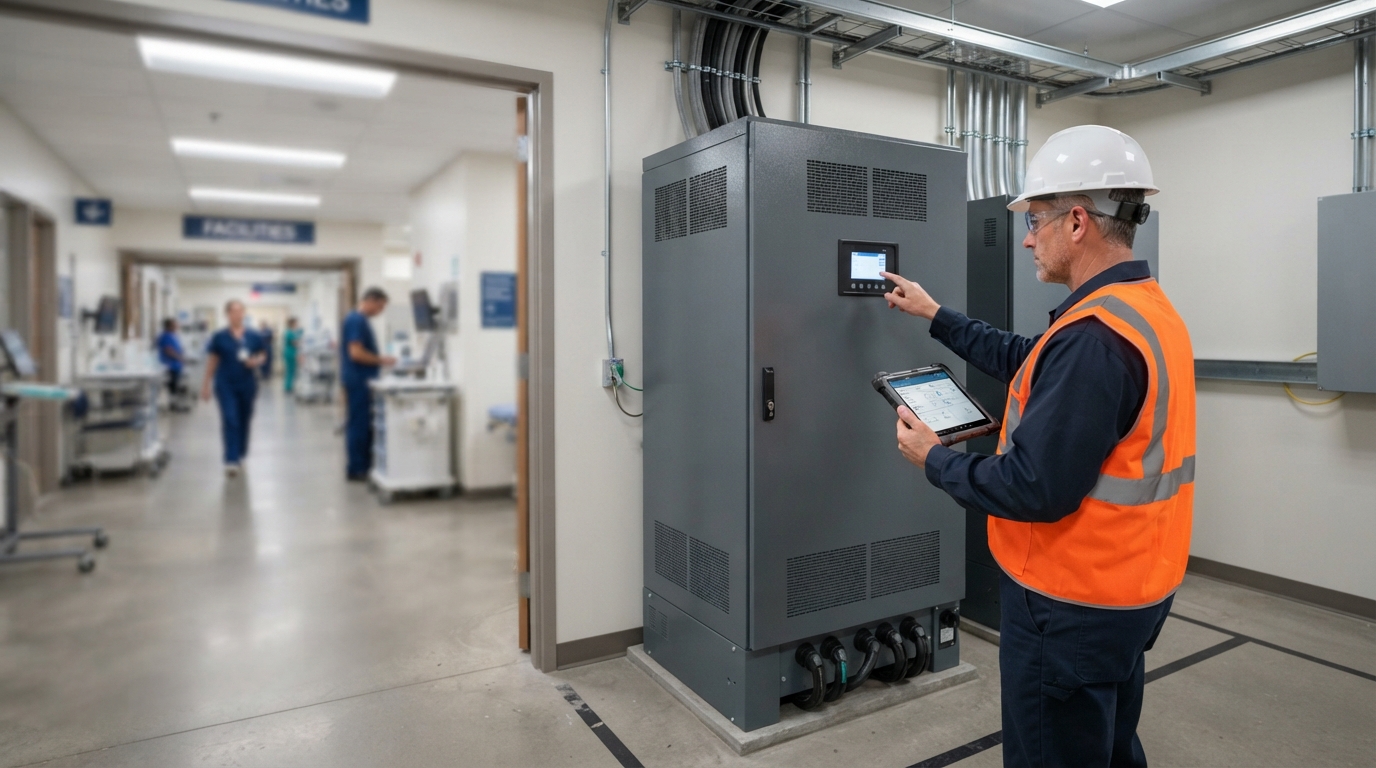
Battery storage can support selected hospital critical loads during a grid outage, but the right system depends on how much load must be carried, for how long, and how the battery coordinates with the hospital’s existing UPS, generators, and electrical controls. Battery backup is not a one-size-fits-all product. It is a resilience layer that needs to be planned around the loads that keep a hospital safe and operational.
This solution guide focuses on that planning process. It explains how to identify critical loads, understand power and energy ratings, compare backup architectures, size a system, plan for safety and commissioning, and evaluate a battery storage supplier for a hospital project. For a broader view of how commercial and industrial facilities use energy storage, see the Commercial & Industrial energy solutions guide.
Why Hospitals Need Battery Storage for Backup Power
Hospitals cannot stop operating when the grid fails. Lighting, medical equipment, refrigeration, communications, and ventilation may all need to continue during an outage. Many facilities already rely on diesel generators for extended backup, but generators have limits.
Generators take time to start, require fuel supply, need regular maintenance, and may not be able to carry every load at once. Battery storage solves a different part of the problem. It responds immediately, does not depend on fuel delivery during an event, and can carry critical loads for a defined period. It can also bridge the gap while a generator starts.
Battery storage is therefore best understood as one layer in a hospital’s overall resilience strategy, not as a universal replacement for generators or UPS systems.
From Generators to Layered Resilience
A resilient hospital electrical system usually combines multiple layers:
- UPS systems provide no-break power for equipment that cannot tolerate even a brief interruption.
- Battery storage provides fast, fuel-independent backup for short-to-medium duration events.
- Generators provide long-duration backup but need time to start and fuel to keep running.
- Microgrid controls or energy management systems coordinate all of these sources during an outage.
The goal is to match each layer to the needs of the load. A battery system may carry a load instantly, support the hospital during a generator startup, reduce generator runtime, or enable the facility to operate as an island during a longer outage.
First, Identify the Hospital Critical Loads That Must Stay Powered
Before selecting a battery, the hospital must define which loads are critical. This is the most important step in the entire planning process.
Critical loads are not all the same. Some are life-safety loads that must remain powered immediately. Others can tolerate a short interruption. Others should be deferred or shed during an outage to preserve battery energy.
| Load Category | Examples | Typical Backup Priority |
|---|---|---|
| Life safety and emergency systems | Egress lighting, fire alarms, emergency communication | Highest priority; may need no-break or rapid backup |
| Clinical and patient care | Operating rooms, ICU equipment, patient monitors, ventilators | Highest priority; transfer sensitivity varies |
| Medical cold chain | Blood bank refrigeration, pharmacy storage, lab samples | High priority; continuous power required |
| Critical infrastructure | Medical gas, ventilation, HVAC, security, nurse call, IT/server rooms | High priority; duration and cooling requirements vary |
| Deferrable loads | Comfort heating and cooling, general lighting, cafeteria equipment | Lower priority; can be shed during an outage |
The exact list depends on the facility’s design, local codes, and the authority having jurisdiction. The article above is a starting point, not a substitute for an engineering review.
How to Build a Critical Load Inventory
A critical load inventory turns a general list into usable sizing data. The process can be completed by facility staff, but should be reviewed by an electrical engineer before system selection.
- List every load that may need backup power. Include clinical equipment, medical refrigeration, IT, communications, security, lighting, elevators, and ventilation.
- Record the power demand in kilowatts (kW). Use nameplate data, measured data, or estimates from the facility’s electrical team.
- Estimate the required runtime for each load. Some loads only need power until a generator starts. Others may need power for hours or days.
- Classify transfer sensitivity. Identify which loads cannot tolerate any interruption, which can tolerate a short break, and which can be switched to backup manually.
- Sum the loads into time-based profiles. The total kW load in each time interval becomes the basis for battery sizing.
Pay attention to starting current. Motors, compressors, elevators, and certain medical devices can draw more current when they start than when they run. A battery system with enough total energy may still be undersized if its maximum power output cannot cover these short-duration peaks.
Battery Storage Fundamentals: Power, Energy, and Runtime
Two ratings are often confused in battery storage discussions: power and energy.
- Power, measured in kilowatts (kW), is the instantaneous load the battery can support. It determines how many devices can run at the same time.
- Energy, measured in kilowatt-hours (kWh), is the total stored work available over time. It determines how long the system can support that load.
A common analogy is a fuel tank. The battery’s power rating is like the size of the fuel line, while the energy rating is like the size of the tank. A system can have a large tank but a small fuel line, or a large fuel line but a small tank.
Runtime is not calculated from the battery’s nameplate energy alone. The usable energy is typically lower than the rated capacity because of depth-of-discharge limits, efficiency losses, temperature effects, and aging.
A simplified formula looks like this:
Approximate runtime = usable energy (kWh) ÷ average load (kW)
For example, a system with 100 kWh of rated energy, an 80% depth-of-discharge limit, and 90% usable efficiency may provide roughly 72 kWh of usable energy. At an average critical load of 30 kW, the approximate runtime would be about 2.4 hours.
This is an illustrative calculation, not a guarantee. Actual runtime depends on the exact system design, operating conditions, and load behavior. The formula, however, explains why most hospital battery projects start with a load profile rather than a battery catalog.
There is also a difference between battery-side direct current (DC) and system-side alternating current (AC). A battery’s DC voltage and current ratings are not the same as the AC power that reaches hospital loads. The power conversion system, or PCS, must be selected to match the battery and the facility’s electrical system.
Hospital Backup Architectures: UPS, Battery, Generator, and Microgrid
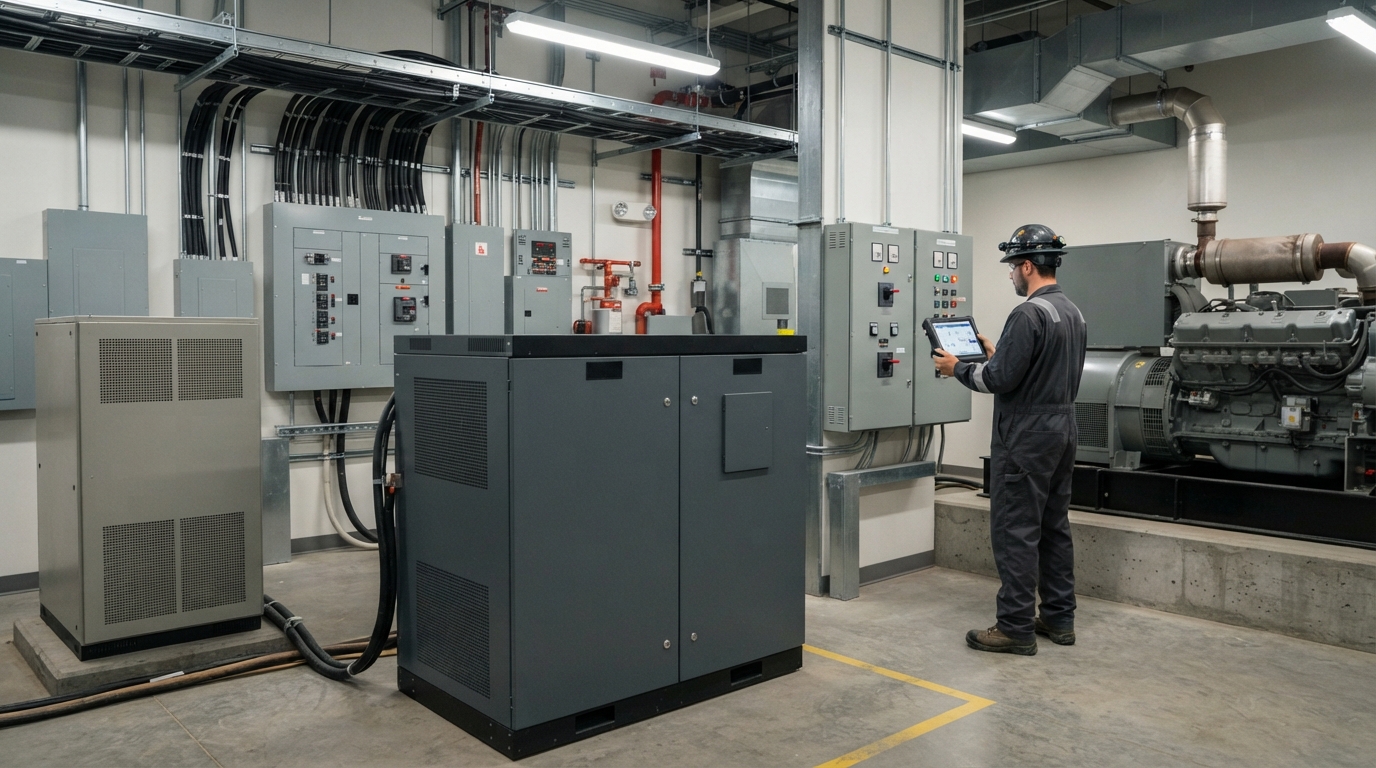
Hospitals rarely need a single technology. Most need a combination that matches each load’s sensitivity and duration requirement.
| Technology | Primary Role | Typical Limitation | Best Fit |
|---|---|---|---|
| UPS | Provides no-break power for sensitive equipment | Limited duration; usually minutes | OR equipment, PACU, monitors, critical IT |
| Battery storage | Provides fast, fuel-independent backup | Energy and power are finite | Bridging generator startup, short-to-medium outages, peak load support |
| Diesel generator | Provides long-duration backup | Start time, fuel, maintenance | Extended outages lasting hours or days |
| Microgrid controls / EMS | Coordinates all sources and loads | Requires proper design and commissioning | Facilities with solar, battery, generator, and islanding needs |
Battery storage can be installed as a standalone system or as part of a larger microgrid. In a hospital, the more common architecture is a coordinated system where the battery works with the generator and, in some designs, with solar photovoltaic (PV) generation.
For more detail on how complete commercial and industrial storage systems are structured, see the ci energy storage system page.
Coordinating Battery Storage with Generators
One of the most useful hospital applications for battery storage is generator coordination.
Generators do not provide power instantly. They need time to start, synchronize, and accept load. A battery can support critical loads during that period. The battery can also reduce generator runtime by carrying loads during short outages, improving generator loading during light loads, and providing reserve power if the generator needs maintenance or refueling.
Recharge planning is essential. After an outage, the battery must be recharged so it is ready for the next event. The recharge source may be the grid, the generator, or solar PV, depending on the system design. This is part of the hospital’s overall resilience plan, not an afterthought.
For more information on how battery storage and diesel generators work together, see bess for diesel generator optimization.
Integrating Solar PV and Microgrid Operation
Some hospitals pair battery storage with solar PV to create a microgrid. During a grid outage, the microgrid can disconnect from the utility and operate independently, or “island.” In this configuration, solar can help recharge the battery during daylight hours, extending the facility’s ability to operate without grid power.
Microgrid operation requires an energy management system (EMS) to coordinate the battery, solar, generator, and loads. The EMS controls which loads are served, when load shedding occurs, and how the system recovers after an outage. If black start capability is required, the system must also be designed to restart without grid power.
This architecture is more complex than a simple battery backup system. It requires careful engineering, commissioning, and testing. But for hospitals seeking longer resilience, it can be a strong option.
Sizing a Hospital Battery Storage System
Hospital battery sizing is not a fixed number. It depends on the load profile, the required outage duration, the system’s usable energy, the power conversion rating, and the recharge plan. The following process is a practical starting point.
- Start with the critical load inventory. Use the list developed earlier, including power demand and required duration for each load.
- Define outage scenarios. Consider short interruptions, generator startup periods, and extended outages. Each scenario may require a different battery strategy.
- Convert the inventory into a load profile. Identify the maximum kW load the battery must support and the total kWh required over the intended duration.
- Calculate usable energy. Account for depth-of-discharge limits, efficiency losses, temperature, and aging. The usable energy must be greater than the required load-duration product.
- Select the power conversion rating. The PCS or inverter must be able to handle the peak load, not just the average load. Review starting currents and short-duration peaks.
- Plan recharge and redundancy. Decide how the battery will be recharged after an event and whether redundancy is needed for critical applications.
The U.S. Department of Energy and the National Renewable Energy Laboratory emphasize that resilience planning should begin with critical loads and anticipated outage duration. Battery storage for resilience is not about buying a generic system. It is about matching the system to the facility’s specific needs.
A final design should be completed by a qualified electrical engineer. The process above helps hospital decision-makers estimate feasibility, but it is not a substitute for detailed load calculations, coordination studies, and code review.
Safety, Installation, and Commissioning Requirements
Battery storage has a strong safety record when designed, installed, and maintained correctly. However, battery systems involve electrical and thermal hazards that must be managed.
The National Fire Protection Association identifies hazards such as electrical shock and arc flash as important concerns in battery energy storage systems. Battery energy storage hazards and failure modes are relevant to any facility, including hospitals.
Key safety and installation considerations include:
- Enclosure and location. Battery cabinets or containers must be located with proper access, ventilation, separation, and environmental protection.
- Thermal management. Cooling systems keep batteries within their operating temperature range. Air cooling and liquid cooling are both common, but their suitability depends on the system design and site.
- Fire detection and suppression. Battery rooms or containers may require fire detection, suppression, and emergency response planning.
- Electrical protection. The system must be integrated with the facility’s electrical distribution and protection systems.
- Authority having jurisdiction (AHJ). Local fire, building, and electrical officials must review the installation. Requirements vary by region.
- Commissioning. The system must be tested to confirm that controls, alarms, transfer behavior, and protection functions work correctly. For hospitals, this should include realistic outage simulations where possible.
The U.S. Department of Energy’s energy storage safety strategy also emphasizes the importance of validated safety, incident response planning, and proper disposal or repurposing considerations. These are not optional for a critical facility.
For more information about siting and installation requirements for containerized systems, see bess container installation requirements.
Limitations and Common Mistakes in Hospital Battery Backup
Battery storage is a valuable resilience tool, but it has limits. Understanding those limits prevents costly mistakes.
- Battery-only backup is not a generator replacement. Most battery systems provide hours of backup, not days or weeks. A hospital planning for extended outages needs a generator or another long-duration source.
- Uninterrupted power cannot be assumed. If a load cannot tolerate any interruption, the battery system must be paired with a UPS or appropriate transfer equipment.
- Recharge time is part of the plan. A battery that is empty after an outage is not ready for the next event until it is recharged.
- Nameplate energy is not necessarily usable energy. Depth-of-discharge limits and efficiency losses reduce the actual energy available.
- Average load is not enough for sizing. Peak loads, starting currents, and load changes matter.
- HVAC and medical refrigeration are easy to overlook. These loads can be large and may be critical for patient safety and medication storage.
- Controls are not guaranteed to work without testing. Transfer sequences, load shedding, islanding, and black start must be commissioned and periodically tested.
- Supplier documentation must be model-specific. A general brochure is not sufficient evidence that a particular system meets the hospital’s requirements.
The U.S. Department of Energy’s resilience guidance for distributed generation and energy efficiency reinforces that facilities should understand their critical loads and design backup systems around them. That discipline is especially important in hospitals.
How to Evaluate a Hospital-Grade Battery Storage Supplier
Hospitals should evaluate battery storage suppliers using the same rigor they apply to other critical infrastructure. The supplier must be able to provide clear technical documentation, integration support, and evidence that the proposed system is appropriate for the application.
A reputable supplier or integrator should be able to explain how the battery, BMS, PCS, EMS, cooling, and enclosure work together. They should also be prepared to work with the hospital’s electrical engineer and the authority having jurisdiction.
For a general overview of how commercial backup systems are applied, see commercial backup energy storage solutions.
Key Questions to Ask a BESS Supplier

Use the following questions to compare suppliers and proposals:
- What exact battery model, chemistry, and enclosure type are proposed?
- What are the battery’s DC ratings in volts (V), amp-hours (Ah), and kilowatt-hours (kWh)?
- What is the system’s AC power rating in kilowatts (kW)?
- What is the usable energy at the expected operating temperature and depth-of-discharge limit?
- What BMS and EMS functions are included?
- What communication protocols are supported, such as CAN, RS485, or Modbus?
- Can the system coordinate with the hospital’s existing UPS, generator, and transfer equipment?
- Is islanding or microgrid operation possible, and what controls are required?
- What testing, commissioning, and documentation will be provided?
- What model-specific test reports and certification documents are available?
- What warranty terms apply, and how does capacity degradation affect usable energy over time?
- What monitoring, alarm, and after-sales support are included?
These questions help separate a marketing proposal from an engineering-ready solution.
Next Step: Move from Planning to Project Assessment
Hospital battery storage starts with the load, not with the battery. Once critical loads are identified, outage scenarios are understood, and a backup architecture is selected, the next step is a site-specific assessment. A qualified electrical engineer, energy consultant, or battery storage supplier should review the hospital’s electrical system, confirm load assumptions, and develop a detailed design.
VoltaLink offers commercial backup energy storage solutions and ci energy storage systems that can be explored as part of that evaluation. The right starting point is always a conversation about the facility’s critical loads, resilience goals, and project constraints.

-

 OEM Residential Energy Storage Solutions: Passive vs. Active Cell Balancing
2026-09-30
-
 Smart Home Battery with BMS Communication: Cybersecurity and BMS Safety
 -
 10kWh Home Battery Backup System: Is 90% DoD Better for Daily Solar Storage?
2026-09-29
-
 Integrated Home Energy Storage System 150–430V MPPT Design
2026-09-28
-
 LiFePO₄ Residential Backup Battery SOC Accuracy in Parallel Systems
Share this:






.svg)






-899.svg)


