




Home Power Storage Solutions: Compare by Use Case
Home power storage solutions should be compared by living situation first: balcony-mount for apartments and small balcony solar, wall-mount for compact homes with a suitable wall, and stackable rack for utility rooms, larger backup loads, or off-grid cabins. Check usable capacity, footprint, installation limits, noise, IP rating, inverter compatibility, and expansion before choosing.
Choosing a home battery is not only about capacity. The same battery chemistry can feel easy in one home and difficult in another because layout, wall strength, floor space, cable routing, and future expansion all matter. This guide compares wall-mount, stackable rack, and balcony-mount storage so you can match the product format to your real living situation before asking for a quote.
Which home power storage solution fits your home best?
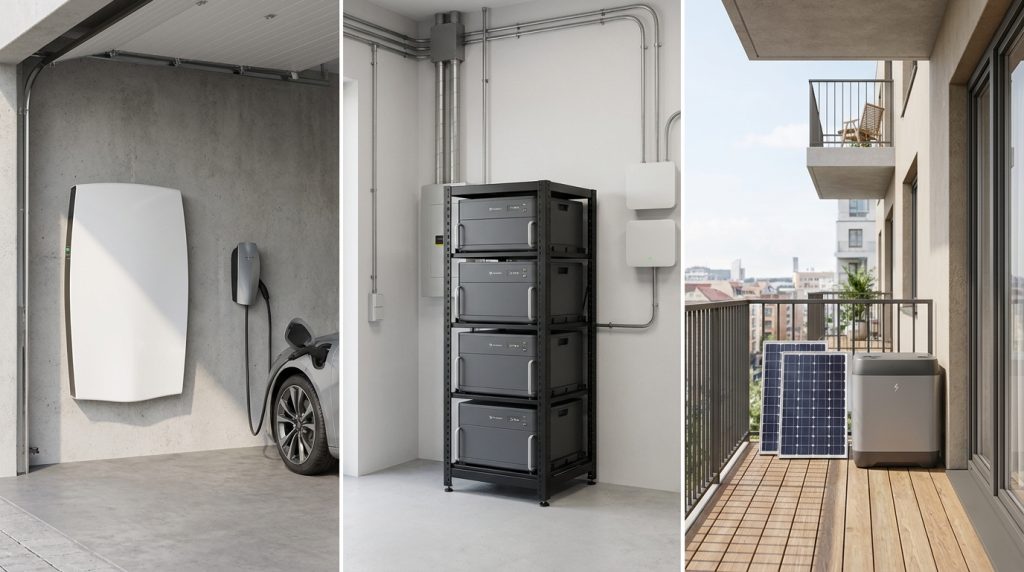
Choose wall-mount storage for compact homes, stackable rack storage for higher-capacity utility rooms, and balcony-mount storage for apartments or small solar balconies. The right choice depends more on location, expansion needs, and installation limits than on battery chemistry alone.
Use this matrix as the first filter. The goal is not to pick the biggest battery. It is to find the format that fits your home, your backup goal, and your available installation space. Battery storage can help solar power serve the home after daylight hours and during outages, according to the U.S. Department of Energy.
| Product type | Best living situation | Capacity | Footprint | Install hours | Noise | IP rating | Expansion | Best use case | Avoid when |
|---|---|---|---|---|---|---|---|---|---|
| Wall-mount storage | Townhome, garage, compact utility area | Verify by model | Saves floor space | Verify with installer | Verify by datasheet | Verify by datasheet | Limited to supported parallel setup | Clean backup storage near the electrical panel | Wall is weak, clearance is tight, or major expansion is planned |
| Stackable rack storage | Single-family utility room, equipment room, off-grid cabin | Usually better for larger systems, verify by model | Needs floor space | Verify with installer | Verify by datasheet | Verify by datasheet | Stronger fit for modular growth | Larger backup loads and future capacity growth | Floor space or service access is limited |
| Balcony-mount storage | Apartment, balcony solar, small-space solar use | Usually compact, verify by model | Very small space | Verify by product type | Verify by datasheet | Must verify outdoor rating | Limited by product design | Small solar self-consumption and light backup | You need whole-home backup or building rules do not allow it |
What do wall-mount, stackable rack, and balcony-mount systems actually mean?
Wall-mount, stackable rack, and balcony-mount describe how the storage system is physically installed. They do not automatically tell you chemistry, usable capacity, backup power, or solar compatibility, so those specs still need to be checked separately.
A wall-mount battery is fixed to a suitable wall, often near a panel, inverter, or utility area. A stackable rack system uses floor-based modules or cabinet-style units. A balcony-mount system is designed for tighter spaces, often with small solar setups where the battery sits on or near a balcony.
These names describe the shape and placement of the system. They do not replace the full design details. You still need to check battery chemistry, battery management system, inverter match, protection devices, and monitoring. For a deeper view of the parts inside a home ESS, read this guide to ESS system anatomy.
| Term | Simple meaning | What it does not confirm |
|---|---|---|
| Wall-mount | Battery installed on a suitable wall | Whole-home backup, outdoor rating, or expansion limit |
| Stackable rack | Modular battery units placed on the floor or in a rack | Compatibility with every inverter |
| Balcony-mount | Compact storage for balcony or small-space solar | Enough power for heavy home loads |
Is wall-mount storage the best fit for compact homes?
Wall-mount storage is best when you need a clean, compact installation near the electrical panel and your backup load is moderate. It is weaker when you expect major expansion or need a service-friendly rack layout.
Wall-mount storage works well when floor space is limited. A townhome, garage wall, or compact utility area can be a good match if the wall is strong enough and the installer has enough clearance. It also keeps the system neat, which matters in homes where the battery area is visible or shared with other equipment.
The tradeoff is expansion. Stackable rack storage is often easier to grow because modules can sit in a structured floor layout. Wall-mount storage is not automatically the wrong choice, but it should match your real load plan. If you need backup for lights, Wi-Fi, a refrigerator, and a few outlets, it may fit well.
Use wall-mount storage when:
- You have a strong wall near the panel or inverter
- You want to save floor space
- Your backup loads are moderate
- You do not expect major capacity growth
- You want a clean, compact installation
Do not choose it only because it looks tidy. If the wall is weak, the clearance is poor, or service access is tight, a floor-based option may be safer. Readers planning a compact system can also review integrated home storage to understand how battery, inverter, and controls work together.
When does stackable rack storage make more sense?
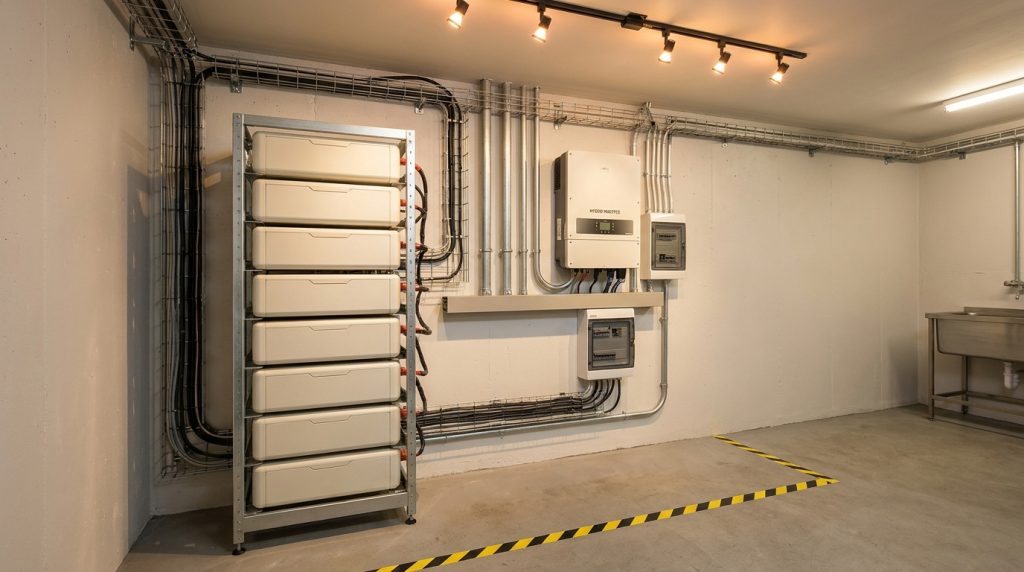
Stackable rack storage makes sense when capacity growth, service access, and larger backup loads matter more than the smallest footprint. It is usually better for utility rooms, equipment rooms, and off-grid setups than for tight apartment spaces.
Stackable rack systems are often the better fit when the home has a dedicated utility room, equipment room, basement area, or off-grid power room. The format gives the installer more room to plan cable routing, service access, module spacing, and future expansion. That matters when the battery system may grow over time.
Stackable rack storage is not automatically better. It works when you need capacity growth and service access, but wall-mount storage is cleaner when the load is moderate and space is tight. A large rack in a small townhome can create more problems than it solves.
Choose stackable rack storage if:
- You want to expand capacity later
- You have enough floor space and service clearance
- You need backup for more than light loads
- You have an off-grid cabin or larger solar setup
- You prefer a structured equipment-room layout
A cabin owner is a good example. If the first system only powers lights, a router, and refrigeration, the load may grow later with pumps, tools, or seasonal appliances. A stackable format gives more room for that future change.
Can balcony-mount storage work for apartments and small solar setups?
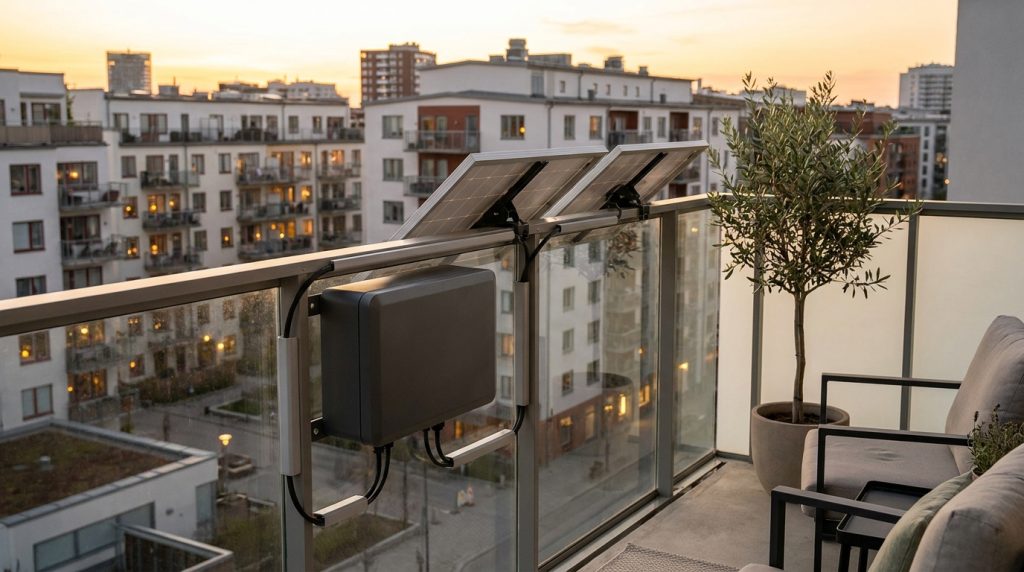
Balcony-mount storage can work for apartments and small balcony solar systems, but it should be treated as a compact self-consumption or light-backup option. It is not a substitute for a full whole-home ESS unless the manufacturer clearly supports that use.
Balcony-mount storage fits a different problem. It is usually for apartment users or small-space homeowners who want to store solar energy from a balcony PV setup. The U.S. Department of Energy explains that storage helps solar energy serve the home when sunlight changes or is no longer available.
This type of system can make sense for evening lights, a laptop, a router, and small daily loads. It should not be treated as the same thing as a large backup system in a utility room. A buyer who wants to run HVAC or whole-home loads from a small balcony battery is probably choosing the wrong format.
What to verify before using balcony storage
Before buying balcony storage, check the practical limits first. Apartment rules can be stricter than product marketing pages. You may need approval from the building, landlord, or local authority before installing panels, routing cables, or placing equipment outdoors.
Use this checklist before asking for a quote:
- Is balcony solar allowed in your building?
- Is the battery rated for the intended location?
- Does the product show an IP rating?
- Can cables be routed safely?
- Does the inverter support the setup?
- What loads can the battery actually support?
- Is the system designed for outdoor temperature swings?
If the main goal is solar self-consumption, read more about ESS for solar PV before choosing a format.
Which option is best by living situation?
The best option depends on where the system will live and what loads it must support. A battery placed on a balcony, mounted on a garage wall, or installed in a utility room has different limits. For resilience planning, the U.S. Department of Energy notes that solar with storage can support islanded operation when designed for that role.
| Living situation | Best-fit option | Why it fits | What to verify | What to avoid |
|---|---|---|---|---|
| Apartment with balcony | Balcony-mount storage | Fits small-space solar and light backup | Building rules, IP rating, cable routing, inverter limits | Treating it as whole-home backup |
| Townhome | Wall-mount storage | Saves floor space and keeps the system compact | Wall strength, clearance, load target | Choosing a wall unit with no expansion plan |
| Single-family garage | Wall-mount or stackable rack | Both may work depending on load size | Panel location, temperature, service access | Picking by appearance only |
| Single-family utility room | Stackable rack | Better for capacity growth and service access | Floor space, ventilation, inverter capacity | Oversizing without a load plan |
| Off-grid cabin | Stackable rack | Better for future loads and seasonal growth | Solar input, battery expansion, backup loads | Relying on a small compact system for heavy loads |
A townhome owner with limited floor space may be better served by a wall-mount unit. A single-family homeowner with a utility room and future expansion plans may be better served by a stackable rack. The format should follow the space and load plan.
What specs should you compare before requesting a quote?
Compare usable capacity, output power, installation rating, inverter compatibility, expansion limits, warranty, and monitoring before choosing a home storage format. Product shape alone does not tell you whether the system can run your actual loads.
A neat product photo is not enough. If the datasheet does not show usable kWh, IP rating, inverter compatibility, cooling method, and expansion limit, the buyer is not ready to compare quotes. Ask for those values before choosing between wall-mount, stackable rack, or balcony-mount storage.
Use this buyer checklist:
- Usable capacity in kWh
- Continuous output power
- Peak output power
- Supported inverter brands or protocols
- CAN or RS485 communication
- Indoor or outdoor rating
- IP rating
- Noise level
- Cooling method
- Operating temperature range
- Expansion limit
- Warranty terms
- Cycle life
- App monitoring
- Service clearance
- Certification and transport documents
Smart monitoring matters because storage is not a set-and-forget product. A clear app can help you see battery state, charging, discharge, and fault alerts. If remote control is part of your decision, review the role of a smart storage app.
There is also a delivery side to battery products. Lithium batteries are regulated for transport, and the Pipeline and Hazardous Materials Safety Administration explains that lithium batteries must follow hazardous materials transport rules when shipped in commerce. For homeowners, this mainly means documentation can affect lead time and delivery handling.
What should you avoid when choosing a home power storage solution?
Do not buy based only on nominal capacity. Usable capacity, output power, inverter match, and load type matter more than a large number on a product card. A battery may store enough energy on paper but still fail to support the appliances you expect during backup.
Avoid using balcony storage as a whole-home backup system unless the product is clearly designed for that purpose. It works best for small-space solar self-consumption and light backup. If you need to run high-demand appliances, start with load sizing and system design instead of forcing a compact product into the wrong role.
Also avoid choosing rack storage just because it looks more serious. A stackable rack system needs floor space, service access, and better planning. If your home only needs moderate backup and has a suitable wall near the panel, wall-mount storage may be the cleaner choice.
Common mistakes to avoid:
- Comparing nominal kWh instead of usable kWh
- Ignoring inverter compatibility
- Skipping IP rating checks
- Assuming all LiFePO4 systems are the same
- Buying for future expansion without confirming the expansion limit
- Choosing balcony storage for heavy loads
- Forgetting service access and clearance
What is the next step after choosing the product type?
After choosing the likely format, request a quote with your home type, available space, target loads, solar setup, and expansion plan. Ask the supplier to confirm datasheet values instead of assuming capacity, IP rating, noise, or inverter compatibility.
Once you know the format, prepare a simple request for the supplier or installer. Include your living situation, available wall or floor space, solar status, target backup loads, preferred location, and whether you want to expand later. Photos of the panel area or balcony can also help the team respond more accurately.
Then ask for the missing technical details. You need usable kWh, output power, IP rating, noise, cooling method, inverter compatibility, communication protocol, warranty, and certification details. If you need a wider system explanation before sizing, use this home energy storage guide for the broader ESS path.
A good quote request should include:
- Home type and installation location
- Available wall, floor, or balcony space
- Existing solar or planned solar setup
- Backup loads you care about
- Expansion goal
- Required datasheet values
Getting the Next Step Right
The right home power storage solutions should match your space before they match your wish list. Balcony-mount systems fit small solar and apartment use. Wall-mount systems fit compact homes with suitable walls. Stackable rack systems fit larger backup plans, utility rooms, and off-grid growth.
Before choosing, send your home layout, target loads, and solar details to the supplier. Ask for the datasheet, not only a product image. That one step can prevent most sizing, installation, and compatibility mistakes.
Frequently Asked Questions
What is the main difference between wall-mounted and rack-mounted batteries?
Wall-mounted batteries save floor space and suit compact residential installations. Rack-mounted or stackable systems are better when the homeowner needs higher capacity, easier expansion, and structured service access in a utility room or equipment space.
How does the installation location influence the right choice?
Installation location affects space, ventilation, service access, weather exposure, and cable routing. A balcony, garage wall, or utility room can point to completely different storage formats even when the battery chemistry is similar.
Which inverters are compatible with wall-mounted batteries?
Wall-mounted batteries usually need a compatible hybrid inverter or approved inverter communication protocol. The buyer should confirm CAN, RS485, voltage range, and brand compatibility from the battery and inverter datasheets before purchase.
How does the modular expansion of rack-mountable batteries work?
Rack or stackable systems expand by adding approved battery modules within the supported system limit. Expansion still depends on inverter capacity, BMS support, cabinet design, wiring, and manufacturer rules.
What is BESS?
BESS means Battery Energy Storage System. In a home setting, it usually includes battery modules, a BMS, an inverter or inverter connection, monitoring, protection devices, and wiring that stores electricity for later use.
How many batteries does it take to power a house with solar?
The number depends on daily energy use, critical loads, usable battery capacity, and whether the goal is light backup or whole-home backup. A supplier should size this from load data, not from home size alone.
How much does a residential energy storage system cost?
Cost depends on battery capacity, inverter needs, installation complexity, backup panel work, certifications, and local labor. This article should not give a fixed price unless the supplier provides a verified quote range.

-

 OEM ODM Home Energy Storage Manufacturer for Stackable Home Battery Solutions
2026-08-20
-
 High-Rate Discharge in Data Center UPS Battery Backup Systems Explained
 -
 LiFePO₄ RV Battery 48V System Design: Battery, Inverter, Solar and DC Load Integration
2026-08-19
-
 51.2V LiFePO₄ Server Rack Batteries: 100Ah Capacity, Energy Output and Runtime
2026-08-18
-
 51.2V 100Ah LiFePO₄ Battery for Inverter in Solar Energy Storage Systems
2026-08-17
Share this:





.svg)






-899.svg)


