




Home ESS for Solar PV: Adding a Battery Smartly
A home ESS solar energy storage system is worth adding to existing solar when export credits are low, time-of-use rates make evening grid power expensive, or outages happen often. Start by checking your net-metering rules, evening load, and backup needs. Then compare AC-coupled retrofit, hybrid inverter replacement, and DC-coupled design before sizing the battery.
If your solar panels already produce more power than you use during the day, a battery may look like the next obvious upgrade. It isn’t always that simple. The smart move depends on how your utility values exported solar, when your home uses electricity, and how much backup power you need during outages. Use this guide to decide whether adding storage now makes practical and financial sense.
Should you add a home ESS solar energy storage system to existing solar?
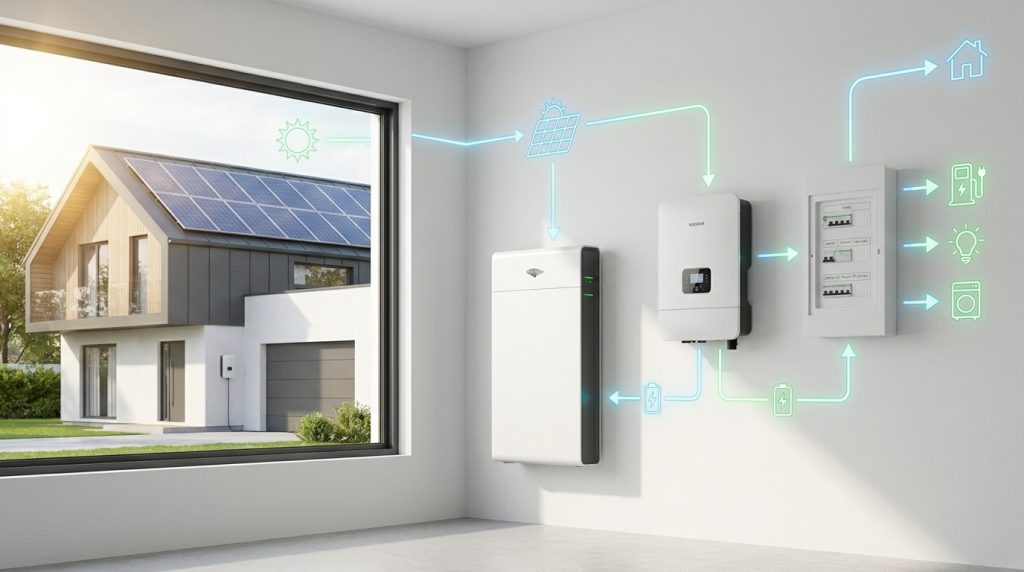
A home ESS solar energy storage system is worth adding when stored daytime solar is more valuable than exported solar, evening electricity is expensive, or outages are frequent. It is less compelling when net metering is generous and backup power is not important.
A battery is not automatically the next step after solar. It works best when your exported solar is undervalued, your evening grid power is expensive, or outages create real household risk. If your current solar plan still gives strong credit for exported power, the payback may be slower.
For a broader setup view, keep this storage setup guide open as you compare your options.
| Decision factor | Add battery now | Wait | Ask installer first |
|---|---|---|---|
| Export credit | Low credit for exported solar | Full retail net metering still applies | Rules are changing soon |
| Time-of-use rates | Evening power is much higher | Flat rate all day | Tariff details are unclear |
| Outage frequency | Several outages per year | Rare short outages | Need medical or work backup |
| Inverter status | Compatible or easy retrofit | New solar system already optimized | Old inverter may need replacement |
| Budget | Clear use case and payback path | Savings case is weak | Incentives or rebates need checking |
Solar storage can help shift solar power into hours when panels are not producing, which is one reason the U.S. Department of Energy describes storage as useful for matching solar supply with demand. A battery makes the most sense when that shift creates real value for your home. Read more on solar energy and storage basics.
What changed in your net-metering or export-credit rules?
If exported solar is credited far below the price you pay later, a battery can turn low-value midday exports into higher-value evening self-consumption. If exported kWh still offset imported kWh at full retail value, payback usually gets harder.
Net metering is one of the first numbers to check. If your utility gives you strong credit for excess solar, sending power to the grid may already work well. If your export credit is low, storing solar for your own evening use can become more attractive.
Think of the battery as a value-shifting tool. It stores daytime solar that may earn a small credit and uses it later when grid power costs more. If you need a plain component breakdown before comparing rates, review this ESS system anatomy.
| Your rule situation | What it means | Battery impact |
|---|---|---|
| Full retail net metering | Exported power offsets later use at a strong value | Battery payback may be weaker |
| Low export credit | Midday solar is sold cheaply | Battery self-consumption becomes stronger |
| New export limits | More solar may be wasted or underpaid | Battery may protect solar value |
| Unclear tariff | Savings are hard to estimate | Get the rate sheet before buying |
This is why two homes with the same PV array can make different decisions. The system with poor export compensation may benefit from storage. The system with strong credit may get better value from waiting or upgrading only for backup.
Do your time-of-use rates make stored solar valuable?
Time-of-use rates improve battery economics when peak evening electricity is much more expensive than midday or off-peak power. The bigger the rate spread and evening load, the more useful stored solar becomes.
Time-of-use rates charge different prices at different times. If your utility charges more in the evening, a battery can store daytime solar and discharge when your home would otherwise buy expensive grid power. The U.S. Department of Energy notes that battery storage can help solar customers use stored energy when rates are higher or during outages.
Here is a simple example. A family uses 6 kWh between 5 pm and 10 pm. If peak power costs $0.22/kWh more than the value of exported solar, the daily shifted value is:
6 kWh x $0.22 = $1.32 per day
That is not the full payback answer, because real systems lose some energy during conversion and solar output changes by season. Still, this quick math shows whether the rate spread is large enough to care about. If the spread is tiny, battery savings may depend more on outage protection than bill reduction.
How much does outage frequency change the decision?
Outages can justify a battery even when bill savings alone are modest. Size for the loads that truly matter first: refrigerator, lights, router, medical devices, security, and selected outlets.
Backup value is different from payback value. A battery may not return its full cost through bill savings, yet still be worth it for a home that loses power often. The DOE explains that solar-plus-storage can support resilience by helping a home continue operating during outages when properly designed.
Critical-load backup is often smarter than whole-home backup. It keeps the system smaller, reduces cost, and stretches stored energy longer. Start with a simple backup load planning list before asking for quotes.
Use this checklist first:
- Refrigerator or freezer
- Wi-Fi router and modem
- Key lights
- Phone and laptop charging
- Medical devices
- Security system
- Selected kitchen outlets
- Well pump or sump pump, if needed
Example: a 10 kWh usable battery keeps 20% reserve. That leaves 8 kWh for outage use. If critical loads average 0.8 kW, rough backup time is:
8 kWh / 0.8 kW = 10 hours
That estimate is not a promise. Actual runtime depends on load spikes, battery settings, temperature, inverter output, and how much solar recharges the battery during the day.
Should you choose AC-coupled or DC-coupled battery retrofit?
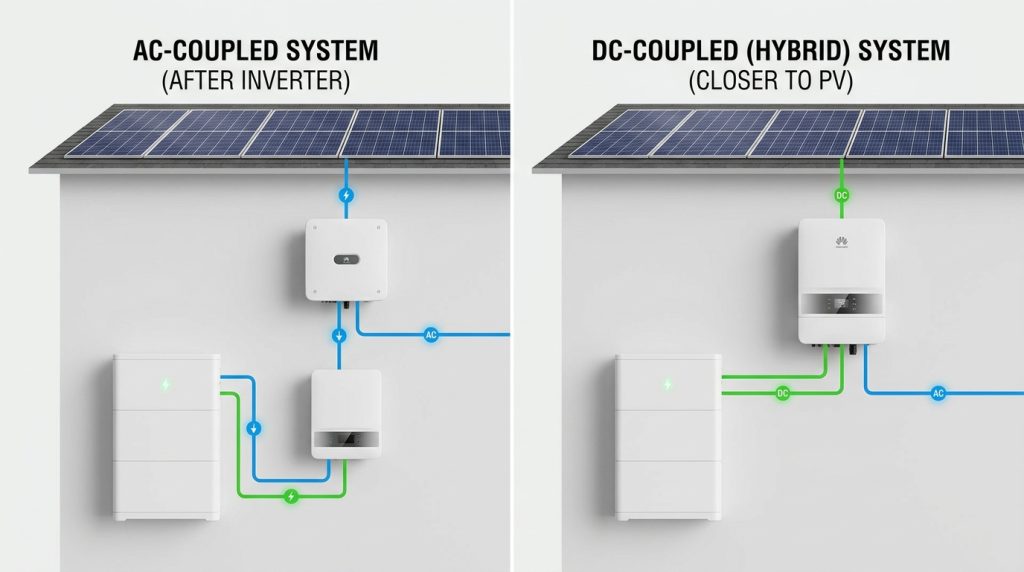
AC-coupled batteries are usually the simplest retrofit for existing solar because they work after the solar inverter. DC-coupled systems can reduce conversion losses, but they are usually cleaner for new installs or inverter replacement projects.
The right topology depends on your current inverter, wiring, backup goals, and budget. AC-coupled is not always the most efficient choice, but it is often the cleanest retrofit when your existing PV inverter still works.
| Option | Best fit | Main benefit | Main tradeoff |
|---|---|---|---|
| AC-coupled battery | Existing solar with working inverter | Easier retrofit | Extra conversion steps |
| DC-coupled battery | New solar or major redesign | Better solar-to-battery flow | More equipment changes |
| Hybrid inverter replacement | Old inverter or planned upgrade | Cleaner integrated design | Higher upfront work |
If these terms feel unclear, think of your home solar system as a chain of parts. Panels make DC power. Most homes use AC power. Inverters handle conversion. A battery may connect before or after that conversion point, which changes cost, efficiency, and retrofit complexity. This battery system parts guide can help when reviewing installer proposals.
When AC-coupled is the safer retrofit choice
Choose AC-coupled when your current solar inverter is still in good shape and the battery system can connect without replacing the core PV equipment. For example, if you have a 6 kW string inverter that is only 4 years old and not hybrid-ready, AC coupling can avoid removing a working inverter.
This path is common for battery add-ons because the new battery inverter manages storage separately from the existing solar inverter. The tradeoff is that energy may convert more than once before reaching loads or the battery.
When DC-coupled or hybrid replacement makes sense
DC-coupled storage can make sense when you are installing solar and battery together, or when your old inverter is near end of life. A hybrid inverter can manage solar, battery, and grid connection in one design.
For example, if your inverter is 10 to 12 years old or near warranty end, replacing it with a hybrid inverter may be cleaner than adding separate battery hardware. The better choice depends on quote details, permit rules, and backup expectations.
How should you size the battery to your existing PV array?
Start with evening and night usage, not PV size alone. A large solar array does not automatically mean you need a large battery. The right size depends on how much energy you want to shift, how much backup reserve you need, and how much power the battery inverter can deliver.
A battery has two numbers that matter most. Capacity, measured in kWh, tells you how much energy it can store. Power, measured in kW, tells you how much it can deliver at one time. The DOE’s solar storage basics explain why storage capacity and output both matter in solar-plus-storage systems.
Battery capacity in kWh
Use your utility bills, solar app, or home energy monitor to estimate evening and night consumption. Then decide whether the battery should cover only daily self-consumption or also keep a backup reserve.
A simple first-pass worksheet:
| Input | Example | Your number |
|---|---|---|
| Evening and night use | 8 kWh | |
| Desired backup reserve | 2 kWh | |
| Usable battery target | 10 kWh | |
| Nameplate battery needed | Depends on usable capacity |
Do not size from nameplate capacity alone. If a battery is sold as 10 kWh, the usable capacity may be lower depending on system settings, reserve, chemistry, and depth of discharge.
Battery power in kW
Power output decides what can run at the same time. A battery may have enough kWh for the night but still be unable to start or run several high-draw loads together.
List your must-run loads before buying. A fridge, lights, router, and laptop are simple. A water pump, air conditioner, electric oven, or EV charger can change the design fast. Review kW and kWh basics before comparing quotes.
What should a quick battery payback calculator include?

A quick payback calculator should compare battery cost against the value of energy shifted, incentives, and backup value. It should not promise exact savings. It should show whether the numbers are strong enough to continue.
The U.S. Department of Energy notes that battery storage can let solar customers store electricity for use when rates are higher or during outages. Use that idea as the base, then add your own tariff numbers.
| Calculator input | What to enter | Example |
|---|---|---|
| Installed battery cost | Final installed price after quote | $10,000 |
| Incentives or rebates | Tax credits, rebates, grants | $2,000 |
| Net cost | Installed cost minus incentives | $8,000 |
| Daily shifted energy | Solar moved to evening use | 8 kWh |
| Import rate | Evening grid price | $0.30/kWh |
| Export credit | Value of exported solar | $0.05/kWh |
| Value gap | Import rate minus export credit | $0.25/kWh |
| Daily value | Shifted kWh x value gap | $2.00 |
| Annual value | Daily value x 365 | $730 |
Low export credit scenario: a homeowner exports 8 kWh/day at $0.05/kWh but buys evening power at $0.30/kWh. The value gap is $0.25/kWh. Daily value is 8 x $0.25 = $2.00, and annual value is about $730 before losses and seasonal changes.
Then compare net cost to annual value:
$8,000 / $730 = about 11 years simple payback
This is only a rough screen. Battery reserve settings, degradation, round-trip efficiency, changing utility rates, outages, and seasonal solar output can all change the result.
What should you check before asking for battery quotes?
Before requesting quotes, collect your inverter model, solar production data, utility tariff, export credit, outage goals, and critical-load list. This prevents oversizing and helps installers propose the right retrofit topology.
A good quote starts with clear information. If you only ask for “a battery for my solar,” you may get oversized options, weak backup design, or equipment that does not fit your current inverter.
Use this quote-ready checklist:
- Current inverter brand, model, size, and age
- Solar array size in kW
- 12 months of utility bills
- Solar production history
- Export credit or net-metering details
- Time-of-use rate schedule
- Critical loads for backup
- Preferred backup reserve
- Available wall or floor space
- Permit and utility interconnection needs
- Battery safety certifications
- Installer experience with retrofits
Safety should not be treated as a small detail. The EPA says battery energy storage planning should consider siting, permitting, battery chemistry, monitoring, BMS, system integration, and current safety standards. UL also explains that UL 9540A is used to evaluate thermal runaway fire propagation in battery energy storage systems.
Before you move from research to quote review, use this home storage checklist to keep your questions organized.
Getting the Next Step Right
A home ESS solar energy storage system should solve a clear problem. That problem may be low export value, high evening rates, repeated outages, or a mix of all three. If none of those apply, waiting can be the smarter choice.
Your next step is simple: collect your tariff, solar production, evening load, inverter model, and backup load list. Then ask installers to compare AC-coupled retrofit, DC-coupled design, and hybrid inverter replacement. For broader system planning, use this home energy storage guide without repeating the full pillar decision process here.
Frequently Asked Questions
Can I add a battery to an existing solar system?
Yes, many existing solar systems can add battery storage, but the best method depends on your inverter, wiring, panel size, and backup goals. AC-coupled batteries are often the simplest retrofit, while DC-coupled options may require inverter changes.
What is a residential energy storage system?
A residential energy storage system is a home battery setup that stores electricity from solar panels or the grid for later use. It can support evening self-consumption, backup power, and lower grid reliance when designed around real household usage.
What is the difference between AC-coupled and DC-coupled systems?
AC-coupled systems connect battery storage after the solar inverter, which often makes retrofits easier. DC-coupled systems connect storage closer to the PV side and can reduce conversion losses, but they usually require compatible hybrid equipment.
How do I determine the appropriate size for a solar energy storage system?
Start with evening and night electricity use, then add any backup reserve you want during outages. Compare that target against usable battery capacity, inverter output, solar production, and your budget before choosing a system size.
Is battery storage worth it for homeowners?
Battery storage is most worthwhile when solar export credits are low, peak electricity rates are high, or outages are frequent. It may be less attractive if you still receive full retail net metering and rarely need backup power.
Do home batteries work without solar panels?
Yes, a home battery can charge from the grid and discharge during peak-price hours or outages. For a solar-first homeowner, the strongest value usually comes from storing excess daytime solar for evening use.
Are solar batteries safe?
Modern certified solar batteries are designed with BMS protection, thermal management, and electrical safeguards. Safety still depends on correct installation, code compliance, location, ventilation, and using systems tested to relevant ESS safety standards.

-

 OEM Residential Energy Storage Solutions: Passive vs. Active Cell Balancing
2026-09-30
-
 Smart Home Battery with BMS Communication: Cybersecurity and BMS Safety
 -
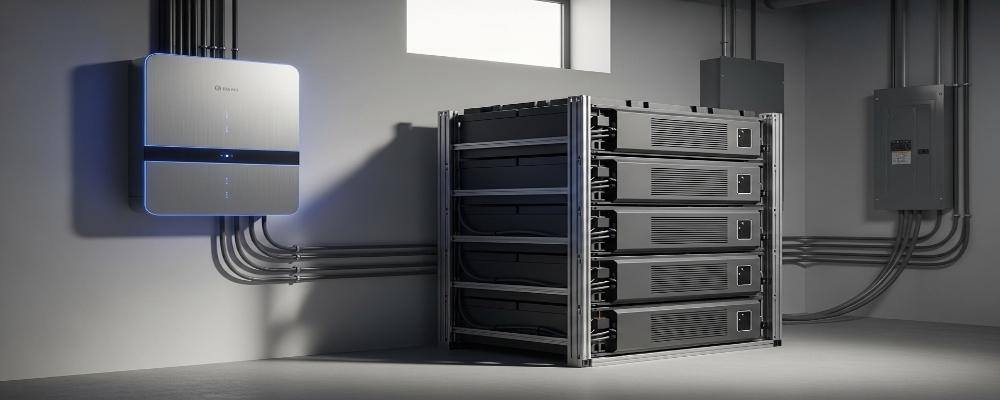 10kWh Home Battery Backup System: Is 90% DoD Better for Daily Solar Storage?
2026-09-29
-
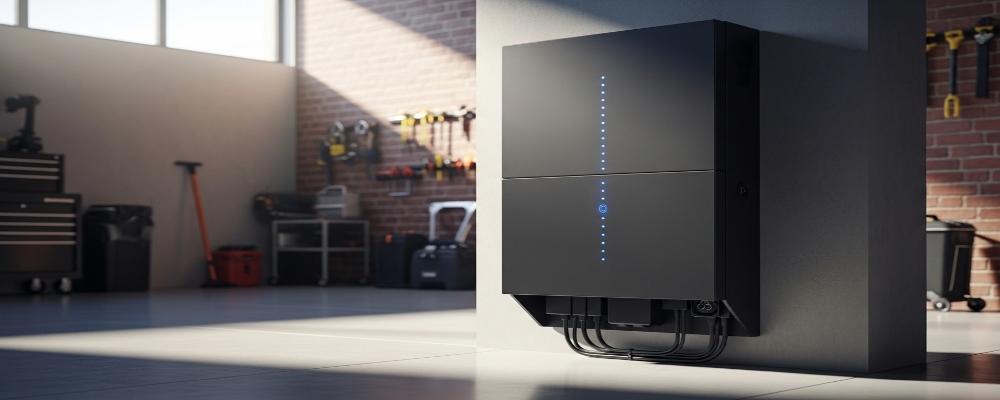 Integrated Home Energy Storage System 150–430V MPPT Design
2026-09-28
-
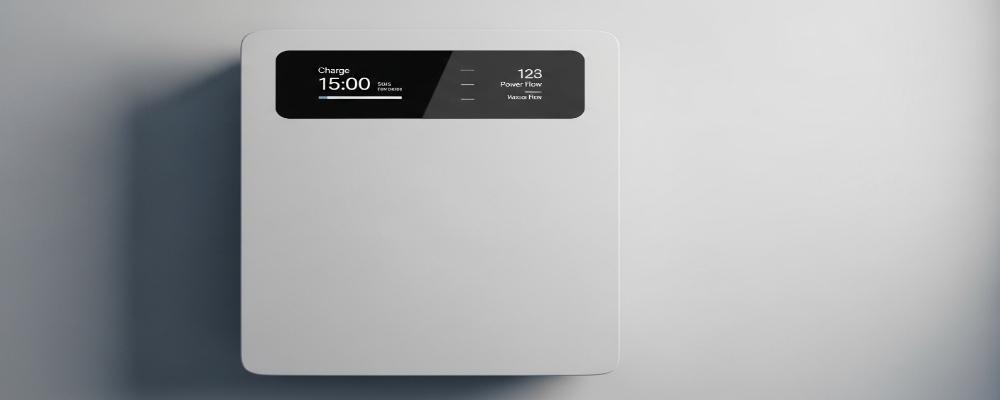 LiFePO₄ Residential Backup Battery SOC Accuracy in Parallel Systems
Share this:





.svg)






-899.svg)


