




Residential Energy Storage: Setup, Cost & Lifespan
A residential energy storage system is a professionally installed home battery that stores solar or grid electricity for outages, evening use, and time-of-use savings. In 2026, a realistic U.S. planning range is about $900-$1,400 per usable kWh before incentives, with many 13.5 kWh installs near $15,000. Expect a permit, qualified electrician, inspection, and a warranty-backed life of roughly 10-15 years.
If you are researching your first home battery, the big question is simple: what does it actually take to put a battery in your house? This guide explains the setup path, expected cost, battery lifespan, and 10-year ownership view so you can speak with an installer more confidently.
What does a residential energy storage system actually include?
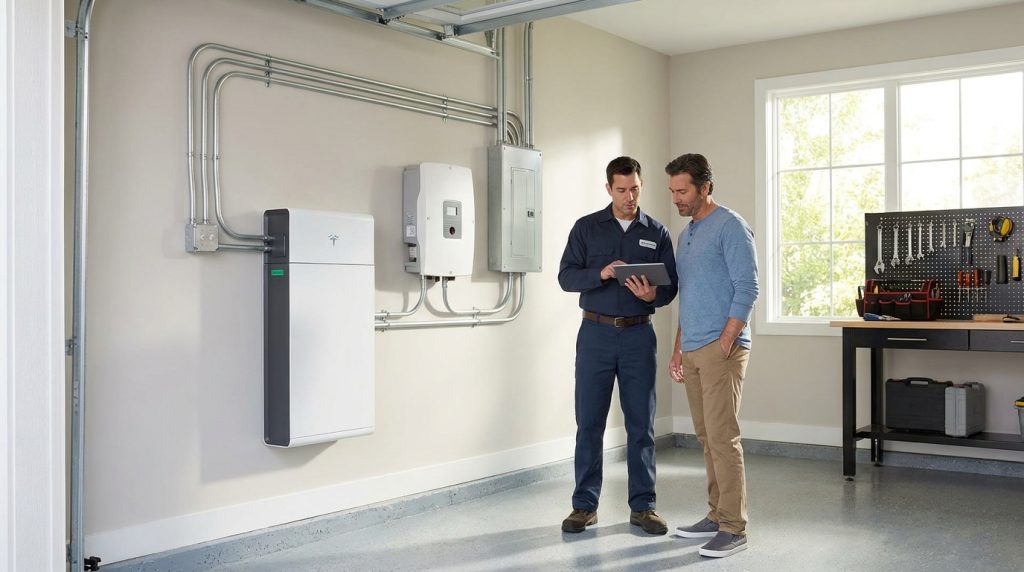
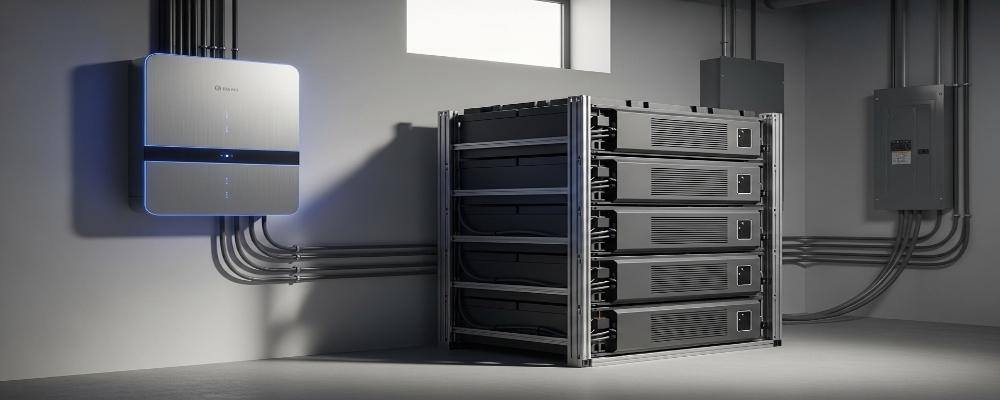
A residential energy storage system is a home battery setup that stores electricity from solar panels or the grid, then sends it back to selected home circuits when needed. The main parts are the battery, inverter, control system, wiring, and monitoring app.
A residential energy storage system is not just one battery box. It is a connected system that stores electricity, manages charging and discharging, and protects the home during normal operation or outages.
- Battery module: Stores electricity for later use.
- Inverter: Moves power between the battery, home, solar system, and grid.
- Battery management system: Helps manage charging, temperature, safety, and battery health.
- Energy management system: Controls when the battery charges and discharges.
- Monitoring app: Lets the homeowner track performance and stored energy.
- Critical-load panel: May be used to back up only selected circuits.
Some systems charge from solar panels. Others can charge from the grid. Many homeowners start with storage because they want backup power, better solar self-consumption, or more control during high electricity rate periods. For broader system basics, see VoltaLink’s home energy storage guide.
What has to happen before a battery is installed?
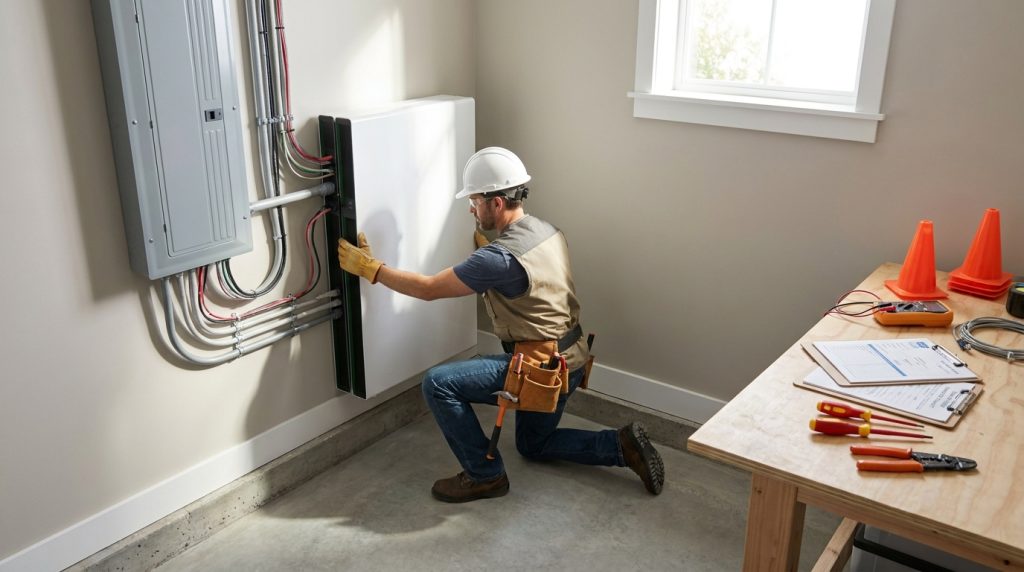
Before installation, an installer should review your loads, choose the battery location, design the electrical connection, file required permits, install the system with qualified electrical work, pass inspection, and commission the monitoring app.
A home battery install is usually a professional electrical project. The exact path depends on your home, local code, utility rules, battery type, and whether the system is connected to solar panels.
Typical quote-to-power-on checklist
- Home load review: The installer checks what you want to back up, such as lights, refrigerator, router, outlets, medical devices, pumps, or HVAC.
- Site placement check: The installer decides where the battery can be safely installed based on space, access, and local rules.
- Battery and inverter design: The quote should show battery capacity, inverter type, backup power rating, and connection method.
- Backup circuit selection: The homeowner chooses essential-load backup or a larger whole-home design.
- Permit filing: The installer should explain which permit steps are included.
- Utility paperwork: If required, the installer should handle or guide the interconnection process.
- Licensed electrical installation: Qualified electrical work connects the battery, inverter, panels, and backup circuits.
- Inspection: The system may need review before final approval.
- Commissioning: The installer tests operation, sets up monitoring, and explains the shutdown procedure.
- Warranty registration: The homeowner should confirm the warranty is active and service support is clear.
This process matters because the lowest equipment price is not the full project. A complete quote should include the battery, inverter path, electrical work, permitting, inspection support, commissioning, and warranty handoff.
How much does a home battery cost in 2026?
In 2026, a practical U.S. planning range for residential battery storage is about $900-$1,400 per usable kWh before incentives. A common 13.5 kWh system can land near $15,000 before incentives, but quotes vary by equipment, labor, and electrical upgrades.
For planning, do not compare only the hardware price. A residential energy storage system is priced as an installed project. EnergySage lists a 13.5 kWh battery benchmark near $15,228 before incentives, which equals about $1,128 per kWh before incentives.
Installed cost per kWh vs total project cost
| Cost item | What it means | Why it changes the quote |
|---|---|---|
| Battery capacity | Usable energy stored in kWh | Larger systems usually cost more, but cost per kWh may vary by brand and design. |
| Inverter setup | How the battery connects to solar, grid, and home circuits | Retrofits and hybrid designs may need different inverter paths. |
| Electrical work | Wiring, panel work, backup circuits, and safety equipment | Older homes or whole-home backup designs may need more work. |
| Permits and inspection | Local approval and final review | Rules depend on location and project type. |
| Installer labor | Design, installation, commissioning, and handoff | More complex projects take more time and expertise. |
| Incentives | Tax credits or local programs if eligible | Net cost can change, but eligibility must be verified for the home. |
A fair quote should show usable kWh, installation scope, warranty, electrical upgrades, and any assumptions about incentives. If the quote only lists battery hardware, it may not represent the full installed cost.
How big should the system be for essential loads or whole-home backup?
Answer: Most first-time homeowners should size for essential-load backup first, not whole-home backup. A smaller system can cover lights, refrigerator, router, outlets, and medical devices, while HVAC, pumps, and cooking loads may require a larger design.
Battery sizing starts with the loads you want to run and how long you want them to run. Usable capacity matters more than nameplate capacity because it shows how much stored energy you can actually use.
| Homeowner goal | Typical design direction | Decision point |
|---|---|---|
| Keep basic devices on during outages | Essential-load backup | Focus on refrigerator, lights, router, outlets, and medical devices. |
| Run HVAC or large appliances | Larger battery and higher power output | Ask whether the system can support startup loads and long outage use. |
| Use more solar energy at night | Solar-plus-storage design | Match battery size to daily solar production and evening use. |
| Reduce peak-rate grid use | Time-of-use strategy | Check utility rules, rate structure, and battery control settings. |
| Back up the whole home | Whole-home design | Expect higher cost, more design work, and clearer load management needs. |
The installer should explain whether the system is designed for backup duration, bill savings, solar self-consumption, or all three. A clear design goal prevents paying for capacity you do not need or expecting backup performance the system cannot deliver.
How long will the battery last before it needs replacement?
A residential home battery is usually planned around a 10-15 year ownership window, but the real limit is the warranty, cycle rating, throughput limit, and remaining capacity guarantee. The quote should state these numbers clearly.
Battery lifespan should not be judged by years alone. A home battery ages through time, charging cycles, temperature, depth of discharge, and total energy throughput. That is why the written warranty is more important than a simple marketing claim.
LiFePO4 batteries are commonly chosen for home storage because they are associated with safety and long cycle life. However, the article should not rely on chemistry claims alone. The buyer should compare the warranty period, cycle rating, usable capacity, capacity retention, and service support.
- What is the warranty period in years?
- What cycle rating is stated?
- Is there a throughput limit?
- What capacity is guaranteed at the end of the warranty?
- Who handles service if the system fails?
- Is remote monitoring included?
A battery may still work after the warranty period, but planning should be based on written terms. For a homeowner, the best quote is the one that makes lifespan, capacity retention, and service responsibility easy to understand.
What will it cost over 10 years?

Upfront price is only one part of the decision. A 10-year total-cost-of-ownership view helps compare quotes, incentives, service scope, and possible savings without pretending every home has the same utility rates or outage value.
Example 10-year TCO table for a 13.5 kWh system
| Cost or value line | Example 13.5 kWh system | Formula or source | Timing | Homeowner note |
|---|---|---|---|---|
| Installed battery system | $15,228 before incentives | EnergySage benchmark | Year 0 | Use as a planning reference, not a guaranteed quote. |
| Cost per usable kWh | About $1,128 per kWh | $15,228 ÷ 13.5 kWh | Year 0 | Compare this across quotes only if usable capacity is clear. |
| Electrical or backup panel work | Variable | Installer quote | Year 0 | May change if the home needs panel work or selected backup circuits. |
| Permits and inspection | Variable or included | Installer quote | Year 0 | Confirm whether these are included in the quoted price. |
| Incentives or tax credit | Verify locally | ENERGY STAR and local program rules | Year 0 or tax filing | Do not subtract incentives until eligibility is confirmed. |
| Monitoring and maintenance | Variable | Installer or manufacturer terms | Years 1-10 | Ask whether app access, service checks, or remote support have fees. |
| Bill savings | Variable | Utility rate and usage pattern | Years 1-10 | Depends on time-of-use rates, solar export value, and battery settings. |
| Outage value | Variable | Homeowner situation | Years 1-10 | Higher value if outages affect work, health devices, food storage, or comfort. |
| 10-year ownership view | Installed cost minus verified incentives and value | Home-specific calculation | Years 0-10 | Use this to compare quotes, not to assume one universal payback. |
This table should stay honest. Some homes will value backup more than bill savings. Others will only make sense if local incentives, time-of-use rates, or solar self-consumption improve the economics.
When is a residential ESS a good decision, and when is it not?
A residential ESS makes the most sense when outages are costly, time-of-use rates are high, solar export value is low, or critical loads need backup. It is weaker when grid power is cheap, reliable, and incentives are limited.
A residential energy storage system is not automatically the best investment for every home. It works best when the battery solves a real problem, such as backup power, high evening rates, low solar export value, or critical-load protection.
| Situation | Decision signal | Best next step |
|---|---|---|
| Frequent outages | Strong fit | Ask for essential-load and whole-home backup options. |
| High time-of-use rates | Possible strong fit | Ask the installer to model charge and discharge timing. |
| Existing solar with low export value | Possible strong fit | Compare AC-coupled and compatible retrofit options. |
| Reliable grid and low electricity rates | Weaker fit | Focus on backup value, not only bill savings. |
| Need to power central AC during outages | Needs careful design | Ask for power rating, startup load support, and cost impact. |
Whole-home backup is not always the best first choice. It works when large loads truly need backup, but essential-load backup is often safer for the budget. For broader background, VoltaLink’s home storage basics can help explain the system role before comparing products.
What should you ask the installer before signing?
The installer quote should make the system design easy to understand. If the quote is vague, ask for the missing details before comparing price. A cheaper quote can become expensive if it excludes permits, panel work, inspection support, commissioning, or warranty registration.
- What is the usable battery capacity in kWh?
- What are the continuous and peak power ratings?
- Which circuits will be backed up?
- Is this essential-load backup or whole-home backup?
- What battery chemistry is used?
- What is the warranty period?
- What cycle rating, throughput limit, or capacity retention guarantee is included?
- Are permit filing, utility paperwork, and inspection support included?
- Will the system need panel work or a critical-load panel?
- Is monitoring included, and are there any app or service fees?
- Who handles warranty claims and service visits?
- What shutdown procedure should the homeowner know?
The goal is not to become an electrician. The goal is to make sure the quote explains capacity, backup performance, safety, installation scope, and long-term support clearly.
FAQ
What is a residential energy storage system?
A residential energy storage system is a home battery setup that stores electricity for later use. It can charge from solar panels or the grid, then supply power during outages, peak-rate hours, or evening demand.
How long do home batteries last?
Most modern home batteries are planned around a 10-15 year service window. The exact life depends on chemistry, cycle rating, depth of discharge, temperature, usage pattern, and the written warranty.
Can a home battery power the whole house?
A home battery can power a whole house only if it is sized for the home’s loads and power demand. Many systems are designed for essential loads instead, such as lights, refrigerator, router, outlets, and medical devices.
Do home batteries work without solar panels?
Yes, home batteries can work without solar panels if they are designed to charge from the grid. The value depends on outage frequency, time-of-use rates, utility rules, and whether incentives apply without solar.
Are solar batteries safe?
Solar batteries can be safe when they are certified, properly installed, permitted, inspected, and placed according to local code. The homeowner should ask for the safety listing, battery chemistry, installation location, and shutdown procedure before signing.
What is the difference between AC-coupled and DC-coupled systems?
AC-coupled systems connect the battery on the home’s AC electrical side, often useful for retrofits. DC-coupled systems connect closer to the solar DC side and are often considered during new solar-plus-storage designs.
How big will my energy storage system be, and how is that decided?
Battery size is decided by the loads you want to back up, how long you want backup power, and whether solar can recharge the battery. Usable capacity, not only nameplate capacity, should guide the quote.

-

 OEM Residential Energy Storage Solutions: Passive vs. Active Cell Balancing
2026-09-30
-
 Smart Home Battery with BMS Communication: Cybersecurity and BMS Safety
 -
 10kWh Home Battery Backup System: Is 90% DoD Better for Daily Solar Storage?
2026-09-29
-
 Integrated Home Energy Storage System 150–430V MPPT Design
2026-09-28
-
 LiFePO₄ Residential Backup Battery SOC Accuracy in Parallel Systems
Share this:





.svg)






-899.svg)


