




Home Battery Energy Storage: 2026 Buyer Reference
Home battery energy storage helps homeowners store solar or grid electricity for backup power, evening use, and better energy control. In 2026, compare systems by chemistry, usable capacity, power output, topology, certifications, warranty terms, and monitoring. LiFePO4 is the practical default for many homes, but the right system depends on backup loads, solar setup, local rates, and installer compatibility.
Buying a home battery is no longer a simple “how many kWh?” decision. A good system needs the right chemistry, inverter match, backup design, safety documents, and warranty structure. This reference gives you the main decisions in one place, then points you to deeper guides when sizing, topology, or system design needs more detail.
What is home battery energy storage in 2026?
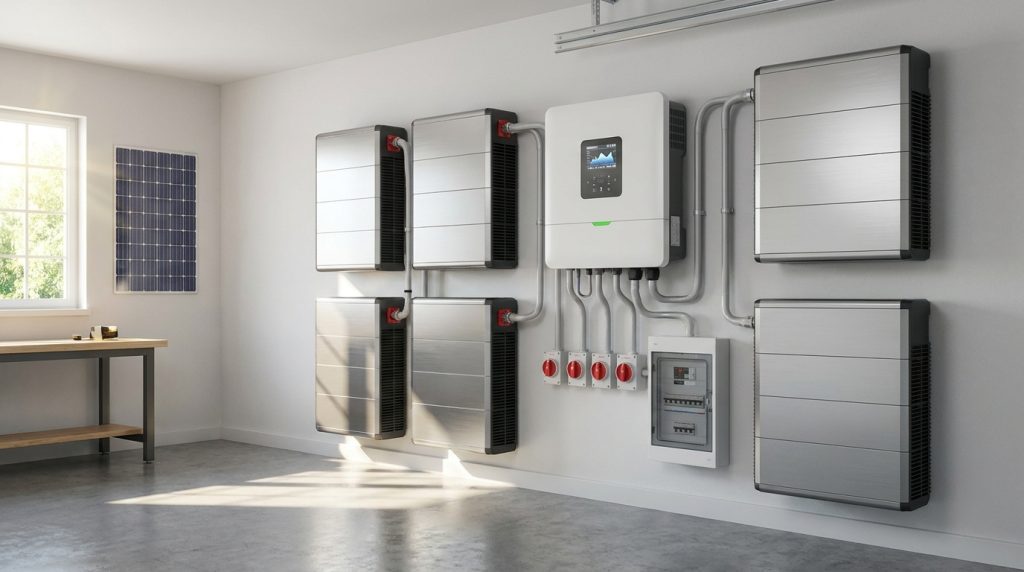
Home battery energy storage is a residential system that stores electricity from solar panels or the grid for later use. In 2026, buyers should compare chemistry, usable capacity, power output, inverter topology, safety certification, and warranty terms before choosing.
A home battery system usually includes battery modules, a battery management system, an inverter or power conversion system, and an energy management system. The battery stores electricity. The inverter converts electricity between DC and AC power. The control system decides when to charge, discharge, or protect the battery.
The U.S. Department of Energy explains that storage captures energy, keeps it for later, and releases it when needed through measures such as capacity and power output. A full home setup can be paired with solar, grid charging, or both. For a wider system overview, read VoltaLink’s home energy storage system guide.
| Component | What it does | Buyer check |
|---|---|---|
| Battery modules | Store electricity | Ask for usable kWh, not only nameplate kWh |
| BMS | Protects cells from unsafe operation | Check temperature, current, and voltage protection |
| Inverter or PCS | Converts power for home use | Confirm solar and grid compatibility |
| EMS | Controls charge and discharge behavior | Check app, monitoring, and mode settings |
| Backup panel | Runs selected loads during outages | Confirm which circuits are protected |
Which battery chemistry should you choose?
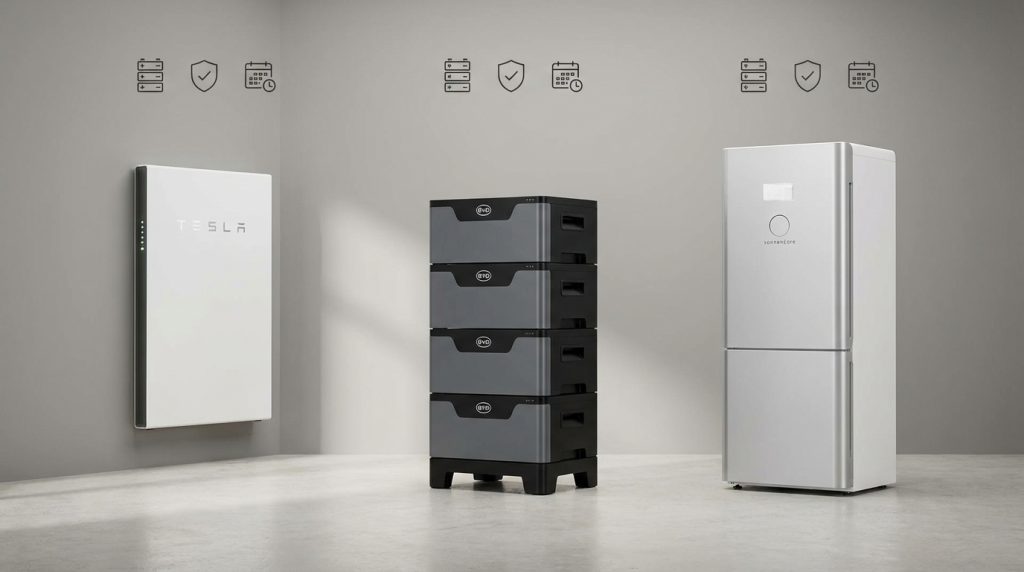
For most home battery buyers, LiFePO4 is the safest practical default because it balances cycle life, thermal stability, and daily-use performance. Lead-acid only makes sense for low-budget, low-cycle use, while flow and sodium-ion remain more specialized.
Chemistry affects safety, lifespan, weight, price, warranty, and daily cycling performance. Many residential systems now focus on lithium-based batteries, especially LiFePO4, also called LFP. Still, chemistry alone should not decide the purchase. A poorly documented LFP system can be a worse choice than a better-certified system with strong inverter support.
LiFePO4 should be the default shortlist for most residential buyers, but certification and inverter matching matter more than cell claims. Ask for system-level documents, not only marketing claims about the battery cell.
| Chemistry | Best fit | Avoid when | Safety note | Warranty signal |
|---|---|---|---|---|
| LiFePO4 / LFP | Daily solar cycling, backup, long service life | You need the lowest upfront cost only | Strong thermal stability compared with many lithium options | Look for cycle count, throughput, and retained capacity |
| NMC lithium-ion | Compact systems where space matters | You want the strongest safety margin for home storage | Needs strong BMS and safety design | Check heat management and warranty exclusions |
| Lead-acid | Low-budget, occasional backup | Daily cycling or deep discharge use | Mature, but heavier and shorter-lived | Often weaker for long daily cycling |
| Flow battery | Larger or niche storage use | Small home installs with limited space | Different risk profile from lithium | Check service network and system support |
| Sodium-ion | Emerging storage option | You need mature residential availability now | Promising, but less common in home systems | Ask for proven deployment and warranty clarity |
How much capacity and power output do you really need?
Choose capacity from the loads you need to run and the hours you need them running. Capacity in kWh decides runtime, while output in kW decides whether the battery can start and support appliances at the same time.
Think of capacity as the tank and power output as the pipe. A 10 kWh battery stores energy, but its kW rating decides what it can run at once. The DOE’s storage basics explain this split between energy capacity and power capacity, which is one of the most important buyer checks.
Capacity is the tank, power output is the pipe
A critical-load backup home might only need a fridge, Wi-Fi router, lights, phone charging, and a few outlets. If those loads use about 3 to 4 kWh per day, a 10 kWh battery may cover roughly two days before you count solar recharge, reserve limits, and conversion losses.
A high-surge home is different. If the buyer wants air conditioning, a water pump, microwave, and kitchen loads, kWh is not enough. The battery must also have enough continuous and surge kW output to start and run those loads safely.
| Buyer situation | Capacity focus | Power output focus | Next step |
|---|---|---|---|
| Basic outage backup | 5 to 10 kWh range | Fridge, lights, router, small outlets | List essential loads first |
| Solar self-consumption | 10 to 15 kWh range | Evening home demand | Compare evening usage with solar surplus |
| Whole-home backup | Higher capacity | High continuous and surge output | Ask installer for load study |
| Existing solar owner | Match battery to surplus generation | Match inverter limits | Check retrofit options |
For deeper sizing steps, use VoltaLink’s battery sizing guide.
Which system topology fits your home?
Existing solar homes usually start by checking AC-coupled retrofit options, while new solar-plus-storage projects often compare hybrid or DC-coupled systems. All-in-one systems reduce compatibility work, but modular systems give more room to expand later.
Topology means how the battery, inverter, solar panels, grid, and home loads connect. Clean Energy Reviews explains that AC-coupled and DC-coupled batteries fit different installation situations. For buyers, the real question is simple: are you adding storage to an existing solar system, or building a new solar-plus-storage setup?
All-in-one systems are convenient, but they are not automatically better. They work well when compatibility and simple installation matter most. Modular systems are safer when you expect future expansion or want more flexibility across battery cabinets, inverter choices, and service plans.
| Topology | Best fit | Watch out for |
|---|---|---|
| AC-coupled battery | Adding storage to existing solar | Extra conversion steps and inverter limits |
| DC-coupled battery | New solar-plus-storage design | Needs careful design from the start |
| Hybrid inverter system | Solar, battery, grid, and backup in one plan | Compatibility must be confirmed early |
| All-in-one ESS | Clean installation and simpler matching | Less flexibility if expansion needs change |
| Modular battery system | Future capacity growth | More planning around cables, cabinets, and controls |
For buyers comparing full system layouts, VoltaLink’s integrated storage design guide is the natural next read.
What certifications and safety checks should be non-negotiable?
Do not buy a home battery on chemistry claims alone. Ask for system-level safety certification, battery safety test documentation, inverter compatibility proof, installation manual, and warranty terms before purchase.
Safety depends on chemistry, battery management, enclosure design, installation, inverter behavior, spacing, and local code. NYSERDA describes battery energy storage systems as including cells, BMS, power conversion, energy management, cooling, and communication parts. That means one weak part can affect the whole system.
UL 9540 and UL 9540A are common safety references in North American battery storage discussions. UL describes UL 9540A as a test method related to thermal runaway fire propagation in battery energy storage systems. IEC 62619 covers safety requirements for secondary lithium cells and batteries used in industrial and stationary applications.
- Ask whether the complete system, not only the cell, has safety documentation.
- Request UL 9540, UL 9540A, IEC 62619, or market-relevant test documents.
- Confirm inverter communication protocol and approved battery list.
- Ask for installation clearances, shutdown procedure, and user manual.
- Confirm local electrical and fire-code requirements with the installer.
- Check whether warranty depends on approved installation conditions.
- Ask how the BMS handles temperature, current, overcharge, and short-circuit events.
How should you compare warranty, cycle life, and usable capacity?
A home battery warranty should be read as a performance promise, not only a number of years. The strongest comparison looks at years, cycle count, throughput, retained capacity, usable kWh, and exclusions together.
Nameplate capacity can be misleading because the usable capacity may be lower. A battery advertised as 10 kWh may not allow the full 10 kWh to be discharged every day. That limit can protect lifespan, but buyers should know the real usable number before comparing price.
| Warranty item | What it means | What to ask |
|---|---|---|
| Warranty years | Calendar coverage period | Does coverage change after heavy cycling? |
| Cycle count | Number of charge and discharge cycles | What depth of discharge is assumed? |
| Throughput | Total energy delivered over life | Is there a kWh throughput cap? |
| Retained capacity | Expected capacity after use | What percentage is guaranteed? |
| Usable capacity | Energy you can actually use | Is the quoted capacity nameplate or usable? |
| Exclusions | Conditions that void coverage | Does installation, temperature, or inverter choice affect it? |
A big battery is not always the best battery. It works when you have enough solar surplus or a real backup need. A smaller system is safer financially when your evening load is modest and your main goal is basic outage protection.
What should you verify before asking for a quote or importing a system?
Before asking for a quote, verify the battery’s fit with your loads, inverter, installation site, and documents. This step prevents the most common mistakes: wrong voltage, weak backup design, unclear warranty, missing certificates, and poor communication between inverter and battery.
For B2B or import buyers, add one more layer. Request HS classification guidance, safety certificates, battery labels, test reports, warranty terms, and destination-market compliance documents before shipment. Keep this check practical. A customs issue should not be discovered after the battery has already left the factory.
Quote-Ready Checklist
| Step | What to confirm | Why it matters |
|---|---|---|
| 1 | Backup goal | Decides whether you need critical-load or whole-home backup |
| 2 | Usable kWh | Shows real runtime, not marketing capacity |
| 3 | Continuous and surge kW | Confirms appliance startup and peak load support |
| 4 | Battery voltage | Prevents mismatch with inverter design |
| 5 | Inverter communication | Allows safe charging, discharging, and monitoring |
| 6 | Safety documents | Supports installer approval and buyer trust |
| 7 | Warranty terms | Shows real coverage beyond years |
| 8 | Installation location | Affects temperature, spacing, and service access |
| 9 | B2B shipment documents | Reduces import and compliance risk |
To compare options before the quote stage, read VoltaLink’s storage options compared guide.
When is a home battery worth it, and when is it not?
A home battery is most worth it when you have outages, time-of-use rates, low solar export value, or critical loads to protect. It is less compelling when your utility gives strong net metering and your outage risk is low.
DOE Energy Saver explains that solar-plus-storage can support power use beyond sunny hours and can improve resilience when designed for that role. The value is strongest when the battery solves a real problem, such as evening grid costs, frequent outages, or poor export credit.
A solar self-consumption home is a common case. A home with a 6 kW solar system may export power at midday and buy grid electricity in the evening. The buyer should compare 10 to 15 kWh systems, then check whether the evening demand and solar surplus justify that battery size.
| If your situation is… | Battery value is usually… | Buyer action |
|---|---|---|
| Frequent outages | Strong | Plan critical loads and backup duration |
| Time-of-use rates | Strong when evening rates are high | Compare charge and discharge windows |
| Low solar export credit | Strong for self-consumption | Match battery size to surplus solar |
| Strong net metering | Weaker for savings alone | Focus on resilience, not payback |
| Low household usage | Mixed | Avoid oversizing |
| Need app-based control | Stronger with monitoring | Review smart storage monitoring options |
Solar panels alone usually do not power a home during grid outages unless the system has the right inverter and storage setup. DOE’s solar resilience guidance explains why solar and storage need proper configuration for outage support.
What should you read next before choosing a system?
The best next guide depends on the question blocking your decision. Use this article as the reference point, then move into the deeper topic that matches your home, quote, or design problem.
| Your next question | Read this next | Why it helps |
|---|---|---|
| How many kWh do I need? | battery sizing guide | Turns load goals into a clearer system size |
| Should I choose all-in-one or modular? | integrated storage design | Explains system layout and integration choices |
| Which storage type fits my use case? | storage options compared | Compares solution paths before purchase |
| Do I need monitoring and app control? | smart storage monitoring | Shows how control settings affect daily use |
| Do I need a full system overview? | complete storage system overview | Covers the broader home ESS picture |
Getting the Next Step Right
Home Battery Energy Storage is a practical purchase when it solves a clear problem: backup power, solar self-consumption, rate control, or energy independence. Start with your loads, then compare usable kWh, kW output, topology, certifications, and warranty terms.
Do not choose by battery size alone. A well-matched 10 kWh system with safe documents, good inverter support, and clear warranty terms can beat a larger system with weak documentation. Use the checklist above before you request a quote.
Frequently Asked Questions
Can a home battery power a house during an outage?
Yes, but only if the system is configured for backup operation. Many systems need a hybrid or backup-capable inverter and a critical-loads panel so essential circuits can run safely when the grid is down.
What size home battery do I need?
The right size depends on your backup loads, daily energy use, and solar surplus. Start by listing essential appliances, estimating their kWh use, and checking whether the battery’s kW output can run them together.
What is the difference between AC-coupled and DC-coupled battery systems?
AC-coupled systems are often easier to add to existing solar, while DC-coupled or hybrid systems are often considered for new solar-plus-storage designs. The best choice depends on inverter compatibility, efficiency goals, and installation layout.
Are home battery energy storage systems safe?
Certified and professionally installed systems are designed with safety layers such as BMS protection, thermal controls, shutdown features, and tested enclosures. Buyers should still request recognized safety documentation and follow local installation rules.
How long do home batteries last?
Many modern lithium home batteries are marketed with long cycle life and multi-year warranties, but the real answer depends on chemistry, cycling depth, temperature, and warranty conditions. Always compare retained capacity, cycle count, and throughput limits.
Can I add a battery to an existing solar system?
Yes, many grid-connected solar systems can add battery storage, often through an AC-coupled battery or compatible hybrid inverter. Before buying, confirm inverter compatibility, space, backup requirements, and whether the installer can preserve warranty coverage.

-

 OEM ODM Home Energy Storage Manufacturer for Stackable Home Battery Solutions
2026-08-20
-
 High-Rate Discharge in Data Center UPS Battery Backup Systems Explained
 -
 LiFePO₄ RV Battery 48V System Design: Battery, Inverter, Solar and DC Load Integration
2026-08-19
-
 51.2V LiFePO₄ Server Rack Batteries: 100Ah Capacity, Energy Output and Runtime
2026-08-18
-
 51.2V 100Ah LiFePO₄ Battery for Inverter in Solar Energy Storage Systems
2026-08-17
Share this:





.svg)






-899.svg)


