




BESS Container Noise Levels: Main Sources and Site Mitigation
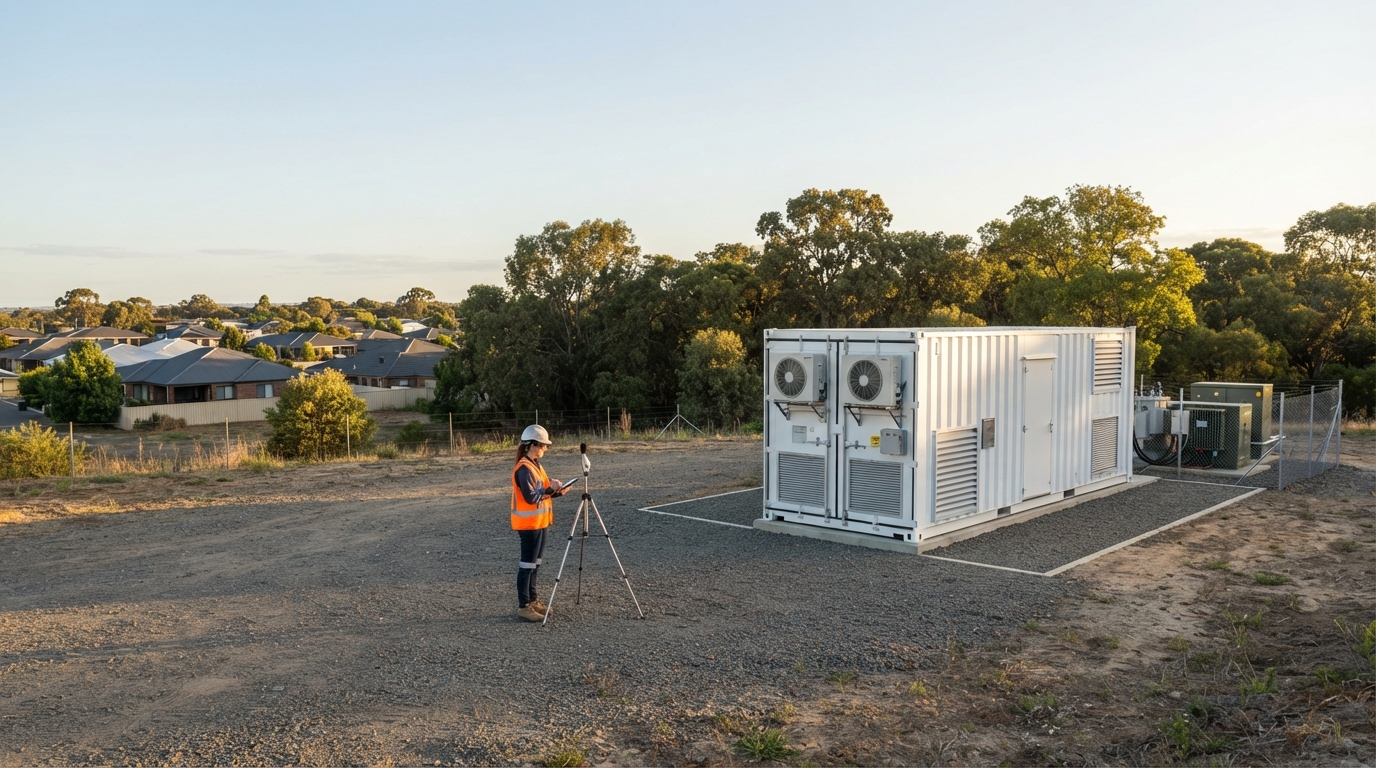
There is no single decibel level for a battery energy storage system (BESS) container. The noise a project produces depends on the equipment package, the operating state, ambient temperature, the distance to nearby receptors, and the existing background sound. What matters for planning is understanding which components make noise, how that noise is measured, and what can be done to control it at the site.
In most projects, the battery cells are not the dominant audible source. A Battery Energy Storage Container: Smart Energy Control for Real-Time Grid Response integrates battery modules, power conversion, thermal management, controls, and electrical protection in one enclosure. The audible noise comes primarily from the auxiliary equipment that keeps the system cool and converts DC power to AC grid power. This guide explains those sources, the acoustic terms needed to evaluate them, and the mitigation measures that keep a BESS project compliant near noise-sensitive areas.
What Makes a BESS Container Noisy?
A battery does not produce constant mechanical noise the way an engine or compressor does. The audible emissions of a containerized BESS come from the systems that manage heat and electricity:
- HVAC and cooling fans. Battery cells and power conversion equipment generate heat. The thermal management system removes it, and the fans that move air through the container are often the loudest continuous source. Fan speed rises with heat load, so a container working hard on a hot day can sound very different from the same container at idle.
- PCS/inverter. The power conversion system converts DC battery power to AC. Its internal fans and power electronics can produce broadband and tonal noise, especially at high output.
- Transformer. Many projects include a transformer to step up the voltage for grid connection. Transformers emit a low-frequency hum that can travel long distances and is difficult to block completely.
- Ventilation openings and louvers. Air intake and exhaust paths allow internal noise to escape. Their location, size, and orientation determine how much sound reaches the outside.
- Auxiliary equipment. Communication cabinets, fire panels, cooling pumps, and small auxiliary power units can contribute, particularly at night when the main system is at low load.
The operating pattern matters. A container may be nearly silent during standby and become clearly audible when fans ramp up during high-rate charging on a warm afternoon. Acentech’s BESS noise guidance highlights this variability: the same system can produce very different levels depending on how hard it is working.
How BESS Noise Is Measured and Reported
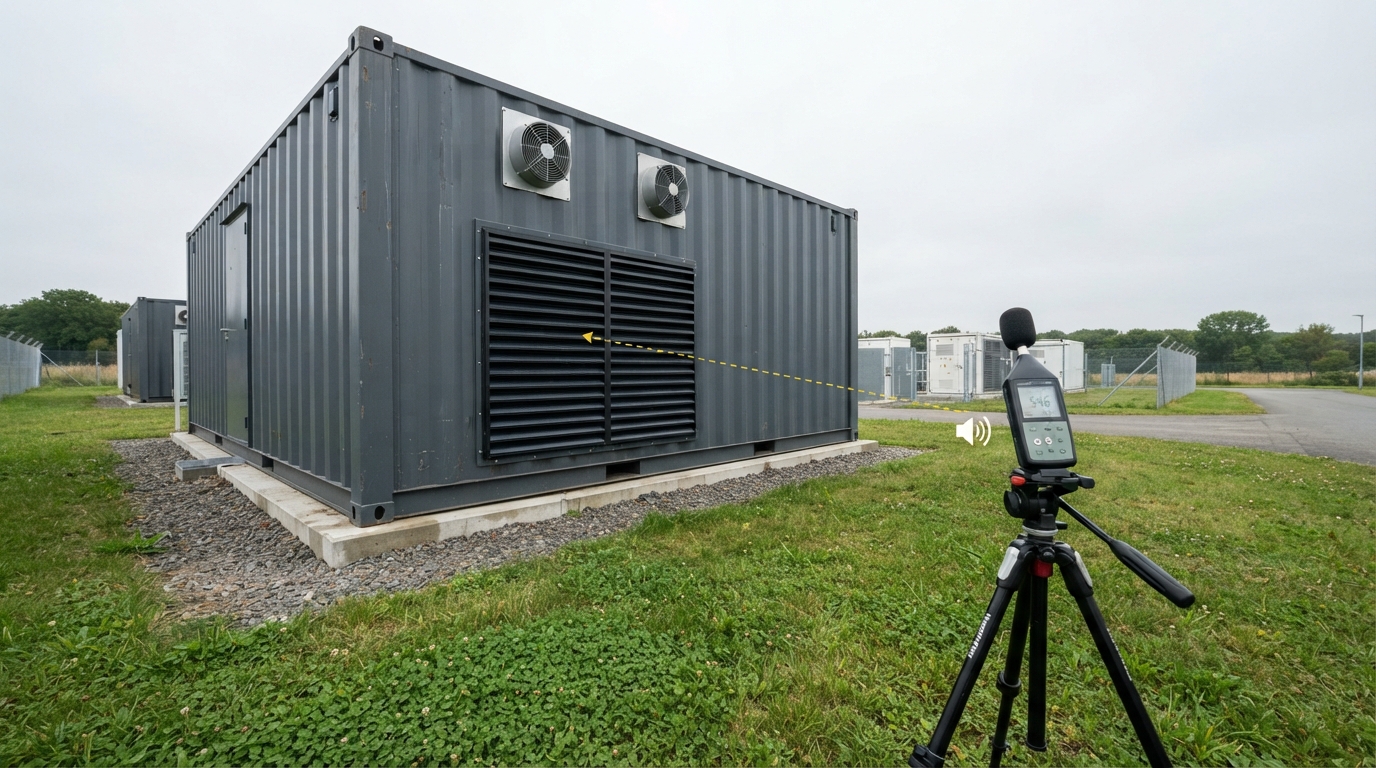
To compare equipment and assess a site, you need consistent acoustic terms.
- dB (decibel) is the unit of sound level. It is logarithmic, so a change of a few decibels represents a meaningful change in acoustic energy.
- dBA is an A-weighted sound level. The A-weighting adjusts the measurement to match the frequency sensitivity of the human ear. Most community noise limits are expressed in dBA.
- Sound power level describes the total acoustic energy emitted by a source. It is a property of the equipment and does not depend on the surrounding environment.
- Sound pressure level describes the sound level at a specific location, such as a neighboring property. It depends on the source’s sound power, distance, terrain, barriers, and weather.
A dBA number without context is not useful. You need to know whether it is a sound-pressure value measured at a receptor, a sound-power value measured at the equipment, which fans were operating, whether the transformer was loaded, and what the ambient temperature was during the test.
Why There Is No Single “BESS Container dBA” Value
Planning reports for different BESS projects can show very different measured levels, even for similar-looking systems. That is not always an error. The result depends on equipment configuration, cooling design, operating state, and measurement location.
Regulators also treat BESS noise on a project-by-project basis. New York City’s Department of Environmental Protection applies the city’s Noise Code to BESS facilities individually, rather than using a universal BESS decibel limit. The same container can be compliant at one site and non-compliant at another, depending on receptors and background sound.
What to Look for in a BESS Noise Datasheet
When a supplier provides acoustic data, verify that it includes:
- Whether the value is sound power or sound pressure.
- The measurement distance, when sound pressure is reported.
- The operating condition: fan speed, ambient temperature, state of charge, and PCS loading.
- Whether the data covers the complete container system or only the battery rack.
- Whether the transformer is included.
- Frequency data, when tonal noise is a concern. Some regulators apply penalties for tones, and barriers perform differently across frequencies.
A datasheet without these details is not sufficient for a predictive noise assessment.
How BESS Container Noise Is Assessed on a Project
A robust noise assessment follows a standard sequence:
- Identify noise-sensitive receptors. These may be homes, schools, hospitals, offices, or other locations where sound is evaluated.
- Measure background sound. The existing ambient level varies by time of day and season, so measurements must reflect the periods covered by the operating limits.
- Establish local noise criteria. Most jurisdictions set separate day and night limits, either as absolute dBA levels or as values relative to the background.
- Collect source data. The consultant needs sound power and frequency data from the equipment suppliers, ideally for the exact models proposed.
- Model propagation from source to receptor. The acoustic model accounts for distance, ground absorption, barriers, multiple containers, and meteorological effects.
- Test mitigation in the model. Setbacks, orientation, barrier heights, and enclosure options can be compared before construction.
- Verify with post-construction measurements. Commissioning tests confirm that the installed system matches the modeled levels.
The Institute of Acoustics has noted that the quality of BESS noise assessments is inconsistent across the industry. The strongest assessments are built on accurate source data from the actual suppliers, a clear understanding of the operating profile, and a realistic treatment of different noise sources.
Background Sound and Noise-Sensitive Receptors
Background sound is the existing ambient level at a site without the new project. It includes traffic, wind, wildlife, and other human activity. A BESS that is barely noticeable in an urban area may be a dominant source in a quiet rural location, even with the same source level.
Receptors are not only homes. Schools, hospitals, care facilities, and workplaces can be treated as sensitive under local rules, often with different limits from residential receptors. Identifying these locations early shapes the container placement and the amount of mitigation required.
Site Mitigation Strategies for BESS Container Noise
Noise mitigation is most effective when applied in a hierarchy: choose quieter equipment, then arrange the site to keep noise away from receptors, then treat the path with barriers or enclosures, and finally manage how the system is operated.
| Mitigation level | Examples | Trade-offs |
|---|---|---|
| Source control | Lower-fan HVAC equipment, separate PCS placement, quieter transformer selection | May limit equipment options or add cost |
| Layout and orientation | Noisy faces away from receptors, longer setbacks, careful container rotation | Requires enough land and affects cabling and access |
| Propagation treatment | Acoustic barriers, enclosures, ventilation silencers | Must preserve cooling airflow and maintenance access |
| Operational controls | Fan-speed scheduling, maintenance routines, operating windows | Depends on thermal limits and grid dispatch requirements |
As research presented to the Australian Acoustical Society shows, reorganizing the layout and orienting the equipment can be as effective as barriers, without the cost or airflow complications.
Source-Level Controls
Start with the quietest practical equipment. Compare fan noise ratings when selecting HVAC and PCS units. Ask whether the inverter can be installed as a separate outdoor unit, which may allow the loudest cooling loads to be moved away from the battery container. Ask where the transformer will sit and whether its noise contribution is included in the quote.
Layout, Orientation, and Setbacks
Distance is the most straightforward control. For a point source, doubling the distance reduces the sound pressure level by roughly 6 decibels in free-field conditions, though real-world terrain and obstacles change that value.
Place fan exhausts, louvered openings, and transformer sides on the parts of the site farthest from sensitive receptors. Orient the containers so service and ventilation faces point away from the neighbors. For a fuller treatment of placement and spacing, review the bess container site layout guide.
Barriers, Enclosures, and Ventilation Treatment
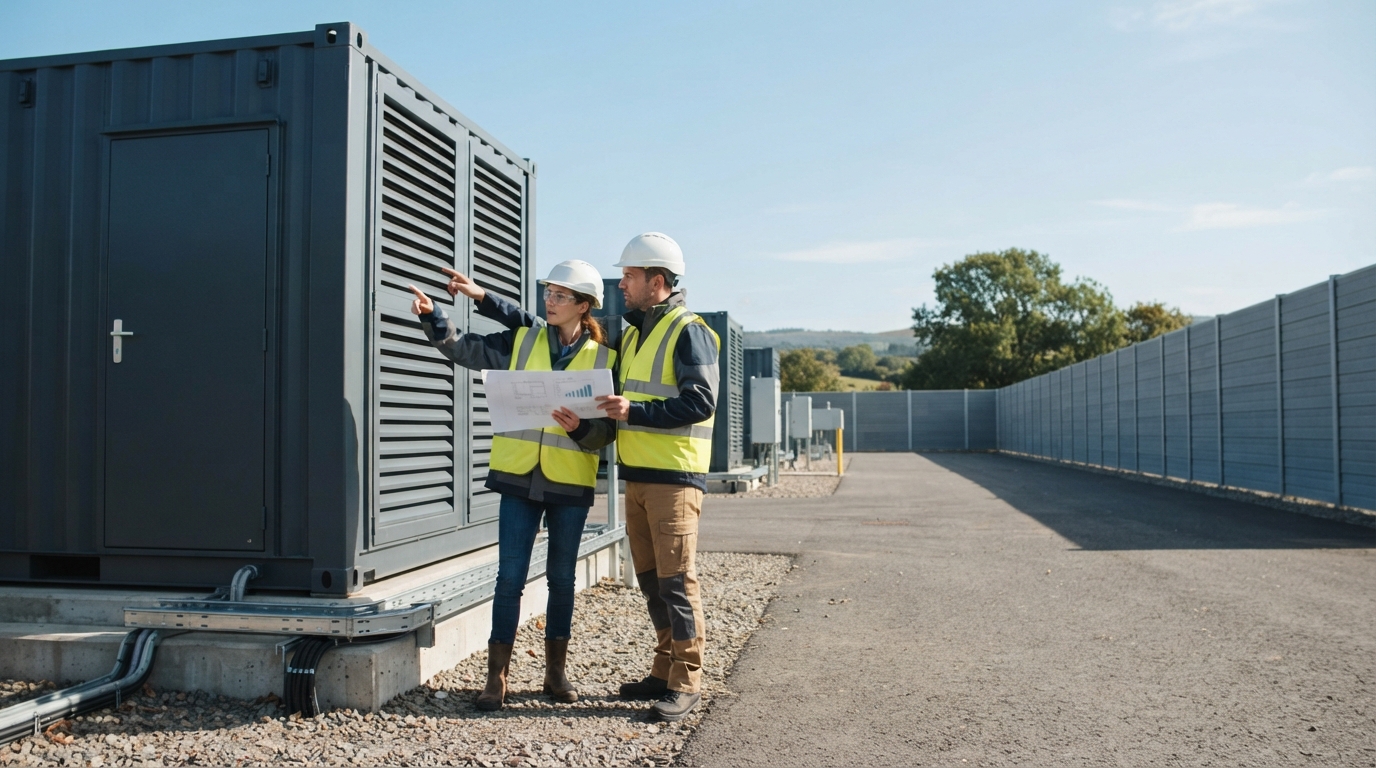
A barrier works only when it interrupts the direct line of sight between the source and the receptor. It must be dense, continuous, tall enough, and free of gaps beneath, around corners, or around pipes. A partial barrier is far less effective than a complete one.
Enclosures can be useful, but they change the thermal balance. Adding mass to contain sound also traps heat, which pushes the cooling fans to work harder. The right design usually combines targeted enclosure treatment with dedicated ventilation silencers that allow airflow while attenuating sound.
Operational Controls and Maintenance
A BESS does not operate at constant load. At night, when demand is low, fan speed may drop and the noise level can fall significantly. Some operators schedule high-power operation outside the most sensitive hours, where the grid and thermal limits permit.
Maintenance also affects acoustics. Dirty filters reduce airflow and force fans to run faster. Worn bearings can introduce tonal noise. A well-managed maintenance routine protects both thermal performance and the acoustic design.
Questions to Ask Your BESS Supplier About Noise
Acoustic performance should be part of supplier evaluation, not an afterthought. Ask:
- What sound power and sound pressure data do you provide, and under what operating conditions?
- Does the data cover the full container system, including the PCS and cooling package?
- Where will the transformer be installed, and is its noise contribution included in the proposed scope?
- What fan control strategy does the thermal management system use at low load?
- Does the proposal include a noise performance guarantee?
- Who is responsible if the installed level exceeds the modeled level?
- Can you provide references from projects operating near noise-sensitive receptors?
The answers will show whether the supplier treats acoustics as a system-level issue. When comparing vendors, use the bess container supplier guide for additional evaluation criteria.
Keep in mind that safety certification and acoustic certification are different subjects. A certification such as UL 9540 or NFPA 855 compliance may be essential for the project, but it does not certify that a container meets a particular noise limit. Those standards address fire safety and installation risk. Acoustic data must be requested separately.
Final Takeaway and Next Steps
BESS container noise does not need to be a project surprise. The key is understanding that noise comes from the integrated system — mainly cooling fans, power conversion, and transformers — rather than from the battery cells themselves. That changes how you evaluate suppliers, how you arrange the site, and how early you bring in an acoustic consultant.
Start with source data, not assumptions. If the project sits near homes or other sensitive receptors, commission a background survey and an acoustic model before the layout is fixed. Use source selection, distance, and orientation before reaching for barriers. Then verify the installed system after commissioning.
For commercial and industrial projects, the same principles apply at smaller scale. The ci energy storage system overview explains how C&I configurations differ from utility-scale installations. And when you compare container suppliers, the acoustic questions above will quickly separate vendors who understand system-level noise from those who do not.

-

 OEM Residential Energy Storage Solutions: Passive vs. Active Cell Balancing
2026-09-30
-
 Smart Home Battery with BMS Communication: Cybersecurity and BMS Safety
 -
 10kWh Home Battery Backup System: Is 90% DoD Better for Daily Solar Storage?
2026-09-29
-
 Integrated Home Energy Storage System 150–430V MPPT Design
2026-09-28
-
 LiFePO₄ Residential Backup Battery SOC Accuracy in Parallel Systems
Share this:





.svg)






-899.svg)


