




1MW Battery Storage Container: Configuration, Runtime and Use Cases
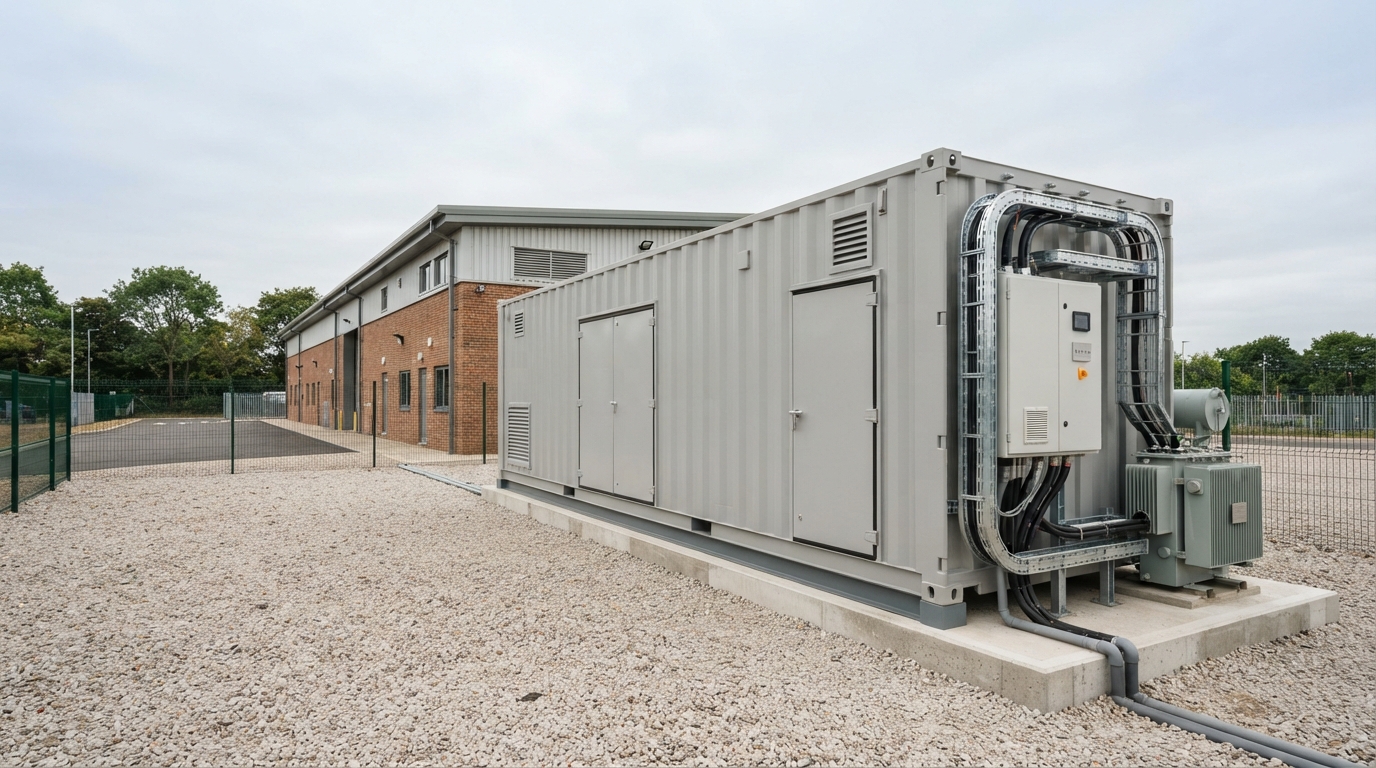
A 1MW battery storage container is a containerized battery energy storage system (BESS) rated at roughly 1MW of AC output power. The “1MW” describes how much power the system can deliver at a given instant — not how much energy it stores, and not how long it can keep running. Runtime depends on the container’s energy capacity in MWh, the actual load, usable energy limits, round-trip efficiency, and reserve settings.
This page explains how a 1MW container is configured, how to estimate its runtime, which configurations fit common use cases, and what to verify before requesting a supplier proposal. For the broader background on containerized BESS architecture and grid-response control, see the Battery Energy Storage Container: Smart Energy Control for Real-Time Grid Response guide.
What Does “1MW” Mean in a Battery Storage Container?
Power and energy are different measurements. Power, expressed in MW or kW, is the rate at which the system can supply or absorb electricity. Energy, expressed in MWh or kWh, is the amount of electricity the battery can store and later release.
A 1MW battery storage container can deliver up to 1MW of AC power, subject to the PCS rating and the battery’s operating limits. How long it can sustain that output is a separate question that only the energy capacity can answer.
For example, a 1MW/2MWh container can deliver up to 1MW of power and stores 2MWh of electrical energy. At a full 1MW load, roughly two hours of operation would be expected before the battery is depleted — before accounting for losses and safety margins. At a 500kW load, the same system could run roughly twice as long.
The relationship between power and stored energy is sometimes expressed as a C-rate. Sustaining 1MW output from a 1MWh battery requires a 1C discharge rate. Sustaining 1MW from a 2MWh battery requires only 0.5C. Lower C-rates usually mean less stress on the cells and simpler thermal management.
Typical 1MW Battery Container Configurations
“1MW” is only half the specification. The same power rating can be paired with different energy capacities to create systems with different runtime profiles. The table below shows common illustrative configurations used in commercial and industrial BESS projects.
| Configuration | Stored energy | Approx. runtime at a 1MW load | Typical driver |
|---|---|---|---|
| 1MW/1MWh | 1MWh | ~1 hour before losses and reserves | Short backup windows; high-power applications |
| 1MW/2MWh | 2MWh | ~2 hours before losses and reserves | Common solar-shifting and peak-shaving profiles |
| 1MW/3MWh | 3MWh | ~3 hours before losses and reserves | Longer backup; larger energy-shifting need |
The runtime figures above are pre-loss estimates. A real system delivers less usable energy because of depth-of-discharge limits, conversion losses, reserve state-of-charge margins, and auxiliary loads. The next section shows how to work through those factors.
These configurations are illustrative market examples, not a list of product options from a single manufacturer. A supplier may offer a 1MW/1.2MWh, 1MW/2.5MWh, or any other combination; the key is to select the MWh capacity based on your load and runtime requirement.
How Long Can a 1MW Battery Storage Container Run?
Runtime cannot be read from the “1MW” label. It must be calculated from the stored energy, the actual load profile, and the system’s operating limits.
A simple method is:
Approximate runtime (hours) = (Nominal energy × Depth of discharge × System efficiency) ÷ Average load
Each input matters. Depth of discharge defines how much of the rated energy the BMS will actually allow. System efficiency accounts for losses in the battery, PCS, and auxiliary equipment. Average load is the actual demand placed on the system, which is usually lower than the 1MW nameplate rating.
Step-by-Step Runtime Calculation
Using a 1MW/2MWh container as an illustrative example:
- Start with nominal stored energy: 2MWh.
- Apply a depth-of-discharge limit of 90 percent: 2MWh × 0.90 = 1.8MWh usable energy.
- Account for AC-side conversion efficiency of 90 percent: 1.8MWh × 0.90 = 1.62MWh delivered energy.
- Divide by the actual average load. At 500kW (0.5MW): 1.62MWh ÷ 0.5MW = 3.24 hours.
- At full rated output: 1.62MWh ÷ 1MW = 1.62 hours.
This is a planning estimate, not a certified performance figure. The result depends on the real DoD, efficiency, and reserve values defined by the supplier for the specific system.
Assumptions That Change Runtime
Several factors can reduce runtime below the raw calculation:
- Reserve state of charge: BMS settings often keep a safety margin at both ends of the charge window.
- Auxiliary loads: Cooling fans, HVAC, controls, monitoring, and container lighting consume energy from the battery or from the site supply.
- Efficiency losses: PCS conversion, battery internal resistance, and cabling all waste some energy as heat.
- Temperature: Cold or hot conditions reduce the usable capacity of lithium-ion cells.
- Degradation: Cycle aging and calendar aging slowly reduce the available capacity over the system’s lifetime.
A system that runs for 3.2 hours in year one may run for fewer hours five years later, even under the same load. That is normal for lithium-ion storage and should be included in the sizing decision.
Core Components Inside a 1MW Containerized BESS
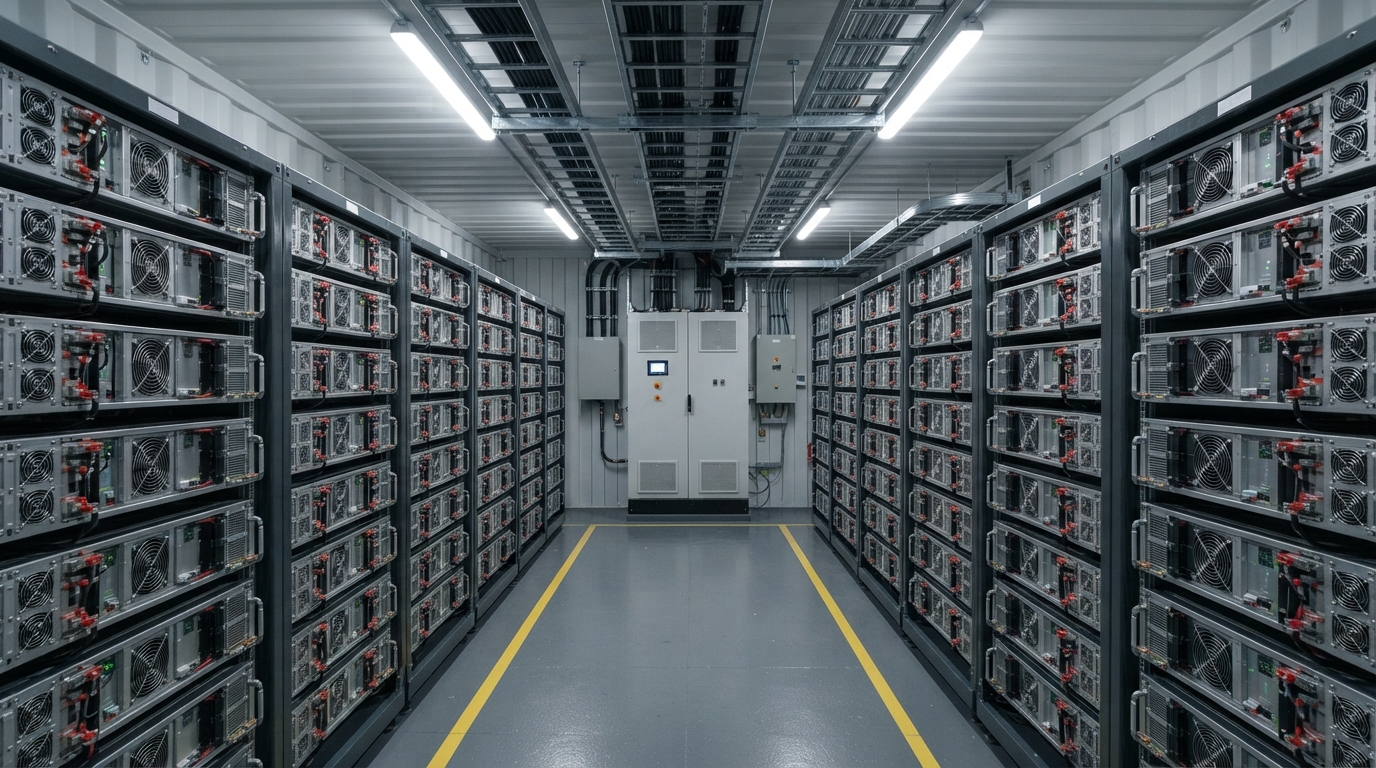
A 1MW battery storage container is more than a large battery. It is an integrated system that combines DC energy storage, power conversion, safety, thermal control, and monitoring inside a transportable enclosure.
| Component | Function | Buyer relevance |
|---|---|---|
| Battery racks and modules | Store DC electrical energy | Determines cell chemistry, system voltage, and total energy capacity |
| BMS (Battery Management System) | Monitors and protects battery cells | Manages cell balancing, state of charge, temperature, and alarms |
| PCS / inverter | Converts battery DC to AC and back | Sets the AC power rating and enables grid-connected or off-grid operation |
| EMS (Energy Management System) | Supervises system dispatch and operating modes | Schedules charging and discharging based on load, tariff, and solar input |
| HVAC or liquid cooling | Regulates container temperature | Affects cycle life, available capacity, and auxiliary energy use |
| Fire suppression | Detects and suppresses fire events | Essential safety subsystem for lithium-ion storage |
| Transformer and switchgear | Interfaces with the site or grid voltage | Required when PCS output voltage differs from the connection point |
| SCADA / remote monitoring | Provides visibility and control from outside the container | Logs data, alarms, and system performance |
The PCS is the component that makes the “1MW” rating real on the AC side. Choosing the right PCS requires matching the battery DC voltage range, the site AC voltage, and the required output characteristics. The bess container pcs sizing guide explains that matching process in detail.
Use Cases for a 1MW Battery Storage Container
Containerized 1MW systems are common in commercial, industrial, and microgrid applications where a single battery cabinet is too small but a full utility-scale plant is not appropriate. The configuration that makes sense depends on the operational goal. For a broader view of how VoltaLink frames commercial and industrial energy-storage projects, see the ci energy storage system page; the profiles below cover the most common 1MW-level use cases.
Solar Energy Storage and Time Shifting
Solar-plus-storage is one of the most common deployments for a 1MW container. During the day, solar panels may generate more electricity than the site can consume. The BESS captures that surplus and discharges it in the evening, when solar output drops and demand often rises.
For this use case, the MWh capacity is usually dictated by the evening load duration rather than by the solar array size alone. A site that needs three hours of post-solar coverage requires a larger MWh duration than one that needs only one hour.
Peak Shaving and Load Shifting
Commercial and industrial facilities often pay demand charges based on their highest monthly power draw. A 1MW BESS can shave that peak by discharging during the short intervals when the site load spikes.
The economics depend on the tariff structure, the frequency of peak events, and the duration of each peak. Load shifting follows the same logic: the battery charges during low-tariff periods and discharges during high-tariff periods.
In both cases, the correct runtime is the length of the peak window, not the full day. If the facility’s peak lasts 90 minutes, a 1MW/1.5MWh or larger configuration will typically be a better fit than a 1MW/4MWh system.
Backup Power, Microgrids, and Grid Support
A 1MW container can also serve as backup power for critical loads, as a core component in a microgrid, or as a distributed resource providing grid services.
In backup applications, the required runtime is set by the critical load and the expected outage duration. A facility that must ride through a four-hour outage needs more MWh than one that only needs to bridge a 30-minute utility switchover.
In microgrids, the BESS coordinates with generators, PV, and loads, often through the EMS and a microgrid controller. Islanding capability — the ability to disconnect from the main grid and operate independently — may require a specialized PCS and additional site engineering.
Grid services such as frequency regulation or reactive power support are also possible, but they are market-dependent. The role of a 1MW container in those services depends on the local utility or system operator’s requirements.
How to Select the Right Configuration for Your Project
Selecting between 1MW/1MWh, 1MW/2MWh, and longer durations is a sizing exercise, not a purchasing preference. The load profile and the charging source set the boundary.
Start with four questions:
- What are the peak and average loads during the discharge period?
- How long must the system sustain the load?
- What is the charging source during the window before discharge?
- Is the objective economic (peak shaving, arbitrage) or resilience (backup)?
The table below offers directional guidance.
| Scenario | Suggested direction | Rationale |
|---|---|---|
| Short backup window at high power | Shorter MWh duration | High power capability matters more than large storage volume |
| Long evening shift after solar | Longer MWh duration | Energy, not power, is the limiting resource |
| Peak shaving with a defined peak window | Match MWh to the peak duration | Size to the facility’s daily demand-reduction period |
| Microgrid with generator coordination | Longer duration or islanding-enabled design | Autonomy and fuel reduction are the primary objectives |
The decision should also account for future expansion. Some containers allow parallel connection of additional units, but the total expansion capacity depends on the PCS design, EMS coordination, and site constraints. Ask the supplier directly whether the configuration can be scaled.
For a full step-by-step load analysis, use the commercial battery storage sizing method before finalizing your specification.
What to Verify in a 1MW BESS Supplier Proposal
Because “1MW” alone does not define the system, a quotation should be specific. A reliable supplier should be able to answer the following questions:
- What is the AC power rating, and what is the DC battery-side specification?
- What is the total energy capacity in MWh or kWh, and what is the usable energy after depth of discharge?
- What is the PCS model, and what battery voltage range does it accept?
- What depth of discharge, round-trip efficiency, and reserve settings does the design assume?
- Which BMS and EMS are included, and which communication protocols are supported?
- Is the system air-cooled or liquid-cooled, and what thermal limits are guaranteed?
- What fire detection and suppression equipment is installed?
- Which certifications or standards apply to the battery, PCS, and container system in the target region?
- What are the container dimensions, weight, transport method, and site-access requirements?
- What is the warranty period, and what does it cover?
- Who handles installation, commissioning, and after-sales service?
- What delivery lead time is realistic for the project?
Certifications deserve special attention. A system that meets UL 9540 and UL 9540A in North America, or the relevant IEC standards in other regions, should come with documentation that names the exact model. Do not rely on a generic claim that the whole product line is certified; ask for evidence tied to the specific configuration.
Once the specification is clear, send it to a qualified bess container supplier for a configuration-specific proposal. The supplier should be able to match the power rating, MWh duration, PCS, cooling, and safety design to the project rather than selling a fixed one-size-fits-all unit.
Conclusion and Next Steps
The “1MW” in a 1MW battery storage container is only the output power. The energy capacity in MWh, the actual load, and the usable-energy assumptions determine how long the system can run. A 1MW/1MWh container and a 1MW/3MWh container are not the same product — they serve different runtime profiles and different economics.
To move from a general search to a project-ready specification:
- Define the load profile and the required runtime.
- Calculate the usable-energy requirement using depth of discharge, efficiency, reserve, and degradation assumptions.
- Choose an MWh configuration that fits the operating window.
- Confirm the PCS, cooling, safety, and certification requirements with the supplier.
- Request a written proposal that matches the configuration to the project.
A 1MW container is a significant investment, and the configuration should be driven by the site’s real operating conditions. A supplier that asks about the load profile, charging source, grid connection, and outage requirements is likely to be a better partner than one that only quotes a standard box.

-

 OEM Residential Energy Storage Solutions: Passive vs. Active Cell Balancing
2026-09-30
-
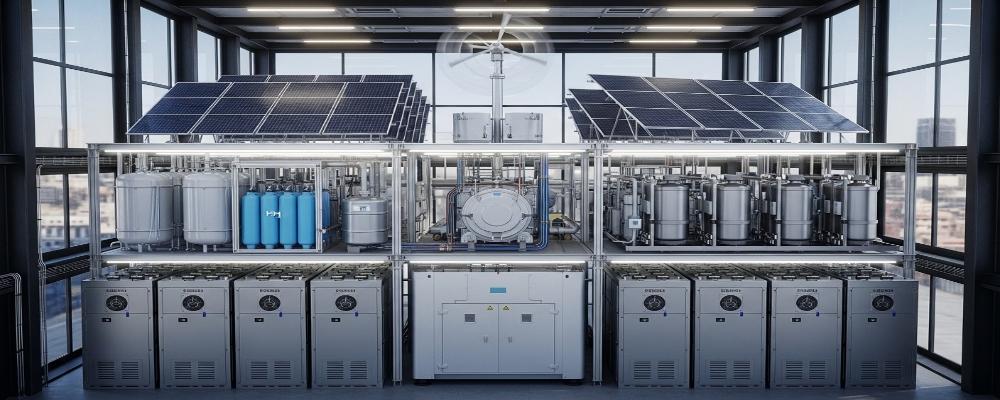 Smart Home Battery with BMS Communication: Cybersecurity and BMS Safety
 -
 10kWh Home Battery Backup System: Is 90% DoD Better for Daily Solar Storage?
2026-09-29
-
 Integrated Home Energy Storage System 150–430V MPPT Design
2026-09-28
-
 LiFePO₄ Residential Backup Battery SOC Accuracy in Parallel Systems
Share this:





.svg)






-899.svg)


