




Energy Storage Battery Container Manufacturer: What Buyers Should Verify
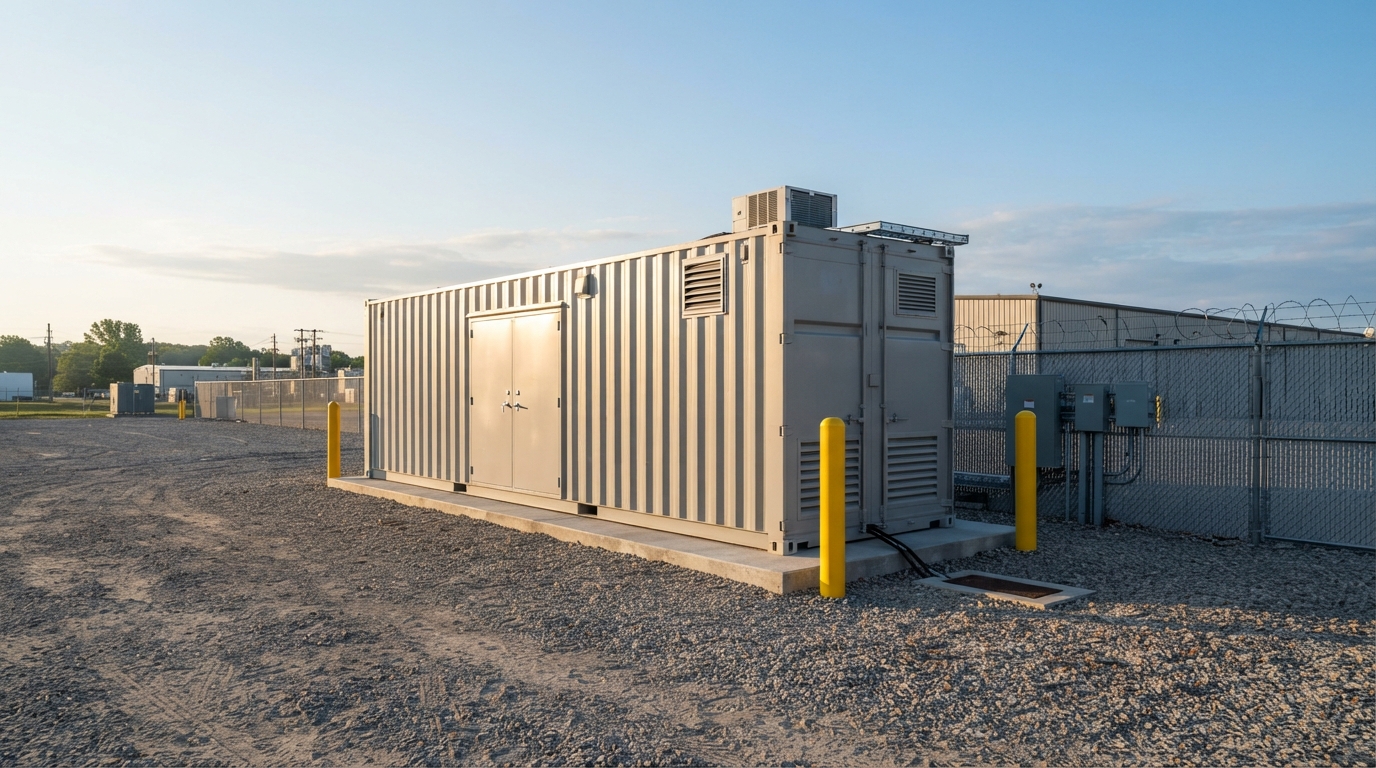
An energy storage battery container is not just an enclosure. It is an integrated system that combines battery racks, management and control electronics, power conversion, thermal management, fire detection and suppression, communications, and the container itself. When you evaluate an energy storage battery container manufacturer, your job is not simply to compare brochure specifications. You need to verify that the supplier can design, integrate, test, document, deliver, and support a system that meets your project’s technical, safety, and commercial requirements.
For a closer look at the container format itself, see our detailed page on the battery energy storage container.
This guide explains what buyers should verify before choosing a containerized BESS supplier.
Start With the Supplier Type: Manufacturer, Integrator, or Reseller?
The word “manufacturer” is used loosely in the energy storage industry. Before evaluating technical details, clarify the supplier’s actual role.
| Supplier Type | What It Typically Means | Buyer Focus |
|---|---|---|
| Manufacturer | Owns product design or factory production, or both | Verify factory capability, design authority, quality control, and warranty responsibility |
| System integrator | Procures components and assembles a complete system | Verify engineering integration, component selection, testing, and system-level performance claims |
| OEM / ODM | Builds to a customer’s specification or provides white-label products | Verify who owns the design, what can be customized, and which specifications are guaranteed |
| Reseller or trading company | Markets another company’s product under its own brand | Verify the original manufacturer, real design authority, and after-sales responsibility |
A credible manufacturer should be able to explain who designs the system, who builds it, who tests it, and who supports it after delivery. If those answers are unclear, ask for more evidence.
For more on supplier relationships and procurement options, see our bess container supplier page.
Verify Battery Architecture and System Components
A battery energy storage container contains several subsystems that must work as one system. Ask the supplier to provide a system description or single-line diagram for the exact model you are considering.
Key components to verify:
- Battery cells. The basic electrochemical unit. Confirm the chemistry, cell format, capacity, and voltage ratings.
- Battery modules. Groups of cells that must be mechanically and thermally managed as a unit.
- Battery racks. Module assemblies that create the DC battery architecture inside the container.
- Battery management system (BMS). Protects the battery by monitoring voltage, current, temperature, cell balance, insulation, and fault conditions.
- Energy management system (EMS). Manages charging, discharging, and coordination with site loads, solar, or grid controls.
- Power conversion system (PCS) or inverter. Converts DC battery power to AC power for loads or the grid.
- Thermal management. Controls temperatures inside the container. The design must match the project’s climate and duty cycle.
- Fire detection and suppression. Identifies abnormal conditions and helps limit the consequences of a battery fire or thermal event.
- Communications and monitoring. Allows operators to see system status, alarms, and performance data.
Do not assume that one component is compatible with another. A battery from one supplier does not automatically work with a PCS from another. Ask the manufacturer how the BMS, EMS, PCS, inverter, and site controller communicate.
Important entity relationships to verify:
- Cells are arranged into modules, and modules are arranged into racks.
- The BMS monitors and protects the battery.
- The PCS connects the DC battery system to the AC site or grid.
- The EMS coordinates the BMS and PCS according to the project’s operating strategy.
- Thermal management and fire suppression protect the battery and the surrounding environment.
A manufacturer that cannot explain these relationships clearly may not have control over the complete system.
Check Electrical Specifications Without Mixing Units
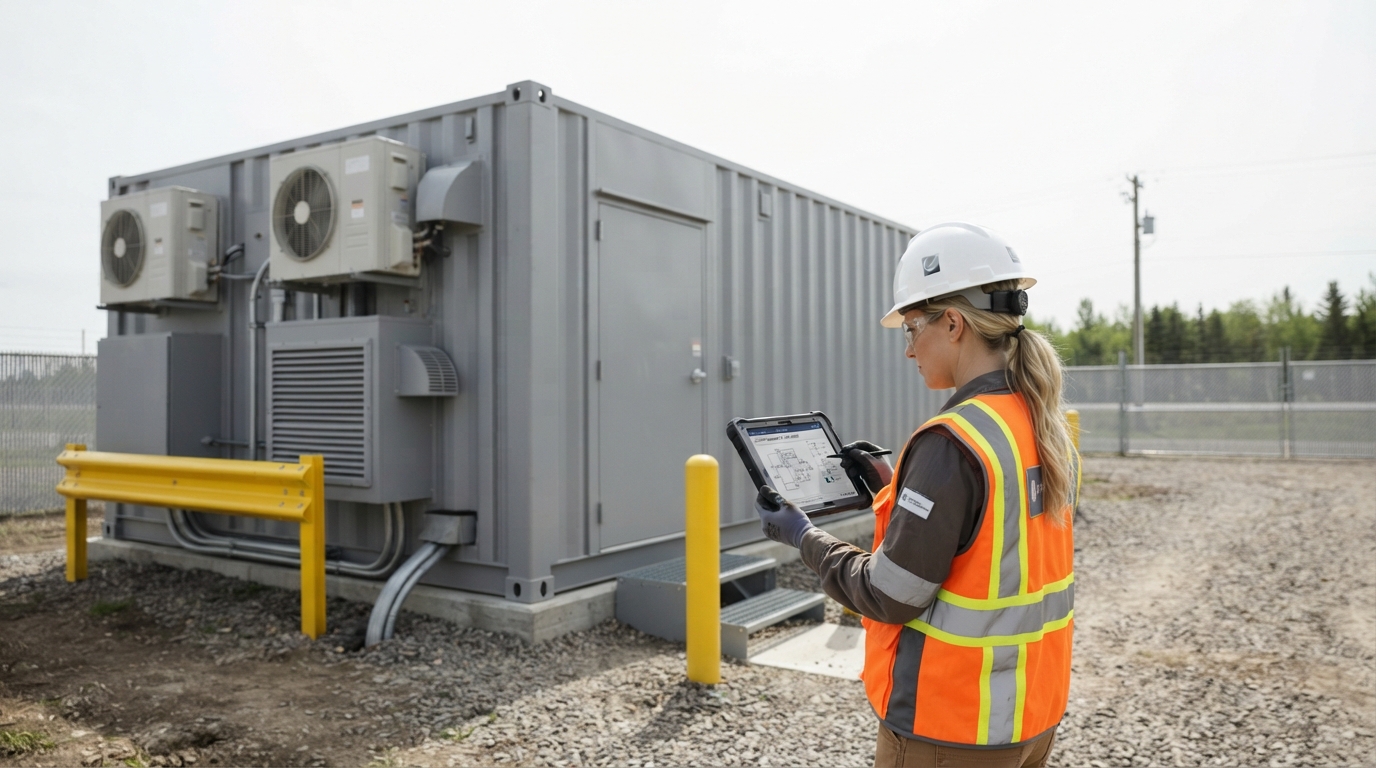
BESS specifications are often presented with inconsistent units. Buyers should keep voltage, current, capacity, energy, and power separate.
| Term | Typical Unit | What It Tells You |
|---|---|---|
| Voltage | V | Electrical potential of the system or component |
| Current | A | Rate of charge or discharge flow |
| Charge capacity | Ah | How much electric charge the battery holds |
| Stored energy | kWh or MWh | How much energy the battery can store |
| Power | kW or MW | How quickly energy can be delivered or absorbed |
| C-rate | ratio | How current compares with the battery’s rated capacity |
| Depth of discharge | % | How much of the battery’s capacity is used in a cycle |
| Usable energy | kWh or MWh | The energy actually available for the project under defined conditions |
Common mistakes buyers should avoid:
- Confusing power (kW) with energy (kWh). A large battery can still have limited discharge power.
- Comparing Ah values across different voltages without checking the effect on stored energy.
- Treating nominal battery capacity as usable system capacity.
- Ignoring depth of discharge, degradation, auxiliary loads, and operating temperature when estimating delivered energy.
- Mixing DC battery ratings with AC system ratings.
The relationship matters. Voltage and amp-hour capacity together determine nominal stored energy. Power tells you how fast that energy can be used. Usable energy depends on allowable depth of discharge, system efficiency, and long-term degradation. When a manufacturer gives you a specification, ask what the numbers mean in your project’s operating profile.
Verify Thermal Management and Fire-Safety Design
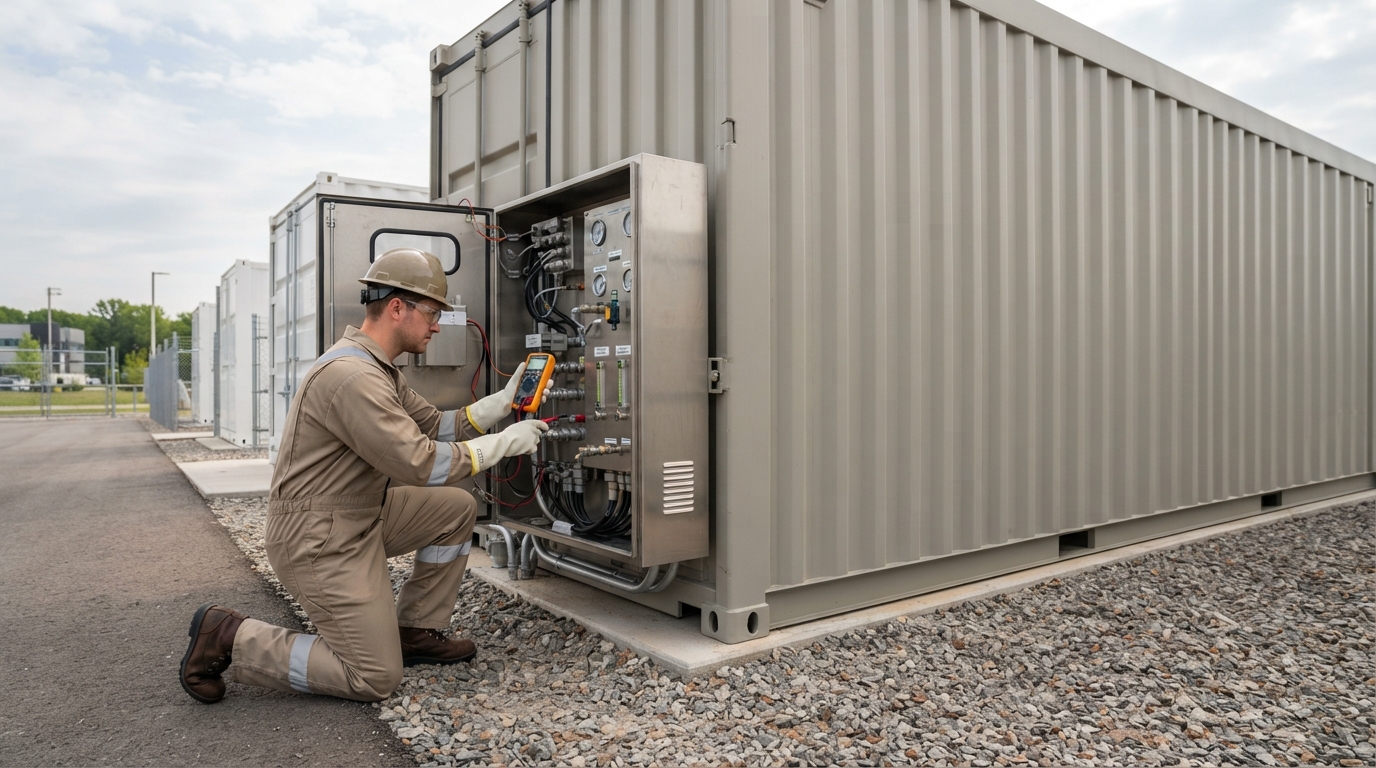
Thermal management is not a generic feature. It has to fit the container design, the battery chemistry, the climate, and the expected charge and discharge profile.
Air-cooled systems are often simpler and may be sufficient for lower power density or moderate climates. Liquid-cooled systems can handle higher heat loads but add complexity, pumps, coolant, maintenance requirements, and potential leak risk. Neither option is universally better. The right choice depends on the project.
Ask the supplier:
- How is heat removed from the container?
- What operating temperature range is supported?
- What are the auxiliary power requirements of the cooling system?
- How does cooling behavior change at high ambient temperatures?
- What maintenance is required?
Fire safety is equally important. A container may include detection, alarm, ventilation, fire suppression, thermal barriers, and safe access provisions. The safety concept should be designed into the system, not bolted on as an afterthought.
For background on BESS safety considerations and the codes and standards that may apply, the U.S. Environmental Protection Agency provides a useful overview of BESS safety considerations and incident response.
Ask for Model-Specific Safety, Certification, and Transport Evidence
Certification claims are easy to print and hard to verify. Buyers should insist on evidence that applies to the exact system model under consideration, not to the company’s general product line.
Certificates and test reports should include:
- Product or system model name and number;
- Certificate or report number;
- Issuing body;
- Test date and validity;
- Scope of the certificate or report;
- Configuration tested.
Relevant standards and test frameworks include, where applicable:
- UL 9540. A system-level listing standard for energy storage systems in North America. It applies to the complete system, not just the battery.
- UL 9540A. A test method for evaluating thermal runaway fire propagation. It is not the same as a system listing.
- NFPA 855. An installation standard for stationary energy storage systems. It is adopted or referenced by many local jurisdictions.
- UN 38.3. A transport-testing framework for lithium batteries. Buyers should confirm that the specific battery configuration has the required transport documentation.
For more on how UL 9540, UL 9540A, and NFPA 855 relate to energy storage safety, see the Sandia National Laboratories explainer on UL 9540 and UL 9540A.
A certificate for one product family does not prove compliance for a different container configuration. If a supplier says a container is certified, ask to see the report that lists that exact container model.
Confirm Factory Acceptance, Delivery, Warranty, and After-Sales Responsibilities
A container can look correct on paper and still fail when it reaches the site. That is why the factory acceptance test and the site acceptance test are essential steps.
The factory acceptance test should verify, before shipment:
- functional performance;
- electrical safety;
- BMS and EMS behavior;
- PCS or inverter operation;
- alarms and protection functions;
- communication with site or grid controls;
- documentation and deliverable completeness.
For a complete overview of what should be checked, see our bess container factory acceptance test page.
Buyers should also define in writing:
- delivery and lead times;
- shipping requirements and transport responsibilities;
- installation scope;
- commissioning responsibilities;
- warranty duration and conditions;
- degradation assumptions;
- spare parts availability;
- service response times;
- repair or replacement procedures.
Warranty terms are not only about duration. The conditions matter. A warranty may be limited by how the battery is cycled, how deeply it is discharged, and how it is maintained. Ask the manufacturer to state the warranty in terms that match your expected operating profile.
How Buyers Should Request Information From a BESS Container Manufacturer
A structured request for information helps you compare suppliers on the same basis. Ask every candidate for the same documents.
Request:
- A complete system datasheet with exact units for voltage, capacity, energy, power, current, dimensions, and operating conditions.
- A single-line diagram showing the battery, BMS, EMS, PCS, transformer, and monitoring connections.
- Mechanical and container layout drawings.
- Component-level documentation for cells, modules, racks, BMS, PCS, cooling, and fire suppression.
- Model-specific certificates and test reports.
- A proposed FAT procedure and acceptance criteria.
- A commissioning plan and SAT procedure.
- Warranty and degradation assumptions.
- A service, spare parts, and technical support plan.
- Documentation of how the system will be adapted to your climate, grid connection, and operating strategy.
If a supplier cannot provide these documents for the exact model you want, treat that as a risk.
Why Consider VoltaLink as a Potential BESS Container Partner?
VoltaLink Battery is an example of why verification matters. The official website identifies the brand as VoltaLink Battery and names Guangdong Voltalink New Energy Co., Ltd. as the company. It also states a relationship with Shandong Guoli New Energy Co., Ltd., gives an establishment date of 2025, and says its global foreign trade and business center is located in Shenzhen.
Those facts are useful context, but they are not a substitute for technical evidence. VoltaLink also positions itself around new-energy and energy-storage solutions. The appropriate next step is to ask VoltaLink directly for the same model-specific documentation, test reports, project references, and warranty terms that you would require from any container manufacturer.
Contact VoltaLink through the official website to request current technical documentation and a project-specific quotation. Verify the details against your own engineering requirements before making a decision.
A containerized battery energy storage system is a long-term infrastructure investment. The manufacturer you choose should be able to prove that its design, testing, documentation, and support are ready for your project.

-

 OEM Residential Energy Storage Solutions: Passive vs. Active Cell Balancing
2026-09-30
-
 Smart Home Battery with BMS Communication: Cybersecurity and BMS Safety
 -
 10kWh Home Battery Backup System: Is 90% DoD Better for Daily Solar Storage?
2026-09-29
-
 Integrated Home Energy Storage System 150–430V MPPT Design
2026-09-28
-
 LiFePO₄ Residential Backup Battery SOC Accuracy in Parallel Systems
Share this:





.svg)






-899.svg)


