




Residential Emergency Power Supply with Automatic Switching
A Residential Emergency Power Supply with Automatic Switching is designed around one critical moment: the instant utility power disappears.
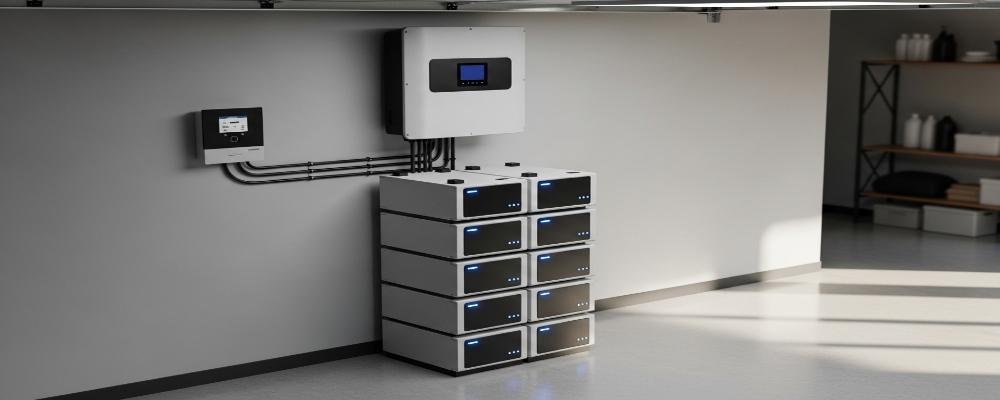
Battery capacity alone does not determine whether a home has reliable emergency power. The system must detect the grid failure, electrically separate the backup side from the utility, activate inverter output, support connected loads, and later return to grid operation in a controlled sequence.
For this reason, buyers evaluating a Residential Emergency Power Supply should examine automatic switching together with inverter power, startup surge, battery capacity, solar recharge capability, and the transfer architecture used in the installation.
VoltaLink’s referenced residential configuration combines a 51.2V 200Ah LiFePO₄ battery with 10.24kWh rated energy, a 5.5kW pure sine wave inverter, 11kW surge capability, and grid-tied/off-grid/hybrid operating modes with automatic switching.
What Happens When the Grid Fails?
Automatic backup is a sequence of functions rather than a single function.
A home emergency power supply includes the following processes:
Detecting a power outage → Isolating the grid → Taking control of the inverter → Providing backup supply to the load
When grid power is restored, the process gets reversed:
Stabilizing the grid → Confirming grid power availability → Connecting the load → Battery charging / normal operation
1. Grid Failure Detection
The control system monitors incoming AC conditions. When grid voltage or frequency moves outside the permitted operating range, the system recognizes that normal grid operation is no longer available.
Detection is only the first step. The home backup circuit must then transition into an appropriate islanded operating condition.
2. Electrical Isolation
A grid-connected Residential Emergency Power Supply cannot simply energize the household while remaining improperly connected to an inactive utility network.
The transfer architecture therefore needs to separate the supported backup circuit from the utility before inverter-based emergency power is supplied.
Depending on the system design, this function may involve:
• An integrated transfer mechanism
• An external automatic transfer switch
• A dedicated backup box
• A critical-load distribution panel
This is why buyers should ask not only “Does it switch automatically?” but also “Which component performs the transfer and grid isolation?”
3. Inverter Takeover
After isolation, the inverter becomes the AC source for selected household circuits.
The VoltaLink configuration provides 5,500W rated inverter output and 11,000W surge capability, with pure sine wave AC output.
At this stage, inverter power matters more than total battery capacity.
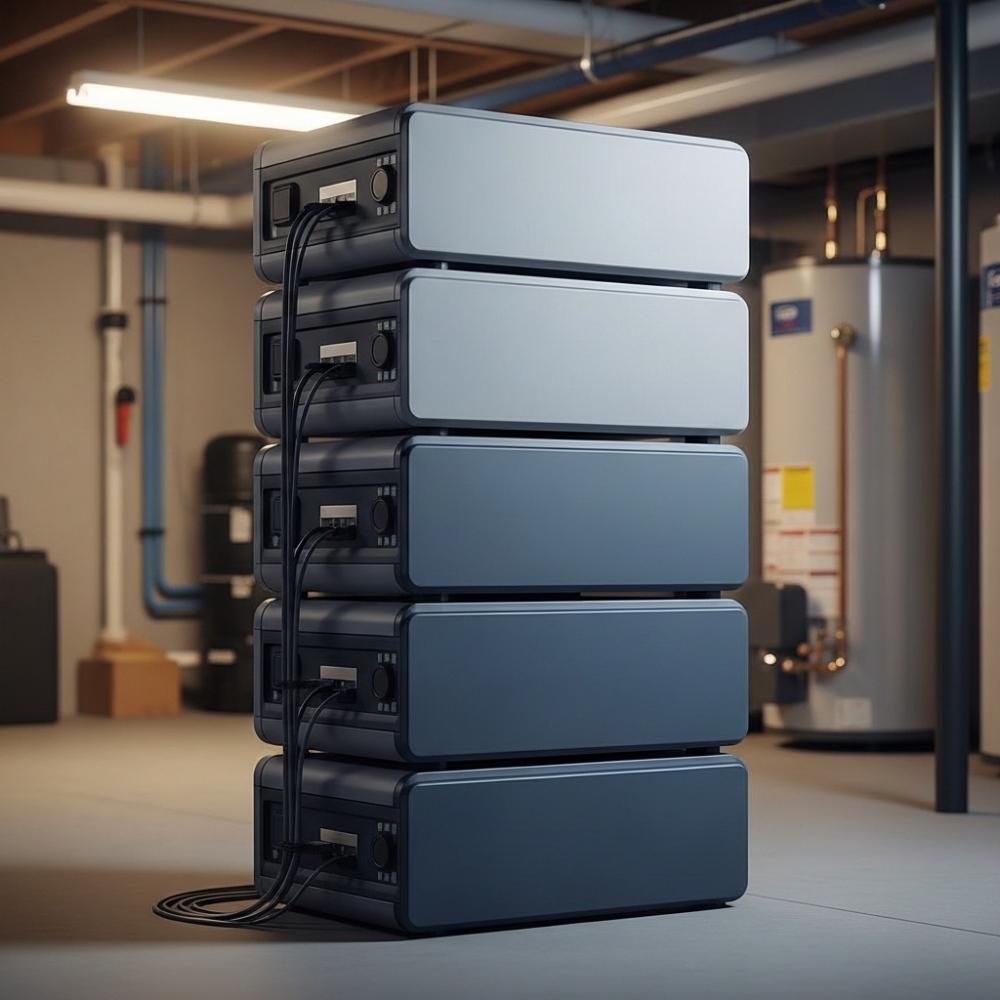
Automatic Switching Does Not Mean Zero Interruption
One of the most important specifications for a Residential Emergency Power Supply with Automatic Switching is transfer time.
Different household loads react differently to a brief interruption.
| Load | Main Switching Concern |
| LED lighting | Brief interruption may be visible |
| Refrigerator | Compressor restart and surge |
| Wi-Fi router | May reboot if interruption is too long |
| Desktop computer | More sensitive to power interruption |
| Water pump | High startup current |
| Security/control equipment | Transfer sensitivity should be verified |
Therefore, terms such as “seamless switching,” “0 ms transfer,” or “UPS-grade backup” should only be used when supported by measured transfer-time data.
For a Residential Emergency Power Supply project, VoltaLink should match the required switching behavior to the application rather than assuming that every household load has the same interruption tolerance.
Note: The VoltaLink 5.5kW emergency power system features a reliable automatic transfer time of under 10 ms, ensuring continuous operation for most household appliances
Automatic Transfer vs Other Backup Architectures
Automatic switching should also be evaluated against alternative system layouts.
| Architecture | Outage Response | Best Fit | Key Check |
| Automatic transfer | No manual switching required | Regular home backup | Transfer time |
| External ATS | Automated through separate equipment | Flexible system integration | ATS/inverter coordination |
| Manual transfer | User-operated | Basic emergency systems | Human intervention |
| Critical-load backup | Selected circuits automatically supported | Moderate inverter capacity | Load prioritization |
| Whole-home backup | Broad household coverage | Higher-power systems | Peak and surge demand |
For a 5.5kW-class Residential Emergency Power Supply, critical-load planning is often more useful than assuming every circuit should remain energized.
Why 10.24kWh Does Not Define Automatic Backup Performance
The battery, inverter, and automatic transfer system perform different jobs.
| Specification | VoltaLink Configuration | Role During an Outage |
| Battery energy | 10.24kWh | Determines potential backup duration |
| Continuous output | 5.5kW | Determines sustained load capability |
| Surge output | 11kW | Handles short startup peaks |
| Battery chemistry | LiFePO₄ | Energy storage chemistry |
| Built-in BMS | Yes | Battery monitoring and protection |
The relationship is straightforward:
• kWh determines approximately how long loads can run.
• kW determines how much equipment can run simultaneously.
• Surge power determines whether motor-driven equipment can start.
• Automatic switching determines how the system transitions into backup mode.
These parameters should never be evaluated independently.
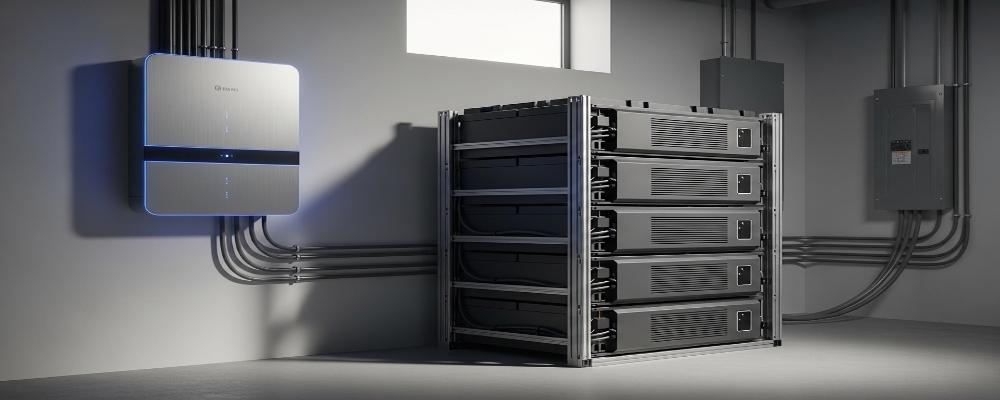
What Should Stay Powered After Automatic Switching?
A well-designed Residential Emergency Power Supply does not necessarily need to reproduce normal household electricity consumption during an outage.
Critical loads might include:
• Refrigerator and freezer
• Essential lighting
• Internet and communication equipment
• Security systems
• Selected sockets
• Computers
• Circulation or water pumps
High-demand equipment such as electric water heaters, ovens, EV chargers, and large HVAC systems can consume a substantial share of inverter capacity.
Motor loads introduce another issue: starting current.
A water pump may operate within the inverter’s continuous power limit after startup but temporarily demand significantly more power when its motor starts. That is where the relationship between the 5.5kW continuous rating and 11kW surge capability becomes relevant.
The practical engineering question is therefore:
After automatic switching occurs, what is the highest simultaneous running load and startup surge the Residential Emergency Power Supply must support?
Solar Input Can Extend Emergency Operation
Automatic switching becomes more valuable during extended outages when the system can combine battery backup with available solar generation.
The VoltaLink configuration supports:
• 6000W maximum PV array power
• 450VDC maximum PV open-circuit voltage
• 60–360VDC MPPT range
• 28A maximum PV input current
During a long outage, the relevant energy flow becomes:
PV generation → Active household loads → Remaining solar power → Battery recharge
However, PV wattage alone is not enough to establish compatibility. Installers must verify PV string voltage, maximum Voc, operating current, MPPT range, and whether the system configuration permits solar production while operating in backup mode.
Automatic Switching Must Be Tested During Commissioning
A Residential Emergency Power Supply with Automatic Switching should be commissioned by deliberately testing both transition directions:
• Grid → Battery
• Battery → Grid
The installer should verify:
• Which circuits transfer
• Actual transfer behavior
• Inverter overload response
• Motor startup performance
• Battery-to-inverter communication
• PV operation during outage
• Grid recovery behavior
• Automatic charging after reconnection
VoltaLink’s documented production process includes battery-cell consistency matching, capacity testing, aging validation, and safety inspections before system delivery. The built-in BMS also monitors voltage, current, and temperature and provides electrical and thermal protection.
Factory testing and field commissioning should work together: one verifies the equipment, while the other verifies the installed backup system.
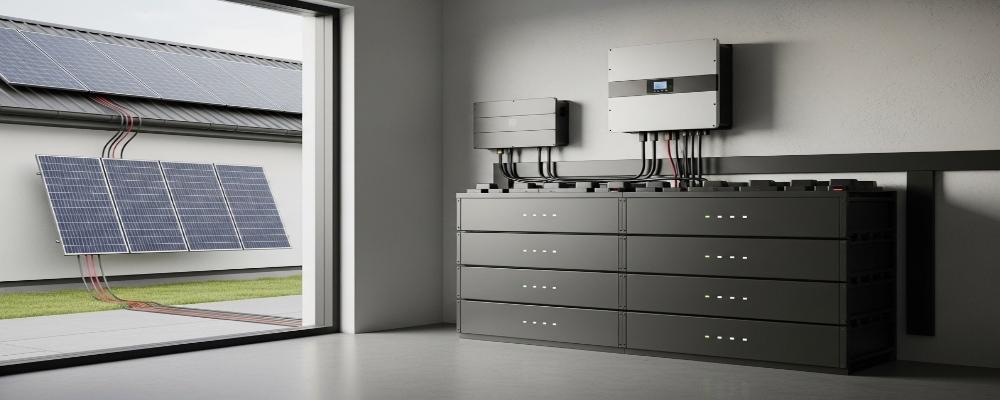
Specify Automatic Backup From the Load Backward
When selecting a Residential Emergency Power Supply with Automatic Switching, the most reliable purchasing sequence is:
Critical loads → Continuous power → Startup surge → Transfer requirement → Backup duration → Battery capacity → Solar input → Installation architecture
This prevents buyers from selecting a system simply because it has a large kWh rating.
For reliable home backup, VoltaLink helps you configure the right Residential Emergency Power Supply based on load demand, surge requirements, backup duration, solar input, and automatic switching needs. Contact VoltaLink to discuss a system matched to your residential energy project.
FAQs
Q1. Are solar panels used to charge the battery during emergency operations?
The system’s design includes the capability to incorporate a 6,000W PV array power. The operation of the PV during a utility blackout must be confirmed as part of the final configuration of the inverter, transfer, and backup solutions.
Q2. What is the battery capacity in the VoltaLink Residential Emergency Power Supply?
The system described uses a 51.2V, 200Ah LiFePO₄ battery with 10.24kWh of energy. The actual backup time will be less than the rated energy and will depend on the connected load, the depth of discharge, inverter losses, and other factors.
Q3. What is the maximum continuous power delivery?
The inverter, which is part of the system, is rated for 5,500W of continuous power. The system should not be selected on the basis of the battery capacity. A customer must consider the sum of all emergency loads.
Q4. Will the VoltaLink system work with a refrigerator, pump, or other motor loads?
The inverter provides up to 11,000W of surge power, however final compatibility will depend on the actual current and surges for each device.
Q5. Can a Residential Emergency Power Supply back up an entire house?
This is determined by the total power demand of the house at any given time. For a 5.5kW inverter, VoltaLink suggests that a home owner considers refrigeration, lighting, communications, security systems, power supplied to select outlets, and pumps for the critical-load option or the whole home backup system.

-

 OEM Residential Energy Storage Solutions: Passive vs. Active Cell Balancing
2026-09-30
-
 Smart Home Battery with BMS Communication: Cybersecurity and BMS Safety
 -
 10kWh Home Battery Backup System: Is 90% DoD Better for Daily Solar Storage?
2026-09-29
-
 Integrated Home Energy Storage System 150–430V MPPT Design
2026-09-28
-
 LiFePO₄ Residential Backup Battery SOC Accuracy in Parallel Systems
Share this:





.svg)






-899.svg)


