




Home Battery for Solar System: Three PV Inputs for Balcony Efficiency
Unlike standard rooftop solar systems, balcony systems can function under more varied conditions. In addition to having many panel orientations, systems are subject to uneven shading from adjacent buildings, railings, and trees, as well as seasonal shading from the sun.
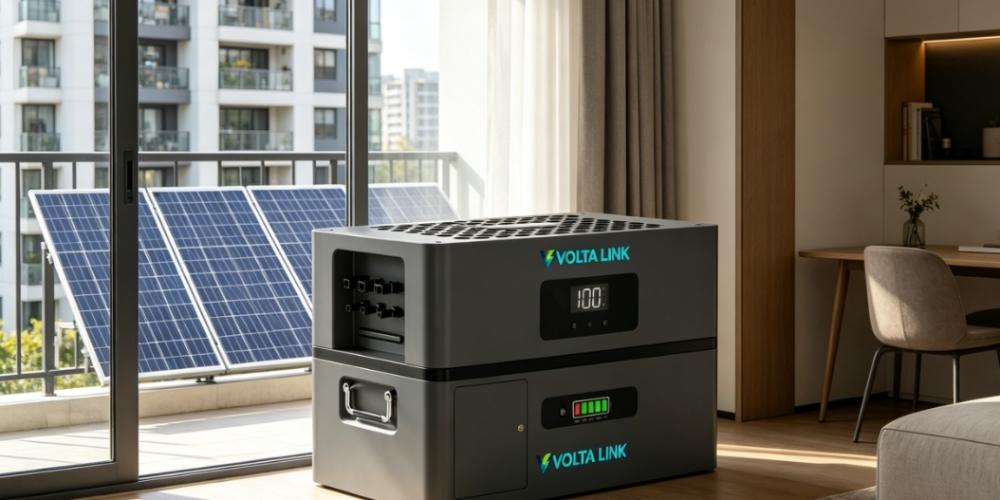
A Home Battery for Solar Systems with three Independent PV inputs can accommodate the separate groups of solar panels. Instead of forcing differently positioned panels to share one input channel, the system can collect, store, and distribute solar energy through three PV paths.
From VoltaLink’s perspective, an effective Home Battery for Solar System should combine flexible PV management, modular battery storage, stable AC output, safety protection, and intelligent energy monitoring.
What Are Three Independent PV Inputs?
A photovoltaic input connects one group of solar panels to the solar inverter or energy storage controller. In a 3-input layout, the Home Battery for Solar System can connect to 3 distinct solar PV groups.
Each PV input can accept solar panel voltages in the range of 18V to 108V, currents of up to 16A, and solar panel capacities of up to 1100Wp. Collectively, 3 inputs can accept up to 3300Wp of installed solar capacity.
• Each input is totally independent. This means varying solar conditions can occur in each group of solar panels.
• East-facing panels can start generating much earlier than west-facing panels.
• South-facing panels have stronger solar production at midday.
• West-facing panels can extend solar production into the afternoon.
• Partially shaded panels can be separated from other panel groups to reduce performance impacts.
• Separate PV arrays can be created by panels installed on different balcony surfaces.
Why Flexible Input Management is Important for Balcony Solar Panels
The conditions on most balconies do not lend themselves to the same level of uniformity and control as rooftop arrays. For example, railings, trees, nearby buildings, roof edges, seasonal sun angles, and even the direction of the sun can create variable shading.
When multiple panels with differing conditions are connected in a single string, the stronger panel group is often limited to the output of the weaker group. Multiple independent inputs significantly mitigate this scenario, as each input can control its own operating point.
This is really important for the Home Battery for Solar System because it is designed for a rooftop array in a dense urban setting with panels oriented in multiple directions.
How MPPT Functions with Three PV Inputs
The primary function of maximum power point tracking (MPPT) is to dynamically modify the electrical operating point of the solar panels to optimize the available power. The optimal level of available power changes as the sunlight, temperature, and shading conditions vary.
The VoltaLink balcony solar storage platform features MPPT technology with a minimum rated efficiency of 97%. The system as a whole achieves a 97% conversion of solar energy to household electricity. Additional losses will still occur in the inverter, battery, cabling, and other system components. Instead, MPPT efficiency describes how effectively the controller identifies and follows the available power point of the connected solar array.
With three PV inputs, MPPT control can respond separately to different panel groups.
| PV Input Condition | Common Solar Challenge | Possible System Response |
| Morning-facing array | Stronger output before midday | Tracks the morning production profile independently |
| Midday-facing array | Higher output around peak sunlight | Maintains a separate operating point for central daytime production |
| Afternoon-facing array | Continued output later in the day | Extends the solar charging period |
| Partially shaded array | Reduced voltage or current | Limits the effect on other PV groups |
| Different panel quantities | Uneven electrical characteristics | Allows more flexible array organization |
How Three Inputs Enhance Balcony Efficiency
Balcony efficiency transcends the rated efficiency of a single component. The extent to which a household can collect, store, and make use of the available electricity also constitutes balcony efficiency.
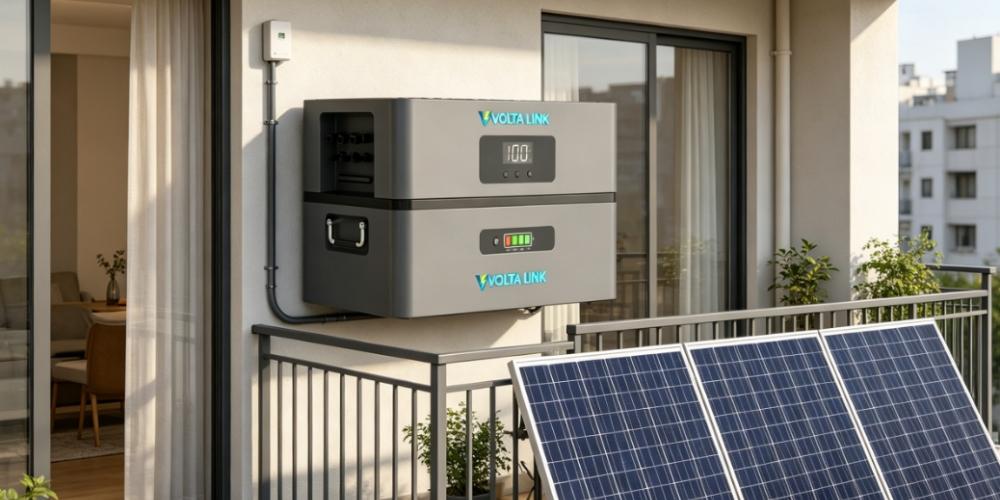
Independent PV (photovoltaic) inputs promote flexible designs.
• Longer generation time: PV panels, mounted on disparate building facades or building panels and therefore oriented in different building ways, can generate electricity for longer time periods.
• Fewer mismatch losses: Independent inputs help to ignore the unequal shading losses for the different sets of panels.
• Placement flexibility: Smaller PV panels can be mounted on smaller balcony mounting positions compared to the larger ones.
• Increased self-consumption: Increased generation duration allows for increased self-consumption.
• Consistent charging: Reduced generation peaks and increased duration of charging intervals can be achieved through multiple distributed solar generations.
• Flexible layout: The layout of one of the PV groups can be adjusted, leaving the other groups unchanged.
The overall performance is influenced by the quality of the panels, local weather, panel tilt, household demand, and the co-opted solar input.
Balancing Demand, Storage and Solar Input
An efficient solar home battery system must balance the input from solar photovoltaic (PV) panels, battery storage capacity, and household demand. VoltaLink’s modular system provides battery modules of 2880Wh and allows for the selection of 1 to 5 modules.
This gives the system a flexible storage capacity between 2.88kWh and 14.4kWh.
| Battery Configuration | Nominal Storage Capacity | Typical Application |
| 1 module | 2.88kWh | Power lighting and small devices (like routers and small appliances) during evening |
| 2 modules | 5.76kWh | Power larger evening loads and provide longer backup duration |
| 3 modules | 8.64kWh | Power households with larger daily solar surplus |
| 4 modules | 11.52kWh | Power longer energy shifting and backup planning |
| 5 modules | 14.4kWh | Power greater demand for storage within the system’s output limits |
The available runtime and stored energy definitely increase with the addition of the battery modules. However, the system’s AC output power does not increase automatically. It is very important for the customers to consider both the storage (in kWh) and the output (in kW).
Output and Energy Conversion Considerations
The system’s nominal grid-connected output is rated at 0.8kW, and its maximum output can be configured to reach 1.6kW. The system is capable of delivering 230V AC power with total harmonic distortion of less than 3%.
This system has several stages of energy conversion:
1. Conversion of solar energy to system energy: The system utilizes MPPT to optimize captured solar energy.
2. Battery charging: Conversion efficiency of the system is rated at 85% and above.
3. Provision of AC supply: The efficiency of the inverter is rated at 90% and above.
4. Use of appliances at home: Solar energy can be utilized directly or can be drawn from stored energy.
5. Standby power: Standby and control power to the system communication are up to 16W.
This information provides better insight about the energy realistically available, which is beyond the rated power of the solar panels and the nominal capacity of the battery.
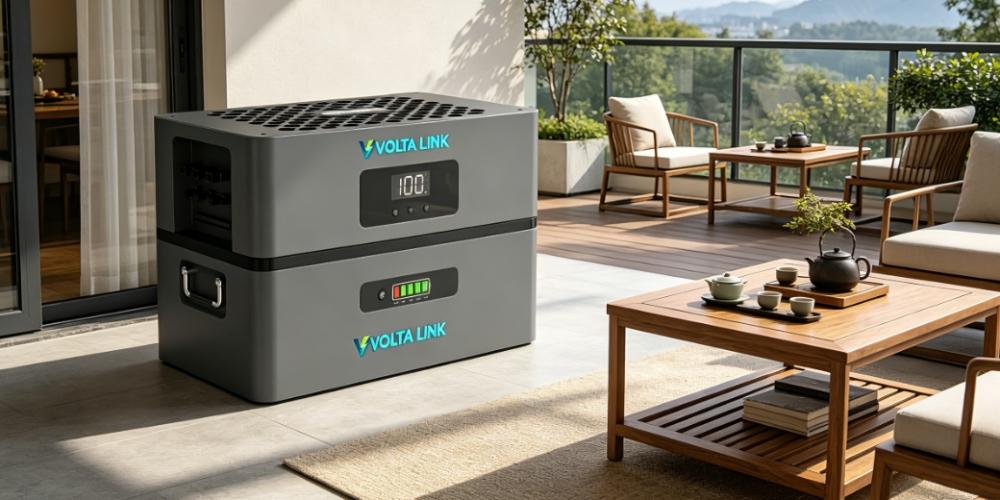
Backup Power and Smart Energy Management
Some loads can be powered during grid failure with the Home Battery for Solar Systems. Backup switching is within 10 ms of the stated operating conditions.
• Planning of essential loads: This is the determination of the devices (loads) that will take priority during planning. This will typically be a load for routers, lights, computers, refrigeration, and some means of communication.
• Understanding power limits: Resistive heating appliances will most likely exceed the system output.
• Leaving some battery reserve: This should improve the predictability of backup availability.
• Taking advantage of the dynamic tariff: AC charging at 1600W max can be set to automatically charge during off-peak pricing.
System and energy flow status can be monitored through WiFi, Bluetooth, Ethernet, and CAN communication.
The system is compatible with several devices, including smart meters, smart plugs, infrared meters, and heat pump power controllers. These devices assist in managing the interaction between solar power generation, battery storage, household demand, and the economics of electricity.
Final Thoughts
The Home Battery for Solar with three PV inputs enhances the management of balcony solar installations with the ability to segment solar panels of varying orientations, shading conditions, and physical placement. The use of this can reduce the mismatch in solar panel arrays and can elongate the period of solar energy generation within a single day. It can also maximize the use of solar energy generated for in-home consumption.
The VoltaLink system offers a modular design for up to 3300Wp of PV input, 2.88 – 14.4kWh of storage, a 1.6kW output, smart monitoring, backup switching, and a level of protection that is IP65, making it ideal for solar storage systems for apartments. The final system design will depend on the local conditions for solar availability and household demand, along with the local electricity rates, installation conditions, and applicable regulations for the grid.
FAQ
Q1. Can the battery charge from the grid?
Yes. The system can charge from the AC grid at a maximum of 1600W.
Q2. What are the benefits of having three PV inputs?
Three PV inputs enable the use of multiple groups of panels, allowing for the adjustment of the solar configuration to account for differing levels of sunlight and shading.
Q3. Can solar panels have different orientations?
Yes. Solar panels that are East, South, and West facing can all be connected to dedicated PV inputs.
Q4. What are the limits to the PV inputs?
For the three PV inputs, the maximum input limit is 3300Wp.
Q5. What is the maximum battery storage capacity?
The battery storage capacity is expandable with the use of up to five battery extensions, bringing the total storage capacity from 2.88kWh to a maximum of 14.4kWh.

-

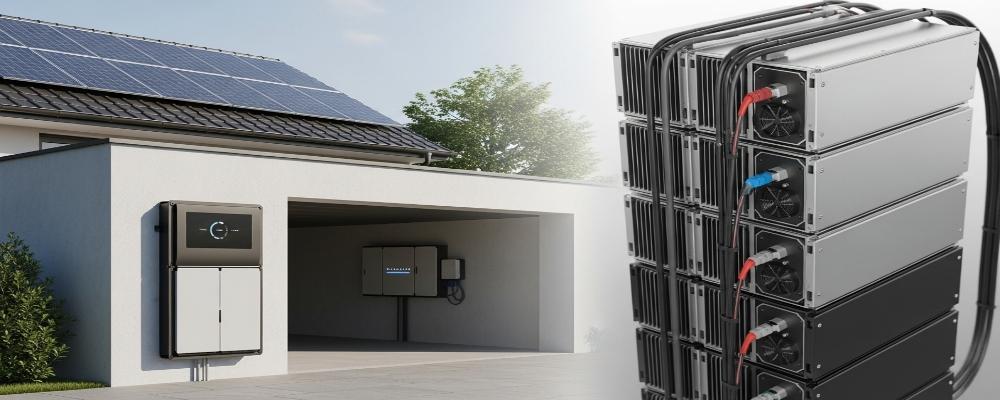 OEM ODM Home Energy Storage Manufacturer for Stackable Home Battery Solutions
2026-08-20
-
 High-Rate Discharge in Data Center UPS Battery Backup Systems Explained
 -
 LiFePO₄ RV Battery 48V System Design: Battery, Inverter, Solar and DC Load Integration
2026-08-19
-
 51.2V LiFePO₄ Server Rack Batteries: 100Ah Capacity, Energy Output and Runtime
2026-08-18
-
 51.2V 100Ah LiFePO₄ Battery for Inverter in Solar Energy Storage Systems
2026-08-17
Share this:





.svg)






-899.svg)


