




Commercial Battery Storage ROI: Savings, Revenue and Payback Inputs
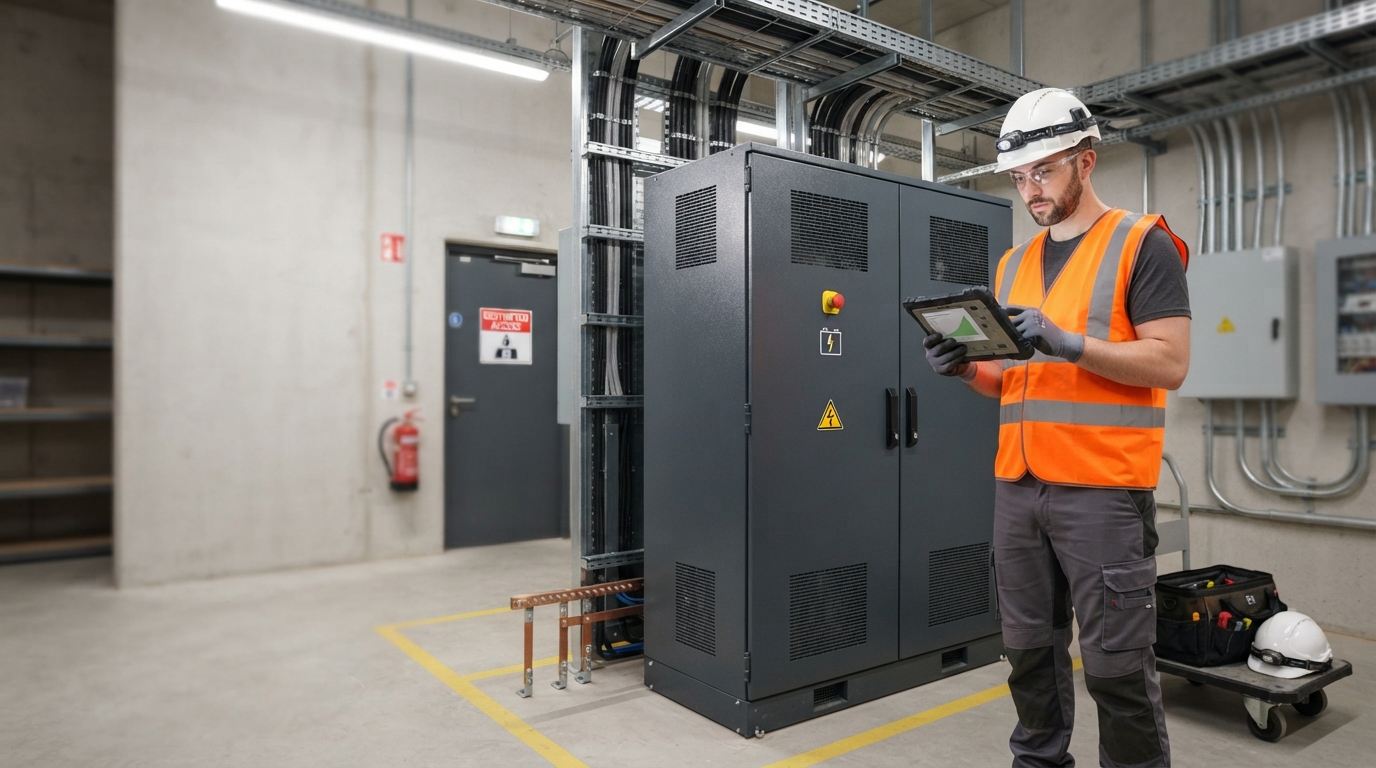
Commercial battery storage ROI is not a single published number. It is the result of a calculation that depends on your facility’s electricity tariff, load profile, system performance, operating strategy, and financing structure. A battery that delivers strong returns for one business can be a poor investment for another, even with identical hardware.
This guide explains the financial inputs that drive commercial battery storage savings and revenue, how to model payback realistically, and what to ask a supplier before you commit to a project. If you are evaluating battery storage as part of a broader commercial and industrial energy solutions strategy, this article gives you the financial framework to assess whether storage makes sense for your specific site.
What “Commercial Battery Storage ROI” Really Means
ROI, or return on investment, measures the financial return generated by a project relative to its cost. For commercial battery storage, ROI is usually expressed in one of several ways:
- Simple payback period: How many years it takes for cumulative net savings to recover the initial investment.
- Net present value (NPV): The total lifecycle value of the project, discounted to today’s dollars, minus the initial investment.
- Internal rate of return (IRR): The annualized rate of return the project is expected to generate over its life.
Simple payback is the most common metric in the battery-storage industry because it is easy to understand. A 6-year payback means cumulative savings and revenue will cover the project cost in 6 years. However, payback alone does not tell you whether the project is a good use of capital. NPV tells you whether the project creates value after accounting for the time value of money. IRR helps you compare the battery project against other investment opportunities.
When someone quotes a “battery ROI” figure without showing their assumptions, treat it as marketing shorthand. The calculation must include site-specific data, system performance parameters, and lifecycle costs to be credible.
The Value Streams That Drive Commercial Battery Storage ROI
A commercial battery can create value through several mechanisms. The most common approach is value stacking: combining multiple savings and revenue streams in one dispatch strategy. However, not every facility can access every value stream, and double counting must be avoided.
The main value streams are:
- Demand-charge reduction
- Time-of-use (TOU) arbitrage
- Solar self-consumption
- Backup power and resilience value
- Revenue from demand response and grid services
Demand-Charge Reduction
Many commercial and industrial electricity tariffs include a demand charge, billed in dollars per kilowatt ($/kW) of the highest power draw during a billing period. Demand charges can represent 30–70% of a commercial electricity bill, depending on the utility and region.
A battery reduces demand charges by discharging during the interval when the facility’s load peaks. The battery shaves the top of the peak, lowering the measured demand for that billing month. The savings are calculated as:
Demand savings = peak reduction in kW × demand charge rate ($/kW)
To estimate this accurately, you need interval load data that shows exactly when your peaks occur and how large they are. If your peaks are unpredictable or occur early in the billing cycle, the battery may have to reserve capacity for the entire month, which affects dispatch flexibility.
Time-of-Use Arbitrage
TOU tariffs charge different rates for electricity depending on the time of day. Off-peak energy is cheap, while on-peak energy is expensive. A battery can charge during off-peak or mid-peak hours and discharge during on-peak hours, reducing the energy purchased at the high rate.
The arbitrage value is:
Arbitrage savings = energy shifted in kWh × (on-peak rate − off-peak rate)
Round-trip efficiency matters here. If a battery stores 100 kWh but only returns 85–92 kWh due to charging and discharging losses, the effective margin shrinks. Arbitrage alone rarely justifies a commercial battery; it is usually combined with demand-charge reduction or solar self-consumption.
Solar Self-Consumption
If your facility has solar PV, a battery allows you to capture solar energy that would otherwise be exported to the grid. Exported solar often earns a low feed-in tariff or no credit at all. By storing that energy and using it when your load exceeds solar generation, you avoid purchasing grid electricity at the retail rate.
The value is the retail energy rate you avoid, not the export rate you lose. A battery effectively shifts solar generation into the evening or other high-consumption periods, increasing the percentage of on-site solar you actually use.
Backup Power and Resilience Value
Backup power is not a bill-saving mechanism; it is a risk-reduction benefit. A battery can keep critical loads running during an outage, avoiding lost production, spoiled inventory, data loss, or safety incidents. This value does not appear on the utility bill, so it must be estimated separately.
A simple approach:
Annual resilience value = expected outage cost per hour × expected avoided outage hours per year
If your facility loses $10,000 per hour during an outage and a battery would prevent 5 hours of outage per year, the resilience value is $50,000 per year. That figure can dramatically improve payback, but it depends on your facility’s specific risk profile. For a deeper look at backup applications, explore commercial backup energy storage solutions.
Revenue from Demand Response and Grid Services
Some markets pay commercial battery owners for providing grid support. Demand response programs pay facilities to reduce grid consumption during peak events. Grid services markets pay for services such as frequency regulation, voltage support, or capacity reserves.
Revenue potential varies significantly by market. Participation requires:
- Eligibility under local market rules
- Interconnection approval
- An aggregator, or a control system capable of receiving dispatch signals
- Sufficient battery capacity and performance
Grid-service revenue can be attractive, but it should not be assumed. Dispatch events may conflict with behind-the-meter savings, and market rules change. Treat grid-service income as a possible upside, not a guaranteed base case.
Every Input a Commercial BESS ROI Model Needs
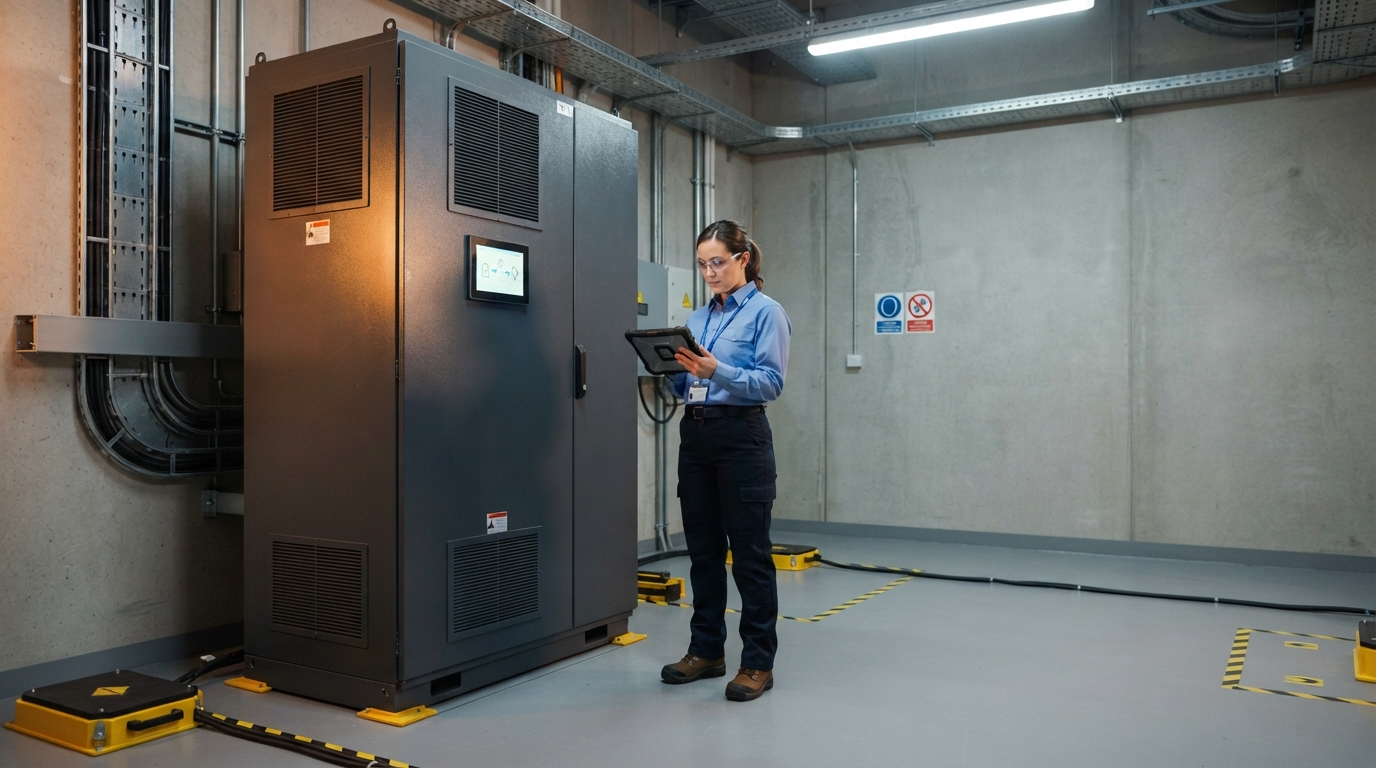
The accuracy of your ROI model depends entirely on the quality of your inputs. A battery storage project has three input categories: site and tariff data, battery performance data, and cost and financing data.
Site and Tariff Data
You need a clear picture of how your facility consumes electricity and how your utility charges for it.
- Interval load data: 15-minute or hourly consumption data for at least 12 months.
- Current utility tariff: energy charges, demand charges, time-of-use periods, and any ratchets.
- Operating schedule: hours of operation, shift patterns, and seasonal variation.
- Critical loads: which equipment must remain powered during an outage.
- Planned changes: EV charging, electrification, production expansion, or new equipment that will alter the load profile.
Without accurate load data, the model is guesswork. A battery that appears very profitable on an average day may struggle to capture value if the facility’s peak occurs at an unusual time or is driven by a single large asset.
Battery Performance Inputs
Battery specifications that affect the financial model include:
- Rated power (kW): How much power the battery can deliver at a given moment. This determines whether the battery can shave a peak or respond to a demand-response event.
- Rated energy (kWh): The total stored energy, before usable-energy limits are applied.
- Usable energy (kWh): The share of rated energy you can actually dispatch, limited by depth of discharge (DoD). A battery rated at 100 kWh with 90% DoD has 90 kWh of usable energy.
- Round-trip efficiency (%): The percentage of stored energy that can be withdrawn after charging and discharging losses. Typical values are 85–95%.
- Cycle life: The number of charge/discharge cycles the battery can deliver before capacity degrades.
- Degradation: The gradual loss of usable capacity over time, which reduces savings in later years.
- Auxiliary loads: Power consumed by cooling, controls, and monitoring systems, which reduces net deliverable energy.
These inputs determine how much energy you can actually shift, how fast you can respond, and how long the system remains profitable. A battery with a low round-trip efficiency will need a larger arbitrage spread to generate the same value as a more efficient unit.
Cost, Financing, and Lifecycle Inputs
The ROI model must capture the full lifecycle cost of the system, not just the hardware price.
- CAPEX: Battery hardware, PCS/inverter, integration, balance-of-plant, installation, interconnection, permitting, and commissioning.
- OPEX: Maintenance, monitoring, insurance, software/EMS fees, and warranty adders.
- Financing: Interest on debt, lease payments, or PPA terms. Financing structure changes cash flow and payback. See commercial battery storage financing for a detailed look at funding options.
- Incentives: Rebates, tax credits, or grant programs that reduce net cost. These change frequently and vary by region, so verify current eligibility.
- Augmentation and replacement: Some systems require adding modules over time to maintain capacity, which adds future capital cost.
- Residual value: The value of the system at end of life, if any.
For a detailed breakdown of system cost components, see commercial battery storage cost per kwh.
How to Calculate Payback and ROI for a Commercial Battery System
The simplest payback calculation is:
Simple payback (years) = Net project cost ÷ Total annual net benefits
Where net project cost is the total installed cost minus incentives, and total annual net benefits is the annual savings plus revenue minus annual operating costs.
Example (hypothetical):
| Input | Assumption |
|---|---|
| System size | 100 kW / 200 kWh usable |
| Net project cost | $250,000 |
| Annual demand-charge savings | $30,000 |
| Annual TOU arbitrage savings | $12,000 |
| Annual solar self-consumption value | $8,000 |
| Annual grid-service revenue | $5,000 |
| Annual O&M cost | $4,000 |
| Net annual benefits | $51,000 |
Payback = $250,000 ÷ $51,000 = 4.9 years
This example uses assumptions for illustration only. Your actual figures will depend on tariff rates, load profile, system performance, and market participation. To build a robust model:
- Collect interval load data and tariff documents.
- Model the battery dispatch strategy month by month.
- Apply round-trip efficiency and degradation to energy figures.
- Include all lifecycle costs, not just the purchase price.
- Test the model with different sensitivity inputs.
Why Real-World ROI Sometimes Misses the Projection
Battery-storage projects underperform when the model is built on optimistic assumptions. The most common reasons are:
- Double counting value streams: The same discharge event is counted for both demand-charge savings and demand-response revenue. A battery can only be in one place at one time.
- Ignoring degradation: Capacity fades over time, reducing savings in years 5–10.
- Using ideal efficiency figures: Round-trip efficiency is lower in real operating conditions, especially with high charge/discharge rates or extreme temperatures.
- Assuming static tariffs: Power rates, demand charges, and TOU windows change. Rising rates may improve savings; restructuring can reduce them.
- Mismatched battery size: Oversizing the battery relative to the load profile leaves capacity unused. Undersizing leaves peak-reduction potential on the table.
- Soft-cost surprises: Permitting, interconnection, commissioning, insurance, and financing fees are often underestimated.
- Poor dispatch logic: The EMS or control system may not be optimized for tariff-aware scheduling, reducing achievable value.
Run a sensitivity analysis to see how payback changes if key assumptions are 10–20% worse than expected. A project should only be approved if it survives reasonable downside scenarios.
What to Ask a Supplier Before Committing to the Financial Model
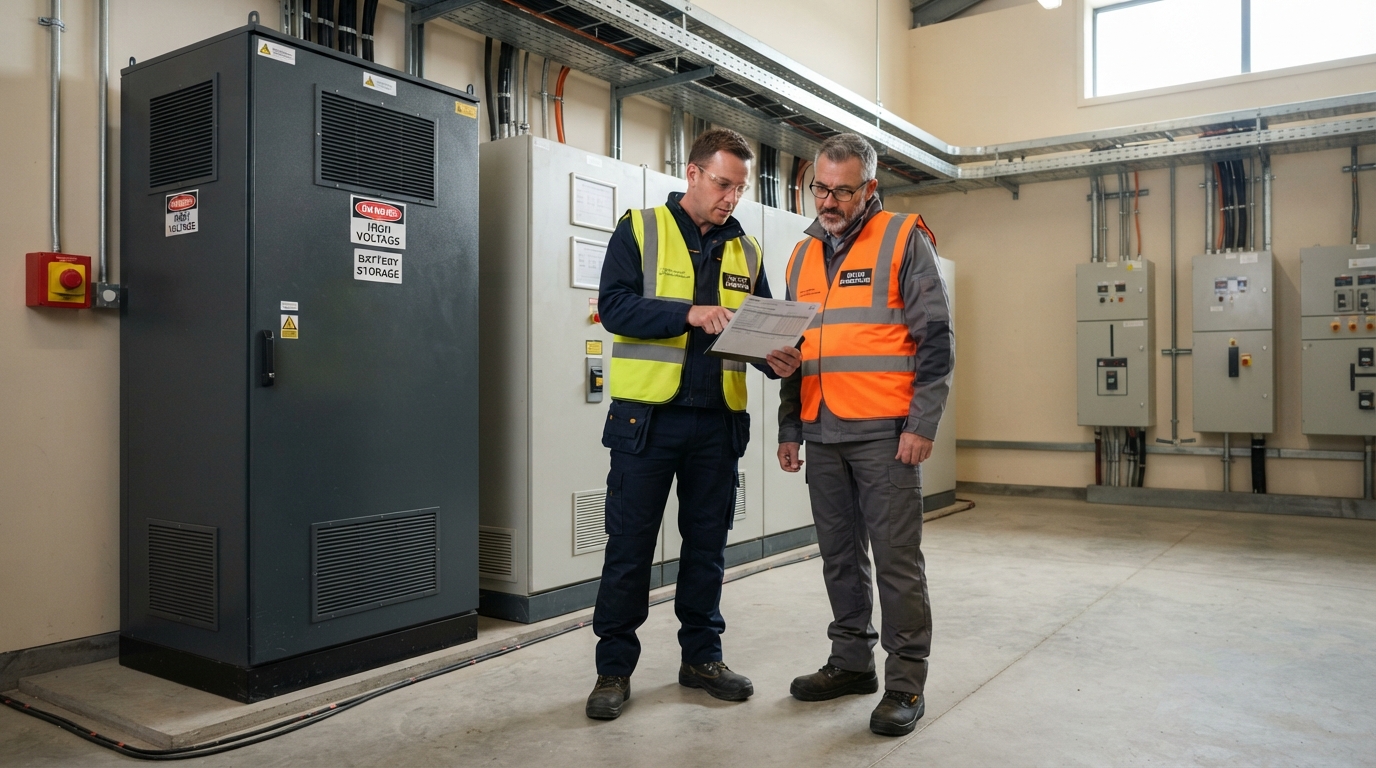
Your supplier should provide the information needed to build a credible model, not just a price quote. Ask for:
- A detailed cost breakdown: hardware, PCS/inverter, integration, installation, interconnection, soft costs, and warranty.
- Performance documentation: usable energy, DoD, round-trip efficiency under operating conditions, and degradation curve.
- EMS capabilities: tariff-aware scheduling, demand forecasting, solar integration, generator coordination, and communication protocols.
- BMS and safety features: protection functions, thermal management, fire-safety design, and applicable model-level certifications.
- Warranty and performance guarantees: what is warranted, for how long, under what throughput conditions, and what happens if the system underperforms.
- Integration plan: inverter compatibility, communication with existing building systems, and interconnection support.
- Long-term support: who is responsible for maintenance, monitoring, and replacement if the supplier discontinues the model.
Compare quotations on lifecycle performance, not just price per kWh. A slightly more expensive system with better efficiency, stronger dispatch software, or a more comprehensive warranty can deliver better ROI over its lifetime. To understand how complete systems are configured, review the ci energy storage system page as a reference point for what to expect from a commercial-grade solution.
The Bottom Line on Commercial Battery Storage ROI
Commercial battery storage ROI is a site-specific calculation, not a one-size-fits-all number. It depends on your facility’s load profile, utility tariff, battery performance, system cost, financing, and operating strategy.
The smart first step is not to buy a battery. It is to gather your interval load data, tariff documents, and facility operating schedule. Then model the realistic value stack for your site, test it against downside scenarios, and ask suppliers to provide complete performance and cost data before you compare proposals. A well-built model protects you from inflated promises and helps you identify the project that genuinely makes sense for your business.

-

 OEM Residential Energy Storage Solutions: Passive vs. Active Cell Balancing
2026-09-30
-
 Smart Home Battery with BMS Communication: Cybersecurity and BMS Safety
 -
 10kWh Home Battery Backup System: Is 90% DoD Better for Daily Solar Storage?
2026-09-29
-
 Integrated Home Energy Storage System 150–430V MPPT Design
2026-09-28
-
 LiFePO₄ Residential Backup Battery SOC Accuracy in Parallel Systems
Share this:






.svg)






-899.svg)


