




Commercial Battery Storage Cost per kWh: What Changes the Quote
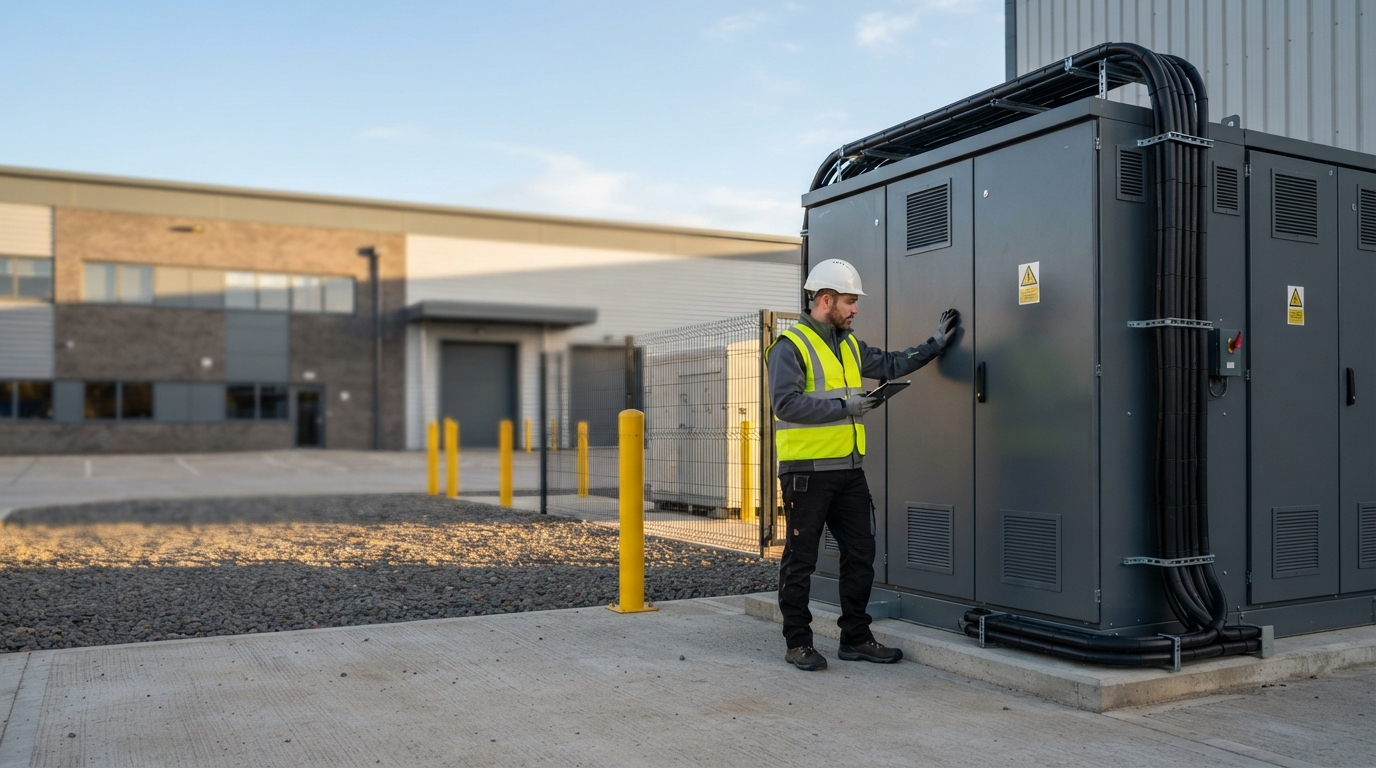
There is no honest single answer to “What does commercial battery storage cost per kWh?” A commercial battery quote can describe a bare battery module, a fully integrated BESS, or a complete installed project. Those three things have very different price levels.
The real question is not simply “What is the price?” It is “What is included in the price, and why does the quote change when the system changes?”
This guide explains the different ways cost per kWh is quoted, what drives the number, and how to compare commercial battery storage quotations like-for-like.
What “Cost per kWh” Actually Means in a Commercial Battery Quote
When a supplier or article gives you a cost per kWh, the first thing to check is which kWh they mean. The same number can describe completely different scopes.
| Quote basis | Usually includes | Usually leaves out |
|---|---|---|
| Battery hardware / module-level | Cells, modules, and the rack or pack structure; sometimes a basic BMS | PCS/inverter, EMS, enclosure, cooling, fire suppression, installation, shipping |
| BESS equipment cost | Battery hardware plus BMS, PCS/inverter, EMS, enclosure, thermal management, and fire-safety components | Freight, installation, commissioning, grid connection, site works |
| Installed project cost | Equipment plus engineering, installation, commissioning, interconnection support, logistics, taxes, and project management | Operating costs, degradation, maintenance, replacement, financing |
| Lifetime storage cost | Installed cost plus the operating and performance effects of efficiency, degradation, and warranty over the system’s life | A simple number that can be compared without agreeing on assumptions |
Most of the disagreement you see between quoted prices comes from comparing these different scopes as if they were the same thing. A battery-only price will always look cheaper than an installed BESS price, even if the underlying hardware is similar.
Organizations such as the U.S. National Renewable Energy Laboratory treat system size and storage duration as separate variables in their commercial battery storage technology baseline rather than reporting one fixed cost per kWh. That is an accurate reflection of the market: the useful price depends on the project, not on a universal benchmark.
Why kWh Alone Does Not Set the Price: Capacity, Power, and Duration
A second common mistake is comparing quotes only by kWh.
- kWh is the amount of energy the battery can store.
- kW is the rate at which the battery can deliver that energy.
- Duration is roughly the usable energy divided by the rated power.
So a 200 kWh system rated at 100 kW can deliver full power for about 2 hours. The same 200 kWh system rated at 200 kW can deliver full power for about 1 hour.
Both systems have the same stored energy, but they are not the same product. The higher-power version needs a larger PCS/inverter, heavier electrical connections, and more thermal management. That changes the price, even though the kWh number stays the same.
There is also a difference between nominal capacity and usable capacity.
Nominal capacity is the full energy content of the battery under standard conditions. Usable capacity is the energy the system is allowed to deliver without shortening its service life, because depth-of-discharge limits and other operating rules protect the cells.
For example, a nominal 200 kWh system with 90% usable energy can deliver about 180 kWh before recharge. If one supplier quotes the nominal figure and another quotes the usable figure, the price per kWh will look different even when the actual hardware cost is the same.
Always ask whether a quote is based on nominal kWh or usable kWh.
What Is Inside a Typical Commercial BESS Quote
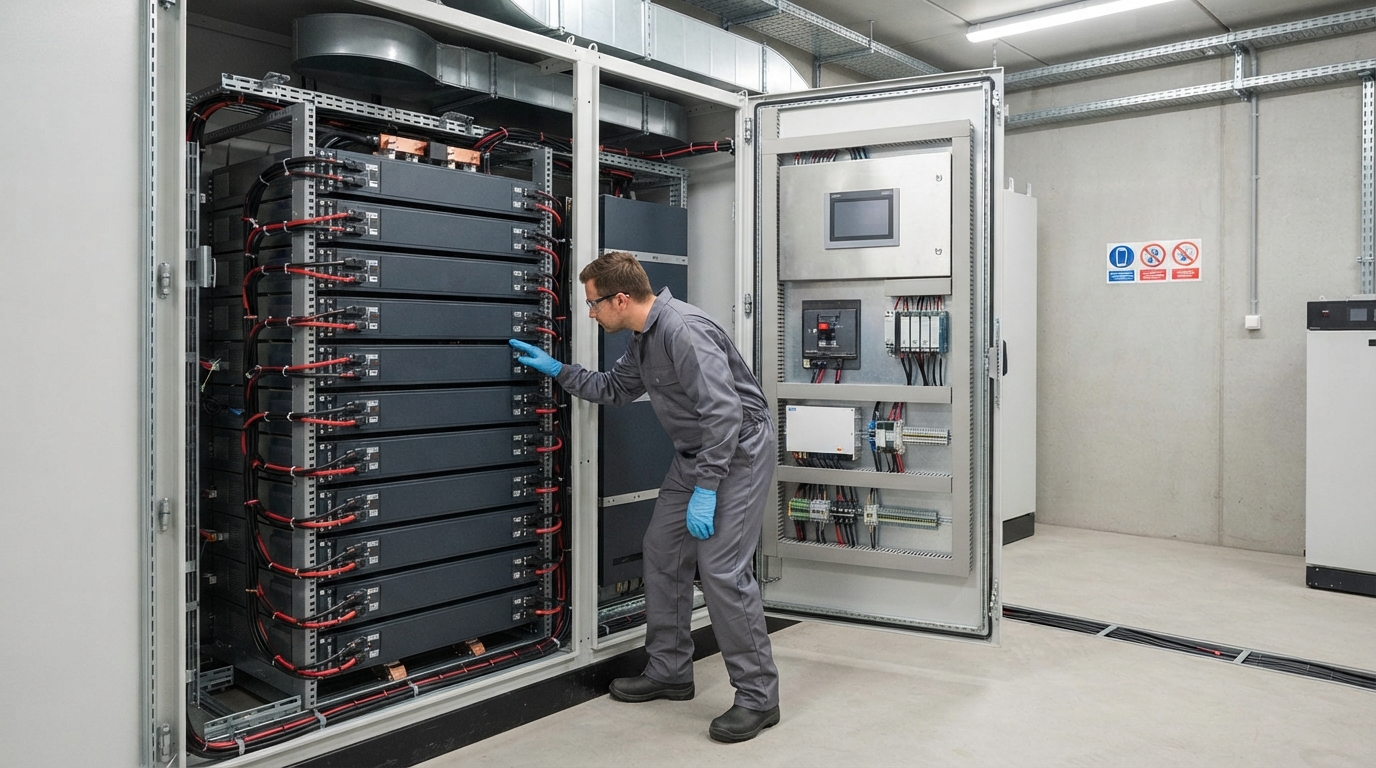
A complete commercial battery storage system is more than a battery. The components below explain why two systems with similar kWh can have very different prices.
| Component | What it does | Why it affects cost |
|---|---|---|
| Battery modules and racks | Store energy | The main kWh-based cost driver |
| BMS | Protects the cells, manages balancing, and communicates status | Cost scales with cell count, safety features, and functionality |
| PCS/inverter | Converts DC battery power to AC power for the site | Cost scales with power output, not just stored energy |
| EMS | Controls when the battery charges, discharges, and responds to site signals | More complex applications need more capable software |
| Enclosure | Houses the equipment and protects against the environment | Indoor vs outdoor, footprint, and IP rating change the design |
| Thermal management | Keeps cells within their operating temperature range | Cooling method and ambient conditions affect cost |
| Fire detection and suppression | Reduces the risk of thermal events | Required in many installations and can add significant cost |
| Auxiliary electrical equipment | Includes cabling, breakers, metering, transformer, and switchgear | Site-specific and often underestimated |
Battery Hardware and Storage Enclosure
The battery itself is usually assembled from cells into modules, modules into racks, and racks into a cabinet or container. The way those components are packaged affects the price.
A cabinet system is often easier to place on an existing site. A containerized system can offer better economies of scale when space is available, but it brings larger logistical and site-planning requirements. Enclosure choice also depends on whether the system is installed indoors or outdoors, and what climate and safety conditions it must handle.
PCS, BMS/EMS, Cooling, and Fire Safety
The power conversion system, or PCS/inverter, is sized around the required power output. That is why two systems with the same kWh can have different equipment costs when one is designed for higher power.
The BMS protects the battery pack and keeps the cells balanced. The EMS manages how the system operates across applications such as peak shaving, load shifting, or backup power. Cooling design affects both the hardware cost and the auxiliary energy the system consumes. Fire detection and suppression requirements depend on local codes, system size, and installation location.
For a closer look at the full system architecture, see our ci energy storage system page.
Project, Site, and Logistics Costs That Are Often Understated
The most common reason an installed commercial battery storage project costs more than the advertised hardware price is that site, grid, and delivery costs are left out.
These costs can be grouped into four areas:
Engineering and project costs
- System design and engineering.
- Permitting and approval.
- Project management.
- Safety reviews.
Installation and commissioning
- Delivery to site.
- Mounting and assembly.
- Electrical installation.
- Testing, startup, and operator training.
Site and grid infrastructure
- Civil works, foundations, or concrete pads.
- Transformer, switchgear, and metering upgrades.
- Grid interconnection studies and utility approvals.
- Fire-code and inspection requirements.
The grid and fire-safety items are especially variable. A site with an existing transformer and available interconnection capacity will cost less to connect than a site that requires new electrical infrastructure. These requirements vary by utility and jurisdiction, so no single price per kWh can include them all.
Logistics and commercial terms
- Freight and insurance.
- Import duties and taxes.
- Incoterms, which define whether the seller or buyer pays for delivery, insurance, and customs clearance.
Ask every supplier to state which of these items are included in the quote and which are separate. A quote with a low battery price may simply exclude the costs that make the project usable.
Why Smaller Commercial Systems Usually Cost More per kWh
Smaller commercial systems often look expensive on a per-kWh basis. That is not usually because the supplier is charging a premium for the battery. It is because many of the costs do not shrink when the battery gets smaller.
Engineering, project management, safety design, installation labor, and grid connection work all have a practical minimum cost. If that minimum cost is spread across a 50 kWh system, the cost per kWh will be higher than if it is spread across a 500 kWh system.
The same logic applies to hardware. Power electronics, controls, cooling, and fire safety do not scale in direct proportion to battery capacity. A small cabinet may still need a similar BMS, EMS, PCS, and protection package as a larger cabinet, even though it stores far less energy.
This is not an argument to oversize a system. It simply explains why comparing a small commercial project with a utility-scale project produces meaningless price differences.
How the Application Changes the Required System and the Quote
The same kWh number can produce very different project costs depending on what the system is expected to do.
| Application | What usually drives sizing | Why the quote changes |
|---|---|---|
| Peak shaving / demand management | Dispatchable energy and EMS capability | More complex controls and metering or integration work |
| Load shifting | Energy capacity and cycle life | Larger kWh and cells designed for frequent cycling |
| Solar self-consumption | PV-inverter compatibility and control logic | Need for inverter/PCS integration and EMS coordination |
| Backup power | Power rating, transfer speed, and autonomy | Higher kW output, standby capability, and possibly different control logic |
The same battery cabinet can sometimes serve more than one application, but only if the PCS, EMS, and protection settings are specified for it. That is why two quotes with the same kWh can have different prices when one system is designed for demand management and the other is designed for backup.
For backup-specific system requirements, see our commercial backup energy storage solutions.
How to Compare Commercial Battery Storage Quotes Like-for-Like

The most useful thing a buyer can do is force every supplier to quote the same scope and the same technical basis.
Use this checklist when comparing quotes:
- Scope of supply: battery hardware, BMS, PCS/inverter, EMS, enclosure, cooling, fire safety.
- Nominal kWh vs usable kWh.
- Rated power in kW.
- Storage duration at rated power.
- Depth-of-discharge limit and round-trip efficiency assumptions.
- Delivery terms: ex-works, FOB, DDP, or another Incoterm.
- Freight, insurance, import duties, and taxes.
- Installation and commissioning responsibilities.
- Interconnection and utility-approval responsibilities.
- Warranty term, exclusions, and performance guarantees.
- Quote validity period.
- A written list of exclusions.
When you request quotes, give every supplier the same project data:
- Site address and environment.
- Load profile and monthly demand.
- Target application: peak shaving, load shifting, solar self-consumption, backup, or a combination.
- Available solar PV capacity, if relevant.
- Backup loads and required autonomy, if backup is needed.
- Grid constraints or interconnection requirements.
- Project timeline.
- Installation responsibility.
- Required certifications or compliance documents.
- Delivery location and preferred Incoterms.
This makes the quotes comparable and reduces the chance of comparing a battery-only price from one supplier with an installed-project price from another.
Upfront Cost per kWh vs Lifetime Storage Cost
The price per kWh on a quotation is an upfront cost. It does not tell you how much the system costs per useful kWh over its operating life.
Four factors matter once the system is running:
- Round-trip efficiency determines how much energy you get out compared with what goes in.
- Degradation reduces the usable capacity over time.
- Cycle life determines how long the battery can serve the intended duty cycle.
- Warranty defines what the supplier guarantees and under what conditions.
A cheaper upfront quote can become more expensive over time if the system has lower efficiency, faster degradation, a shorter cycle life, or a warranty that excludes the operating conditions you need.
Levelized cost of storage, or LCOS, is the concept used to compare lifetime cost, but it requires assumptions about charging costs, dispatch, financing, maintenance, and degradation. Those assumptions belong in a financial analysis, not in a simple price-per-kWh comparison.
Cost is an input to payback, not the final measure of value. For the next step, see our commercial battery storage ROI guide.
FAQ — Commercial Battery Storage Cost per kWh
Do commercial battery-storage quotes normally include installation?
Not always. Some quotes cover equipment only, while others include installation and commissioning. Always confirm which costs are included and which are separate before comparing prices.
Are prices quoted per nominal kWh or usable kWh?
Suppliers can use either basis. Ask directly whether the price is based on nominal capacity or usable capacity. Comparing the two as if they were the same will produce misleading results.
How long is a commercial battery quote usually valid?
Battery prices and freight costs can move quickly, so validity periods vary. Ask the supplier to state the validity period in writing, and do not assume a price is still current after several months.
Quotes are only comparable when the scope is comparable. If you are planning a commercial or industrial installation, write down the same project data for every supplier: application, load profile, site conditions, target duration, and delivery expectations. VoltaLink Battery covers commercial and industrial energy storage on its website and can discuss a project-specific approach when you reach out through the site.

-

 OEM Residential Energy Storage Solutions: Passive vs. Active Cell Balancing
2026-09-30
-
 Smart Home Battery with BMS Communication: Cybersecurity and BMS Safety
 -
 10kWh Home Battery Backup System: Is 90% DoD Better for Daily Solar Storage?
2026-09-29
-
 Integrated Home Energy Storage System 150–430V MPPT Design
2026-09-28
-
 LiFePO₄ Residential Backup Battery SOC Accuracy in Parallel Systems
Share this:





.svg)






-899.svg)


