




Air-Cooled vs Liquid-Cooled BESS: Which Architecture Fits the Project?
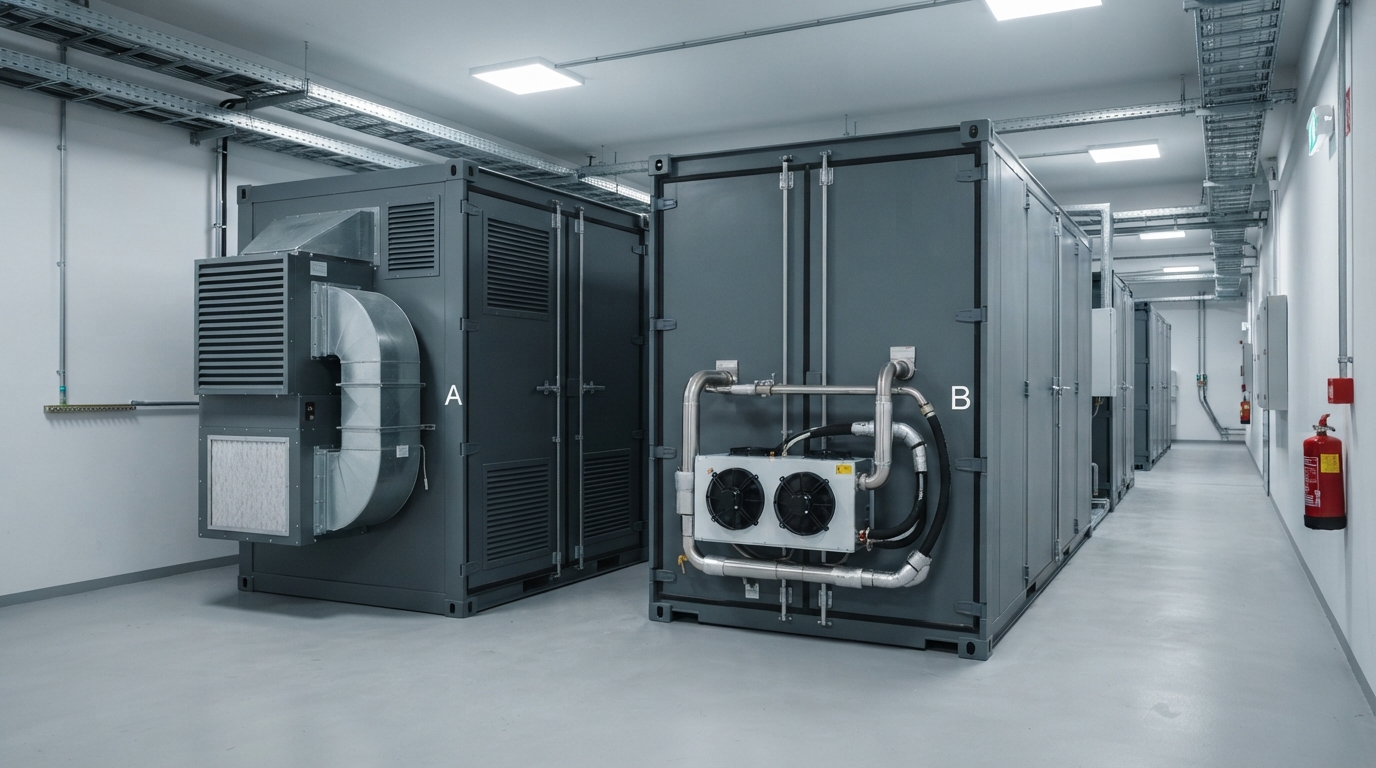
Choosing between air-cooled and liquid-cooled battery energy-storage systems (BESS) is not about finding a universal winner. It is about matching the thermal-management architecture to the project’s actual duty cycle, site conditions, space constraints, and maintenance capability. Air cooling is often simpler and easier to maintain. Liquid cooling can remove heat more effectively and improve temperature uniformity in demanding applications. The right choice depends on how hard the battery will work, where the system will be installed, and what the owner can support over the system’s life.
This article compares both architectures, explains the project factors that matter, and finishes with a supplier-documentation checklist so you can evaluate competing offers against the same evidence-based standard. For a broader view of how containerized BESS systems are designed and controlled, see Battery Energy Storage Container: Smart Energy Control for Real-Time Grid Response.
How Air-Cooled and Liquid-Cooled BESS Manage Heat
Batteries generate heat during charge and discharge. The rate of heat generation depends on current, internal resistance, and chemistry. If that heat is not removed, cell temperatures rise, temperature differences between modules grow, and the result can be accelerated aging, reduced usable capacity, or in extreme cases, safety events. Thermal management therefore has two objectives: remove heat and keep temperature uniform across cells and modules.
The two dominant thermal-management architectures solve those objectives differently. One moves air across the battery modules. The other circulates a liquid coolant through plates or manifolds attached to the modules. Both can be well designed or poorly designed. A well-designed air-cooled system can serve many projects. A poorly designed liquid-cooled system will not outperform it simply because it uses liquid.
It is also important to distinguish battery cooling from the cooling of power-conversion equipment. A BESS container holds more than batteries. The PCS, transformers, and control electronics generate heat as well. An architecture that keeps battery modules cool may need separate provisions for power-conversion equipment. The comparison below focuses on the battery side, but a complete evaluation should cover both.
How Air-Cooled BESS Works
In an air-cooled BESS, fans or blowers push air across the battery modules. The airflow path is designed to carry heat away from the cells and out of the enclosure. The system may include filters, ducting, and HVAC equipment that heats, cools, or dehumidifies the air before it reaches the battery space.
Air is readily available and inexpensive to move. But air has a lower heat-transfer capability than a liquid coolant, so the design must pay close attention to flow distribution. If some modules receive less airflow than others, hot spots form. Those temperature differences lead to uneven aging and performance. Larger systems or high-power designs may therefore require larger fans, more ducting, and heavier HVAC capacity.
The practical implications for an owner are straightforward: filters need to be cleaned or replaced, fans and HVAC components wear out, and dust or humidity can degrade performance. For a detailed look at enclosure-level thermal-control options, see our article on bess container hvac system.
How Liquid-Cooled BESS Works
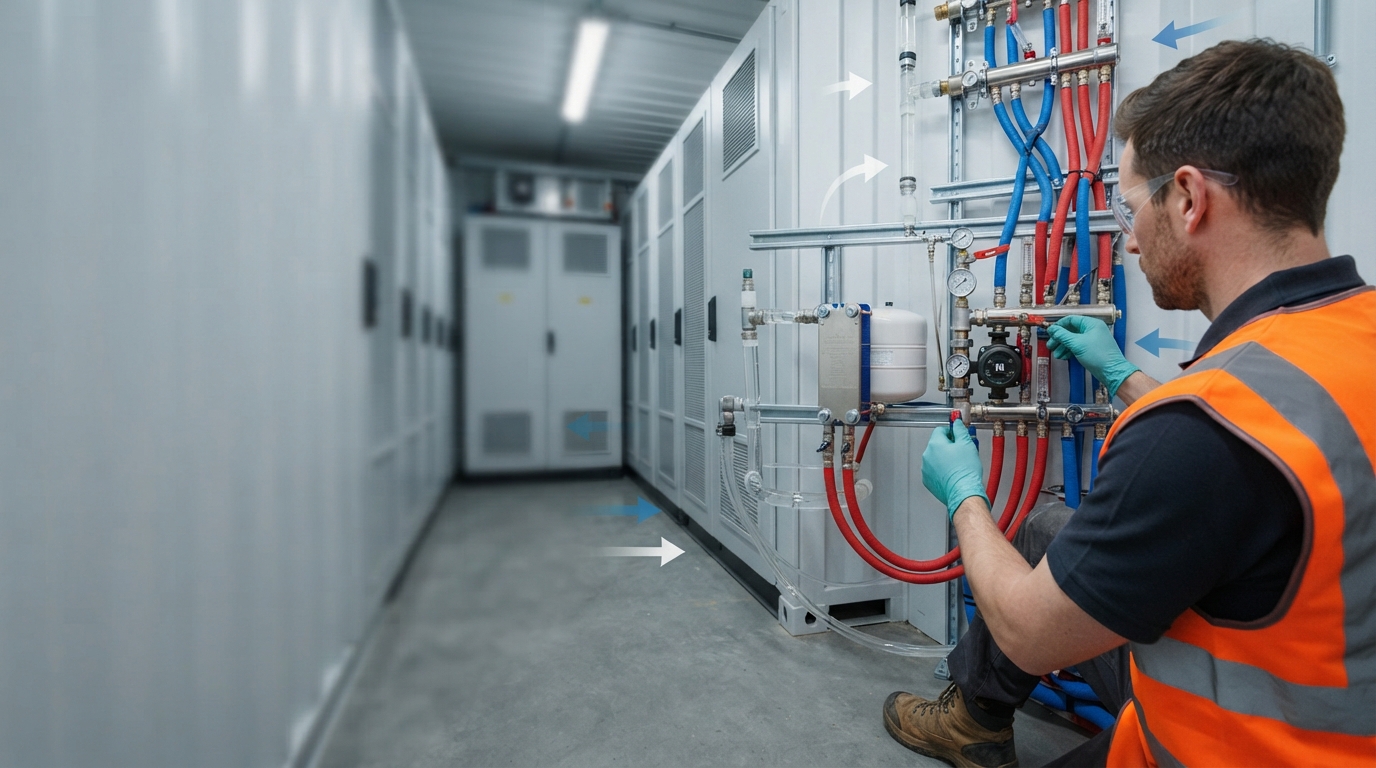
A liquid-cooled BESS attaches cold plates or cooling manifolds directly to the battery modules. A pump circulates a coolant through the loop, and a heat exchanger rejects the captured heat to the ambient air or to a secondary cooling loop. Because the coolant has a higher heat capacity and thermal conductivity than air, heat can be moved away from the modules more effectively and with greater temperature uniformity.
Liquid cooling also adds complexity. The pump is a moving part that can fail. The coolant must be maintained at the correct concentration, flow rate, and condition. Leak detection, condensation management, and freeze protection must all be engineered into the system. If the coolant loop is not serviced properly, thermal performance can degrade quietly over time.
In practice, liquid cooling is most valuable when heat is concentrated, duty cycles are demanding, or available floor space is tight. It can reduce the volume needed for cooling infrastructure and keep cell temperatures within a tighter band during aggressive cycling.
Air-Cooled vs Liquid-Cooled BESS: Side-by-Side Comparison
| Comparison Factor | Air-Cooled BESS | Liquid-Cooled BESS |
|---|---|---|
| Heat-transfer capability | Lower; more dependent on ambient air temperature | Higher; coolant carries more heat per unit volume |
| Temperature uniformity | Good when airflow is well distributed; risk of hot spots | Better in many designs; module-level plates reduce thermal gradients |
| System complexity | Moderate; fans, filters, ductwork, HVAC | Higher; pump, coolant loop, cold plates, heat exchanger, leak detection |
| Footprint and power density | Requires more airflow volume; may need larger enclosure or spacing | More compact thermal path supports higher power density |
| Auxiliary energy consumption | Depends on fan and HVAC load; can be significant in hot climates | Depends on pump and heat-rejection load; not automatically lower |
| Maintenance | Filters, fans, and HVAC service; usually familiar to facility teams | Pump, coolant, seals, leak checks; may require specialized service |
| Environment sensitivity | Airflow performance drops with high ambient temperatures, altitude, dust, and humidity | Battery heat removal is less air-dependent, but heat rejection still depends on ambient conditions |
| First-cost direction | Generally lower upfront complexity | Generally higher upfront complexity |
| Best-fit project types | Moderate C-rates, temperate sites, space available, standard service capability | High cycling, hot or high-altitude sites, compact footprints, sophisticated maintenance support |
The table is intentionally qualitative. Actual differences between products depend on the specific thermal design, the battery cell configuration, and the operating envelope the supplier actually validates.
How to Choose the Right Cooling Architecture for Your Project
The most reliable way to choose is to start with project inputs, not marketing claims. Collect the rated power (kW), usable energy (kWh), charge and discharge current (A), C-rate, expected cycles per day, ambient temperature range, altitude, available footprint, dust and humidity conditions, noise constraints, and the owner’s maintenance capability. Then evaluate each architecture against that profile.
Duty Cycle and Power Density
Battery heat generation is directly related to charge and discharge current. A system that cycles multiple times per day at a high C-rate produces significantly more heat than a system operating in daily backup mode. Sustained high current raises internal cell temperatures and increases the need for effective heat removal.
The EMS sets the operating schedule, and that schedule determines the duty cycle and cumulative thermal load. A peak-shaving application may cycle several hours each day and require a very different cooling design than a backup system that rarely operates.
Power density matters because heat is concentrated in a smaller physical space. A high-density container that packs more kilowatt-hours into a standard 20-foot or 40-foot form factor creates a more demanding thermal environment. Liquid cooling often earns its higher upfront complexity when heat concentration and sustained cycling are both high. Air cooling can handle moderate duty cycles and lower power densities, particularly when the enclosure has room for adequate airflow.
Site Environment and Space Constraints
Air cooling depends on ambient air conditions. High temperatures reduce the temperature difference between the battery and the cooling air, lowering the system’s ability to reject heat. High altitude reduces air density and weakens the heat-transfer effectiveness of fans and airflow systems. Dust and humidity add filtration and condensation concerns that affect maintenance frequency and system reliability.
Liquid cooling reduces the dependence on ambient air for the battery-to-coolant heat transfer. But the heat still must be released to the environment through a heat exchanger, so ambient conditions cannot be ignored entirely.
Space also plays a role. A liquid-cooled system transfers more heat per unit volume and can reduce the footprint needed for thermal-management equipment. Projects located in tight sites, or retrofits into existing enclosures, may favor liquid cooling for that reason alone.
Maintenance and Total Cost of Ownership
The economic decision goes beyond upfront CapEx. An air-cooled system requires filter changes, fan inspections, HVAC maintenance, and periodic checks of airflow. These tasks are familiar to most facility teams. A liquid-cooled system requires coolant-level and condition checks, pump health monitoring, leak inspection, condensation control, and sometimes specialized service. If the owner cannot support liquid-loop maintenance, the long-term cost of ownership will rise even if the initial price is competitive.
Auxiliary energy consumption also matters. Fans, HVAC compressors, and pumps all consume power. A liquid-cooled system does not automatically consume less energy than a well-designed air-cooled system; the comparison depends on ambient conditions, duty cycle, and control logic. When a supplier claims an efficiency advantage, ask for the test conditions and operating envelope behind the claim.
The Safety Boundary: Cooling, BMS, and Fire Suppression
Cooling architecture is not a substitute for fire-safety engineering. Thermal management helps control temperature, but thermal runaway is a complex chain of events involving cell failure, heat generation, and gas release. A cooling system does not eliminate that risk.
The BMS monitors voltage, current, and temperature at the cell or module level and can limit operation before conditions become unsafe. Fire detection, alarm systems, gas sensors, suppression agents, enclosure design, ventilation, and separation distances are separate layers governed by project-specific codes and standards.
In the United States, safety context often includes UL 9540 for system certification, UL 9540A for thermal-runaway fire-propagation testing, and NFPA 855 for installation requirements. Internationally, IEC 62933-5-3 provides safety guidance for grid-connected energy-storage systems. The Sandia National Laboratories codes and standards reference provides a useful overview of the broader landscape, and UL Solutions offers a practical guide to BESS regulatory compliance.
When you evaluate a BESS supplier, distinguish between cell-level certificates and system-level safety evidence. A cell certificate alone does not prove that the complete container has been tested for thermal-runaway propagation.
What Documents Should You Request from a BESS Supplier?
Comparing air-cooled and liquid-cooled offers is only reliable when every supplier provides the same level of evidence. Use this checklist when requesting quotations:
- Thermal-performance documentation for the proposed duty cycle and ambient temperature range.
- Module-level temperature data or a thermal map that shows expected temperature differences during normal operation.
- Auxiliary-power consumption of the cooling system, with test conditions stated.
- Cooling-component details: fans, HVAC units, pumps, coolant type, cold plates, and heat-exchanger specifications.
- Leak detection and condensation controls for liquid-cooled systems.
- System-level safety evidence, including which standard or test report applies to which model.
- Warranty conditions for temperature, cycling, maintenance, and coolant-related service.
Ask the same questions to every supplier and treat submitted evidence as the basis for comparison. If a supplier will not provide model-specific thermal or safety documentation, that is a signal in itself.
VoltaLink publishes separate pages for its bess container supplier offering and its ci energy storage system solutions. It also maintains a liquid cooling energy storage system for industrial use product page. Apply the same documentation standard to any supplier you evaluate, including VoltaLink.
Final Decision Guide: Air-Cooled or Liquid-Cooled BESS?
Air cooling is often the better starting point when thermal load is moderate, site conditions are manageable, the enclosure has room for airflow, and the owner’s team can perform routine HVAC and filter maintenance.
Liquid cooling is worth serious evaluation when the project demands sustained high C-rates, power density is high, space is tight, ambient temperatures are elevated, or the owner can support liquid-loop maintenance and service.
Neither conclusion is a universal rule. The final selection must be based on project-specific data and model-specific supplier evidence. Ask for the thermal map, measure the auxiliary load, review the safety documentation, and compare total cost of ownership over the intended life of the system.

-

 OEM Residential Energy Storage Solutions: Passive vs. Active Cell Balancing
2026-09-30
-
 Smart Home Battery with BMS Communication: Cybersecurity and BMS Safety
 -
 10kWh Home Battery Backup System: Is 90% DoD Better for Daily Solar Storage?
2026-09-29
-
 Integrated Home Energy Storage System 150–430V MPPT Design
2026-09-28
-
 LiFePO₄ Residential Backup Battery SOC Accuracy in Parallel Systems
Share this:






.svg)






-899.svg)


