




2.6MWh Battery Container: Design Questions for Project Buyers
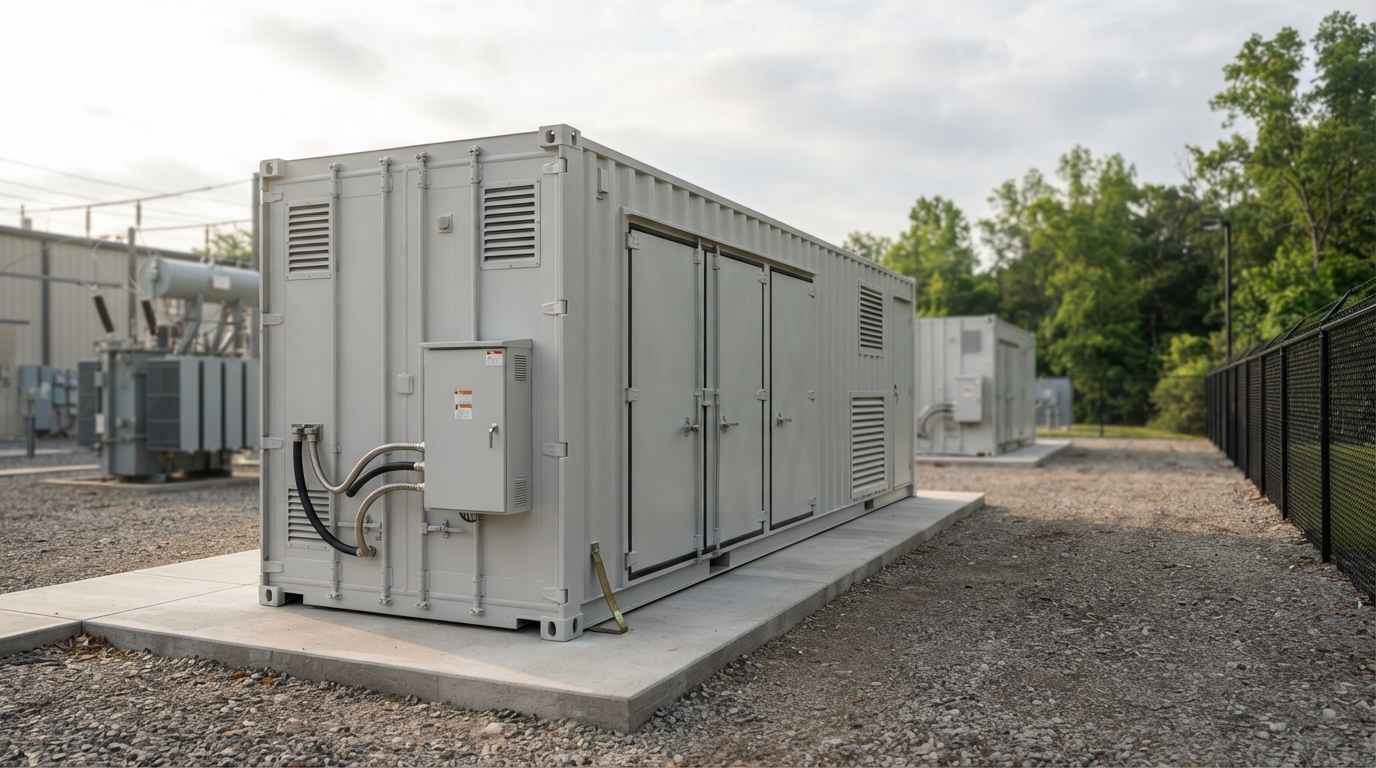
A 2.6MWh battery container is a containerized battery energy storage system (BESS) with roughly 2,600 kilowatt-hours (kWh) of nominal stored energy. It is a useful starting point for a commercial or industrial project, but it is not a complete specification.
If your job is to evaluate one of these containers, the useful question is not only “how much energy?” but also “what can this system deliver on site, for how long, and under what conditions?” This guide answers those questions. For the wider role of containerized BESS in grid response and energy control, see Battery Energy Storage Container: Smart Energy Control for Real-Time Grid Response. Here, the focus is on the design decisions behind a nominal 2.6MWh system.
What Does “2.6MWh” Specify — and What Does It Leave Out?
The unit “MWh” measures stored energy. One megawatt-hour is 1,000 kWh. A 2.6MWh container therefore holds about 2,600 kWh of energy when fully charged under the supplier’s stated conditions.
The unit “MW” measures power — how quickly that energy can be delivered or absorbed. A container with 2.6MWh of stored energy can be paired with many different power ratings. It might be configured with a 500 kW inverter, a 1,000 kW inverter, or a 1,250 kW inverter, depending on the application.
| Term | What it indicates | Why it matters to a buyer |
|---|---|---|
| MWh or kWh | Stored energy | Determines how long the system can supply a load, within system limits |
| MW or kW | Power | Determines how fast the system can charge or discharge |
That is why “2.6MWh battery container” does not tell you:
- the rated power of the PCS or inverter;
- how much of the nominal energy is usable;
- the round-trip efficiency;
- the operating temperature range;
- the cooling architecture;
- the safety and compliance evidence;
- the warranty conditions;
- the dimensions, weight, or site requirements.
The buyer’s first task is to separate the energy specification from the rest of the system. The second task is to confirm the usable energy rather than assuming the nominal value can be fully delivered.
Why Nominal Capacity Is Not Usable Capacity
Most battery systems do not operate from 100% state of charge to 0% on a regular basis. The supplier will normally define a recommended depth of discharge (DoD), and the usable energy of the system will be lower than the nominal energy.
For example, a nominal 2,600 kWh system with a 90% usable window would deliver about 2,340 kWh under ideal conditions, before conversion losses. The same system will also lose some energy during charging and discharging because of round-trip inefficiency.
When a supplier quotes a 2.6MWh system, ask:
- What is the nominal energy in kWh?
- What is the usable energy at the specified depth of discharge?
- What round-trip efficiency is assumed?
- At what temperature, charge rate, and discharge rate are those figures valid?
These numbers are more important than the nominal capacity when you estimate runtime and payback.
How to Match the 2.6MWh Battery to Project Power and Runtime
A battery container does not simply “supply 2.6MWh.” It supplies energy within the limits of the PCS and the battery’s own electrical and thermal design.
The rough relationship for estimating runtime is:
Usable energy (kWh) ÷ average load (kW) ≈ runtime (hours), before losses.
The calculation is useful for a first pass, but it assumes the battery can physically sustain the required current and that the PCS can deliver the required power.
| Illustrative example | Nominal energy | Usable at 90% DoD | Average load | Approx. runtime before losses |
|---|---|---|---|---|
| A | 2,600 kWh | 2,340 kWh | 500 kW | ~4.7 hours |
| B | 2,600 kWh | 2,340 kWh | 1,000 kW | ~2.3 hours |
| C | 2,600 kWh | 2,340 kWh | 1,250 kW | ~1.9 hours |
These are example calculations, not supplier guarantees. They show why the same energy rating can serve very different projects.
To define the required configuration, the buyer needs to answer:
- What is the connected load, and how much power does it demand?
- How long must the system sustain that load?
- Does the site need backup power, peak shaving, solar shifting, or grid services?
- Can the site accept a single container, or will the project need multiple containers?
- What is the AC output power of the PCS, and is that value compatible with the grid connection?
The required MW rating comes from the application. The MWh rating comes from the duration requirement. A 2.6MWh container is only one possible solution to that equation.
Core System Architecture: What the 2.6MWh Container Must Contain
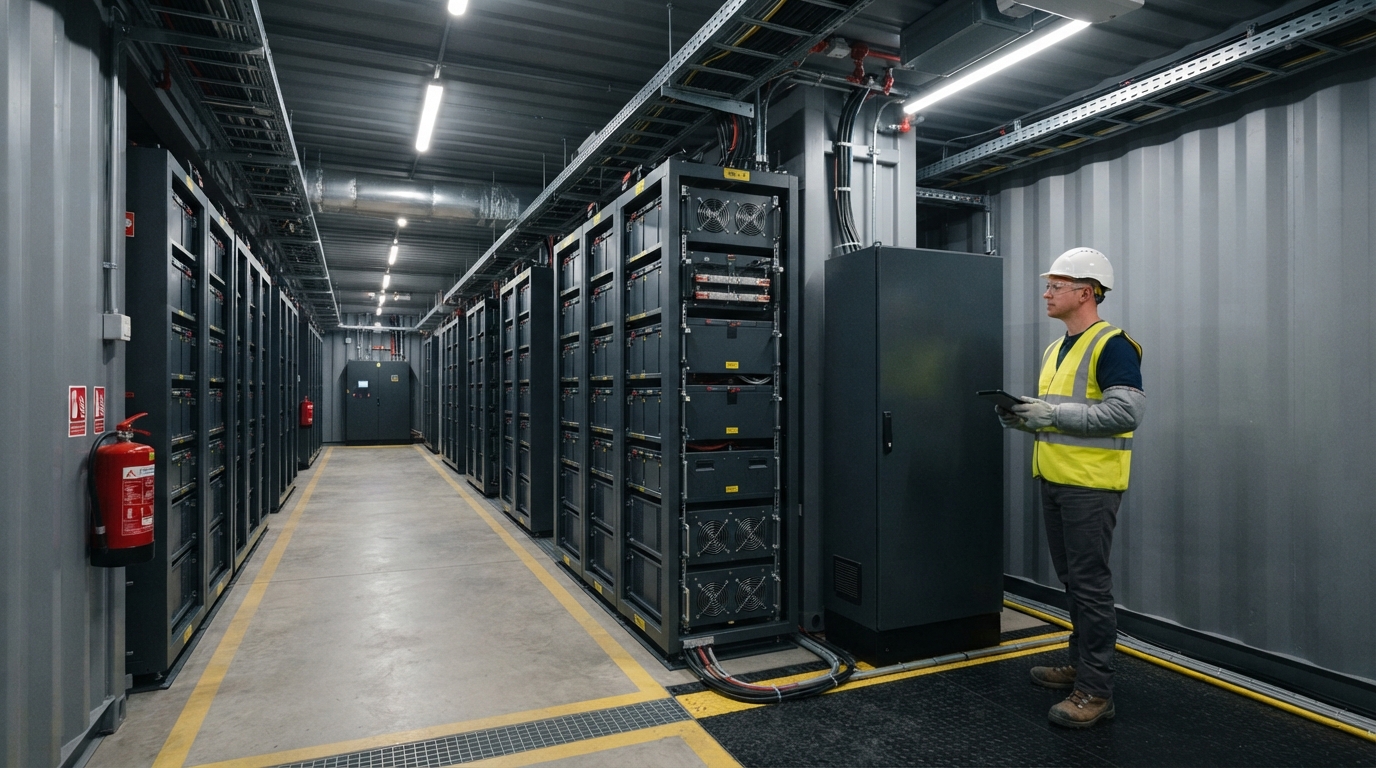
A containerized BESS is more than a stack of batteries inside a box. The main subsystems include the battery itself, the battery management system (BMS), the energy management system (EMS), the power conversion system (PCS) or inverter, thermal management, and fire detection and suppression.
The buyer should ask which of these components are included and which are supplied separately.
Battery Pack: Cells, Modules, and Racks
The battery is assembled in stages:
- Cells are the smallest unit.
- Cells are grouped into modules.
- Modules are installed into racks.
- Racks are connected inside the container.
This structure affects the system’s nominal voltage, amp-hour (Ah) capacity, and maintenance plan. Two containers with the same nominal kWh can use different cell sizes, module voltages, or rack counts.
Important questions include:
- What battery chemistry is specified? Lithium iron phosphate (LiFePO4) is common in container BESS designs, but the buyer should confirm the cell type.
- What is the nominal voltage and DC voltage range?
- What is the Ah capacity of the pack at the container level?
- What is the maximum continuous charge and discharge current, expressed in A or C-rate?
- Are cells, modules, or racks replaceable on site?
Do not confuse a module specification with a container specification. A module voltage and capacity are not the same as the full container voltage and capacity.
BMS, EMS, and PCS: Who Does What?
The control and power conversion layers determine whether the container can operate safely and coordinate with the site.
| Component | Main job | Typical buyer question |
|---|---|---|
| BMS | Monitors voltage, current, temperature, state of charge, and cell balance; protects the battery | What protections and alarms are included? |
| EMS | Coordinates system dispatch, schedules, and site or grid signals | Can it manage solar, load, or grid instructions? |
| PCS | Converts DC battery power to AC grid/load power and back during charging | What is the AC power rating and grid code compliance? |
These systems need to communicate. Common options include CAN, RS485, and Modbus, but the exact protocol depends on the supplier’s architecture.
Ask which component is responsible for:
- overcurrent, overvoltage, undervoltage, and overtemperature protection;
- state-of-charge reporting and balancing;
- charge and discharge control;
- grid interconnection and export limiting;
- remote monitoring and alarm handling.
The BMS is not a substitute for the EMS or the PCS. A complete container should describe how all three work together.
Air-Cooled or Liquid-Cooled: Which Is Right for the Project?
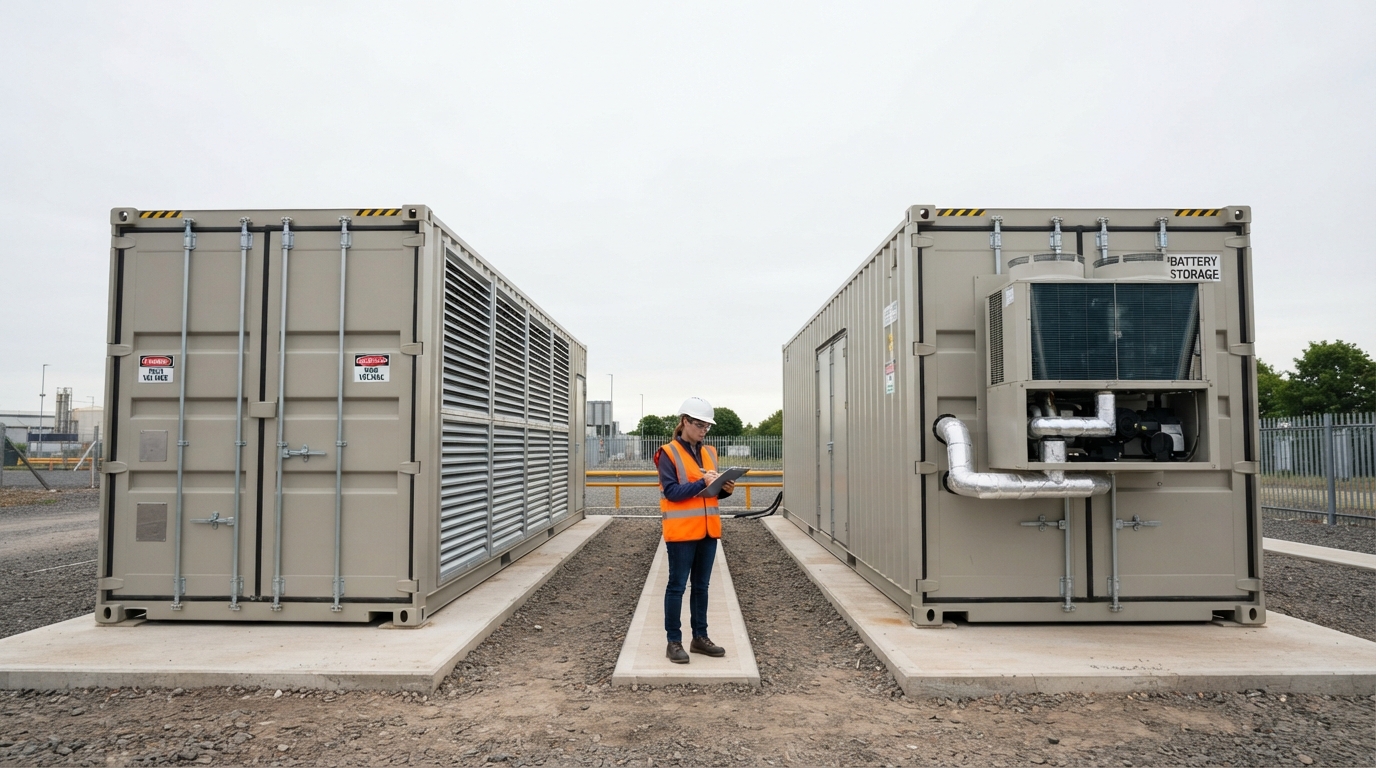
Thermal management is a design decision, not a checkbox. The cooling system influences container dimensions, auxiliary power consumption, battery temperature uniformity, service complexity, and performance in hot climates.
Air-cooled designs are generally simpler and use familiar HVAC equipment. Liquid-cooled designs can provide tighter temperature control and may support higher energy density, but they add components, maintenance points, and engineering complexity.
| Cooling approach | Potential advantage | Potential trade-off |
|---|---|---|
| Air cooling | Simpler system; familiar installation and maintenance | May be less effective in high ambient temperatures or high-rate applications |
| Liquid cooling | More consistent cell temperatures; compact thermal path | More components; more commissioning and maintenance points |
Neither option is universally better. The right choice depends on ambient conditions, charge and discharge rates, container layout, and the supplier’s service capability.
Ask the supplier:
- what cooling method is used;
- what ambient temperature range the system is designed for;
- how much auxiliary power the cooling system consumes;
- how the system behaves during maximum continuous discharge;
- what maintenance the cooling system requires.
For a deeper look at HVAC and thermal-control choices, see the bess container hvac system page.
Fire Safety, Site, and Transport: What the Buyer Must Request Before Installation
Fire and installation planning should be part of the initial specification, not an afterthought.
The buyer should ask for a clear description of:
- fire detection inside the container;
- alarm and monitoring integration;
- fire suppression system type and coverage;
- emergency venting and gas management;
- interaction between the suppression system and the BMS.
Thermal runaway is the main battery failure condition that these systems are designed to address. Safety evidence often refers to UL 9540A and installation guidance from NFPA 855. UL 9540A is a test method for thermal runaway fire propagation, and NFPA 855 is a stationary energy storage installation standard used in many jurisdictions. National laboratory summaries also explain the difference between UL 9540 and UL 9540A.
The buyer should confirm which safety standards apply in the project location. The authority having jurisdiction may require particular spacing, fire ratings, ventilation, or permitting documentation.
Site and transport questions should include:
- container footprint, height, and weight;
- minimum clearance around the container;
- concrete slab or foundation requirements;
- access for delivery, crane, or roll-back trailer;
- ingress protection (IP) rating and expected environmental conditions;
- transport test documentation for lithium batteries, including the applicable UN 38.3 test requirements;
- grid interconnection requirements for protection, metering, and control signals.
A certificate name without a model number is not sufficient. Request the exact report, certificate, or listing that applies to the proposed configuration.
Which Projects Commonly Specify a 2.6MWh Battery Container?
A container with this energy range is often evaluated for commercial, industrial, and grid-edge applications where a full utility-scale system is too large but a cabinet system is too small.
Common project types include:
- Peak shaving and load shifting for commercial or industrial facilities;
- Solar-plus-storage for self-consumption, excess solar capture, or renewable shifting;
- Backup power for critical loads or site resilience;
- Microgrid support where storage must coordinate with other generation;
- Grid services such as frequency regulation or demand response, depending on the PCS capabilities and grid operator requirements.
The right container design depends on the application. A peak-shaving project may be sized for 2–4 hours of discharge. A backup project may require enough energy to carry critical loads through an outage. A solar project may need more charging capacity than a standalone peak-shaving project.
For application-level context and commercial/industrial system planning, see the ci energy storage system page.
The key point is that one 2.6MWh container may not cover an entire facility. The sizing result should come from the load profile and the operating strategy, not from a fixed capacity assumption.
Documents and Answers to Request From a 2.6MWh Battery Supplier
A professional supplier should be able to provide model-specific documentation. The most useful request list includes:
- Technical datasheet for the exact model, including nominal and usable energy, rated power, voltage range, dimensions, weight, and operating limits;
- Single-line diagram (SLD) showing the electrical architecture;
- General arrangement (GA) drawing showing the container layout and service access;
- BMS, EMS, PCS, and communication documentation;
- Cooling system description and operating temperature limits;
- Fire detection and suppression system description;
- Applicable certificates and test reports with model numbers and report references;
- Transport compliance documents, including lithium battery test documentation;
- Warranty terms, including cycle assumptions, throughput limits, degradation values, exclusions, and service conditions;
- Project schedule covering delivery, installation, commissioning, training, and after-sales support.
These documents matter because two bids for a “2.6MWh battery container” can be very different. The buyer should compare the full system, not just the nominal energy.
When you evaluate proposals from any bess container supplier, use the evidence above as the basis for comparison.
Comparing Two 2.6MWh Bids: What Is Actually Different?
| Criterion | Why it matters | What to compare |
|---|---|---|
| Usable energy | Determines real runtime | Usable kWh at the supplier’s stated DoD |
| AC power rating | Determines what loads can be served | PCS AC rating, not only battery DC power |
| Round-trip efficiency | Affects energy losses and operating cost | Efficiency at stated power and temperature |
| Operating temperature range | Determines site feasibility | Minimum and maximum ambient conditions |
| Cooling design | Affects performance, auxiliary load, and maintenance | Air vs liquid cooling and service requirements |
| Warranty and degradation | Determines long-term value | Cycle/throughput limits, exclusions, and capacity end-of-life |
| Certification scope | Determines approval risk | Model-specific certificates, reports, and standards references |
The supplier with the strongest nominal kWh figure may not be the best fit if the usable energy, AC power, efficiency, or warranty is weaker.
Common Buying Mistakes to Avoid With a 2.6MWh Battery Container
The most common sourcing errors are avoidable:
- Treating 2.6MWh as the complete specification.
- Comparing nominal energy instead of usable energy.
- Ignoring the PCS rating and the difference between DC and AC power.
- Assuming one cooling method fits every climate and operating profile.
- Accepting a general certification claim without a model-specific certificate or test report.
- Underestimating site access, clearances, foundation work, and fire-authority approvals.
- Choosing on price per kWh without comparing warranty, degradation, efficiency, and service scope.
The safest approach is to write a project requirement list before contacting suppliers, then ask every supplier to respond to the same list.
Start With the Right Questions
A 2.6MWh battery container can be a practical building block for a commercial, industrial, or grid-edge project, but the MWh number only describes stored energy. The complete system is defined by power, usable energy, cooling, safety, integration, evidence, and warranty.
Use the questions in this guide to build a short project specification. Then ask suppliers to confirm their exact configuration against that specification.
When you are ready to turn the checklist into a project-specific discussion, start with a bess container supplier and request the technical documents and model-specific details for your application.

-

 OEM Residential Energy Storage Solutions: Passive vs. Active Cell Balancing
2026-09-30
-
 Smart Home Battery with BMS Communication: Cybersecurity and BMS Safety
 -
 10kWh Home Battery Backup System: Is 90% DoD Better for Daily Solar Storage?
2026-09-29
-
 Integrated Home Energy Storage System 150–430V MPPT Design
2026-09-28
-
 LiFePO₄ Residential Backup Battery SOC Accuracy in Parallel Systems
Share this:





.svg)






-899.svg)


