




Rack Mount Battery Factory for UPS and Critical Power Backup Applications
A Rack Mount Battery Factory produces more than a battery that happens to fit inside a server cabinet. For UPS and critical power applications, the battery is part of a complete DC power system involving cells, a BMS, communication interfaces, protection devices and the UPS itself.

Rack-mounted LiFePO₄ batteries are increasingly used in server rooms, telecom facilities, data centers and other backup-power environments because the modular format makes capacity easier to organize and expand.
At VoltaLink, the server rack battery backup range includes 100Ah, 150Ah and 200Ah configurations designed around this modular architecture.
How a Rack Mount Battery Supports a UPS
A UPS supplies power to connected equipment when utility power becomes unstable or unavailable. During normal operation, the battery remains charged. When the AC source fails, stored DC energy is supplied to the UPS, which converts it into the power required by the load.
The basic energy relationship is:
Battery Energy (Wh) ≈ Voltage × Capacity (Ah)
For example:
48V × 100Ah ≈ 4.8kWh
This does not mean a 4.8kWh battery will always deliver exactly 4.8kWh to the equipment. Actual usable energy is affected by:
• Battery discharge limits;
• BMS cutoff settings;
• UPS conversion efficiency;
• Operating temperature;
• Allowable depth of discharge;
• Battery aging.
This is why a Rack Mount Battery Factory normally considers both electrical capacity and the way the battery will operate inside the UPS system.
Ah, kWh and kW Describe Different Things
These terms are often confused.
Ah describes battery charge capacity.
kWh describes stored energy.
kW describes how quickly power is being delivered.
A battery can therefore have a large energy capacity but still be unable to support a high-power load if its permitted discharge current is too low.
For a simplified 48V system:
| Battery Current | Approximate DC Power |
| 50A | 2.4kW |
| 100A | 4.8kW |
| 150A | 7.2kW |
The real power varies as battery voltage changes during discharge, but the relationship explains why UPS batteries must be considered in terms of both energy and current.
VoltaLink rack battery configurations use different capacity and current levels so the battery architecture can be adapted to different backup-power requirements.

Why 48V and 51.2V Batteries Can Both Appear in Rack Systems
“48V lithium battery” is often used as a general system description, but LiFePO₄ battery packs may have a nominal voltage of 51.2V depending on their cell configuration.
A lithium battery therefore does not operate at one fixed voltage.
During charging and discharging, voltage moves through a defined operating window. The UPS charger and DC input must work within that same range.
This relationship can be simplified as:
Battery Voltage Window ↔ UPS DC Bus ↔ Charger Settings
This is especially important when lithium batteries replace traditional VRLA battery banks. The physical rack connection may look similar, but lithium chemistry uses a different voltage profile and electronic protection strategy.
A Rack Mount Battery Factory therefore has to design the battery as an electrical system rather than simply copying the dimensions of an older lead-acid battery.
The BMS Is the Control Layer Inside the Battery
One of the largest differences between a modern rack-mounted LiFePO₄ battery and a conventional battery bank is the Battery Management System, or BMS.
The BMS continuously monitors operating conditions such as:
• Individual cell voltage;
• Total pack voltage;
• Charging current;
• Discharge current;
• Cell temperature;
• State of charge;
• Abnormal operating conditions.
If a parameter moves beyond its permitted range, the BMS can limit or interrupt operation to protect the battery.
This means the BMS also defines part of the battery’s practical power capability.
For example, even if the cells contain enough stored energy, a UPS cannot continuously draw more current than the BMS and battery pack are designed to provide.
VoltaLink develops battery packs together with BMS solutions, allowing voltage, protection logic and system communication to be considered as part of the rack battery design.
Why Rack Batteries Are Built as Modules
One major advantage of rack-mounted batteries is modularity.
Instead of installing one very large battery enclosure, a system can use several modules connected to a common DC architecture.
Typical module capacities may include:
• 100Ah for smaller capacity increments;
• 150Ah for greater energy per module;
• 200Ah where higher module capacity is preferred.
Increasing module capacity generally increases stored energy, while adding parallel modules can increase total system capacity.
However, parallel operation involves more than simply connecting positive and negative terminals.
The system also has to consider:
• Current sharing;
• Cable resistance;
• Busbar capacity;
• Protection devices;
• Module SOC;
• BMS coordination.
This is why scalable battery design is an important technical capability for a Rack Mount Battery Factory.
Communication Makes the Battery Visible to the Power System
Modern rack batteries are no longer completely passive DC devices.
Interfaces such as RS485 and CAN allow battery operating information to be shared with compatible controllers, inverters or monitoring equipment.
Depending on the system architecture, communication can provide information such as:
• Battery voltage;
• Current;
• Temperature;
• State of charge;
• Alarms;
• Protection status.
VoltaLink integrates communication capability into its rack-mounted battery platforms, which is particularly useful in telecom, server and energy-storage applications where multiple battery modules may need centralized monitoring.
An important distinction is that having a CAN or RS485 port does not automatically guarantee communication with every UPS. The devices still need to use compatible communication protocols.
Why the 19-Inch Rack Format Is Widely Used
Many rack batteries use the familiar 19-inch cabinet format because it allows batteries, servers, network equipment and power devices to be organized within standardized infrastructure.
However, “19-inch” primarily describes mounting width.
Real installation also depends on:
• Module height;
• Cabinet depth;
• Battery weight;
• Cable clearance;
• Ventilation;
• Service access.
Higher-capacity batteries can reduce the number of modules required, but they may also be heavier. Smaller modules may use more rack positions while making individual units easier to handle.
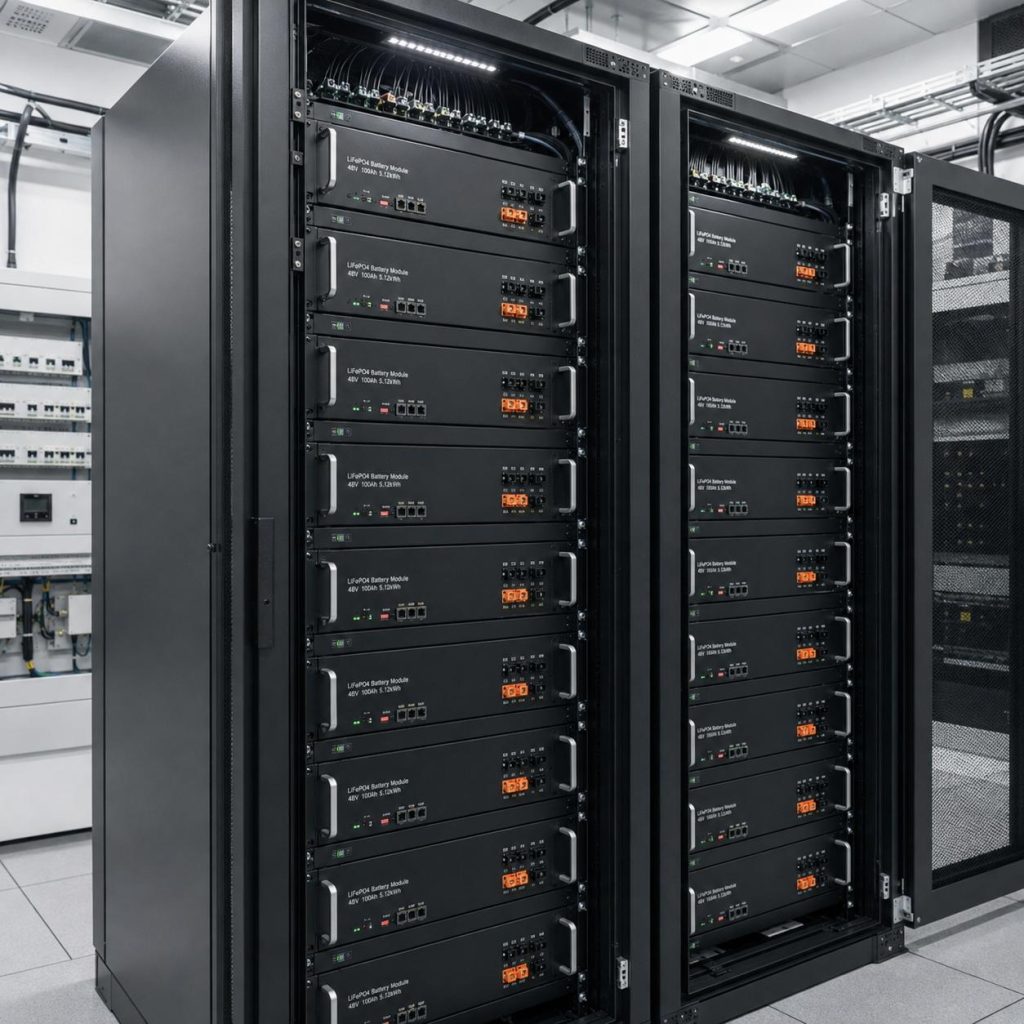
At VoltaLink, mechanical enclosure design and electrical battery configuration are therefore closely related rather than treated as separate parts of the product.
What Does “6000 Cycles“ Actually Mean?
Cycle life is one of the best-known advantages of LiFePO₄ technology, but the number needs context.
Battery life depends on factors including:
• Depth of discharge;
• Charging current;
• Discharge rate;
• Temperature;
• Operating voltage limits;
• End-of-life definition.
VoltaLink rack battery products are specified for 6000+ cycles, with selected configurations referencing operation at 80% depth of discharge.
For UPS applications, however, batteries may spend long periods in standby rather than completing one full cycle every day. UPS battery life therefore depends on both cycling performance and long-term standby conditions.
Rack Mount Batteries Are Part of a Larger Safety System
Battery safety, transportation and UPS safety are covered by different standards.
For example, stationary lithium battery projects may reference IEC 62619 or UL 1973, while UN38.3 relates to lithium battery transportation testing. UPS equipment itself may be evaluated under standards such as the IEC 62040 series or UL 1778.
Understanding these distinctions helps explain why a battery certificate and a complete UPS system approval are not the same thing.
From Battery Module to Critical Power System
The role of a Rack Mount Battery Factory is ultimately to connect battery chemistry with real electrical-system requirements.
• Voltage determines system compatibility.
• Capacity influences backup time.
• Current determines power capability.
• The BMS manages operating limits.
• Communication connects the battery to the wider power system.
• Modular rack construction makes capacity expansion more practical.
VoltaLink combines LiFePO₄ battery PACK design, BMS development and modular rack battery manufacturing for UPS, telecom, data center and energy-storage applications.
For projects involving a new UPS architecture or conversion from conventional battery banks, VoltaLink can help evaluate the required voltage, capacity, BMS and modular configuration so the rack battery is designed as part of the complete backup-power system rather than as an isolated component.
FAQs
Q1. What are the rack mount battery capacities offered by VoltaLink?
VoltaLink offers rack mount battery configurations for LiFePO₄ battery packs with a choice of 100Ah, 150Ah, or 200Ah. Different capacities provide more flexibility in configuring backup power systems for various loads and backup duration requirements for UPS, telecom, server room, or other critical backup systems.
Q2. Can VoltaLink rack batteries be utilized to back up UPS systems?
Yes. VoltaLink rack batteries can be used to support backup power supplies for UPS systems as well as for data centers, telecom base transceiver stations, and other critical loads. For actual application, the UPS should be checked for the DC voltage range as well as the charging and discharge current.
Q3. What distinguishes a 48V rack battery from a 51.2V rack battery?
Both can be classified as batteries for the 48V system, but their nominal and operating voltages differ. For the UPS and the DC bus, the voltage range of the battery during full charge and full discharge should be checked.
Q4. How much energy can a 48V, 100Ah, rack battery supply?
In addition to the voltage, the capacity also affects the total energy. Consequently, a 48V 100Ah battery provides 4.8 kWh of nominal energy The actual energy available will depend on the limits of the BMS, the temperature, the depth of discharge, and the system efficiency.
Q5. Are VoltaLink rack batteries configurable to be used in parallel?
VoltaLink rack batteries can be configured in a parallel system for higher capacity requirements. In addition to current sharing, parallel systems require protection devices, wiring, and BMS coordination for the allowed number of connected modules.

-

 OEM Residential Energy Storage Solutions: Passive vs. Active Cell Balancing
2026-09-30
-
 Smart Home Battery with BMS Communication: Cybersecurity and BMS Safety
 -
 10kWh Home Battery Backup System: Is 90% DoD Better for Daily Solar Storage?
2026-09-29
-
 Integrated Home Energy Storage System 150–430V MPPT Design
2026-09-28
-
 LiFePO₄ Residential Backup Battery SOC Accuracy in Parallel Systems
Share this:






.svg)






-899.svg)


