




BESS Container Warranty Checklist: Capacity, Throughput and Exclusions
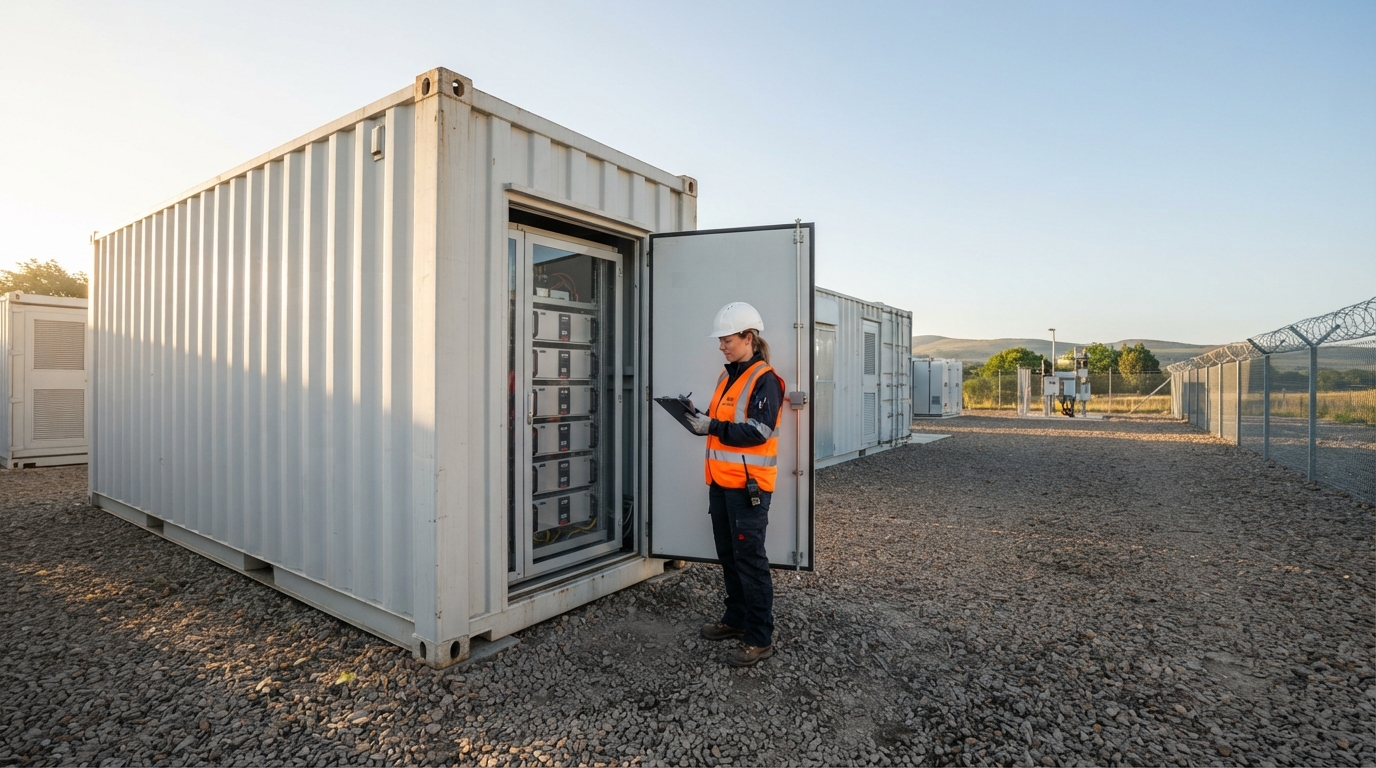
A “10-year warranty” sounds reassuring. In a containerized battery energy storage system (BESS), however, the warranty promise is only as strong as its definitions.
Does it guarantee nameplate capacity or the usable energy you can actually discharge? Does it end after a fixed number of MWh instead of a fixed number of years? What operating conditions, maintenance records, and exclusions can quietly nullify a claim?
This BESS container warranty checklist will help you audit the clauses that determine whether a warranty protects real project performance: product coverage, capacity, throughput, operating conditions, exclusions, evidence, and remedies.
What Does a BESS Container Warranty Actually Cover?
A container warranty normally contains two different promises:
- Product warranty — covers defects in materials and workmanship in the supplied equipment.
- Performance warranty — covers how well the system performs over time, usually expressed as retained capacity, energy throughput, or both.
The second promise is where most ambiguity lives. A manufacturer can offer a long product warranty while the performance warranty remains vague, poorly measured, or subject to a long list of conditions.
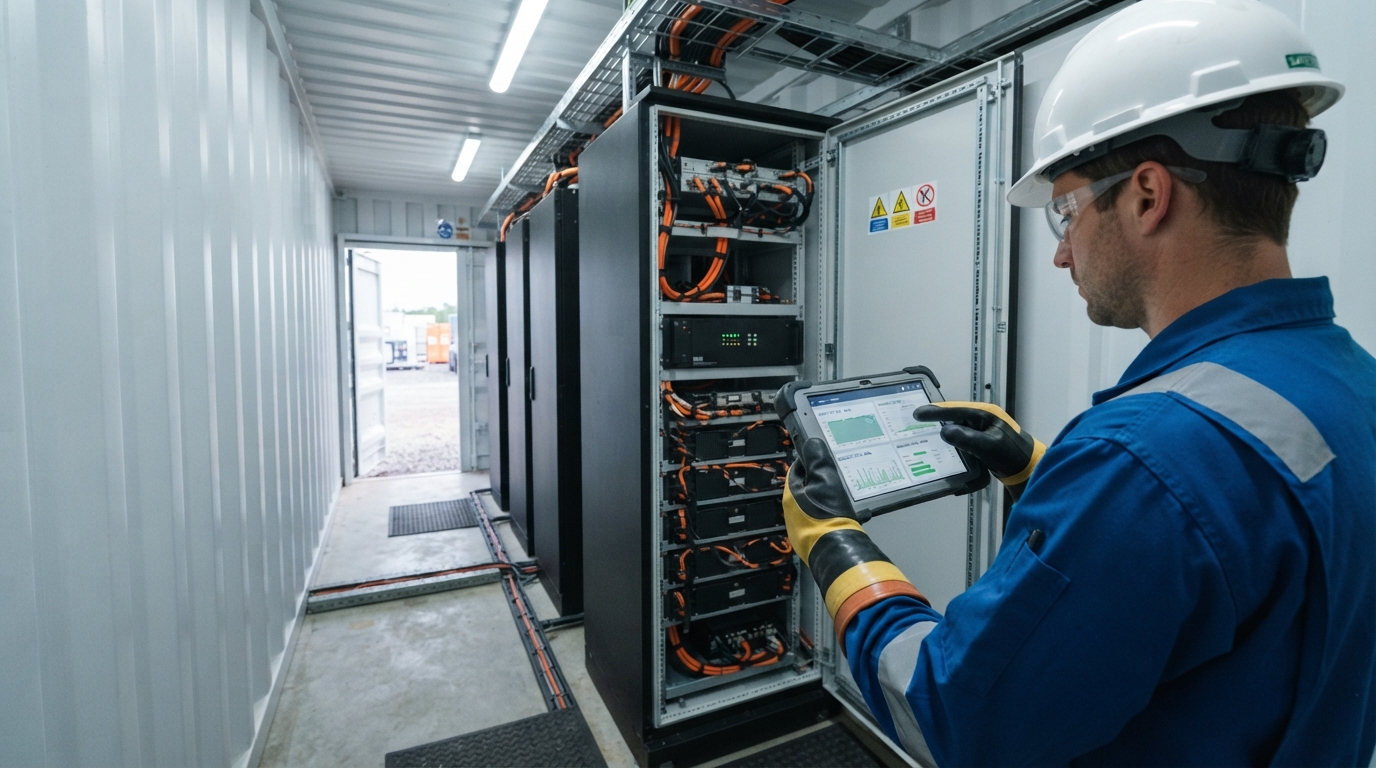
The equipment boundary also matters. A BESS container is not just a battery. It includes battery racks and modules, a battery management system (BMS), an energy management system (EMS), a power conversion system (PCS) or inverter, HVAC or thermal management, fire suppression, enclosure, and auxiliary controls. A warranty may cover only some of these elements. The PCS, HVAC, or fire-suppression system may come from different suppliers and carry separate warranties.
The U.S. Department of Energy’s BESS Technical Specifications treats retained capacity, throughput, commissioning, and monitoring as measurable performance-warranty requirements. That is a useful benchmark for what a buyer should expect to see in a serious procurement document.
Before comparing calendar years, clarify:
- What equipment is covered under the container warranty?
- What equipment is covered by separate supplier warranties?
- Is the performance warranty limited to the battery, or does it include power conversion, cooling, and controls?
- Does the warranty promise a specific remedy, or only “repair or replacement” at the supplier’s discretion?
Capacity: Nominal Capacity, Usable Energy, and the Capacity-Retention Guarantee
Capacity language is the most common source of warranty confusion.
Nominal capacity is the nameplate energy of the battery, usually stated in kWh or MWh. It is a useful reference point, but it is not necessarily the energy the system can deliver under real operating conditions.
Usable capacity or usable energy is the energy the system can actually discharge within its allowed state-of-charge (SOC) window and depth of discharge (DoD). The gap between nominal and usable can be significant.
Capacity retention is the end-of-warranty threshold. It is normally expressed as a percentage of the initial measured capacity, such as a guarantee that the system will retain at least 70% of its commissioning baseline after a defined period or throughput. The percentage, the baseline, the test method, and the operating conditions must all be written down.
Buyers should also check whether the capacity guarantee is based on gross energy or net energy. HVAC, controls, lighting, and other auxiliary loads consume power from the system. If the guaranteed capacity is measured at the battery terminals, it may look very different from the energy delivered to the load.
Keep power and energy separate:
- Energy is measured in kWh or MWh.
- Power is measured in kW or MW.
- A capacity warranty protects stored energy, not output power.
- A power warranty, if offered, protects the system’s charging or discharging capability.
DNV has explained that capacity warranties are only one part of a broader performance guarantee. Usable capacity, SOC limits, auxiliary power, and degradation all affect what the warranty actually delivers. A buyer should expect the warranty to define these factors rather than leave them to interpretation.
Key Capacity Warranty Questions to Ask Before Signing
- Is the guaranteed value based on nominal capacity, usable energy, or net energy after auxiliary loads?
- What is the commissioning baseline and who performs the test?
- What is the end-of-warranty capacity-retention threshold?
- Does the warranty include a year-by-year degradation curve, or only an end-of-term percentage?
- What happens if the system cannot meet the capacity test — repair, replacement, augmentation, or credit?
- Who pays for the test, and what instrumentation is considered acceptable evidence?
Throughput: The Warranty Limit That Can End Coverage Early
Energy throughput is the total energy processed by the battery over the warranty term, usually measured in MWh. It is separate from calendar time.
A warranty can say “10 years or a defined number of MWh, whichever comes first.” If your operating profile is aggressive, the MWh limit may be reached long before year ten.
Throughput language is easy to underestimate for one simple reason: a full cycle is not required to consume throughput. Hundreds of shallow daily cycles accumulate MWh just as quickly as full cycles, sometimes faster, because auxiliary systems and partial cycling still move energy through the battery.
The definition of a cycle matters too. Some warranties count full discharge cycles. Others count equivalent full cycles, where partial cycles are added proportionally. This changes how the warranty tracks your actual operation.
The DOE BESS specification includes throughput as part of the performance warranty framework. That is the right starting point, but the buyer must verify the definition used by the supplier.
Ask specifically:
- Is the throughput limit based on discharge energy, charge energy, or round-trip processed energy?
- How is a partial cycle counted?
- Is the throughput limit separate from the calendar warranty, or does the earlier limit end the warranty?
- Does the warranty state a lifetime MWh value for the exact container model you are buying?
- Can you see the throughput assumption behind the warranty, such as one full cycle per day, two cycles per day, or a specific annual MWh discharge?
How to Estimate Whether Throughput Matches Your Duty Cycle
You can test a warranty against your expected operation without knowing every technical detail:
- Estimate the average daily discharge energy of the project in MWh.
- Multiply that value by the number of operating days per year to estimate annual throughput.
- Compare the annual throughput against the warranty’s lifetime MWh limit.
- Check whether the warranty counts discharges only, charges only, or both.
- Identify which limit is reached first: the calendar term, the cycle count, or the MWh limit.
This is not a substitute for the supplier’s engineering model, but it tells you whether the warranty was designed for your duty cycle or for a much lighter operating profile. For a view of how commercial and industrial duty cycles differ, see the ci energy storage system overview.
Operating Conditions: DoD, SOC, C-Rate, Temperature, and Auxiliary Loads
Most performance warranties are valid only when the system operates within a defined envelope.
Common conditions include:
- Depth of discharge (DoD) — the usable discharge window allowed before the warranty is considered void or degraded.
- State of charge (SOC) — the operating band, such as 10% to 90% SOC, that the BMS is expected to maintain.
- Charge and discharge current — expressed in amps (A) or as a C-rate, which relates the current to the battery’s capacity.
- Temperature range — the ambient or cell temperature limits within which normal operation is permitted.
- Auxiliary loads — consumption from HVAC, controls, lighting, and fire systems that may reduce net usable energy.
These conditions do not exist just to protect the supplier. They also protect the battery from thermal stress, over-discharge, and excessive cycling. The problem appears when the operating conditions are stricter than the project’s intended use case.
For example, a peak-shaving project with one deep cycle per day faces different stress than a frequency-regulation project with many partial cycles. A warranty built around one daily cycle may not cover a project that cycles several times per day. The buyer must match the warranty envelope to the intended dispatch profile before signing, not after a claim is rejected.
The BMS and EMS play an important role here. The BMS monitors voltage, temperature, current, SOC, and alarms. The EMS controls dispatch and operating mode. Both generate the data that proves the system was operated inside the warranty envelope. If that data is missing, the buyer may be unable to prove that a failure was not caused by misuse.
Exclusions and Claim Killers: What Actually Voids Coverage
The exclusions section is where a generous-sounding warranty becomes narrow.
Common exclusions include:
- Misuse, abuse, accidental damage, or operation outside the specified SOC, DoD, current, and temperature limits.
- Unauthorized modification or repair by unapproved personnel.
- Incorrect installation, configuration, or commissioning.
- Failure to follow the supplier’s maintenance procedures.
- Grid events, voltage disturbances, or interconnection issues outside the specified range.
- Communication failures that prevent the BMS or EMS from protecting the system.
- Water ingress, fire, lightning, flood, or other external events, depending on the project’s insurance and warranty wording.
- Loss or corruption of monitoring data that would have shown compliant operation.
A buyer should check not only what the warranty excludes, but what the buyer must prove. If the supplier requires commissioning sign-off, maintenance records, alarm logs, and continuous monitoring data as conditions of coverage, a data gap can be as damaging as an excluded event.
| Exclusion | What to verify |
|---|---|
| Misuse or out-of-envelope operation | The exact DoD, SOC, current, C-rate, and temperature limits. |
| Unauthorized modification | Whether software updates, BMS settings, or communication changes require supplier approval. |
| Incorrect installation or commissioning | Who performs commissioning and what sign-off is required. |
| Maintenance failure | The required maintenance schedule and records. |
| Grid or interconnection events | The voltage, frequency, and power-quality conditions covered. |
| Missing monitoring data | The data-retention period and acceptable logging system. |
The World Bank’s guidance on warranties for battery energy storage systems distinguishes a warranty from a long-term service agreement. Maintenance obligations are often a condition of warranty validity, and buyers should treat those obligations as part of the warranty contract rather than as an optional maintenance plan.
Maintenance and Operating Records as Warranty Conditions
If the warranty requires scheduled maintenance, the buyer must know exactly what to do, who can do it, and what records must be kept. This is not the same as following good operating practice. It is a contractual requirement.
The practical result: a comprehensive bess container maintenance checklist is not just an operational tool. It is also warranty documentation. Maintenance logs, inspection records, software-update history, alarm reviews, and calibration records can all determine whether a future claim is accepted.
Evidence, Remedies, and the Claim Process: What You Must Prove and Expect
A warranty claim is only as strong as the evidence behind it.
The commissioning baseline is the starting point. Without a signed commissioning report, the supplier can argue that the initial capacity was never verified. Later tests have no reference point.
The performance-test method must also be defined. Ask who performs the test, under what conditions, at which SOC, with which instruments, and how the results are calculated. A vague test method is a practical barrier to recovery.
The BMS, EMS, and monitoring system provide the supporting record. The buyer should expect to retain:
- continuous energy and power data;
- SOC and temperature history;
- alarm and event logs;
- charge and discharge records;
- maintenance and inspection logs;
- grid-event records where relevant.
Remedy language matters as much as coverage language. A performance warranty may promise repair, replacement, augmentation, or credit. Each remedy has different consequences for the project:
- Repair may restore function but not necessarily restore guaranteed capacity.
- Replacement may reset the warranty baseline or introduce new logistics costs.
- Augmentation may add capacity to compensate for degradation, but the original performance test may become harder to compare.
- Credit may compensate the buyer without fixing the operational problem.
The claim process should also answer these questions:
- How long does the supplier have to respond to a claim?
- Who pays for testing, shipping, labor, removal, and reinstallation?
- Is the remedy limited to the battery, or does it include system integration work?
- Does the warranty require the buyer to return the failed equipment at the buyer’s cost?
- What happens if the warranty is violated by an action of the EPC, integrator, or operator?
Augmentation deserves particular attention. Adding battery capacity can restore the system’s energy, but it can change the relationship between measured capacity and the original warranty threshold. The buyer should know whether augmentation counts as a warranty remedy or as a separate commercial arrangement, and whether the original commissioning baseline is revised after augmentation.
Finally, check transferability. If the project will be sold, refinanced, or transferred to a new owner, the warranty must state whether rights can be assigned and under what conditions.
BESS Container Warranty Checklist for the Buyer: Documents to Request

Before signing a supply agreement, request these documents for the exact container model under consideration:
| Document | What it should define | Why it matters |
|---|---|---|
| Full warranty text and annexes | Duration, coverage, exclusions, remedies, claim procedure | The actual legal commitment, not the marketing summary. |
| Model-specific datasheet | V, Ah, kWh, kW, C-rate, DoD, SOC, current, temperature, mass, enclosure | Confirms the warranty applies to the correct equipment configuration. |
| Commissioning protocol | Baseline test procedure, instruments, acceptance criteria | Establishes the starting point for capacity and throughput guarantees. |
| Degradation curve and capacity-retention table | Year-by-year or throughput-based retained capacity | Shows whether the warranty is realistic for the intended duty cycle. |
| Throughput schedule and cycle-counting definition | MWh limit, cycle definition, partial-cycle treatment | Reveals whether time or throughput ends the warranty first. |
| Exclusions list and maintenance manual | Excluded events, required maintenance, records | Defines the practical conditions for keeping coverage valid. |
| Service agreement or LTSA | Separately purchased maintenance and performance services | Distinguishes warranty obligations from ongoing service commitments. |
| Safety and transport documentation | Model-specific test reports and shipping classifications, where required by project jurisdiction | Confirms the equipment can be installed and operated according to local requirements. |
A BESS container supplier should be able to map every document to the exact system being quoted. If a document exists only for a different product family or only as a generic company brochure, that is a risk to resolve before purchase.
When you are comparing suppliers, use this checklist to evaluate offers side by side. The goal is not to find the longest warranty. It is to find the warranty that protects your project’s usable capacity, throughput, and operating profile for the full intended service life. If you are evaluating a supplier such as VoltaLink Battery, the commercial team should be able to explain how each warranty term applies to the proposed container configuration. The bess container supplier page is a practical starting point for that conversation.
A warranty is much easier to audit before signing than to enforce after a failure. Read the definitions. Check the measurement method. Confirm the exclusions. Ask for the documents. Then compare suppliers on the terms that actually determine whether your project is protected.

-

 OEM Residential Energy Storage Solutions: Passive vs. Active Cell Balancing
2026-09-30
-
 Smart Home Battery with BMS Communication: Cybersecurity and BMS Safety
 -
 10kWh Home Battery Backup System: Is 90% DoD Better for Daily Solar Storage?
2026-09-29
-
 Integrated Home Energy Storage System 150–430V MPPT Design
2026-09-28
-
 LiFePO₄ Residential Backup Battery SOC Accuracy in Parallel Systems
Share this:





.svg)






-899.svg)


