




Server Rack Battery Bus Bar Material Showdown: Copper vs. Aluminum vs. Copper-Aluminum Clad
When it comes to telecom backup, data center UPS, or industrial energy storage applications, the conductor material in a Server Rack Battery Bus Bar impacts the efficiency, safety, and total cost of ownership of a system. Bus bars may look uncomplicated at a glance, but the electrical and mechanical properties of a bus bar impact the uniformity of current flow among the parallel LiFePO4 modules and the rate at which heat builds up and the lifespan of the entire battery array.
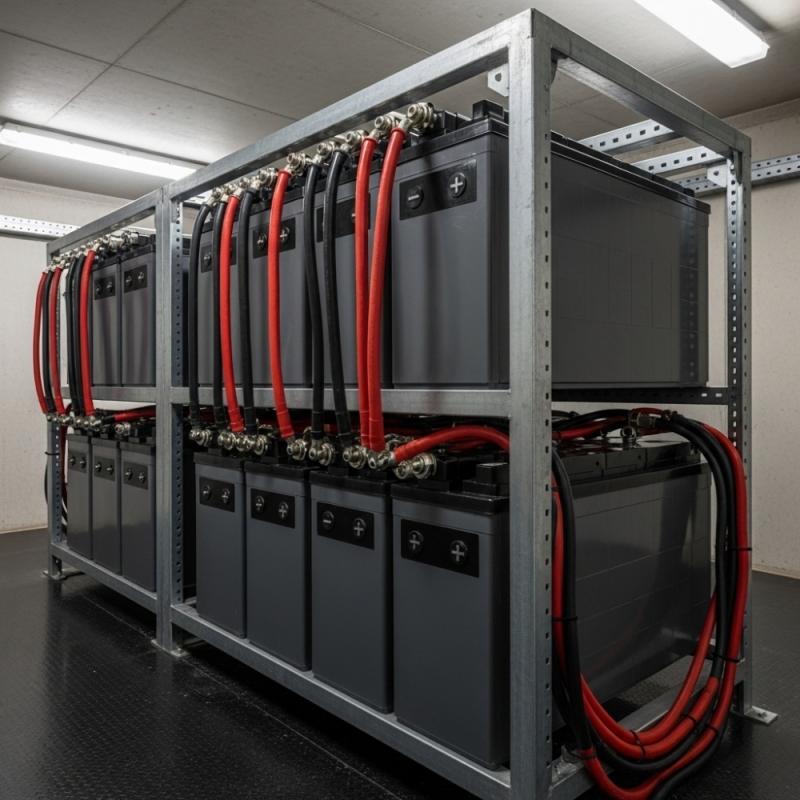
With the shipment of lithium batteries expected to surpass 2.7 TWh unit in 2026, the decision here for procurement teams has become clear: copper, aluminum, or copper-aluminum clad. Each material in this regard has its advantages and disadvantages, and this guide breaks those down and compares them to the Server Rack Battery Bus Bar Relating to a 48V 100Ah or larger Rack Mount System with no exaggeration.
The Importance of Bus Bar Material in Rack Battery Systems
A Server Rack Battery Bus Bar effectively connects a number of battery modules in parallel, generally carrying hundreds of amps for both discharging and recharging. The issues faced are three-fold, and they are:
• Voltage drop: Less backup energy.
• Imbalanced current: Aging of the modules accelerates.
• Uneven heat distribution: Loose fits and incompatible connections can cause significant energy loss and may damage the insulation.
Modern LiFePO4 server rack batteries, take for example the 51.2V 100Ah units, are in need of bus bars with minimal resistance and require a stable bus bar. VoltaLink designs each Server Rack Battery Bus Bar with specific current ratings, terminal interfaces, and environmental conditions, guaranteeing the material itself does not become the weak link in your design.
Pure Copper Bus Bars – The Original Benchmark
For decades, high-current conductors have been standard by copper’s conductivity, equal to 100% IACS. In the case of a Server Rack Battery Bus Bar that is made of pure copper, 3 major advantages are:
• Lowest resistivity: 1.724 µΩ·cm at 20°C, meaning less power loss and a smaller rise in temperature.
• High Thermal Conductivity: Conducts heat away, even after many high-rate charge/discharge cycles.
• Mechanical Strength: Endures coupling, and repeated twisting of terminal bolts.
However, copper has other implications, especially in larger systems.
• High Initial Cost: The price of copper can change at a moment’s notice and this can affect an organization’s budget.
• Heavy weight: A typical 50-Ah copper bus bar for 19-inch racks adds non-trivial mass.
• Terminal galvanic corrosion: When directly connected to aluminum battery terminals (common in some LiFePO4 cells), moisture creates a corrosive cell.
For mission-critical telecom base stations where every millivolt matters, copper remains a reliable Server Rack Battery Bus Bar material. But for price-sensitive or weight-sensitive projects, alternatives deserve a close look.
Aluminum Bus Bars – Lightweight And Cost–Effective
Aluminum is often dismissed as “cheap,” but that misses the engineering nuance. A properly designed aluminum Server Rack Battery Bus Bar can perform reliably when correctly sized. Key facts:
• Conductivity ~61% IACS: To carry the same current as copper, an aluminum bar needs roughly 60% larger cross-section.
• One-third the weight: Critical for portable or vibration-prone installations (e.g., mobile towers).
• Lower raw material cost: Typically 30–50% less expensive than copper.
But aluminum introduces two non-negotiable requirements:
• Larger footprint: A thicker or wider bar may block airflow or reduce rack density.
• Surface oxidation: Aluminum instantly forms an insulating oxide layer. Joints must be treated with anti-oxidant paste and tightened with correct torque.
When these precautions are followed, an aluminum Server Rack Battery Bus Bar works well for medium-current applications (≤200A per rack). However, many field failures occur because installers skip the special washers or torque specifications. For this reason, VoltaLink recommends aluminum only for customers with trained in-house technicians.
Copper–Aluminum Clad Bus Bars – The Balanced Hybrid
The copper-aluminum clad (Cu/Al) Server Rack Battery Bus Bar aims to combine the best of both worlds: an aluminum core with a thin, metallurgically bonded copper layer (typically 10–15% of total thickness). This construction delivers:
• Near-copper conductivity: The cladding carries most high-frequency current (skin effect), while aluminum handles bulk DC current. Effective conductivity reaches 80–85% IACS.
• Weight savings: ~50% lighter than pure copper of equivalent current rating.
• Galvanic compatibility: The copper surface mates directly with copper terminals, eliminating aluminum-to-copper corrosion.
• Lower cost than pure copper: Approximately 60–70% of copper’s material price.
Real-world performance of a Cu/Al Server Rack Battery Bus Bar depends heavily on manufacturing quality. Poor bonding leads to internal voids, thermal runaway, or delamination. Reputable suppliers use roll-bonding or explosive welding under strict process control. VoltaLink’s Cu/Al bus bars undergo ultrasonic testing and accelerated thermal cycling to ensure bond integrity.
When to Choose Each Material
| Application Scenario | Recommended Material | Reason |
| High-power data center UPS (>400A parallel) | Pure copper | Lowest loss, proven reliability |
| Remote telecom tower, frequent vibration | Cu/Al clad | Lightweight + compatible terminals |
| Budget-limited microgrid, trained staff | Aluminum (oversized) | Lowest upfront cost |
| High rack density, limited airflow | Copper or Cu/Al | Smaller cross-section saves space |
How VoltaLink Designs Bus Bars for 2026 Energy Trends
As energy storage systems evolve toward higher power density and modular scalability, a Server Rack Battery Bus Bar must support:
• Quick parallel expansion: Standardized hole patterns and torque ratings.
• Remote temperature sensing: Embedded thermistor pads for BMS integration.
• Environmentally friendly elements: Recyclable copper and aluminum with no poisonous coats.
VoltaLink offers all three bus bar types, each precision-machined with rounded edges to avoid cable abrasion. Our 48V 100Ah server rack batteries ship with optional Cu/Al bus bars that include:
• Tin-plated copper contact surfaces for corrosion resistance.
• 10-second arc flash rating for added safety.
• Laser-marked current ratings and torque values.
We do not claim that one material is “always best.” Instead, we help buyers match the Server Rack Battery Bus Bar to their actual load profile, maintenance capability, and budget.
Final Recommendation
For most telecom and data center applications in 2026, a Copper-Aluminum Clad Server Rack Battery Bus Bar delivers the optimal balance of electrical performance, weight, and cost. Pure copper remains the safe, no-compromise choice for high-current or mission-critical installations. Aluminum works only when you accept its derating and joint maintenance requirements.
VoltaLink manufactures all three variants under ISO 9001:2025, with UL-recognized materials and full traceability. To select the right Server Rack Battery Bus Bar for your next 48V LiFePO4 project, contact our engineering team with your peak current and rack layout. We provide free thermal simulation and torque specifications—no exaggerated claims, just data-driven advice.
Common Questions From Procurement Teams
Q: Can I mix copper and aluminum bus bars in the same rack?
A: Only if every copper-to-aluminum joint uses a bi-metal washer or tin-plated adapter. Direct contact will cause galvanic corrosion within months.
Q: How do I verify a Cu/Al bus bar’s quality?
A: Please send me a mill test report that includes the thickness of the cladding, the bond shear strength (ideally >80 MPa), and the electrical resistivity as per ASTM B898.
Q: Will VoltaLink sell bus bars of custom lengths?
A: Naturally. We offer from 100mm to 1,200mm lengths with any hole pattern to fit standard 19-inch and 23-inch racks.

-

 OEM Residential Energy Storage Solutions: Passive vs. Active Cell Balancing
2026-09-30
-
 Smart Home Battery with BMS Communication: Cybersecurity and BMS Safety
 -
 10kWh Home Battery Backup System: Is 90% DoD Better for Daily Solar Storage?
2026-09-29
-
 Integrated Home Energy Storage System 150–430V MPPT Design
2026-09-28
-
 LiFePO₄ Residential Backup Battery SOC Accuracy in Parallel Systems
Share this:





.svg)






-899.svg)


